The kitchen island starts with such good intentions. In the first weeks of a new home or a newly renovated kitchen, it is a surface with purpose, a place for prep, for breakfast, for setting down the grocery bags in an organized way before unpacking them with deliberate calm. Then real life arrives. The mail that needed to be sorted landed there because the counter by the door was full. The charging cable gets coiled on the corner because there is nowhere better for it. The kids’ school permission slips, the reusable bags that didn’t make it back to the car, the overripe bananas waiting to become bread that no one has started, all of it yet finds the island, because the island is central and horizontal and always there. Within a month, the focal point of the kitchen has become the most visible evidence of the household’s accumulated friction.
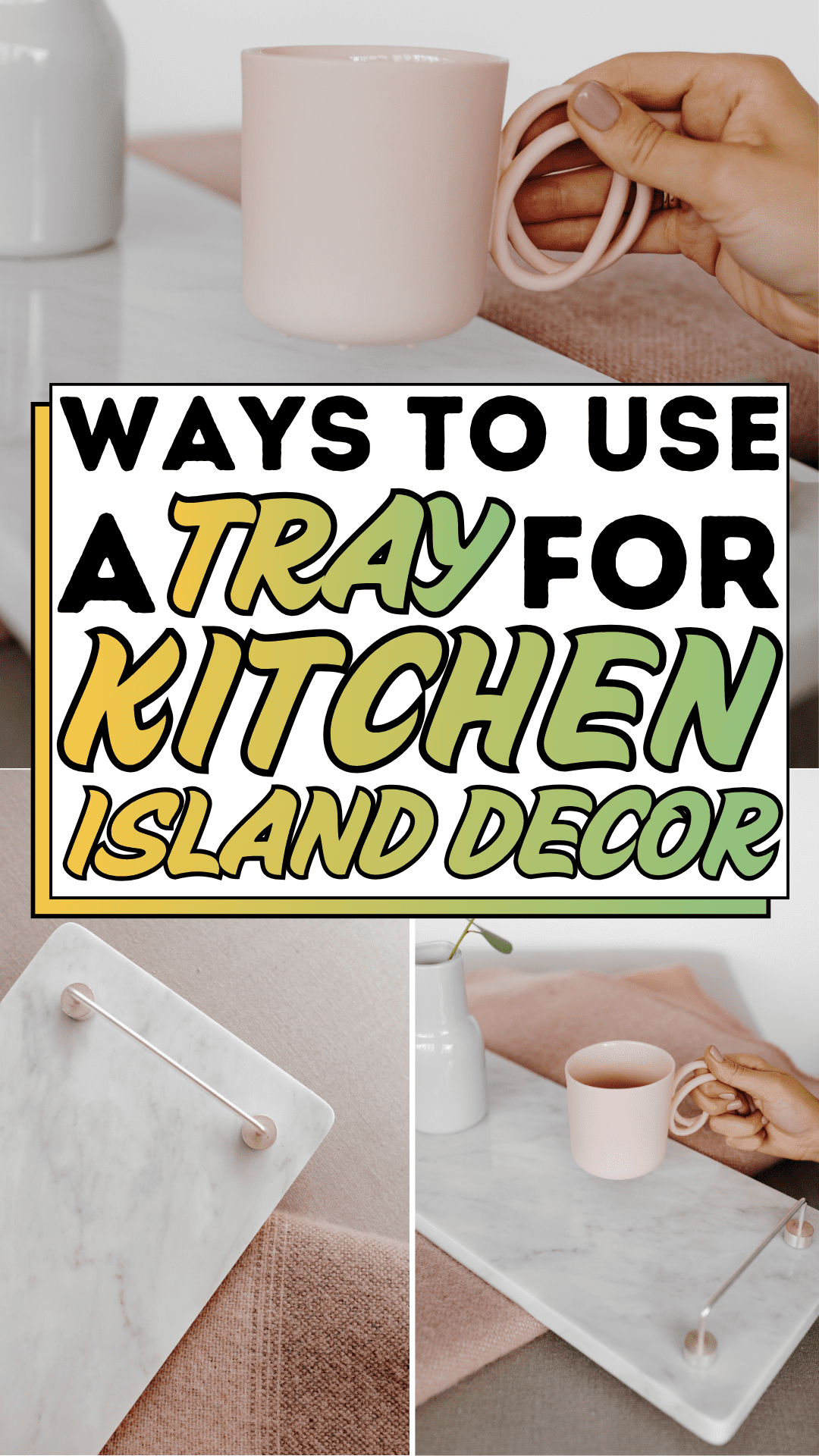
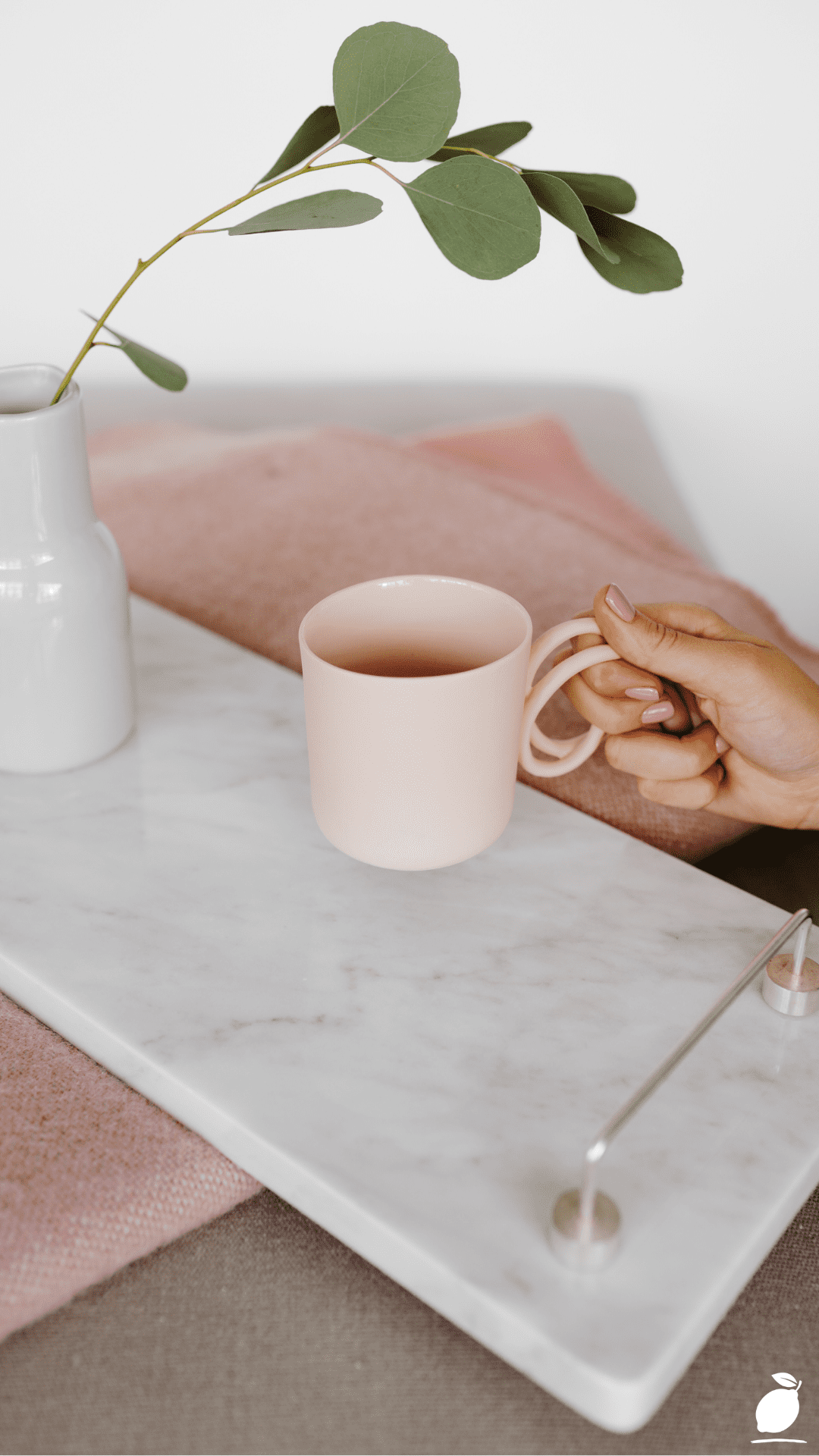
The problem is not the island. The problem is the absence of a defined zone, a bounded area that communicates, visually and functionally, that this portion of the surface is intentional and everything outside it is temporary. That is exactly what a tray does, and it is exactly what the image above demonstrates with the kind of quiet authority that only truly simple solutions possess. A white marble tray. A pink ceramic mug. A single eucalyptus stem in a white vase. A hand reaching for the mug with the ease of someone whose kitchen feels like it belongs to them. The tray has done something the island’s open surface could not: it has created a room within a room, a small, defined territory of calm inside the kitchen’s daily activity. Nothing outside the tray is in disorder. The tray itself is ordered.
Kitchen island decor that actually works is almost always tray-based, and the reason is structural rather than aesthetic. A tray gives the objects placed on it a collective identity; they are not random items sharing a surface, they are a composed arrangement sharing a container. It makes them easier to move as a unit when prep space is needed. It makes the island easier to wipe clean. It makes the kitchen look considered from across the room in a way that individual objects on an open surface rarely do. This guide gives you every technique for using a tray as kitchen island decor that holds its composure through daily family life, not just for the photographs.
The Kitchen Island Decor Blueprint
Step 1: Audit the Island Surface and Identify the Decor Zone
Before any kitchen island decor decision is made, the island needs to be cleared and assessed in the same way every successful design project begins from a clean, honest baseline. Remove everything currently on the surface. Photograph the cleared island from the kitchen’s primary vantage point, the position from which it is most often seen, typically from the living area or the main entry into the kitchen. That photograph shows you the island as guests and family members actually experience it, which is the perspective that kitchen island decor needs to serve.
From that cleared state, identify the decor zone,, the portion of the island surface that will be permanently dedicated to the styled tray arrangement and left functionally unoccupied by prep tools, appliances, or daily clutter. In most kitchen islands, the decor zone occupies one end of the surface: the end nearest the living area, the seating side, or the end furthest from the primary prep and cooking workflow. The decor zone should be generous enough to hold a tray of meaningful size, typically 35cm to 55cm in the longest dimension, without crowding adjacent functional areas.
Mark the boundary of the decor zone mentally rather than physically. Its definition is maintained by the tray itself: when the tray is present, the zone is defined. The clarity of that boundary is what allows the rest of the island surface to be used freely without compromising the kitchen island decor effect.
Step 2: Choose a Tray That Anchors the Kitchen’s Existing Palette
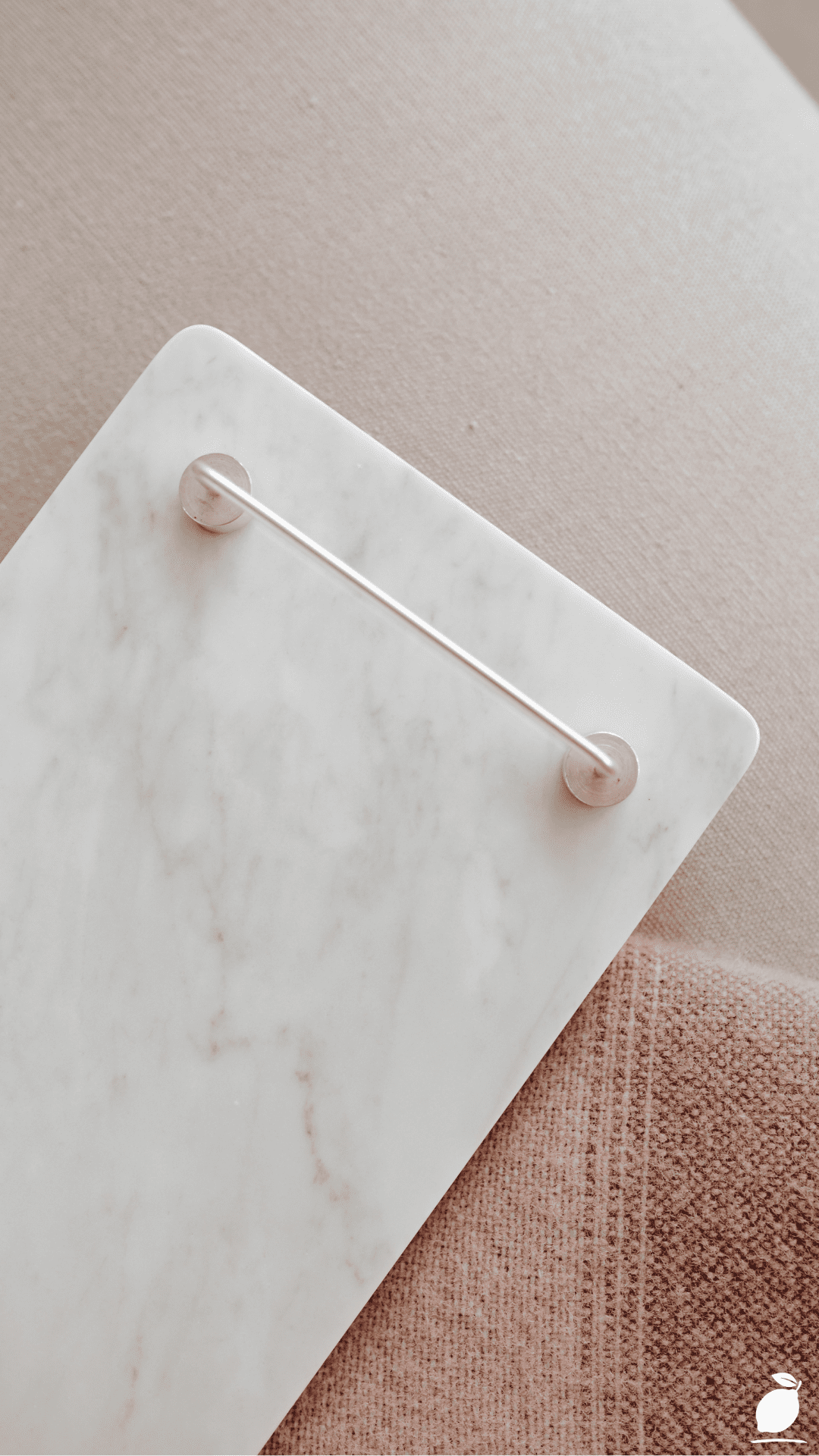
The tray is the most important single purchase in any kitchen island decor project because it sets the material and color language that every other object in the arrangement will need to speak. The marble tray in the image earns its authority immediately: its white and gray veining is neutral enough to coexist with any color palette while being visually substantial enough to read as a designed element rather than a functional afterthought. It communicates a material register of natural stone, cool and refined, which of the pink ceramic and the white vase then respond to with warmth and softness.
Choose your kitchen island decor tray by identifying the dominant material and color language already present in the kitchen. A kitchen with warm wood cabinetry and brass hardware calls for a tray in rattan, light wood, or unlacquered brass materials that continue the warmth of the existing palette. A kitchen with white Shaker cabinets and chrome fixtures calls for a tray in white marble, white-lacquered wood, or brushed silver. A kitchen with dark cabinetry and matte black hardware calls for a tray in black slate, dark oak, or aged iron. The tray does not need to match the kitchen exactly; it needs to belong to the same material conversation.
Tray size matters as much as material. A tray that is too small for the island’s scale reads as a decorative gesture rather than a design anchor; a tray that overwhelms the decor zone leaves no visual breathing room for the objects placed within it. As a general rule, the tray should occupy 60 to 75 percent of the decor zone’s length, with space on all sides for the eye to rest before reaching the island’s edge.
Step 3: Build the Tray Arrangement Using the Rule of Three
Every successful kitchen island decor tray arrangement follows the same underlying compositional logic: three distinct objects of different heights, different textures, and different visual weights, arranged so that the eye moves between them rather than settling on one and stopping. The rule of three is not a stylistic preference; it is a perceptual reality. Two objects on a tray read as a pair and feel symmetrical; four or more objects read as a collection and feel busy. Three objects read as a composition, and a composition has movement.
The image executes the rule of three with precision: a tall white vase with eucalyptus (height and organic texture), a medium-height pink mug (color and ceramic warmth), and the marble tray itself as the visual base (material weight and horizontal grounding). Remove any one of the three, and the arrangement loses its balance. Add a fourth element, and it loses its breathing room. Apply this logic to your own kitchen island decor tray: identify your tall element (a vase, a candle in a tall holder, a small potted plant), your medium element (a mug, a small bowl, a decorative object at seated eye level), and your base element (the tray, which always functions as the third compositional layer even when not consciously counted).
Vary the textures across the three objects as deliberately as the heights. The arrangement in the image combines smooth marble, smooth ceramic, and organic leaf, three different surface qualities that make the composition visually interesting at close range. Kitchen island decor that uses three objects of similar texture feels flat even when the heights are varied; texture variety is what gives a tray arrangement its tactile richness.
Step 4: Introduce a Living or Organic Element
The single change that most consistently elevates kitchen island decor from styled to alive is the introduction of an organic or living element, a plant, a stem, a small arrangement of fresh or dried botanicals that brings the unpredictability of natural form into what would otherwise be a fully controlled composition. The eucalyptus stem in the image does this precisely: its oval leaves are irregular, its stem bends with natural asymmetry, and its green is the one color in the arrangement that the eye cannot predict or manufacture. It makes everything around it feel more real.
For kitchen island decor that needs to survive in a busy household, choose organic elements based on their maintenance requirements. Fresh eucalyptus stems in water last two to three weeks and smell clean and herbal without being overwhelming in a food-preparation environment. Dried pampas grass or dried cotton stems require no maintenance and last indefinitely. A small succulent in a ceramic pot needs watering only every two to three weeks and grows slowly enough to remain in scale with the tray arrangement for months. A potted herb, such as rosemary, thyme, or compact basil, serves double duty as both kitchen island decor and a functional ingredient source.
Whatever organic element you choose, size it to the tray rather than to the kitchen. The eucalyptus stem in the image is a modest one stem in a small vase, not a full bouquet, because the tray is the frame, not the room, and organic elements scaled to the room overwhelm a tray arrangement rather than enriching it.
Step 5: Add a Functional Object That Earns Its Decorative Place
The most durable kitchen island decor arrangements include at least one object that is genuinely functional in the context of the kitchen, something that earns its place not only as a visual element but as a daily-use item that the household actually reaches for. The pink mug in the image is that object. It is not a prop. It is a mug being held, being used, being the reason someone is standing at the island at this particular moment. Its presence in the arrangement does not compromise the kitchen island decor; it validates it by demonstrating that the styled tray is not a do-not-touch zone but a living part of the kitchen.
Candidates for the functional object in a kitchen island decor tray include: a ceramic mug or small carafe for the household’s daily coffee or tea ritual; a small olive wood or marble board for slicing citrus or cheese within reach of the seating side of the island; a glass decanter of filtered water; a small ceramic dish holding a few good-quality chocolates or salted nuts; or a cookbook propped open on a small stand. The functional object should be the most frequently touched item in the arrangement and should be styled rather than merely placed. The mug’s handle position, the board’s angle, and the decanter’s label orientation all contribute to the kitchen island decor composition, even when the object is in active use.
Step 6: Maintain the Tray as a Reset Point, Not a Permanent Installation
The most important and most underappreciated of all kitchen island decor techniques is treating the tray not as a permanent installation that must never be disturbed, but as a reset point, a defined arrangement that can be quickly restored after the disruption of daily cooking, meal prep, and family life. The tray’s greatest practical value is precisely this: when the island has accumulated its inevitable daily layer of mail, school bags, and miscellaneous objects, the tray provides a visual anchor that makes the reset obvious. Everything outside the tray gets cleared. The tray itself or a fresh version of its arrangement is restored in under five minutes.
Seasonal rotation is the other dimension of this maintenance approach. Kitchen island decor that never changes becomes invisible, it recedes into the background of daily perception, and stops contributing to the room’s atmosphere. Rotate the organic element with the season: eucalyptus and pink in spring, dried botanicals in warm amber tones for autumn, a small pine branch or white cotton stem for winter. Change the mug color or the vase style to signal the season’s shift. The tray and marble base can remain constant as the year’s anchor, while everything within them rotates to keep the kitchen island decor feeling current and alive.
Expert Secrets for Success

Pro-Tips for a Better Result
Size the tray to the island’s scale, not to convention. The most common error in kitchen island decor tray selection is choosing a tray that is appropriately sized for a side table or bathroom vanity, typically 30cm or smaller, and placing it on an island that is 90cm or more in its shorter dimension. A small tray on a large island reads as lost and slightly forlorn. For a standard kitchen island, a tray of 45cm to 60cm in its longest dimension provides the visual weight needed to anchor the decor zone. Oversizing slightly is consistently more successful than undersizing.
Use odd numbers within the tray arrangement. Three objects are the compositional baseline, but five work equally well when the kitchen island decor needs more richness: a tall vase, a medium candle, a small ceramic object, a functional mug, and a single folded linen cloth as a base layer. Even numbers of two objects, four objects produce symmetry that reads as static in the context of a kitchen island decor arrangement. Symmetry belongs to formal dining tables and bathroom mirror pairings. Kitchen island decor benefits from the dynamic tension of odd groupings.
Layer a linen or textile beneath the tray. The image places the marble tray on a soft pink textile, and this detail does two things that the tray on a bare island surface would not: it softens the hard-surface-on-hard-surface visual quality of marble on stone or wood, and it adds a layer of color and texture beneath the primary arrangement that makes the whole composition feel warmer and more intentional. A folded linen napkin, a woven trivet, or a small cloth runner beneath the tray elevates the kitchen island decor without adding visual complexity to the arrangement itself.
Vary the finish within a single metallic family if hardware is included. If your kitchen island decor tray incorporates metallic objects, a small vase with a brass rim, a candle in a gold holder, and a copper measuring cup as a decorative element, keep all metallic elements within the same tonal family (warm metals: brass, gold, copper; cool metals: chrome, silver, pewter) while allowing variation in finish within that family. Polished brass, matte brass, and brushed brass in the same arrangement read as intentionally layered. Brass, chrome, and copper in the same arrangement read as collected without intention.
Common Mistakes to Avoid
Don’t place the tray in the center of the island. Center placement is the most intuitive position for a kitchen island decor tray and the least effective one. A tray in the center of the island bisects the work surface and creates equal amounts of unusable-feeling space on either side. A tray at one end of the island, the seating end, the living-room-facing end, or the end furthest from the primary cooktop defines a clear decor zone while leaving the majority of the island’s surface available for its functional purpose.
Don’t choose all objects at the same height. A tray arrangement in which every object is between 10cm and 15cm tall reads as flat, regardless of how carefully each object has been chosen. Height variation, a tall element at 25cm to 35cm, a medium element at 12cm to 18cm, and a low element at or below 8cm, creates the vertical movement that makes kitchen island decor visible and interesting from across the room. The absence of height variation is the single most common reason a carefully assembled tray arrangement fails to deliver the visual impact that motivated its creation.
Don’t over-accessorize the tray in response to seasonal updates. Seasonal rotation is one of the most effective kitchen island decor maintenance strategies, but the rotation should replace rather than supplement. Adding autumnal gourds to a spring arrangement that has not been edited produces an overcrowded tray rather than a seasonally updated one. For every seasonal element added, remove one existing element. The tray’s breathing room, the visible surface of the tray between objects, is as compositionally important as the objects themselves, and it needs to be actively maintained through each seasonal rotation.
Don’t neglect the tray surface itself. Marble trays show water rings and oil stains readily and require sealing every six to twelve months with a food-safe stone sealer to maintain their clean appearance. Wood trays need occasional oiling to prevent drying and cracking. Lacquered trays need to be wiped with a non-abrasive cloth rather than a scrubbing sponge to preserve their finish. The kitchen island decor arrangement is only as polished as the tray beneath it, and a stained or damaged tray undermines every other element in the composition, regardless of how well chosen they are.
Why Kitchen Island Decor Matters
The kitchen island is the geographic center of most modern homes, the surface that family members orbit throughout the day, where meals are prepared, and conversations happen in parallel, where homework gets done while dinner is cooked, and where the household’s daily rhythm becomes visible in the objects that accumulate and disperse across its surface. It is not a room on its own, but it is the most used horizontal surface in the house, and the way it looks at any given moment is a reliable indicator of how organized and at ease the household feels at that moment. Kitchen island decor that holds its composure through daily life is not a cosmetic achievement; it is a structural one.
Environmental psychology has consistently documented the relationship between visual order in shared household spaces and the stress levels of the people who inhabit them. A kitchen island that is perpetually covered in undifferentiated objects, functional items mixed with decorative items, and deferred decisions creates a constant low-level cognitive demand on the people who move past it dozens of times each day. A kitchen island with a defined, maintained decor zone reduces that demand by providing visual clarity: this area is resolved, and its resolution requires no decision from you. That reduction, accumulated across hundreds of daily kitchen interactions, is a real contribution to household calm that extends far beyond the aesthetic.
Easy Peasy Life Matters is built on the conviction that the most meaningful home improvements are not the largest ones but the most precisely targeted ones, the changes that address the specific points where daily life generates friction and replace them with ease. A tray on a kitchen island is among the smallest of those changes. Its effect is among the most consistent. The image at the top of this guide captures the whole argument in a single frame: a hand reaching for a mug with the ease of someone whose kitchen is not working against them. That ease is the goal. These kitchen island decor ideas are how you get there.
Frequently Asked Questions
What size tray is best for kitchen island decor?
For a standard kitchen island between 90cm and 120cm in its shorter dimension, a tray between 45cm and 60cm in its longest dimension provides the right visual scale, substantial enough to anchor the decor zone without overwhelming it. For a larger island over 150cm in length with a wider surface, a tray of 60cm to 75cm is appropriate. As a practical rule, the tray should occupy approximately 60 to 75 percent of the decor zone’s length, leaving visible island surface on all sides so the tray reads as a contained zone rather than a surface covering.
What materials work best for a kitchen island decor tray?
The most versatile kitchen island decor tray materials are white or gray marble (for kitchens with cool or neutral palettes), light or medium wood (for kitchens with warm wood cabinetry), rattan or woven seagrass (for kitchens with a natural or coastal aesthetic), and lacquered wood or painted metal (for kitchens with a more graphic, contemporary design language). The consistent principle across all material choices is that the tray should belong to the kitchen’s existing material palette, extending its language rather than introducing a new one. Marble is the most universally compatible material and the most photogenic, which accounts for its dominance in kitchen island decor inspiration imagery.
How do I keep a kitchen island decor tray looking styled in daily life?
The most practical approach is the reset routine: establish a default arrangement, the standard configuration of your three core tray objects, and spend two to three minutes restoring it at the end of each day or before guests arrive. Keep the tray objects together as a group rather than dispersing them around the kitchen between uses, so the reset requires only returning them to the tray rather than locating them from different surfaces. Replace the organic element with fresh stems, a small plant, seasonal botanicals when it begins to decline, rather than waiting until it is visibly past its prime. A tray that is 80 percent styled is still more effective kitchen island decor than an unstyled surface.
Can a tray work on a small kitchen island or peninsula?
Yes — and in a small kitchen, a tray is even more important as a kitchen island decor tool because it creates a defined zone that prevents the small surface from being entirely consumed by functional use. Scale the tray accordingly: a 30cm to 40cm tray on a small island or peninsula, holding just two objects rather than three if the surface is very limited. A bud vase with a single stem and a ceramic mug, on a small round tray, is a complete kitchen island decor arrangement that works at any scale. The principle is the same regardless of the island’s size: the tray creates the boundary, and the boundary creates the composition.
How often should I change my kitchen island decor tray arrangement?
A full seasonal rotation four times per year is the most sustainable kitchen island decor refresh cadence for most households. Each seasonal update replaces the organic element and one or two secondary objects while keeping the tray and any anchor objects constant. Monthly micro-updates changing the mug color, rotating a different vase, swapping a candle for a small plant, keep the arrangement feeling current without requiring a full redesign. The tray itself and the most structurally important objects (the tallest element, the primary functional object) can remain in place for a year or more. What makes kitchen island decor feel alive over time is not wholesale replacement but the rotation of specific elements at appropriate intervals.