The bathroom refresh was supposed to take a weekend. You repainted the vanity, swapped the towels for a matching set you found on sale, hung a new mirror, and added a shelf for the candles, the diffuser, and the small succulent that looked perfect in the store. Then you stepped back. The new mirror reflected the old light fixture. The towel colors fought the tile grout. The shelf held more than it was designed to hold, and the succulent died within a month. The bathroom was not worse than it had been before the weekend; it was just differently unresolved, a new set of individual decisions that did not add up to a room with a point of view. The problem was not the effort or the budget. The problem was the absence of a governing idea, a single white bathroom idea, clear and disciplined enough to organize every other decision around it.

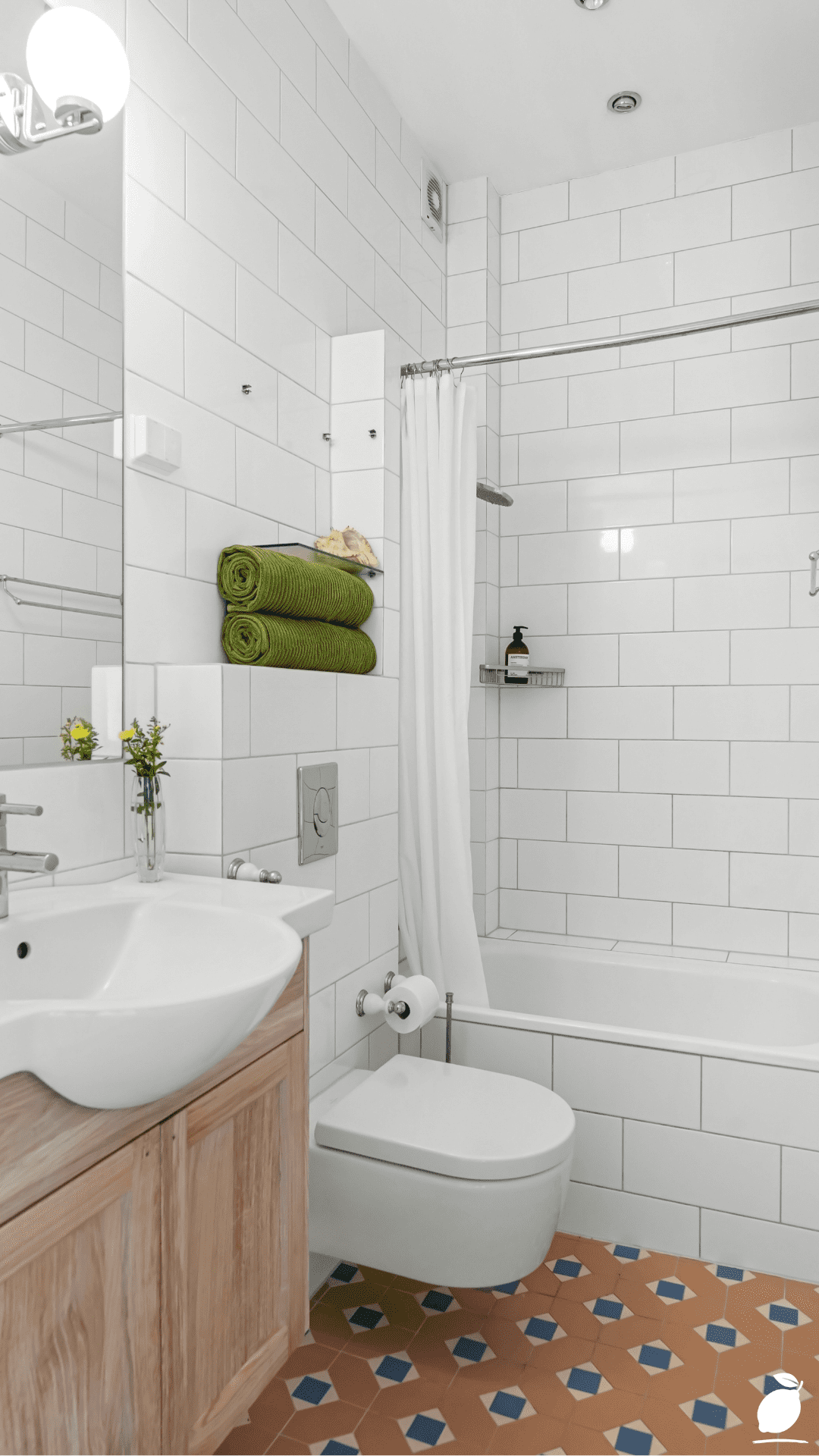
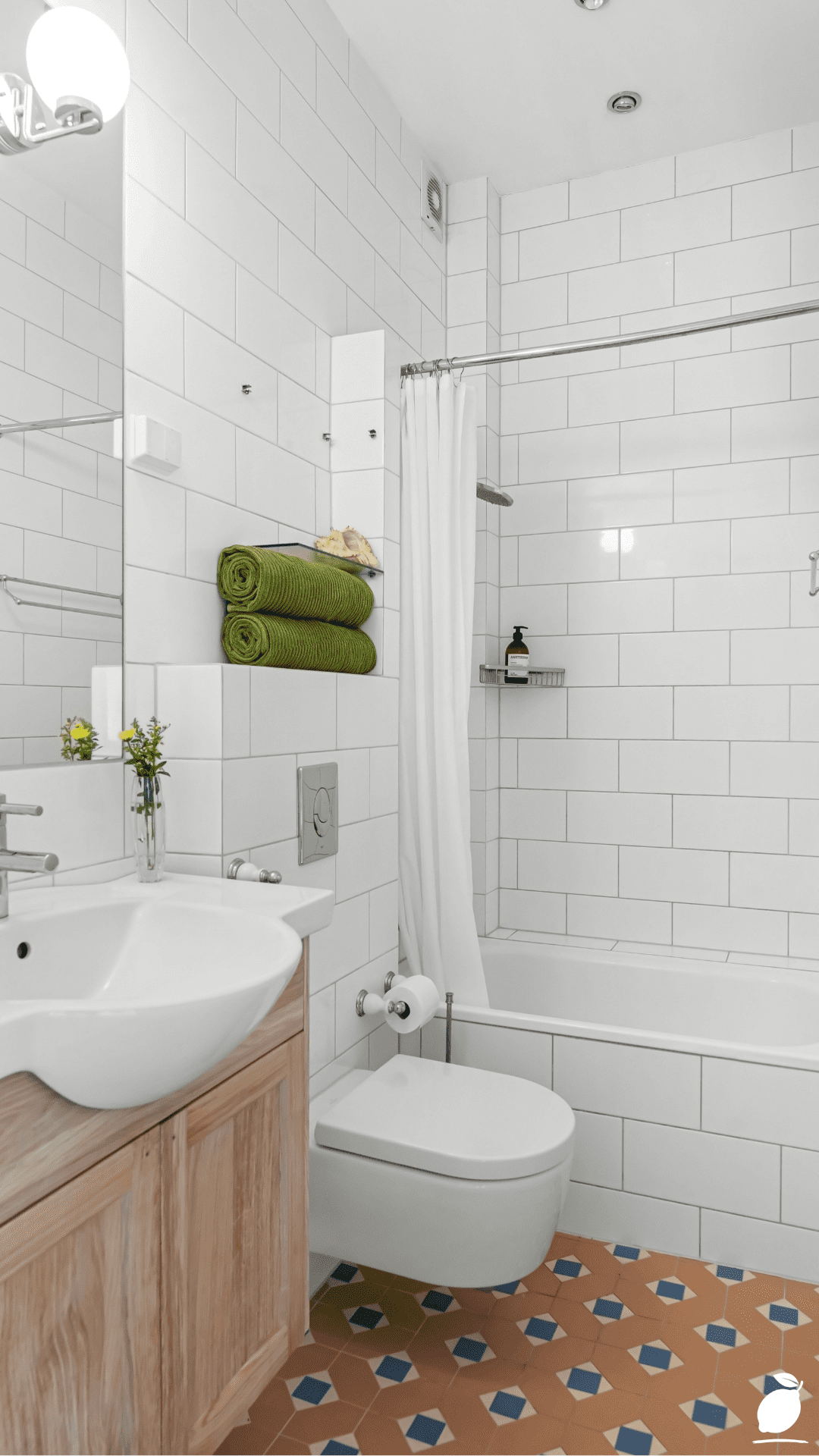
White bathroom ideas that actually work are not about whiteness for its own sake. They are about the specific visual logic that white creates: a field of maximum light reflectance that makes every other element in the room, every material, every texture, every accent color read with unusual clarity and intention. The bathroom in the image above executes that logic with a precision that transforms what could be a small, ordinary bathroom into a space that feels genuinely designed. White subway tile covers every wall surface, creating a clean, continuous field that bounces soft light across the room. A warm honey oak vanity grounds the white with organic warmth. A white vessel sink sits clean and deliberate above it. And on the floor, the single most unexpected and most masterful element in the room, orange and blue geometric patterned tiles provide the accent note that makes every white bathroom idea in the room suddenly visible as a choice rather than a default.
This guide gives you the complete blueprint for executing white bathroom ideas at exactly this level: not the bare-minimum white box that results from simply painting everything white, but the layered, material-rich, intentionally accented white bathroom that the image demonstrates. The white bathroom ideas here work in any bathroom size, at any budget level, and regardless of what the room currently looks like. What they require is the same thing the image demonstrates: a commitment to a governing concept applied consistently, rather than a collection of individual improvements applied separately. These are the white bathroom ideas that change the room rather than update it.
The White Bathroom Ideas Blueprint
Step 1: Define Your White Bathroom Ideas Concept Before Purchasing Anything
Every successful white bathroom idea begins with a written concept, a one-sentence description of the specific type of white bathroom you are building before a single tile, fixture, or accessory is purchased. White bathroom ideas that skip this step produce rooms that are white without being resolved: all the individual white elements are present, but they do not read as a unified design because no single concept governed their selection.
The concept for the bathroom in the image could be written as: a bright, clean white subway tile field anchored by a warm wood vanity and activated by a bold geometric floor pattern in orange and blue. Every element in the room is a direct expression of that concept. The subway tile was chosen because the concept required a white field, not marble, not large-format porcelain, not beadboard. The wood vanity was chosen because the concept required organic warmth to prevent the white from reading as clinical. The geometric floor tile was chosen because the concept required a single bold accent to make all the white bathroom ideas in the room visible as intentional rather than neutral.
Write your concept before opening a browser tab or entering a tile showroom. Make it specific: identify the white tile material and format, the grounding material that prevents the white from feeling cold, and the accent element that activates the palette. With that concept written, every subsequent white bathroom idea purchase either serves the concept or does not — and the ones that do not can be set aside before they become expensive mistakes.
Step 2: Select the Right White Tile for Your Bathroom’s Specific Light Conditions
White bathroom ideas succeed or fail on the quality of the white tile selection, and the quality of that selection depends entirely on understanding your bathroom’s specific light conditions before choosing a tile. White tiles are not interchangeable; they carry undertones (warm, cool, green, gray, yellow) that interact with the light sources in the room to produce dramatically different visual results. A tile that reads as pure white in a showroom under warm display lighting may read as distinctly blue-gray in a north-facing bathroom with cool natural light, or greenish-yellow under certain fluorescent bathroom fixtures.
The subway tile in the image reads as clean, warm white because it was selected to work with the bathroom’s soft, even lighting. The combination of a ceiling-recessed light and the warm bulb of the chrome vanity fixture creates a consistent warm-white light environment that supports the tile’s undertone. For your own white bathroom idea tile selection, identify the bathroom’s dominant light source (natural north or south light, warm or cool artificial light) before choosing a tile. Request samples of every white tile you are considering and install them temporarily on the bathroom wall for at least 48 hours, observing them at every time of day and under the room’s actual artificial lighting before committing.
For white bathroom ideas that prioritize a warm, organic quality like the image, choose subway tiles or field tiles with a slight cream or warm gray undertone rather than a pure optical white. For white bathroom ideas that prioritize a crisp, contemporary quality, a brighter white with a neutral or very slightly cool undertone reads cleaner. The distinction matters at the scale of a full bathroom installation in a way that a small sample card cannot communicate.
Step 3: Ground the White Bathroom Idea With One Warm Natural Material
The single design decision that most consistently prevents white bathroom ideas from producing a cold, clinical, or institutional result is the introduction of one warm natural material, such as wood, natural stone, unlacquered brass, rattan, or ceramic, at a scale large enough to counterbalance the white field without competing with it. The honey oak vanity in the image performs this function with precision: it occupies the largest single furniture footprint in the room, which gives it enough visual weight to anchor the white subway tile walls on three sides, but it does not replicate or repeat the white; it responds to it with warmth and organic grain that the tile cannot provide.
For your white bathroom ideas project, identify the single natural material that will ground the palette. Wood vanities in warm tones, such as honey oak, light walnut, and natural teak, are the most versatile grounding material for white bathroom ideas because they bring warmth, grain texture, and organic variation into a space that the white tile alone would make visually uniform. Natural stone countertops or vessel sinks in a warm white or cream tone are an alternative grounding element that keeps the palette within the white register while adding material depth. Unlacquered brass fixtures, faucets, towel bars, and light fixture housings function as the warmth layer in white bathroom ideas where a wood element is not practical or desired.
Whatever natural material you choose, apply it at one significant scale rather than distributing it across multiple small elements. One full-scale wood vanity is a grounding decision. Three small rattan baskets and two wooden accessories are a decorating habit. White bathroom ideas that ground through a single large-format natural element read as designed; white bathroom ideas that layer multiple small warm accents read as compensatory.
Step 4: Design the Floor as the White Bathroom Idea’s Statement Surface
In a white bathroom idea where the walls are uniformly tiled, and the fixtures are predominantly white, the floor is the room’s single greatest opportunity for visual character, the surface that most determines whether the bathroom reads as a designed space or an assembled one. The orange and blue geometric floor tile in the image is the white bathroom idea decision that makes everything else in the room visible as intentional. Without it, the white subway tile walls, the white fixtures, and the wood vanity are good white bathroom ideas, well executed. With it, the entire room becomes a considered composition in which the floor’s boldness makes the walls’ restraint look deliberate, and the walls’ restraint makes the floor’s boldness look earned.
For your white bathroom idea floor selection, consider the floor as the room’s single accent surface, the place where pattern, color, and visual complexity are permitted and specifically invited in a space that holds everything else to a white-and-neutral discipline. Classic encaustic cement tiles in geometric patterns, Moroccan-style zellige in a terracotta and blue palette, black-and-white hexagon mosaic, or handmade terracotta tile with natural variation all perform the statement floor role that the image’s geometric tile performs. In each case, the floor pattern earns its visual authority precisely because the surrounding surfaces do not compete with it.
For white bathroom ideas on a smaller budget, peel-and-stick vinyl floor tiles in geometric patterns now produce results indistinguishable from ceramic tile at close range and are available in a wide range of patterns and colors suitable for the white bathroom idea aesthetic. Applied over a clean, flat existing floor, they transform the room’s visual identity at a fraction of the cost of a full tile installation.
Step 5: Choose Chrome or Brushed Nickel Fixtures to Complete the White Bathroom Idea Palette
Fixture finish is the white bathroom idea detail that ties the room’s individual elements into a coherent whole, and it operates most effectively when a single finish is applied consistently across every metal element in the room: faucet, shower head, towel bar, toilet paper holder, mirror frame if metal, and light fixture housing. The bathroom in the image uses chrome throughout the vanity faucet, the shower curtain rod, the mirror fixtures, and the towel shelf, and this consistency is what makes the room feel finished rather than assembled.
Chrome is the most natural fixture finish for white bathroom ideas because it shares the clean, reflective quality of the white tile and complements the warm wood vanity with a cool contrast that prevents the room from reading as uniformly warm. Brushed nickel provides the same palette neutrality with a softer, less reflective surface quality that suits white bathroom ideas where a matte aesthetic is preferred. Matte black is the most contemporary fixture choice for white bathroom ideas, with a graphic, high-contrast character that creates strong visual punctuation against white surfaces and suits bathroom palettes that include black-and-white floor tile or dark accent elements.
Whatever finish you select, apply it without exception to every metal element in the room before the white bathroom idea project is declared complete. A single chrome faucet in a bathroom with brushed nickel towel bars and a matte black light fixture is not a design problem that individual pieces can fix. It is a finish consistency problem that only a complete hardware audit and replacement can resolve.
Step 6: Edit Accessories to Three Objects Per Surface and Maintain the White Bathroom Idea’s Visual Discipline
The final white bathroom idea step is the one that sustains the room’s design quality through daily life, the discipline of limiting every horizontal surface in the bathroom to a maximum of three objects, each placed with visible space between it and its neighbors, each chosen because it contributes to the room’s palette and concept rather than because it is useful or attractive in isolation. The bathroom in the image demonstrates this discipline on every surface: the vanity holds a single small glass vase with yellow flowers and a faucet; the wall shelf holds two neatly rolled green towels and a small decorative object; the shower shelf holds a single soap bottle. Nothing else. The restraint is the design decision.
For your own white bathroom idea maintenance, establish a surface rule before the room is finished and communicate it to every household member who uses the space: this surface holds three objects maximum, chosen for the palette, placed with space between them. Everything else, the spare razor, the extra soap, the phone charger, lives in a drawer, a cabinet, or a storage basket behind a closed door. White bathroom ideas that are executed with precision and then gradually reclaimed by daily object accumulation produce a room that feels intentional twice a year and unresolved the rest of the time. The three-object rule, maintained consistently, is what makes a white bathroom idea permanent rather than periodic.
Expert Secrets for Success
Pro-Tips for a Better Result
Use warm-white bulbs throughout your white bathroom idea to support the tile’s undertone. The most common reason well-executed white bathroom ideas look flat or slightly cold in photographs and in the mirror is cool-white, or daylight-spectrum bulbs 4000K or above that shift the white tile’s undertone toward blue-gray. Use warm-white bulbs at 2700K to 3000K in every fixture in the white bathroom idea space: vanity lights, ceiling recessed lights, and any supplementary sources. Warm-white light supports the organic quality of white bathroom ideas built around natural materials like wood vanities and handmade tile, and it makes the skin tones reflected in the bathroom mirror look warmer and healthier, a functional benefit that reinforces the aesthetic one.
Install subway tile in a horizontal running bond pattern rather than vertical stacking for maximum white bathroom impact. The horizontal running bond, each tile offset by half a tile length from the row above and below, is the classic subway tile pattern and the one that creates the continuous, flowing visual quality the image demonstrates. Vertical stacking (each tile directly above the tile below) creates a grid pattern that reads more formal and less dynamic, and a brick-pattern with vertical orientation reads as unconventional but can feel narrow in small bathroom spaces. For white bathroom ideas that prioritize a clean, modern quality with historical resonance, horizontal running bond on all wall surfaces is the pattern that has consistently delivered the strongest result across the widest range of bathroom sizes and styles.
Extend the white tile to the ceiling on every wall, including above the vanity. The most common white bathroom idea installation compromise is tiling the shower area to the ceiling and stopping the tile at chair-rail or door-height on the remaining walls. This compromise produces a room that reads as half-committed, the shower feels finished, and the vanity area feels incomplete. Extending white subway tile to the full ceiling height on every wall in the bathroom, as the image demonstrates, creates the complete white field that makes the floor pattern, the wood vanity, and the accent elements read with full visual clarity. The additional tile material cost is typically 20 to 30 percent of the shower-only installation cost and produces 100 percent of the visual transformation.
Place the accent flower or plant at the vanity’s natural low point. The small glass vase with yellow flowers in the image is positioned at the corner of the vanity closest to the wall, the visual low point of the composition, where the eye naturally settles after traveling from the mirror across the sink surface. Accessories placed at this natural low point read as discovered rather than displayed, which is the quality that makes white bathroom ideas feel genuinely lived-in rather than styled for photography. Place your own organic accent, a small plant, a single stem in a thin vase, or a small ceramic dish at this position, and resist the instinct to center it on the vanity surface.
Common Mistakes to Avoid
Don’t choose white grout for white subway tile in a small bathroom. White grout on white subway tile creates a seamless, continuous surface that reads as very clean and very flat. The visual definition between tiles disappears, and the wall reads as a single uniform white plane. In larger bathrooms with high ceilings and abundant natural light, this seamless quality can work well. In small bathrooms, it removes the grid pattern that gives subway tile its scale reference and can make a small room feel even smaller by eliminating the visual detail that provides spatial orientation. For white bathroom ideas in standard residential bathroom sizes, light gray or warm gray grout provides the tile definition that gives the subway pattern its characteristic visual rhythm without the harsh contrast of dark grout.
Don’t introduce more than one accent color in a white bathroom idea. The orange and blue geometric floor tile in the image works as a white bathroom idea accent. It functions as a single pattern statement, even though the pattern contains multiple colors; the orange and blue read as a unified geometric composition rather than as two separate accent colors because they are contained within a single surface application. Introducing the same orange in towels and the same blue in a vase and a secondary accent color in a soap dispenser produces a different result entirely: multiple competing accent notes that fragment the white bathroom idea palette rather than activating it. Apply the accent principle to surfaces rather than to individual colors, and keep the accent application to one surface, the floor, or one accent wall, or one textile layer.
Don’t use a frameless mirror in a white bathroom, as it needs visual definition. A frameless mirror mounted flush against a white subway tile wall disappears into the white field it reflects without providing visual structure, which means the vanity area lacks the framing element that makes it read as a composed zone rather than a functional area. For white bathroom ideas where the walls are uniformly white, a framed mirror, chrome, wood, black metal, or a shape with inherent visual weight, like a round or arched frame, provides the visual punctuation that defines the vanity as a designed element. The large rectangular mirror in the image earns its authority in the white bathroom idea composition precisely because its chrome-finished frame and significant scale give it visual presence against the white tile field.
Don’t tile over a floor that has not been checked for level and structural soundness. The geometric floor tile that is among the most impactful of all white bathroom ideas available to a homeowner is also the most demanding installation in terms of substrate requirements. Geometric and encaustic tiles are typically thicker and less flexible than standard ceramic tile, which means any unevenness or structural movement in the subfloor will produce cracked tiles within the first year of installation. Before committing to the statement floor tile that makes white bathroom ideas of this type work, verify that the subfloor is structurally sound, level to within 3mm across any 180cm span, and properly waterproofed in wet zones. The tile installation is the most visible investment in the white bathroom idea; the substrate preparation is the investment that makes it last.
Why White Bathroom Ideas Matter
The bathroom is a threshold space, the room where the day begins and ends, where the transition between sleep and wakefulness happens, where five or ten minutes of daily solitude are available to anyone who claims them. The quality of the environment in which those transitions occur is not a trivial consideration. Research in environmental neuroscience has consistently documented that visual clutter and environmental disorder in the first room experienced each morning elevate morning cortisol levels and set a stress-primed tone for the hours that follow. White bathroom ideas that produce genuine visual calm, clean surfaces, a coherent palette, and restrained accessorization are an investment in the quality of those daily transitions, and through those transitions, in the quality of the days they open.
White bathroom ideas matter specifically because white is the most powerful tool available for creating the perception of space, light, and calm in a room that is typically small, typically shared, and typically accumulated with the functional residue of daily use. A white bathroom idea executed well does not just look cleaner than a colored one; it feels more spacious, calmer, and more controllable, because the white field provides a visual resting point that colored walls and patterned surfaces cannot. It is the environmental equivalent of a cleared desk: not because everything has been removed, but because what remains has been placed with intention, and the space between things is as deliberate as the things themselves.
Easy Peasy Life Matters is built on the conviction that the rooms where daily life happens most intensely deserve the most intentional design attention. The bathroom in the image above is proof of what white bathroom ideas look like when that attention is applied with both restraint and personality. When the white field is given its full authority, the natural materials are chosen for their specific warmth, and the accent element is selected with the confidence that one bold decision, placed correctly, is worth more than a dozen cautious ones. These are the white bathroom ideas that change how a room feels to live in, not just how it looks to photograph. And the room that feels right to live in is the one that compounds its value across every morning and every evening for the lifetime of the home that holds it.
Frequently Asked Questions
What are the best white bathroom ideas for a small bathroom?
The most impactful white bathroom ideas for small bathrooms are those that maximize light reflectance and minimize visual fragmentation. White subway tile extended to ceiling height on all four walls creates a continuous light-reflective field that makes a small bathroom feel significantly larger than its measurements. A large-format mirror as close to full-width above the vanity as practical doubles the perceived depth of the room. A statement floor tile in a geometric or encaustic pattern provides the visual interest that prevents the white field from feeling monotonous without adding any visual weight to the walls. Consistent chrome or brushed nickel hardware throughout eliminates the visual fragmentation of mixed finishes. These white bathroom ideas work together to produce a small bathroom that reads as a designed space rather than a constrained one.
How do I keep a white bathroom idea from looking clinical or cold?
The antidote to the clinical quality that white bathroom ideas can produce when not carefully managed is the intentional introduction of warm, organic materials at one significant scale. A honey oak or warm walnut vanity is the single most effective warm counterbalance to a white tile field. Natural linen or cotton towels in a warm green or terracotta tone provide warmth in the textile layer. Warm-white light bulbs at 2700K to 3000K support the tile’s warm undertone and create the soft, even light quality the image demonstrates. A single living plant or fresh flower stem at the vanity introduces the one element that no amount of careful material selection can replicate: the specific warmth of a genuinely living thing in an otherwise constructed environment.
Can white bathroom ideas work with colored floor tiles?
Yes, and the combination of white bathroom ideas on the walls and ceiling with a bold colored or patterned floor tile is among the most successful design approaches in contemporary bathroom design, for exactly the reason the image demonstrates. The white field on all vertical surfaces provides the visual neutrality that allows a bold floor pattern to read as a deliberate accent rather than a competing element. The floor’s color and pattern earn their authority precisely because nothing above them challenges them. For white bathroom ideas that incorporate a colored floor, the key is discipline on every other surface: white tile, white fixtures, one natural grounding material, and no additional accent colors introduced through accessories or textiles that would compete with the floor’s palette.
What grout color works best with white subway tile in a white bathroom idea?
Light gray grout is the most versatile and most consistently successful grout color for white subway tile in white bathroom ideas. It provides sufficient tile definition to give the subway pattern its characteristic visual rhythm without the harsh contrast of charcoal or dark gray grout, and it does not disappear into the tile surface the way white grout does. For white bathroom ideas with a warmer palette, a wood vanity, terracotta floor tile, warm-white walls, and a greige grout (warm gray) align with the palette’s temperature and read as more harmonious than a cool gray. For white bathroom ideas with a crisper, more contemporary character, a cool light gray or silver gray provides clean definition without introducing warmth the palette does not call for.
How do I maintain the clean appearance of a white bathroom idea over time?
The most effective maintenance approach for white bathroom ideas is the combination of a daily surface reset, returning every horizontal surface to its three-object maximum at the end of each day, and a weekly cleaning routine using pH-neutral cleaning products on the tile and a microfiber cloth on all white surfaces. Avoid abrasive cleaning products on white tiles and fixtures, which scratch the glaze and create micro-texture that accumulates grime more quickly than a smooth surface. Seal grout lines annually with a penetrating grout sealer to prevent staining. White and light gray grout in a frequently used bathroom will show discoloration within one to two years without regular sealing. For the wood vanity that grounds most warm white bathroom ideas, apply an annual wax or oil finish appropriate to the wood species to maintain the natural grain and prevent moisture infiltration at the countertop joint.