You have always known you were not a neutral-palette person. The greige walls and the linen sofas and the matching throw pillows in three shades of nothing, you have tried them, or you have watched other people try them and felt the specific exhaustion of a room that works very hard to offend no one and ends up belonging to no one. You have pinned the dark rooms and the velvet sofas and the candlelit shelves full of leather-bound books, and then you have closed the browser and looked at your living room with its perfectly adequate furniture and its perfectly adequate lighting and its complete absence of the atmosphere you were actually trying to live inside. The problem was never that you wanted too much from a room. The problem was not knowing how to name what you wanted precisely enough to build it. The word you were looking for is whimsigoth, and the whimsigoth room is exactly the living room you have been failing to permit yourself to create.
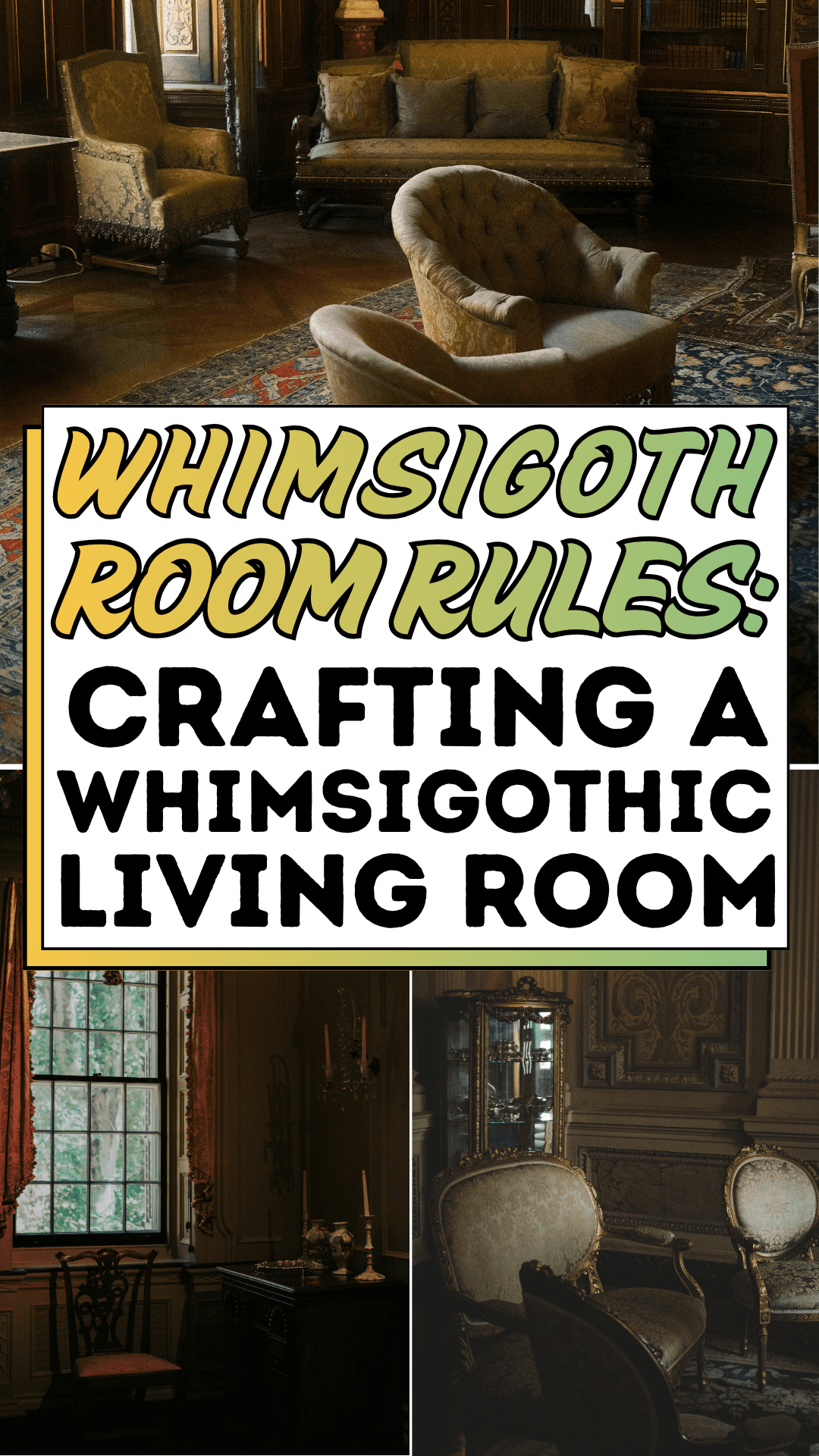
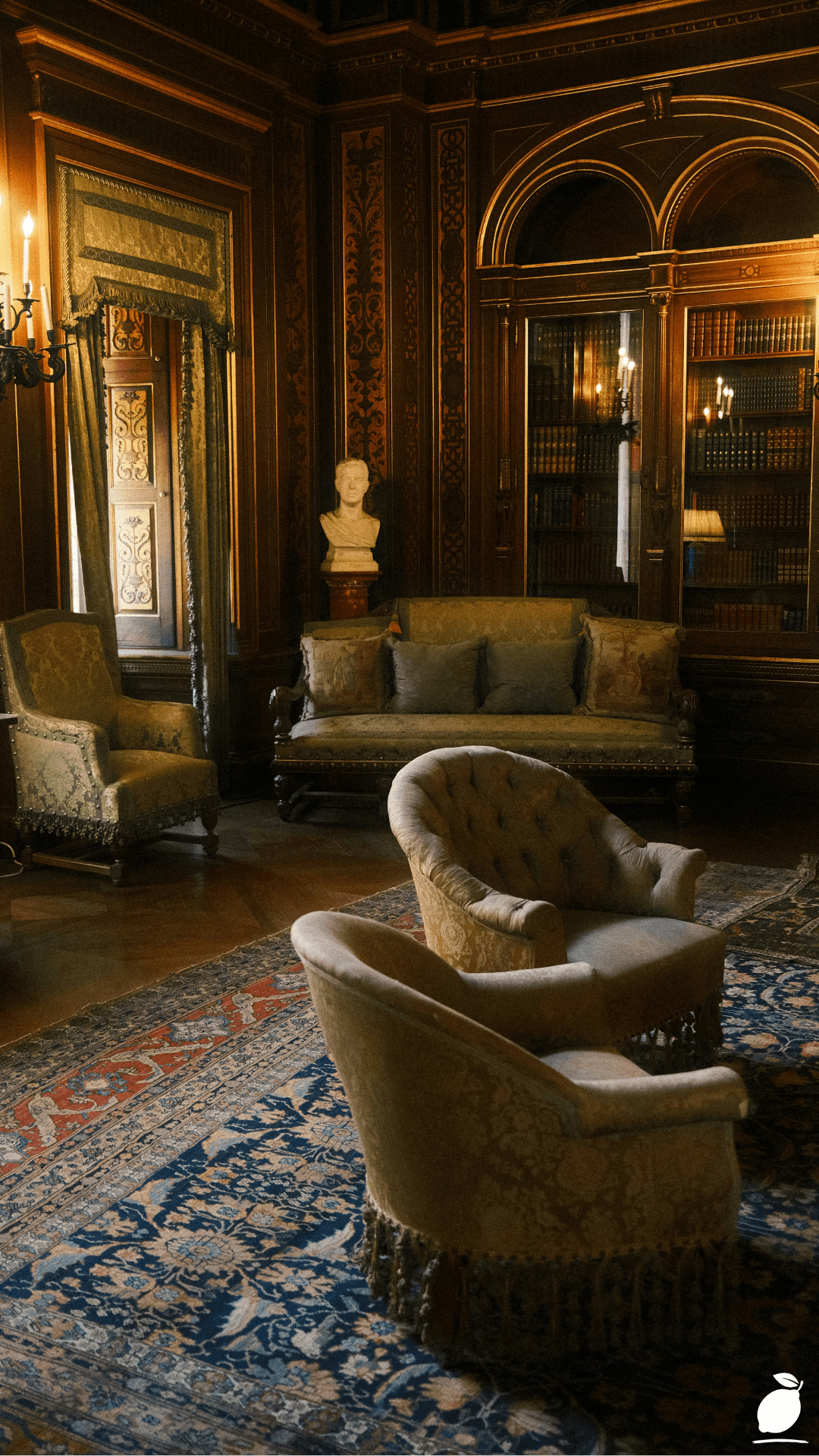
The image above is a whimsical room operating at full authority. Dark wood paneling with gold-leaf accents rising to ornate architectural moldings. Built-in bookshelves lined the floor to ceiling with leather-bound volumes. A velvet sofa in muted olive-green, dressed with gold and olive pillows. Two deep tufted armchairs in cream and patterned green, angled toward the center of the room with the ease of furniture that has been placed rather than positioned. A classical marble bust on a dark pedestal, catching the warm glow of wrought-iron candelabras. An oriental rug in deep blue, red, and cream anchors the dark, polished wood floor with the specific authority that only a room-scale pattern can provide. The arched doorway framed by a green velvet curtain leads into the warm amber of the room beyond. Every element in this whimsigoth room is doing two things simultaneously: contributing to the room’s gothic structural gravity and, through the warmth of its color, the plushness of its texture, and the specific whimsy of its accumulated personality, preventing that gravity from tipping into darkness. That balance of serious and playful, opulent and personal, dark and warm is what the whimsigoth room aesthetic is built on, and it is what this guide will help you achieve.
The whimsigoth room is not a trend in the sense of a seasonal preference that will read as dated in eighteen months. It is a design philosophy built on the same principles that made Victorian libraries feel like the most desirable rooms in the houses that contained them: the commitment to atmosphere over neutrality, to material richness over visual restraint, to the kind of accumulated personality that makes a room feel like it has a history and an inner life rather than a recent purchase date. Building a whimsigoth room does not require architectural paneling or a budget for antique furniture; it requires a governing concept, a commitment to a specific palette, and the willingness to layer texture, pattern, and meaningful objects with the unhurried confidence of someone who knows exactly what kind of room they are building. This guide gives you every step to do exactly that.
The Whimsigoth Room Blueprint
Step 1: Define the Whimsigoth Room’s Governing Atmosphere Before Buying Anything
The whimsigoth room begins with an atmosphere, not a shopping list. Before any furniture is chosen or any paint is sampled, the whimsigoth room needs to be felt as a concept, a specific, written description of the emotional quality the room will deliver to anyone who enters it. The whimsigoth room in the image could be described as: a candlelit Victorian library where intellectual curiosity and physical comfort coexist in a space rich enough to reward extended attention and warm enough to invite genuine rest. Every purchase decision made in the service of that atmosphere belongs in the whimsigoth room. Every purchase decision that cannot be justified by it is not.
Write your own whimsical room atmosphere description before opening a browser tab or entering a furniture showroom. Be specific about the emotional register you are building toward mysterious and warm, scholarly and sensual, theatrically dark and genuinely comfortable. The whimsigoth room aesthetic spans a spectrum from deeply gothic (more shadow, more black, more dramatic contrast) to more whimsical (more color, more pattern, more personal eclecticism), and identifying where on that spectrum your whimsigoth room sits will prevent the common mistake of buying pieces from both ends without a concept to mediate between them.
Post the atmosphere description somewhere visible during the project on your phone, taped to the wall of the room being transformed, and consult it before every purchase. The whimsigoth room is built by accumulation, and accumulation without a governing concept produces clutter rather than character. The atmosphere description is the concept that gives every layer of accumulation its direction.
Step 2: Commit to the Whimsigoth Room’s Dark, Warm Color Palette
Color is the whimsigoth room’s most fundamental commitment and the decision that most dramatically transforms an ordinary living room into one that feels genuinely atmospheric. The whimsigoth room palette is built on dark, warm, saturated tones: deep forest green, burgundy, midnight navy, rich chocolate brown, aged gold applied at a significant scale rather than as accent notes in a lighter room. The image demonstrates this at its most complete: the dark wood paneling, the olive-green velvet sofa, the deep blue and red of the oriental rug, and the warm amber of candlelight create a palette in which darkness is the field rather than the accent, and warmth is what prevents the darkness from becoming oppressive.
For a whimsical room wall color, the most versatile choices are deep, complex darks with warm undertones: Farrow & Ball Railings (near-black with a warm tinge), Sherwin-Williams Caviar (a rich true black), Benjamin Moore Black Forest Green (a deep forest green with brown undertones), or a deep burgundy like Benjamin Moore’s Exotic Red. Avoid cool dark navy with a blue-purple cast, charcoal with a gray-blue undertone, in a whimsical gothic room where warmth is essential to the atmosphere’s livability. The darkness of a whimsigoth room wall should feel like a velvet curtain drawn at dusk, not like a cold winter sky.
Apply the whimsigoth room wall color to all four walls and optionally to the ceiling for full atmospheric immersion. The five-wall dark room has become a defining characteristic of the most successful whimsigoth room transformations, and the psychological effect of a dark ceiling (the room feels lower, warmer, more enclosed in a deliberately sheltering way) is specific to the whimsigoth room aesthetic in a way that a dark-walled, white-ceilinged room does not fully replicate.
Step 3: Build the Whimsigoth Room’s Seating Layer Around Velvet and Tufting
Seating is the whimsigoth room’s primary functional and visual investment, the layer that determines whether the room delivers on the promise of its atmosphere or produces a beautiful-looking space that no one wants to actually inhabit. The whimsigoth room seating layer in the image executes this with three distinct upholstered pieces: the olive-green tufted velvet sofa against the back wall, the patterned green embroidered armchair in the left foreground, and the deep cream tufted armchair in the center. None of the three pieces match. All three belong to the same room because they share the whimsigoth room’s commitment to opulent upholstery, rich color, and furniture that rewards physical contact.
For your whimsigoth room seating choices, prioritize velvet above any other upholstery fabric it is the material most naturally aligned with the whimsigoth room aesthetic because it absorbs light rather than reflecting it (creating the matte, rich depth the aesthetic requires), changes tone dramatically as it is touched and moved (providing the lived-in quality the whimsigoth room needs), and communicates luxury through texture rather than through price point (making it among the most accessible high-impact whimsigoth room materials). Deep tufting, the diamond or button tufting of Victorian and Chesterfield furniture, adds the architectural quality to upholstered pieces that makes them read as whimsical Gothic room furnishings rather than simply dark-colored sofas.
Mix upholstery colors within the whimsigoth room’s palette rather than matching them: an olive velvet sofa paired with a cream tufted armchair and a patterned embroidered accent chair produces the whimsigoth room’s characteristic sense of accumulated richness. Matching upholstery in a whimsigoth room reads as a furniture set rather than a curated collection, and the curated collection is precisely what the whimsigoth room aesthetic requires to communicate its personality.
Step 4: Layer the Whimsigoth Room Floor With a Large-Format Oriental or Patterned Rug
The floor in a whimsigoth room is not a neutral backdrop; it is an active compositional layer, and the rug that covers it is among the single most impactful individual purchases in any whimsigoth room project. The oriental rug in the image deep blue, red, and cream in a complex symmetrical floral and geometric pattern performs multiple functions simultaneously in the whimsigoth room: it anchors the conversation grouping of sofa and armchairs into a unified spatial zone, it introduces the room’s most complex pattern element at a scale that can absorb that complexity without overwhelming, and it provides the warm-toned visual counterbalance to the dark paneled walls that prevents the whimsigoth room from reading as uniformly gloomy.
For a whimsical room floor, size the rug generously; it should be large enough for at least the front legs of all seating pieces to sit on it, and ideally large enough for all four legs of each piece. An undersized rug in a whimsical room looks like an afterthought; an oversized rug looks like a foundation. The whimsigoth room’s visual authority depends on generous scale in every layer, and the rug is the layer where undersizing is most commonly and most damagingly committed.
Pattern and color for the whimsigoth room rug should come from the same warm, saturated register as the room’s palette: oriental or medallion patterns in deep red, navy, forest green, and cream; kilim patterns in rust, gold, and black; or Victorian-era botanical patterns in jewel tones. Avoid contemporary geometric rugs in the whimsigoth room; they read as a different design language and interrupt the room’s historical atmospheric continuity that the whimsigoth room aesthetic specifically cultivates.
Step 5: Install the Whimsigoth Room’s Lighting as Atmosphere-First Architecture
Lighting in a whimsigoth room is not a functional afterthought; it is the element that determines whether all the other whimsigoth room decisions read as atmospheric or merely dark. The image demonstrates the whimsigoth room’s ideal lighting approach: wrought-iron wall-mounted candelabras with actual lit candles provide the room’s primary warm glow, supplemented by a small table lamp in the background that adds depth without competing with the candelabra light. The result is a room illuminated at multiple heights from multiple warm sources, creating the layered, directional light that makes the dark walls and opulent furnishings feel rich rather than simply dim.
For a functional whimsigoth room, replicate this multi-source, warm-temperature lighting architecture without requiring actual candles for daily use. Wall-mounted sconces in wrought iron, aged brass, or black metal with Edison-style warm bulbs at 2200K to 2700K provide the candelabra quality at the flip of a switch. Floor lamps with fabric or opaque shades that direct light downward rather than outward create the intimate pool-of-light quality that the whimsical room atmosphere requires. Battery-powered LED pillar candles on bookshelves, mantels, and pedestal surfaces extend the candlelight effect to surfaces where real candles are impractical. Every light source in the whimsigoth room should be warm, 2200K to 3000K maximum, and no overhead lighting should be the room’s primary illumination source. The whimsigoth room ceiling light, if present, should be on a dimmer set at 20 to 30 percent of its maximum output, serving as fill light rather than the room’s dominant source.
Step 6: Curate the Whimsigoth Room’s Meaningful Object Layer
The whimsigoth room’s defining characteristic above all its other qualities is its relationship to objects, specifically, its insistence on objects that have presence, history, and specificity rather than decorative function alone. The marble bust in the image is the clearest example of this principle: it is not a decorative accessory in the way a vase or a candle is a decorative accessory. It is an object with cultural weight, physical substance, and the specific quality of something that belongs to the room rather than to a trend. The whimsigoth room accumulates objects of this type, and the accumulation, when governed by the whimsigoth room’s atmospheric concept, reads as a collection rather than as clutter.
Objects that belong in a whimsigoth room: leather-bound or antique books in quantity (not arranged by spine color arranged by age, size, and history); classical or art-historical sculpture in marble, bronze, or ceramic; apothecary or scientific instruments in brass, glass, or dark wood; taxidermy or natural history specimens; maps, celestial charts, or antique prints in dark frames; crystals, geodes, and mineral specimens; candles in elaborate holders; dried botanical specimens in glass or pressed frames. Objects that do not belong in a whimsigoth room: mass-produced decorative typography, plastic or faux-brass accessories, anything that communicates novelty rather than age, and anything whose primary quality is its utility rather than its presence.
Arrange whimsigoth room objects in grouped compositions of varying height: tall objects behind, medium objects mid-frame, small objects in the foreground rather than in evenly spaced rows. The whimsigoth room’s object layer should feel discovered rather than displayed, and the composition approach of grouping by height and visual weight produces that quality more reliably than any other arrangement method.
Expert Secrets for Success
Pro-Tips for a Better Result
Introduce the whimsigoth room palette through textiles before committing to wall color. If painting all four walls of a living room dark is a commitment that feels too large to make before seeing the effect in person, introduce the whimsical room’s palette first through large-format textiles, a deep green or burgundy velvet sofa, an oriental rug in jewel tones, and a set of dark velvet curtains floor-to-ceiling. Live with the textile palette for four to eight weeks before painting the walls. The textile layer will demonstrate how the whimsigoth room’s dark, warm palette affects the room’s daily atmosphere, and it will almost certainly confirm that the wall color commitment is not only warranted but overdue.
Use bookshelves as both storage and a whimsical room atmosphere architecture. The built-in bookshelves in the image are not purely functional storage; they are a primary atmospheric element of the whimsigoth room, providing the visual depth and intellectual density that signals the aesthetic. For whimsigoth rooms without built-in shelving, freestanding bookcases painted the same color as the walls so they read as architectural rather than furniture can achieve a similar effect. Fill them generously with actual books rather than decorative objects posed among sparse volumes: the whimsigoth room’s bookshelf should look like the library of someone who reads, not the prop shelf of someone who wants to appear to.
Apply dark paint behind bookshelves and in recessed alcoves for maximum whimsigoth room depth. Painting the interior of bookshelves and recessed architectural niches in a darker tone than the room’s primary wall color or in a deep complementary color like midnight navy behind forest green walls creates a layered depth effect that makes the whimsical gothic room feel architecturally complex without any structural work. The books and objects placed against the darker interior read with greater visual clarity, and the bookcases appear to recede into the wall rather than project from it.
Mix rug patterns with upholstery patterns using the one-dominant-scale rule. A whimsical room that features both a large-scale oriental rug pattern and a large-scale upholstery pattern, two competing focal elements of equal visual weight, produces visual confusion rather than visual richness. Apply the one-dominant-scale rule: if the rug carries the room’s largest and most complex pattern, upholstery patterns should be smaller in scale and simpler in structure. If a large-pattern upholstery fabric is used, the rug pattern should be smaller or more geometric and less visually complex. The whimsigoth room’s layered pattern quality comes from the interplay of different scales and complexities, not from the competition of equals.
Common Mistakes to Avoid
Don’t mistake a dark room for a whimsigoth room. A room with dark walls, dark furniture, and dark accessories that lacks the warmth, the texture richness, and the accumulated personal object layer of the whimsigoth room aesthetic is a gloomy room, not a whimsigoth room. The whimsigoth room’s darkness is specifically warm and specifically inhabited; it is the darkness of candlelight on velvet, of leather-bound books in firelight, of a room where interesting things have accumulated over time. If your whimsigoth room feels oppressive rather than enveloping, the solution is warmth: add candles, add warm-temperature bulbs, add a velvet throw in a deep gold or burgundy, add one living plant. The whimsigoth room’s darkness should feel like a shelter, not a void.
Don’t furnish the whimsigoth room from a single store or a single shopping session. The whimsigoth room’s character comes from the specific quality of accumulated objects that appear to have arrived from different times and contexts, the antique armchair, the velvet sofa, and the oriental rug that each carries the suggestion of a history. A whimsical room furnished entirely from the same contemporary retailer in the same style family reads as a themed room rather than an atmospheric one, regardless of how good the individual pieces are. Build the whimsigoth room’s furniture layer across multiple sources: estate sales and antique markets for upholstered pieces with genuine age and patina, contemporary retailers for anchor pieces that need structural reliability, and thrift stores and vintage markets for the object layer that gives the whimsigoth room its personal specificity.
Don’t use cool-white or daylight-spectrum bulbs anywhere in the whimsigoth room. A single cool-white overhead bulb in an otherwise warm, whimsical room will flatten the velvet, bleach the wall color, and make the candlelit atmosphere the room is designed to deliver functionally impossible. Every bulb in a whimsical room must be warm 2200K to 3000K, and the overhead lighting must be on a dimmer or avoided entirely as a primary source. The whimsigoth room’s atmosphere is made of warm light, and cool-white light is its specific and irreversible antidote.
Don’t over-style the whimsigoth room’s object layer into symmetrical perfection. The whimsigoth room’s objects derive their atmospheric authority from the quality of accumulated presence, the sense that they arrived over time and settled where they belong rather than being arranged by a styling professional on a shoot day. Symmetrical groupings, evenly spaced objects, and matching pairs undermine this quality by communicating deliberate arrangement rather than personal accumulation. Style the whimsigoth room’s shelves, mantels, and surfaces with intentional asymmetry: odd numbers of objects, varying heights within each grouping, unexpected juxtapositions of scale, and the occasional space that lets nearby objects breathe.
Why Whimsigoth Room Matters
The whimsigoth room is, at its heart, a refusal. It is the refusal of the premise that a living room should be inoffensive, that home design should be legible to everyone who enters it, that the rooms where we spend our most private hours should be calibrated to the preferences of guests rather than to the specific and possibly eccentric needs of the people who actually inhabit them. The whimsigoth room is a room that says something specific, something personal, something that could not have been built by anyone who did not have exactly this set of interests and references, and sensory preferences. In a home design landscape saturated with rooms that could belong to anyone, the whimsigoth room is a room that belongs to someone in particular. That belonging is not a decorating outcome. It is a psychological one.
Research in environmental psychology has documented the relationship between environmental personalization and psychological well-being, specifically, the degree to which living in a space that reflects one’s genuine aesthetic preferences reduces baseline anxiety, increases the quality of time spent at home, and creates the conditions for the kind of creative and intellectual engagement that feeds a full inner life. The whimsigoth room, by its specific nature, is one of the most thoroughly personalized of all residential design aesthetics; every layer of it, from the palette to the object curation, requires specific individual choices that cannot be made by someone who does not know exactly what kind of room they are building. The result is a space that functions as a genuine psychological shelter, not just a pleasant room.
Easy Peasy Life Matters believes that the most important home improvement project is always the one that brings a room into genuine alignment with the person who lives in it. The whimsigoth room is, for the people it belongs to, the project that transforms the living room from the room that was there into the room that was always meant to be there. The image at the top of this guide is proof of what that alignment looks like when it is fully achieved: a room so thoroughly itself that it could not have been built by accident, and so genuinely livable that you could spend an entire evening inside it without once wishing you were somewhere else. That room is what the whimsigoth room aesthetic makes possible. This guide is how you build it.
Frequently Asked Questions
What exactly is a whimsigoth room, and how is it different from traditional gothic decor?
The whimsigoth room is a design aesthetic that combines the atmospheric darkness and material richness of gothic design with a warmer, more personal, more eclectic sensibility that prevents the space from feeling theatrical or severe. Where traditional gothic decor prioritizes dramatic contrast, religious or macabre iconography, and a formal atmospheric weight, the whimsigoth room emphasizes warmth through velvet upholstery and candlelight, whimsy through personal objects and pattern eclecticism, and livability through comfortable seating and layered textiles. The whimsigoth room feels like a Victorian scholar’s private library, dark and opulent and full of interesting things rather than like a stage set for a gothic novel.
What colors work best for a whimsical goth room palette?
The most effective whimsigoth room palettes are built on deep, warm, saturated darks: forest green, burgundy, deep plum, midnight navy with warm undertones, aged gold, and rich chocolate brown. The warmth of the undertone is the critical distinction; cool darks (blue-gray charcoal, pure black without warmth, cold navy) produce a chillier atmosphere than the whimsical room requires. Walls in the whimsigoth room palette’s darkest tone, upholstery in mid-depth saturated colors, olive, rust, cream, deep teal, and accent objects in gold, bronze, and aged brass create the layered tonal depth that characterizes the whimsigoth room’s visual identity.
Can a whimsical room be achieved in a small living room?
Yes, and in some ways, the whimsigoth room aesthetic benefits from smaller spaces, because the enclosing quality of dark walls and rich textiles creates an atmosphere of intimate shelter that reads as intentional in a small room and cozy rather than oppressive in the way it might be in a larger space. For a small whimsigoth room, prioritize scale in two or three key pieces rather than attempting to include all elements at full size: one full-size velvet sofa, one large oriental rug, bookshelves on one wall, and wall-mounted candelabras rather than floor lamps will establish the whimsigoth room aesthetic in a compact living room without overcrowding the functional space.
How do I mix patterns in a whimsical gothic room without the room looking chaotic?
The whimsigoth room’s pattern mixing succeeds through scale differentiation and color unity. Allow one large-scale pattern to dominate the oriental rug at floor level and keep other pattern applications at smaller scales: a medium-scale botanical or damask in an accent chair upholstery, a small-scale geometric or texture pattern in throw pillows or curtain lining. All patterns should draw from the same warm, saturated color family: deep red, forest green, gold, and cream. So that even when scales vary significantly, the palette unity creates a visual coherence that prevents the whimsical room’s pattern layering from reading as chaotic.
What budget-friendly ways can I start building a whimsical goth room aesthetic?
The most accessible entry points into the whimsigoth room aesthetic are those that deliver the largest atmospheric return at the lowest material cost. Dark wall paint is the highest-impact, lowest-cost single whimsigoth room investment. A gallon of deep forest green or burgundy paint costs the same as any other gallon of paint and transforms the room’s atmosphere more dramatically than any furniture purchase. Battery-powered LED pillar candles in varying heights on shelves and surfaces create the warm, multi-source lighting that the whimsigoth room requires without the fire safety considerations of real candles. Thrift stores and estate sales are the most reliable sources for the velvet upholstered pieces, leather-bound books, framed prints, and sculptural objects that give the whimsigoth room its object layer character, typically at a small fraction of retail cost.