My kitchen used to be the one room I could not figure out how to love. It was functional; the appliances worked, the layout made sense, and there was enough counter space to actually cook, but it had the personality of a rental specification. Everything was either white, gray, or stainless steel, and while that is not inherently a problem, the room had no warmth, no story, no sense that a real person with real tastes lived and cooked and gathered here. I kept adding small things: a ceramic bowl, a cutting board propped against the backsplash, a plant that eventually died because the kitchen did not feel like a place where living things thrived. Every change felt like a patch rather than a solution because I was still missing the single most important ingredient: a clear aesthetic intention that would give every element in the room a reason to be there.
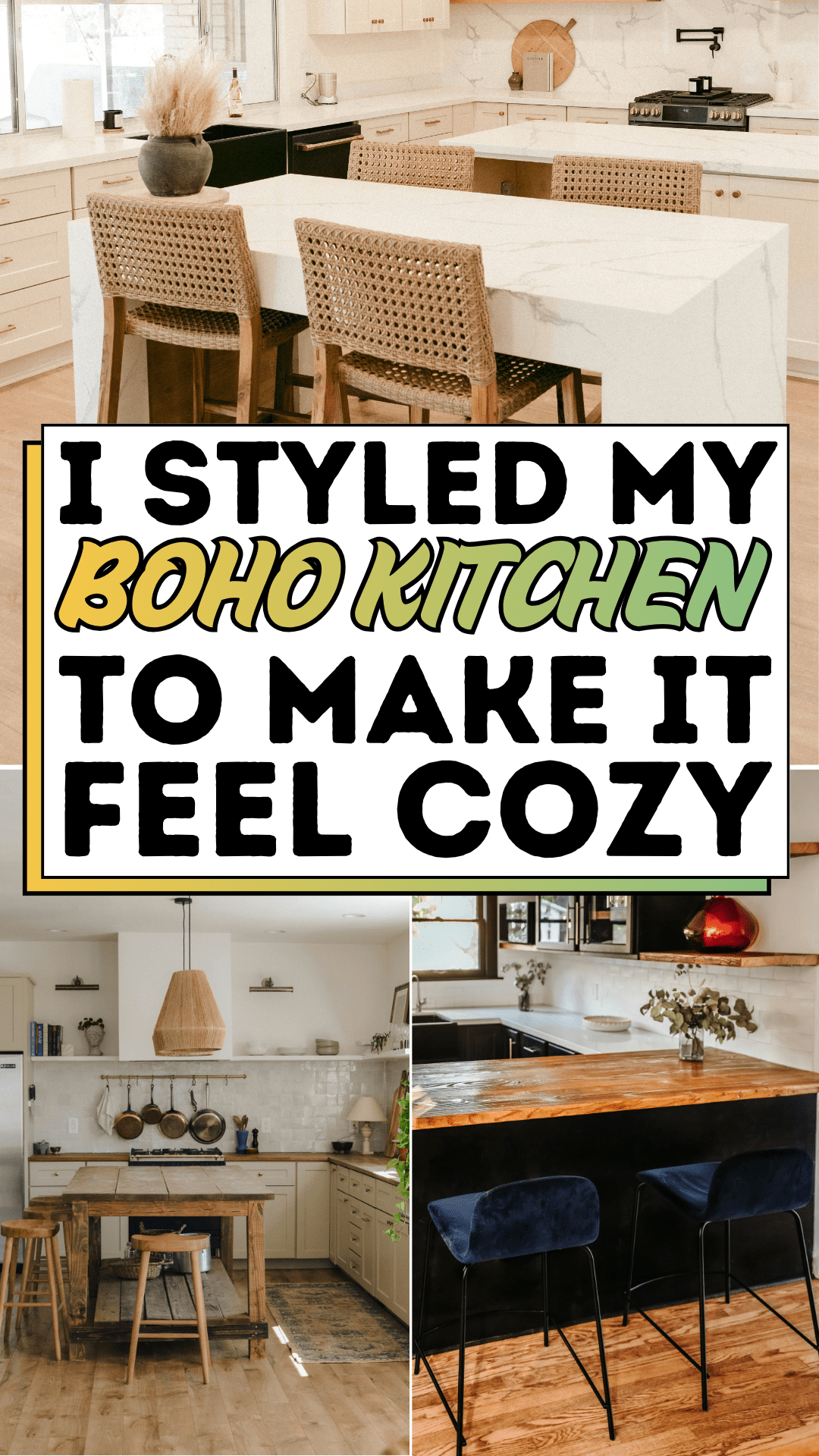
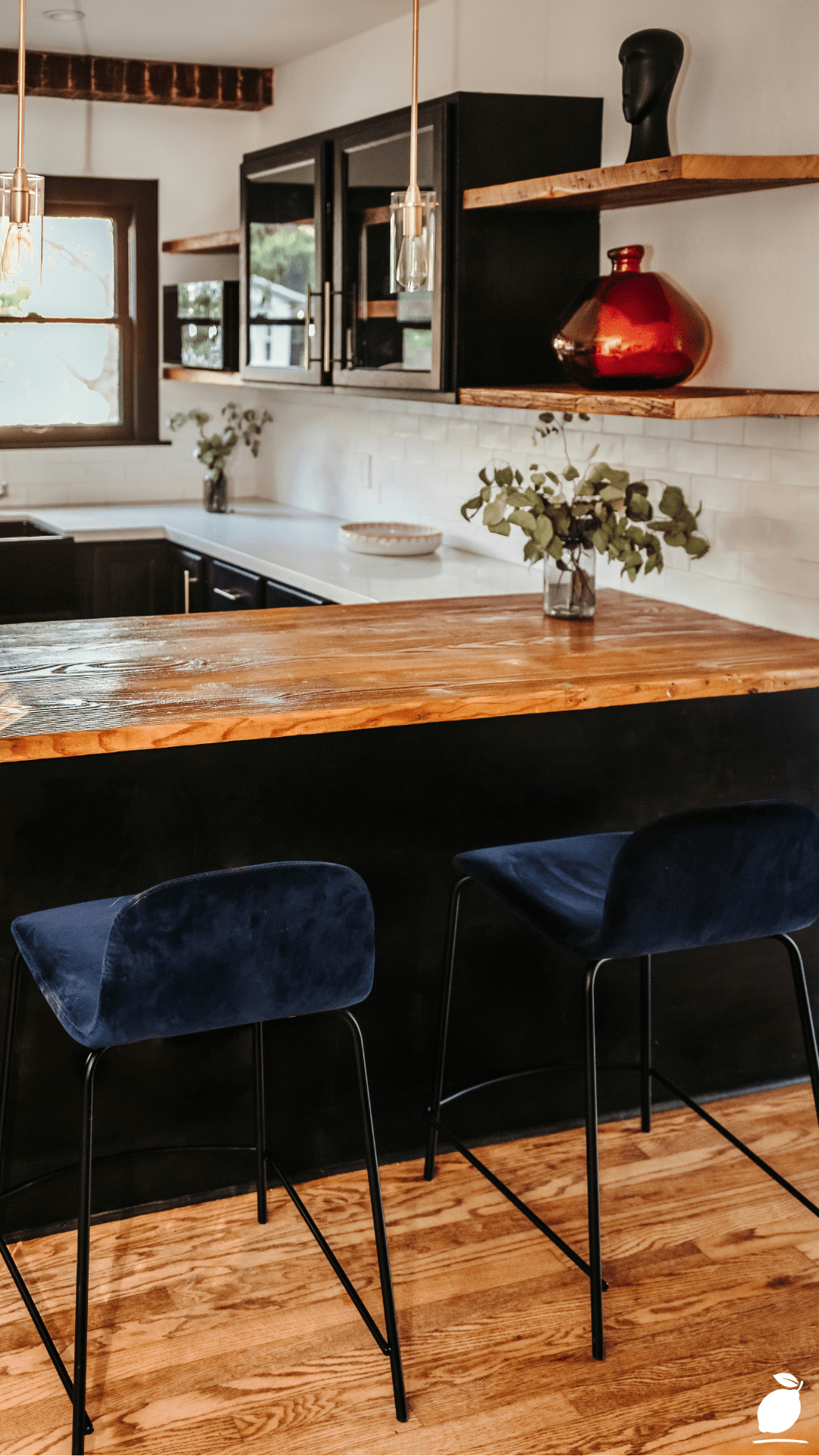
The kitchen in the image above is that intention made visible. It is a boho kitchen in the most evolved and sophisticated sense, not the predictable macramé-and-open-shelving version, but a boho kitchen that has absorbed the warmth and organic character of bohemian design and expressed it through genuinely beautiful, modern materials. A large kitchen island anchors the space with a thick live-edge oak countertop in warm honey tones, its prominent natural grain and raw edge bringing the outdoors in with quiet authority. Two navy blue velvet bar stools with slim black metal legs flank the island, adding jewel-toned richness and the kind of color that makes a kitchen feel genuinely inhabited.
Matte black cabinetry runs along the left wall, housing an integrated microwave with clean precision. Two horizontal floating shelves in raw-edged natural wood hold a large, rounded red glass vase with a deep translucent hue, and a smooth black minimalist sculpture, an elegant head form that introduces art into the kitchen without apology. A small potted plant on the white countertop near a large window, a bouquet of eucalyptus in a clear glass vase on the island, and a white subway tile backsplash complete the composition. The whole room is flooded with natural light from a generous window that frames an outdoor scene of green trees and bright sky. This is what a kitchen looks like when it knows exactly what it is.
A boho kitchen is not a decorating category you fall into accidentally. It is a considered design philosophy that values natural materials, expressive color, organic forms, and the layered character of a space that has been assembled with genuine taste rather than assembled from a single catalog. The kitchen in the image above achieves something that most kitchens never manage: it feels like the most beautiful and personal room in the home rather than the most purely functional one. This guide will show you exactly how to build your own boho kitchen, step by careful step, from the largest structural decisions down to the final styling details that bring the whole composition to life.
The Boho Kitchen Blueprint
Step 1 — Establish the Boho Kitchen Foundation with a Live-Edge or Natural Wood Surface
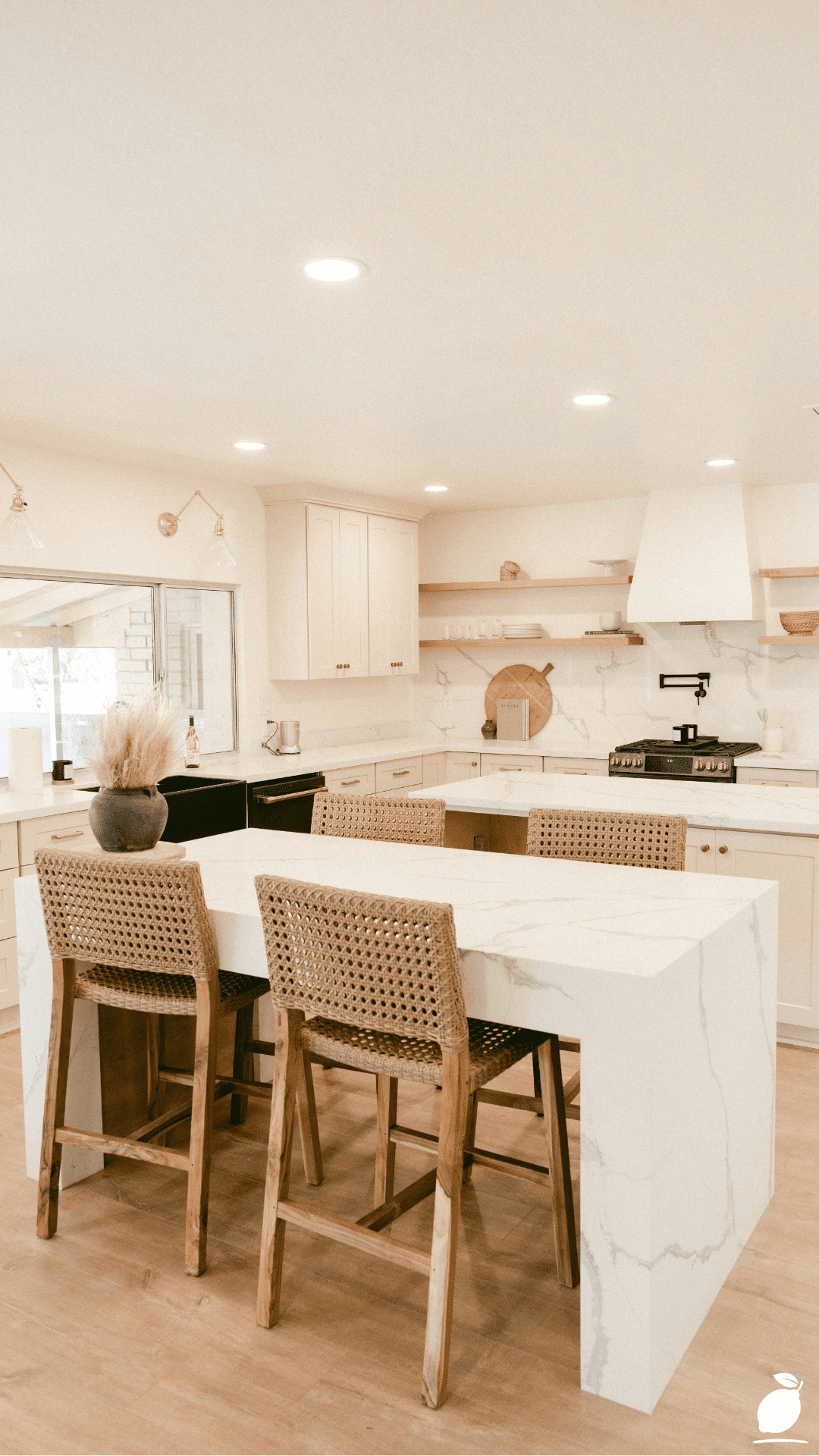
The single most transformative element in any boho kitchen is a natural wood surface that carries the irregular, organic character of the material it came from. In the image, the live-edge oak island countertop is this ick, warm-toned, with visible grain and a raw, unfinished outer edge, which is the room’s most powerful design statement. It is the element that immediately signals “boho kitchen” to anyone who walks in, because it is irreducibly natural and irreplaceable by any synthetic alternative. For your kitchen, the natural wood surface can take several forms depending on your budget and layout: a live-edge island or peninsula countertop, floating shelves in raw-edged wood, a butcher block counter section alongside standard countertops, or even a large wooden serving board permanently displayed as a countertop accent. Whatever form it takes, natural wood with visible character grain, knots, and raw edges is the foundational kitchen element that no amount of accessorizing can replace if it is absent.
Step 2 — Choose a Boho Kitchen Color Story Built on Contrast and Richness
The boho kitchen in the image operates on a color palette of controlled drama: matte black cabinetry, warm honey oak, white walls and subway tile, navy blue velvet, and a single pop of deep red glass. This is a kitchen palette that uses contrast black and white as the structural poles, warm wood as the organic bridge, and jewel tones as the expressive accent to create visual interest without chaos. For your boho kitchen color story, choose one dark structural tone (black, deep navy, forest green, or charcoal for cabinetry or island base), one warm natural wood tone, a white or cream for walls and backsplash, and one or two jewel-toned accents in textiles, glass, or ceramics. The restraint of four to five colors used with conviction is what separates a genuinely styled boho kitchen from a room that just has a lot of things in it.
Step 3 — Anchor the Boho Kitchen Social Zone with the Right Island Seating
Bar stools in a kitchen are not just functional seating; they are the most visible color and material accent in the room’s gathering zone. The navy blue velvet stools in the image introduce a richness of both color and texture that transforms the island from a work surface into a social destination. In your boho kitchen, choose stools that contribute to the palette deliberately: velvet, boucle, or woven fabric in a jewel tone (navy, emerald, terracotta, or mustard) on a slim black or brass metal frame reads authentically boho kitchen without tipping into excess. Avoid matching plastic or uniform metal stools; they remove the warmth and eclecticism that give a boho kitchen its character. Two stools in the same design but at a slight angle to each other, as in the image, create an inviting, casual asymmetry that is distinctly bohemian in spirit.
Step 4 — Build a Boho Kitchen Shelf Display That Functions as Wall Art
The two raw-edged floating shelves in the image are styled with an economy of objects that produces maximum impact: a smooth black sculptural head on the upper shelf, a large deep-red glass vase on the lower two shelves, entirely unlike each other, sharing enough visual confidence to make the whole wall feel curated. This is the boho kitchen shelf philosophy: treat open shelving as a gallery wall where every object earns its place through beauty, material interest, or personal significance. For your kitchen floating shelves, use raw-edged or live-edge wood brackets that echo the island countertop, and style each shelf with no more than three objects: one tall, one medium, one small in materials that include at least one glass, one ceramic, and one natural or sculptural form. The space between objects is not wasted space; it is the breathing room that makes a boho kitchen shelf read as intentional rather than crowded.
Step 5 — Introduce Boho Kitchen Greenery at Multiple Scales
The boho kitchen in the image layers greenery at two distinct scales: a small potted plant in a dark, slender vase on the white countertop near the window, and a lush bouquet of eucalyptus in a clear glass vase directly on the live-edge island. These are not afterthoughts; they are structural elements of the kitchen composition. The small countertop plant connects the kitchen to the natural light coming through the window, while the eucalyptus bouquet on the island brings organic softness right to the heart of the room’s social zone. For your boho kitchen, always include at least one plant that responds to the available natural light (pothos, a small herb pot, or a trailing philodendron near a window) and one fresh or dried botanical arrangement on the island or counter surface. Rotate the botanical arrangement seasonally to keep the boho kitchen feeling alive and responsive to time rather than static and staged.
Step 6 — Choose a Boho Kitchen Backsplash That Bridges Classic and Organic
The white subway tile backsplash in the boho kitchen image is a deliberate and sophisticated choice: it is a classic, timeless format that provides clean visual breathing room behind the matte black cabinetry and warm wood, while its slight texture and grout lines introduce the handcrafted quality that bohemian design values. In a boho kitchen, the backsplash should always bridge the classic and the organic. White or cream subway tile, zellige-style Moroccan tile in a natural glaze, handmade terracotta hex tile, or unlacquered white brick all work beautifully. Avoid highly uniform, large-format porcelain tile in a boho kitchen; its perfection reads as too contemporary and too sterile to support the warm, imperfect character that makes a kitchen feel genuinely alive.
Step 7 — Maximize Boho Kitchen Natural Light as a Design Element
The large window in the kitchen image is not incidental; it is one of the room’s most important design assets. The way it floods the white subway tile and honey oak countertop with warm outdoor light, frames a view of green trees and sky, and connects the kitchen interior to the living world outside is central to what makes the room feel like a boho kitchen rather than a merely modern one. For your boho kitchen, maximize any available natural light by keeping window treatments minimal or absent, using light-reflective white or cream for backsplash and walls, and positioning plants near windows so they bridge the interior and exterior visually. If your boho kitchen is poorly lit by natural sources, supplement with warm-toned pendant lights (2,700K bulbs, pendant shades in woven rattan or amber glass) that replicate the warmth of natural light without its directionality.
Expert Secrets for Success
Pro-Tips for a Better Result
Pro Tip 1 — Use One Sculptural Art Object in the Boho Kitchen. The black minimalist head sculpture on the boho kitchen shelf in the image is one of the most quietly powerful elements in the whole room. It signals that this boho kitchen is not afraid to treat itself as a living space worthy of art rather than a purely utilitarian food-preparation zone. In your boho kitchen, introduce one object that is unambiguously art, a sculptural ceramic, a small bronze form, a woven vessel too beautiful to use for storage on a shelf or countertop where it will be seen. This single choice elevates the entire boho kitchen from styled to genuinely designed.
Pro Tip 2 — Add a Jewel-Toned Glass Vase as a Boho Kitchen Signature The deep red glass vase on the kitchen shelf in the image accomplishes something that no matte ceramic or natural wood object could: it introduces translucent color and light interaction into a room that might otherwise read as purely warm and matte. In a boho kitchen, one piece of colored glass, a vase, a vessel, a pendant shade, adds a layer of visual richness that is distinctly bohemian in character. Choose your jewel tone based on the boho kitchen’s accent palette: deep red against black cabinetry, amber against natural wood, cobalt against white tile, or emerald against warm cream.
Pro Tip 3 — Keep the Boho Kitchen Island Surface Nearly Clear. The live-edge island in the image holds exactly two things: the eucalyptus bouquet and a small white ceramic bowl, nothing more. This restraint is not minimal by accident; it is what allows the live-edge wood grain to read as the island’s primary statement rather than being obscured by appliances, cutting boards, and accumulated daily objects. In your boho kitchen, designate the island as a display-plus-single-task surface: one botanical arrangement, one small decorative bowl, and everything else stored or moved to the counter perimeter. The beauty of the kitchen island surface depends on the space around each object.
Pro Tip 4 — Integrate Appliances into the Boho Kitchen Cabinetry When Possible. The integrated microwave in the matte black cabinetry of the boho kitchen image is a detail that many homeowners overlook, but that makes a significant difference to the room’s overall visual coherence. When appliances sit on countertops, they interrupt the boho kitchen’s styling surfaces and compete with the organic, curated elements that give the room its character. In your boho kitchen, integrate or conceal as many appliances as possible: a built-in microwave, a pantry with appliance storage, a drawer-style dishwasher, so that the surfaces visible in the room are those you have intentionally styled rather than those that simply need to be plugged in.
Common Mistakes to Avoid
Mistake 1 — Defaulting to Open Shelving Overload in the Boho Kitchen. The most common misconception about a boho kitchen is that it requires maximum open shelving displaying every dish, glass, and jar the kitchen contains. The image shows exactly two floating shelves holding exactly two objects each, and the restraint is precisely what makes them beautiful. A boho kitchen with too much open shelving and too many displayed objects reads as chaotic rather than curated. Limit open shelving in your boho kitchen to one or two dedicated display surfaces, keep the objects intentional and few, and use closed cabinetry for everything else.
Mistake 2 — Using Too Many Warm Wood Tones in the Boho Kitchen. Natural wood is essential to a boho kitchen, but when multiple wood tones compete across the island, the shelves, the floor, and the cabinetry simultaneously, the room loses the graphic clarity that makes the boho kitchen feel modern rather than rustic. In the image, one wood tone dominates: the warm honey oak of the live-edge island countertop. The floating shelves are in a related but slightly different natural wood, and the light-colored, wide-plank floor provides a quiet base. In your boho kitchen, choose one primary wood tone as your statement and keep supporting wood tones closely related or more neutral, so the boho kitchen reads as intentional rather than accidentally rustic.
Mistake 3 — Neglecting Seating as a Boho Kitchen Design Opportunity. Bar stools in a boho kitchen are treated by many homeowners as an afterthought, chosen for height and price rather than for their contribution to the room’s color and texture story. The navy blue velvet stools in the image are a statement piece that introduces the boho kitchen’s most expressive color in its most tactile material. Before choosing bar stools for your boho kitchen, decide what color and material gap they need to fill in the room’s palette, and then choose deliberately rather than defaulting to the least offensive available option. The right seating choice costs the same as the wrong one and transforms the entire boho kitchen.
Mistake 4 — Installing Cool or Blue-White Lighting in the Boho Kitchen. Cool LED lighting is one of the fastest ways to undermine the warmth that makes a boho kitchen feel cozy and inviting. The image’s kitchen is flooded with warm natural daylight that gives every surface, the honey oak, the white subway tile, and the navy velvet their most flattering and warm reading. In a boho kitchen, all artificial lighting should replicate this warmth: pendant lights over the island in warm-white bulbs (2,700K or lower), under-cabinet lighting in the same warm tone, and no cool or daylight-balanced bulbs anywhere in the room. A boho kitchen lit with cool lighting is a room whose palette is working against itself.
Why Boho Kitchen Matters
The kitchen is the most used and most communal room in most homes, the place where mornings begin, where meals take shape, where people gather without being asked, and stay longer than they planned. When a kitchen is purely functional and visually uninspiring, those daily rituals happen in a space that offers nothing back: you cook, you eat, you clean up, and the room remains indifferent to all of it. A boho kitchen changes that equation entirely. When the kitchen has genuine visual warmth, a live-edge wood surface that rewards being touched, a jewel-toned glass vase that catches the afternoon light, velvet bar stools that make staying at the island feel luxurious, the daily rituals of cooking and gathering become experiences rather than tasks.
For families, this shift is particularly significant. Children who grow up in a home where the kitchen is the most beautiful and personal room rather than the most purely utilitarian one develop a different relationship with cooking, with food, and with gathering. A boho kitchen with a styled island where homework gets done and morning coffee gets made slowly, and eucalyptus sits in a clear glass vase becoming the best version of itself, that is a kitchen that participates in family life rather than simply enabling it. The aesthetic investment in a boho kitchen returns daily, in small moments of sensory pleasure that accumulate into the texture of home as a genuinely loved place.
And for the person who cooks alone, there is something deeply restorative about a boho kitchen that has been styled with care. Cooking in a beautiful space where the countertops are worth keeping clear, where the light is warm enough to make the act of chopping vegetables feel almost meditative, where a single vase of eucalyptus makes the room smell like the outdoors, is a different experience from cooking in a room that was designed to store appliances and resist stains. A boho kitchen is an investment in the quality of your daily experience, in the twenty or thirty minutes every day when you are standing at a counter feeding yourself and the people you love. Those minutes deserve a beautiful room. A boho kitchen gives them one.
Frequently Asked Questions
What defines a boho kitchen aesthetic?
A boho kitchen is defined by the integration of natural materials, live-edge wood, raw-edged shelving, organic stone, woven textiles with expressive color in jewel tones, a layered and eclectic collection of meaningful objects, and an overall sense of warmth and personal character that distinguishes it from purely modern or minimalist kitchens. A boho kitchen is never anonymous; it reflects the specific tastes, travels, and sensibilities of the person who created it. Key boho kitchen signatures include natural wood countertop surfaces, velvet or woven bar stool upholstery, open shelving styled as display rather than storage, colored glass or ceramic accents, abundant greenery, and warm, natural, or warm-toned artificial lighting.
What colors work best in a boho kitchen?
The most successful boho kitchen palettes combine a neutral structural base (white walls, cream subway tile, or light-colored wood floors) with a dark grounding tone for cabinetry or island base (matte black, deep navy, forest green, or charcoal), a warm natural wood surface as the organic bridge, and one or two jewel-toned accents in textiles and decorative objects. Common boho kitchen jewel tones include deep red, cobalt blue, emerald green, amber, and rich terracotta. The key boho kitchen color principle is contrast between the neutral base and the rich accent, with natural wood as the material that bridges them without competing with either.
How do I add a boho kitchen feel without a full renovation?
The most impactful no-renovation boho kitchen upgrades are: replacing standard countertop accessories with a live-edge wood cutting board or butcher block section, adding raw-edged floating shelves and styling them with two or three curated objects, swapping existing bar stools for a velvet or woven upholstered version in a jewel tone, adding a large eucalyptus or botanical bouquet in a glass vase on the island or counter, and switching overhead bulbs to warm-white equivalents. These five kitchen changes can transform the feel of a kitchen without touching a single cabinet or tile, and most can be completed over a single weekend for a modest budget.
What kind of plants work best in a boho kitchen?
A boho kitchen benefits from plants at two scales: one or two small countertop or windowsill plants in dark ceramic or glass vases (pothos, small herb pots, a trailing philodendron, or a compact succulent arrangement), and one or two fresh or dried botanical bouquets in clear glass or ceramic vases on the island or counter surface. Eucalyptus is a particularly excellent kitchen botanical because it is long-lasting, fragrant, visually graceful, and available at most grocery stores. For windowsill kitchen plants, choose species that thrive in the specific light your kitchen receives. Low-light varieties like pothos and snake plants for north-facing kitchens, and herbs and succulents for south- or east-facing windows.
Can a boho kitchen work with dark cabinetry?
Absolutely, and the image above is direct proof. Matte black cabinetry in a boho kitchen works exceptionally well when it is balanced by three elements: a warm, natural wood surface that prevents the dark tones from reading as cold, white or light-colored walls and backsplash that reflect light and create visual breathing room, and jewel-toned accents in textiles and glass that introduce the bohemian warmth. A kitchen with dark cabinetry and warm natural wood is actually more sophisticated and more distinctly boho kitchen in character than an all-white kitchen with bohemian accessories, because the contrast gives the room dramatic presence while the organic materials and eclectic objects give it warmth and soul.