The spare room had been collecting intentions for two years. A treadmill in the corner that had achieved the universal fate of treadmills in spare rooms. Boxes from the last move that had been living there temporarily since the beginning of the current mortgage. A folding table pushed against one wall, holding the specific combination of objects that accumulate in rooms without a defined purpose: a printer, a lamp without a shade, a box of cables that might be important.
I had told myself the room would become a home office, then a guest room, then a home gym, and finally arrived at the honest admission that what I actually wanted was a room for myself, a room that was mine in the specific way that no shared space in the house could be. A place to read late, to watch something without headphones, to have a drink at the end of a long week in a room that communicated something about the person who had made it. Man cave ideas felt, at first, like a category that belonged to other people, people with finished basements and sports memorabilia collections and the kind of confidence to hang a vintage movie poster on a wall and mean it.
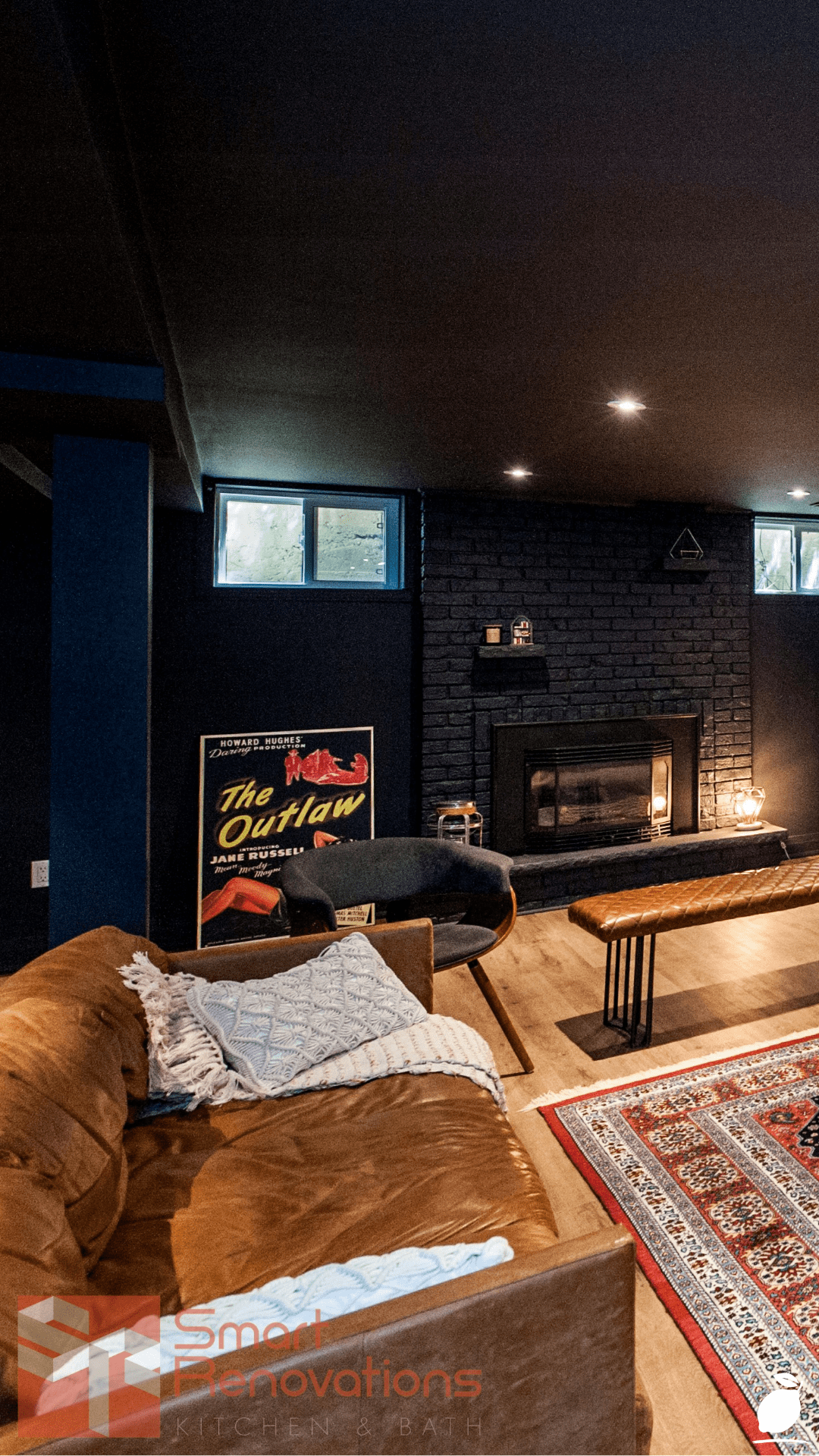
The room in the image above is what man cave ideas look like when they are executed with the specific combination of darkness and warmth that makes a room genuinely moody rather than simply dark. Navy blue walls rising to a black ceiling with recessed LED lighting that creates warm pools of illumination rather than flat overhead brightness. A black brick fireplace with a wooden mantel flanked by two modern wooden benches, the kind of furniture that communicates that sitting here is a choice rather than a default. A brown leather couch with white throw pillows anchored in the left corner by a tall floor lamp with a rectangular shade.
At the room’s center, an oriental rug in red, black, and cream patterns under a circular black metal and wood coffee table with multiple tiers, the kind of coffee table that holds a book, a glass, and a remote without any of them competing for space. Built-in wooden shelving fills the right wall with books of various colors that together produce more atmosphere than any art collection at the same scale. The vintage-style movie poster for “The Outlaw” on the wall near the fireplace is making a personal declaration rather than a decorating decision. This man cave idea is not assembled from a trend board. It is built from specific preferences, specific objects, specific darkness, and it works because every element has been allowed to be itself rather than calibrated to a safe middle ground.
The man cave ideas I used to transform my spare room into the moody, atmospheric space I had been circling for two years came together faster than I expected once I stopped treating the project as a home décor exercise and started treating it as a self-expression one. The question that unlocked every man cave idea in this guide is not “what should a man cave look like?” but “what do I actually want to feel when I close that door?” For me, the answer was: enclosed, warm, surrounded by things that mean something, in a room that has no ambiguity about what it is. These man cave ideas deliver that answer in a specific, achievable sequence. If you have a room waiting to become yours, this is the guide that gets you there.
The Man Cave Ideas Blueprint
Step 1: Claim the Room and Clear It Completely
The first man cave idea is the one that costs nothing and requires only the decision that the room is now yours, a real decision, communicated to everyone who shares the house, with whatever negotiation that requires. Man cave ideas that are applied to rooms that are still nominally general-purpose storage spaces, or that are technically available for other uses, never fully become man caves because the ambiguity of the room’s purpose prevents the full commitment of investment and identity that makes a man cave idea work. The room in the image has no ambiguity about what it is. The navy walls, the black ceiling, the leather couch, the vintage poster, these are declarations that the room belongs to someone specific and is not available for general use.
Once the room is claimed, clear it entirely. Remove every object that does not belong to the man cave idea you are building, every box, every piece of exercise equipment that is not part of the plan, every cable, every temporary item that has found permanent residence in the room’s undefined state. Photograph the empty room from each corner and from the center. The empty room reveals the space’s actual assets and constraints: the ceiling height that will determine whether a black ceiling feels atmospheric or oppressive, the natural light sources that will need to be supplemented or managed, and the wall lengths that will determine the placement of the room’s primary man cave idea furniture pieces.
This cleared-room assessment is where every great man cave idea begins in the honest confrontation with a specific space that has specific dimensions, specific light, specific structural features, and specific limitations. The man cave idea that works in the room you actually have is always better than the man cave idea designed for the room you wish you had.
Step 2: Paint the Man Cave Walls in a Deep, Atmospheric Color
Wall color is the man cave idea with the highest single impact on the room’s atmospheric quality and the lowest cost relative to that impact. The navy blue walls in the image transform the room’s character at the most fundamental level; they make every object placed against them read as a deliberate element in a designed space rather than furniture arranged in a painted room. Dark, saturated wall colors in a man cave idea context perform three specific functions: they absorb the room’s ambient light and redistribute it as warm, directional illumination from the lamps and fireplace; they make the room feel enclosed and sheltered in the specific way that a man cave idea requires; and they provide a palette field against which wood, leather, and warm metal accents read with unusual clarity and warmth.
For man cave ideas in the navy and dark palette family, the most consistently successful wall colors are: Benjamin Moore’s Hale Navy (HC-154) for a deep, slightly warm navy with excellent undertone stability across lighting conditions; Sherwin-Williams Anchors Aweigh (SW 9179) for a slightly lighter navy that reads more blue than gray; Farrow & Ball’s Hague Blue (No. 30) for the richest, most complex navy with strong green undertones that change beautifully in warm light; and Benjamin Moore’s Newburyport Blue (HC-155) for man cave ideas that want navy with a slightly brighter, more saturated character. Test physical samples on all four walls before committing to man cave ideas, as dark wall colors are particularly affected by the room’s specific light sources, and the difference between a navy that reads as rich and complex and one that reads as flat and cold is often determined by the room’s light conditions rather than the paint formula.
Apply the man cave idea wall color all the way to the ceiling line rather than stopping at a chair rail or wainscoting division. The full-height color application creates the enveloping atmospheric quality that man cave ideas require and prevents the room from reading as a wall treatment applied over a neutral room.
Step 3: Paint the Man Cave Ceiling Black for Maximum Atmospheric Effect
The black ceiling in the image is the man cave idea that most dramatically differentiates a moody, atmospheric room from a simply dark-walled one. A black ceiling in a man cave idea context performs two visual functions: it lowers the perceived ceiling height, which creates the enclosed, sheltered quality that the man cave’s atmosphere requires rooms that feel smaller in dimension feel more intimate in character and it creates a visual boundary at the top of the room that makes the navy walls read as a fully enclosed dark field rather than a dark surround with a contrasting white lid above.
For man cave ideas where the actual ceiling height is below 240cm, assess whether the black ceiling will feel claustrophobic before committing to a ceiling below 240cm painted black in an already-enclosed man cave idea space can feel oppressive rather than atmospheric. For rooms at or above 240cm, black ceiling paint consistently produces the atmospheric result the image demonstrates. Use a flat or ultra-matte black ceiling paint, not semi-gloss or satin, which produces unwanted light reflection at ceiling level that undermines the dark, receding quality the black ceiling needs to achieve.
Install recessed LED lighting as the man cave idea’s primary ceiling-level light source, positioned to cast warm pools of light downward rather than diffuse ambient light upward. Recessed LEDs in a black ceiling become visible as pinpoints of warm light rather than as ceiling-mounted hardware, which preserves the black ceiling’s receding quality while providing functional illumination. Use warm-white bulbs at 2700K to 3000K in every recessed fixture. Cool-white bulbs will shift the navy wall color toward an undesirable blue-gray and undermine the leather and wood accents’ warmth.
Step 4: Build the Man Cave’s Seating Layer Around Leather and Warmth
The brown leather couch in the image is the man cave idea’s most important single furniture investment, the piece that most immediately communicates the room’s character and most directly determines whether the man cave idea will be used daily or merely admired. Leather in a man cave idea context is not a stylistic choice but a functional one: leather upholstery develops patina with use, aging into the room’s character rather than deteriorating from it; it is durable under the conditions of heavy daily use that a man cave seating piece experiences; and its warm brown tone against navy walls produces the specific contrast that makes the man cave idea’s palette feel resolved rather than monochromatic.
For man cave ideas at various investment levels, full leather sofas in dark brown, cognac, or warm tan are the highest-quality option and the most durable over a decade of use. Top-grain or full-grain leather ages best; bonded leather or faux leather provides the initial visual quality of leather without the durability, and is not recommended for a man cave idea seating piece that will be the room’s most-used surface. If a full leather investment is not in the current budget, a leather armchair in the corner combined with a fabric sofa provides the man cave idea’s leather material quality at the accent level while keeping the primary seating cost accessible.
Position the man cave seating to face both the fireplace and the primary entertainment source in the image. The leather couch faces the fireplace in the left corner, with the two wooden benches creating additional seating that can orient toward either the fireplace or the room’s center. The man cave idea seating arrangement should always prioritize the fire as its focal point, as this is the atmospheric element that most directly produces the warm, enclosed quality the man cave requires.
Step 5: Install the Man Cave’s Built-In Shelving as Personality Architecture
The built-in wooden shelving filling the right wall in the image is the man cave idea that most transforms the room from a decorated space into a personal one. Shelving in a man cave idea context is not primarily storage; it is the room’s autobiography, the surface on which the occupant’s specific interests, collections, and accumulated objects are displayed in a way that communicates, to anyone who enters the room, the specific person who made this space. The books of various colors on the image’s shelving produce more atmospheric richness than any art collection at equivalent scale, because their variety and their specific titles communicate genuine intellectual engagement rather than decorative intent.
For man cave ideas where built-in shelving is a project goal, the most accessible DIY approach uses plywood or MDF shelving units painted or stained to match the room’s wood tone, installed as floor-to-ceiling units against the primary non-fireplace wall. Floating shelves in a consistent finish at varied heights are an alternative man cave idea for rooms where built-in cabinetry is beyond the current project scope. Whatever shelving approach the man cave idea uses, fill it with genuine objects from the occupant’s actual life, books that have been read, objects that mean something, collections that have accumulated over the years, rather than objects purchased specifically for display. The man cave shelving that looks authentic is authentic.
Include the man cave idea’s personal statement objects at the most visible shelf positions: the vintage movie poster in the image is mounted on the wall near the fireplace, claiming the room’s most prominent non-shelving wall surface for a specific personal reference. Man cave ideas that include one clearly personal statement piece, a framed poster, a specific artwork, a displayed object of genuine meaning, produce a room that feels inhabited and specific rather than atmospherically designed but personally anonymous.
Step 6: Layer the Man Cave’s Floor and Lighting for Warmth and Depth
The hardwood flooring and oriental rug combination in the image completes the man cave idea’s material palette from the floor up: the warm honey hardwood grounds the dark walls and ceiling with organic warmth, and the oriental rug in red, black, and cream defines the seating zone while introducing the pattern complexity and warm color accent that the man cave idea’s otherwise restrained palette benefits from. The combination of hardwood and rug is the man cave idea floor approach that most consistently delivers both the practical warmth of soft flooring underfoot and the visual warmth of a patterned, color-rich textile at the room’s center.
For man cave ideas where the existing floor is not hardwood carpet, tile, or laminate, a large-format oriental or Persian-style rug placed over the existing flooring provides the man cave idea’s warm floor register at the seating zone without requiring floor replacement. Choose a rug with a dark ground color and warm accent tones (the image’s black ground with red and cream patterns) that relates to the dark navy wall color rather than contrasting with it. A light-ground rug in a dark-walled man cave idea creates a visual disconnect that prevents the room from reading as a unified composition.
The floor lamp with a rectangular shade in the image’s corner completes the man cave lighting layer that the ceiling recessed LEDs begin as a warm, directional secondary light source at seated eye level that creates the intimate pool-of-light quality that atmospheric rooms require. Add at least one floor lamp or table lamp at seated eye level for every seating position in the man cave idea, using warm-white bulbs throughout, and the room will feel genuinely atmospheric at every hour of the day rather than only when the fire is lit.
Expert Secrets for Success
Pro-Tips for a Better Result
Apply the dark man cave wall color before installing any flooring or built-in shelving. The sequence of installation in a man cave idea project matters as much as the individual choices. Dark paint applied after hardwood flooring installation requires precise edge masking at the baseboard line and risks paint drips on the finished floor surface. Paint all man cave walls and ceiling first, allow to cure for 48 hours, install flooring second, and build or install shelving against the painted walls last. This sequence also allows the paint’s true appearance in the room’s light to be assessed before the flooring and furniture investment is made, providing a final opportunity to adjust the man cave idea wall color before the room is committed.
Use a leather conditioner on the man cave couch twice annually to maintain patina and prevent cracking. Brown leather furniture in a man cave idea context is specifically valued for the patina it develops over years of use, the softening, darkening, and character accumulation that makes leather furniture look more itself rather than less as it ages. This patina development requires the leather to remain supple rather than drying out under the low-humidity conditions that a heated room with a fireplace creates. Apply a quality leather conditioner twice per year, in the spring and autumn, to all leather surfaces in the man cave, and the leather sofa will be visibly better at year ten than it was at year one.
Install the oriental rug with a non-slip rug pad cut to match the rug’s dimensions. The oriental rug in the image is the man cave idea’s most visually complex single element, and its most practically vulnerable. A rug on hardwood flooring without a pad will shift with foot traffic, bunch at the edges, and create a trip hazard at the fireplace hearth that undermines the man cave’s functionality as a daily-use room. A quality felt-and-rubber rug pad adds no visible element to the man cave idea and prevents every rug-movement problem the room’s daily use creates.
Mount the man cave’s statement artwork or poster at seated eye level rather than standing eye level. The vintage movie poster in the image is mounted at a height that is seen from both standing and seated positions, but the primary viewing position in a man cave idea is seated, and artwork mounted at standing eye level (typically 150cm to 165cm to the center) reads as too high when viewed from a sofa or armchair. Mount the man cave idea’s primary wall art at 125cm to 135cm from the floor to the artwork’s center, the height that reads correctly from a seated position and still reads well from standing.
Common Mistakes to Avoid
Don’t use cool-white LED bulbs in a man cave with dark walls and warm materials. The man cave idea’s atmospheric quality depends entirely on the specific warmth of its lighting, the way warm-white light interacts with navy walls, leather upholstery, and warm wood to produce the amber, firelit quality that the image demonstrates. Cool-white bulbs (4000K and above) in the same room produce a completely different result: the navy walls read as cold blue-gray, the leather reads as orange against a cool field, and the room loses the moody warmth that makes the man cave idea work. Use only warm-white bulbs at 2700K to 3000K in every fixture in the man cave idea, without exception.
Don’t fill the man cave shelving with purchased decorative objects rather than personal ones. Man cave ideas that produce rooms that feel genuinely personal rather than atmospherically staged always fill their shelving with objects that have been accumulated rather than curated books that have been read, objects that have specific provenance, collections that represent genuine interest. Purchased decorative objects placed on man cave shelving to fill space, producing a room that looks like a showroom version of a man cave idea rather than an actual one. Empty shelf space is always preferable to space filled with objects that have no relationship to the occupant.
Don’t apply black ceiling paint in a man cave with a ceiling height below 240cm without testing the effect first. Black ceiling paint in a room with insufficient ceiling height produces claustrophobia rather than atmosphere, the enclosed, oppressive quality of a space that is too low and too dark simultaneously. Test the effect by hanging large sheets of black craft paper or black fabric from the ceiling and observing the room’s quality at that ceiling level before committing paint to the surface. If the test reveals a ceiling that feels too low, consider a very dark charcoal rather than true black, or apply the dark color to three walls and leave the ceiling in a dark navy that matches the walls without going to black.
Don’t position man cave seating against the walls; rather than into the room. The brown leather couch in the image is positioned in the corner, not pushed flat against the wall, which creates the visual separation between the sofa and the wall that allows both to be perceived as distinct elements. Sofas pushed directly against walls in a man cave idea produce the impermanent, temporary quality of furniture that has been placed where it fits rather than where it belongs. Pull all man cave seating at least 20cm from the walls, angle pieces toward the fireplace focal point, and the room immediately reads as arranged rather than stored.
Why Man Cave Ideas Matter
The man cave has been dismissed in popular culture as a retreat from responsibility, a room for avoidance, for the immaturity of wanting a space that does not have to accommodate anyone else’s preferences. This dismissal misses something important: the need for a space that is specifically, unambiguously yours is not immaturity. It is the acknowledgment that people who share their homes, their time, and their daily energy with others need somewhere to restore the sense of personal identity that constant accommodation gradually erodes. A man cave idea executed well is not a room for avoiding the family. It is a room that makes returning to the family possible at full capacity, a genuine restoration space rather than a collapse space, built with enough intention to actually work as a psychological refuge rather than simply serving as a room where a person is alone.
Research in environmental psychology has documented the specific psychological function of personal spaces within shared domestic environments, the degree to which having access to a space that is unambiguously one’s own reduces ambient household stress, and increases the quality of shared-space engagement that follows time spent in personal space. The man cave idea, executed with the intentionality demonstrated in the image above, is that personal space at its most functional: a room with dark walls that shut out the visual complexity of the shared house, warm light that supports the nervous system’s evening down-regulation, leather and wood surfaces that age with the person who occupies them, and shelving filled with the specific objects of a specific person’s interior life. This is what man cave ideas look like when they are taken seriously as design and as psychology simultaneously.
Easy Peasy Life Matters is built on the conviction that every person in a household deserves at least one space that belongs to them specifically and that the creation of that space through man cave ideas is an act of genuine household investment rather than domestic indulgence. The room in the image is proof of what that investment produces: a moody, warm, completely personal space that gives back, in daily quality of restoration and identity, everything that went into building it and considerably more. These man cave ideas are how that room gets built in yours.
Frequently Asked Questions
What are the best colors for a moody man cave?
The most effective man cave idea color palettes for a moody, atmospheric result are built on deep, warm-spectrum darks: navy blue (the image’s primary choice and the most versatile man cave idea wall color for warm material pairings), forest green with brown undertones (for man cave ideas with more natural or hunting-lodge character), deep burgundy or wine (for man cave ideas with a more traditionally masculine, library-adjacent atmosphere), and warm charcoal with brown undertones (for man cave ideas where navy feels too blue or too bright). All of these man cave idea wall colors work in combination with black ceilings, warm wood flooring, and leather upholstery, the palette relationship that produces the moody man cave quality, the image demonstrates.
How do I soundproof a man cave without major renovation?
Man cave ideas for acoustic improvement without structural work include: acoustic panels covered in fabric that matches or complements the man cave idea wall color (mounted on the wall behind the primary seating position where sound reflection is greatest), heavy curtains on any windows (mass-loaded fabric absorbs sound transmission through glazing), a large-format area rug over the entire floor area (the single most effective surface-level sound absorption improvement available in a man cave idea), and a bookshelf filled with books (books are among the most effective acoustic diffusers available and are already present in the image’s man cave). Together, these man cave ideas can reduce ambient noise and room echo by 30 to 50 percent without any permanent structural modification.
What is the best flooring for a man cave idea?
Warm honey hardwood, as in the image, is the most atmospherically effective man cave idea floor choice because its warm tone contrasts with dark walls in the specific way that grounds the room’s palette, and because its surface reflects the warm lamp and firelight in a way that cold-toned or patterned flooring cannot. Engineered hardwood in a honey or medium-brown oak finish provides the visual quality of solid hardwood at greater moisture stability, which matters for man cave ideas in basement spaces where humidity fluctuates. For man cave ideas where flooring replacement is not currently in scope, a large-format dark-ground oriental or Persian rug over the existing floor provides the man cave idea’s warm, patterned floor register at the seating zone without permanent installation.
How do I incorporate a home bar into man cave ideas?
Man cave ideas that include a home bar work best when the bar element is integrated into the room’s built-in shelving wall rather than occupying a separate piece of freestanding furniture. A dedicated shelf section at counter height, fitted with a small wine refrigerator or beverage cooler below and open shelving for glasses and bottles above, occupies the same wall as the man cave’s book shelving and reads as an intentionally integrated element rather than an addition. For man cave ideas in larger rooms, a dedicated bar cart in a warm metal finish, bronze, brass, or matte black, positioned near the fireplace seating area, provides the bar function without requiring built-in installation.
How long does a man cave idea transformation take from start to finish?
A standard single-room man cave idea transformation wall painting, ceiling painting, flooring installation, shelving installation, and furnishing typically takes two to three weekends of active work. The critical path is paint first (walls and ceiling, allowing 48 hours full cure between coats), flooring second (one weekend for professional installation or two for DIY), shelving third (one day for floating shelves, one weekend for floor-to-ceiling built-in units), and furnishing last. The leather sofa, rug, coffee table, and accessories that complete the man cave idea can be installed in a single afternoon once the structural elements are complete. The man cave idea project that respects this sequence structure before surface, surface before accessories consistently produces better results than projects that attempt to work on all layers simultaneously.