The mirror closet doors were there when you moved in. They were there when you repainted the bedroom. They were there when you changed the bedding, the curtains, the rug, and the nightstands in an attempt to make the room feel like a space you had chosen rather than inherited. And they remain: a full wall of reflective glass that multiplies the room’s apparent size and illuminates every angle qualities that should feel like assets and somehow, in this particular bedroom, in this particular configuration, feel like the room is watching you rather than welcoming you. Mirror closet doors are one of the most consistent aesthetic frustrations in modern bedrooms: installed for their light-amplifying, space-expanding functionality, experienced as the one element that keeps the room from feeling finished, warm, or genuinely personal.
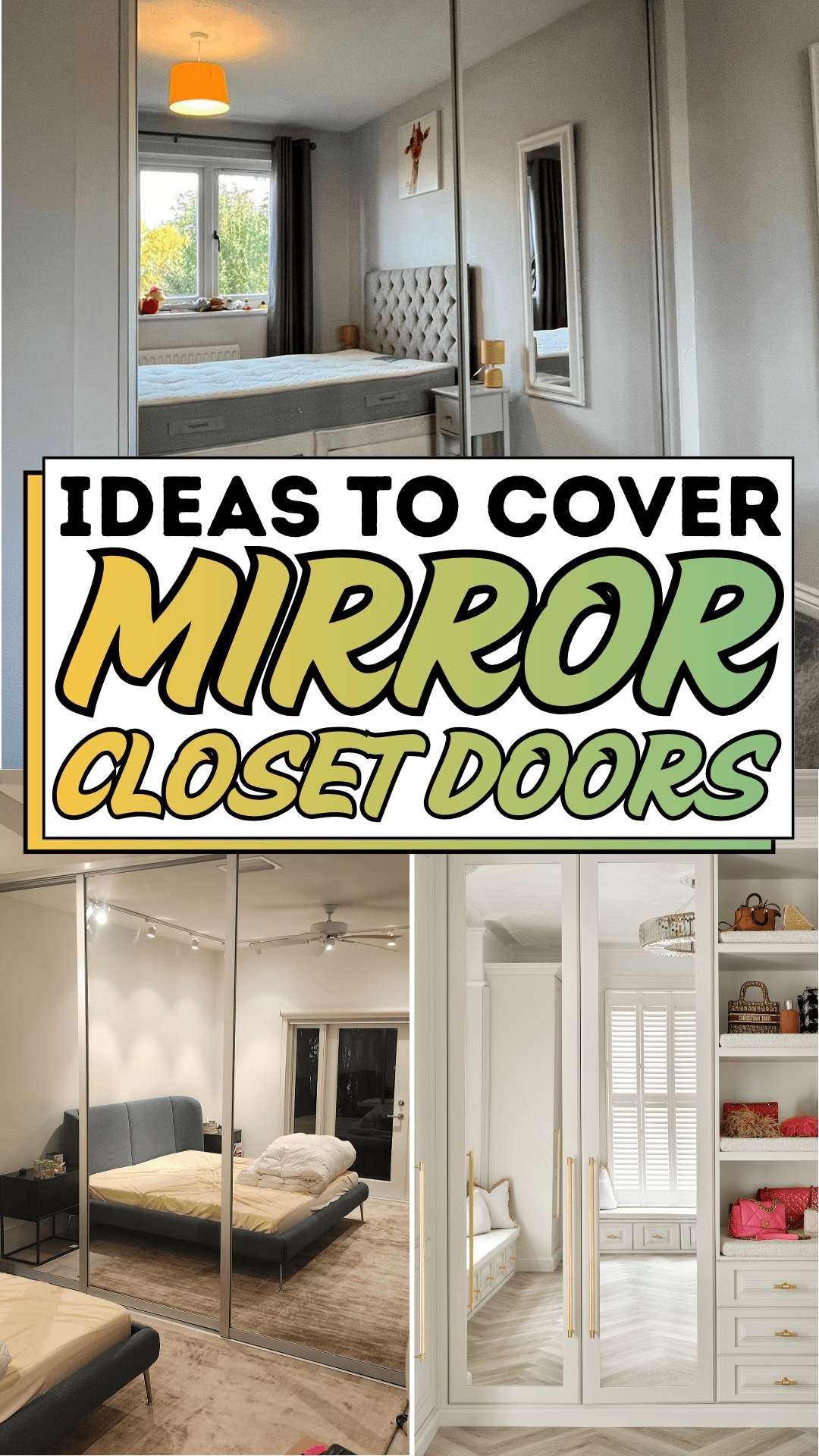
The bedroom in the image above shows mirror closet doors handled correctly, not removed, not fought against, but integrated. The large mirrored wardrobe door reflects the bed’s grey headboard, the white bedding, the dark curtains, the orange pendant light, and the yellow bedside lamp, and the reflection of all of these elements makes the mirror closet doors part of the room’s visual composition rather than an interruption of it. The room around the mirror closet doors has been designed with the reflection in mind; the colors work in the mirror as well as on the walls, the light sources create warmth in both the real space and the reflected one, and the smaller mirror on the adjacent wall creates a considered relationship with the mirror closet rather than competing with it. The mirror closet doors haven’t been covered. The room has been designed to include them, and the result is a bedroom that feels complete.
This guide addresses both options: the fully integrated approach of designing the room around existing mirror closet doors, and the covering approaches that transform the reflective surface into something else entirely. Not every mirror closet situation is right for integration, and not every household wants to live with a full-wall mirror regardless of how well the room around it is designed. The ideas in this guide give you the complete range of solutions, from the removable and rental-appropriate to the structural and permanent, so that whatever your mirror closet situation and whatever your commitment level to the project, you have a clear path forward.
The Mirror Closet Blueprint
Step 1: Assess Your Mirror Closet Doors and Decide on the Approach
The first step in any mirror closet doors project is an honest assessment of the specific doors: their dimensions, their construction, their mounting system, and their current condition, because the appropriate covering or transformation approach depends on the physical reality of the doors rather than on abstract preference.
Measure the mirror closet doors precisely: the full height and width of each panel, the gap between the floor and the door’s bottom edge, and the projection of the track system from the wall surface. These measurements determine which covering approaches are physically viable and what quantities of any covering material will be required.
Assess the mirror closet door’s construction: are the mirrors adhered to a solid backing panel, or are they free-standing glass panels in a metal frame? Solid-backing mirror doors can accept adhesive films, fabric adhesive, and similar surface treatments directly. Free-standing glass panels in metal frames require non-adhesive covering approaches, such as curtains, panels hung from above, or freestanding screens positioned in front, to avoid any risk of damaging the glass or the adhesive system holding it in the frame.
Assess the mirror closet track system: top-hung or bottom-tracked sliding doors have different clearance requirements above and below that affect what curtain or panel covering approaches are accessible. A top-hung mirror closet door system that operates from a track at ceiling height cannot accommodate a curtain rod mounted above it; a bottom-tracked system that requires clear floor access cannot accommodate a draped curtain that pools on the floor.
Determine your commitment level: are these mirror closet doors permanent fixtures you are confident will remain for the foreseeable future (supporting a structural or semi-permanent approach), or are they rental apartment fixtures or doors you may wish to restore to their original condition (supporting a reversible, non-adhesive approach)?
Step 2: Use Removable Adhesive Film for a Quick Mirror Closet Transformation
For mirror closet doors in rental properties, for households wanting a reversible transformation, or for anyone wanting to test a new aesthetic before committing to a more substantial project, removable adhesive film is the most accessible and most immediately effective mirror closet covering option available.
Frosted adhesive film applied to mirror closet doors transforms the reflective surface into a translucent, frosted glass appearance, the same finish used in bathroom privacy applications that allows light to pass through while eliminating the mirror’s reflective properties. The bedroom no longer has a mirror wall; it has a frosted glass feature that reads as architecturally intentional rather than builder-standard. Frosted film is available in plain frosted white, etched frosted patterns, and colored frosted finishes that can coordinate with the bedroom’s palette.
Opaque printed film on mirror closet doors allows any pattern, color, or even photographic imagery to be applied to the mirror’s surface, completely replacing the reflective quality with a printed surface that reads as wallpaper, artwork, or decorative panel. This is the most dramatic transformation available through the adhesive film approach: a botanical print, a geometric repeat, a woodgrain simulation, and it is entirely reversible when the film is removed.
Application technique for any adhesive film on mirror closet doors: clean the mirror surface thoroughly with isopropyl alcohol and allow it to dry completely. Cut the film to the exact door dimensions, leaving a 5mm margin. Apply the film using the wet application method, spraying the mirror surface and the film’s adhesive side with a dilute soapy water solution, positioning the film, and squeegeeing all air bubbles toward the edges from the center. The wet application method allows repositioning and significantly reduces the bubble formation that makes dry application of large-format films difficult.
Step 3: Hang Curtains or Fabric Panels to Cover Mirror Closet Doors
The most versatile, most adjustable, and most dramatically transformative approach to covering mirror closet doors is floor-to-ceiling curtains or fabric panels that hang in front of the doors, replacing the mirror’s visual presence with fabric texture, color, and the soft, residential quality that fabric brings to a bedroom better than almost any other single element.
For a mirror closet that runs along a full bedroom wall, floor-to-ceiling curtains hung from a ceiling-mounted track or from a tension rod fitted between the side walls create the effect of a fabric feature wall, a design element that is far more intentional-looking than either the original mirror closet or a curtain rod mounted at standard height. The ceiling-mounted track approach produces the most seamless and most architecturally integrated result; the tension rod approach is the most rental-friendly.
Fabric selection for mirror closet curtains is the decision that most directly determines the room’s overall character after the covering. Linen in natural, cream, or grey tones creates the relaxed, contemporary bedroom quality most appropriate for the grey and white palette visible in the featured image. Velvet in a deep color, such as burgundy, navy, or forest green, creates a dramatically cocooning bedroom atmosphere. Sheer voile allows light to pass through while softening the mirror’s reflective quality. Choose the fabric based on the room’s existing palette and the quality of light in the bedroom; heavier fabrics absorb more light and require well-lit rooms; sheers work in both light and low-light bedrooms.
Hem the curtains to exactly floor length; curtains that gap between their hem and the floor read as incorrectly sized; curtains that pool dramatically on the floor read as too long. The precisely floor-length curtain in front of a mirror closet reads as designed rather than improvised.
Step 4: Apply Barn Door Panels or Decorative Overlays to Mirror Closet Doors
For a more structural transformation that changes the mirror closet doors’ appearance without removing or replacing them, applying barn door panels or decorative wood overlays to the existing mirror closet door surface creates the look of custom-built wardrobe doors while preserving the original door’s functionality.
Lightweight MDF or plywood panels, painted or stained to the desired finish, can be adhered directly to the face of solid-backing mirror closet doors using mirror adhesive or construction adhesive, transforming the reflective surface into a painted panel that reads as a built-in wardrobe. This approach is most appropriate for mirror closet doors that will not be sold as a separate item and for doors in owned rather than rented properties. The panels add minimal weight to the door and don’t typically affect the sliding mechanism when cut to the precise door dimensions and applied without protruding beyond the door frame.
For a less permanent decorative overlay approach, apply board and batten trim to the mirror closet door surface using removable mounting strips, creating the visual impression of a board and batten paneled wardrobe door without any permanent adhesive on the mirror surface. The board and batten trim (thin strips of MDF in a vertical pattern) is mounted using heavy-duty removable adhesive strips, painted in a coordinating color, and reads from a normal room distance as custom-built wardrobe paneling.
Step 5: Use Artwork, Wallpaper Panels, or Tapestries for Mirror Closet Door Covering
For mirror closet doors where a decorative rather than functional covering approach is preferred, artwork panels, framed wallpaper sections, or large-format textile hangings create the most personalised and most visually interesting transformation of a mirror closet wall.
Large-format artwork prints mounted in frames sized to match the mirror closet door panels one piece of art per door, all at the same height create a gallery-wall quality across the full wardrobe wall that transforms the mirror closet from a functional storage element into the bedroom’s primary decorative feature. Choose artwork in coordinating colors rather than identical subjects; the unity comes from the scale and the framing rather than from the imagery.
Wallpaper panels: individual drops of wallpaper cut to the door height, applied to a thin board backing and mounted with adhesive strips, create a patterned feature wall across the mirror closet that reads as seamlessly designed as standard wallpaper at a fraction of the installation complexity.
Oversized woven tapestries hung from a curtain rod above each mirror closet door panel cover the mirror completely while adding the specific warmth and organic texture that no other covering approach provides. This is the most bohemian and the most globally-influenced of the mirror closet covering approaches and the one most appropriate for bedrooms with an eclectic, layered, or artistic aesthetic direction.
Expert Secrets for Success
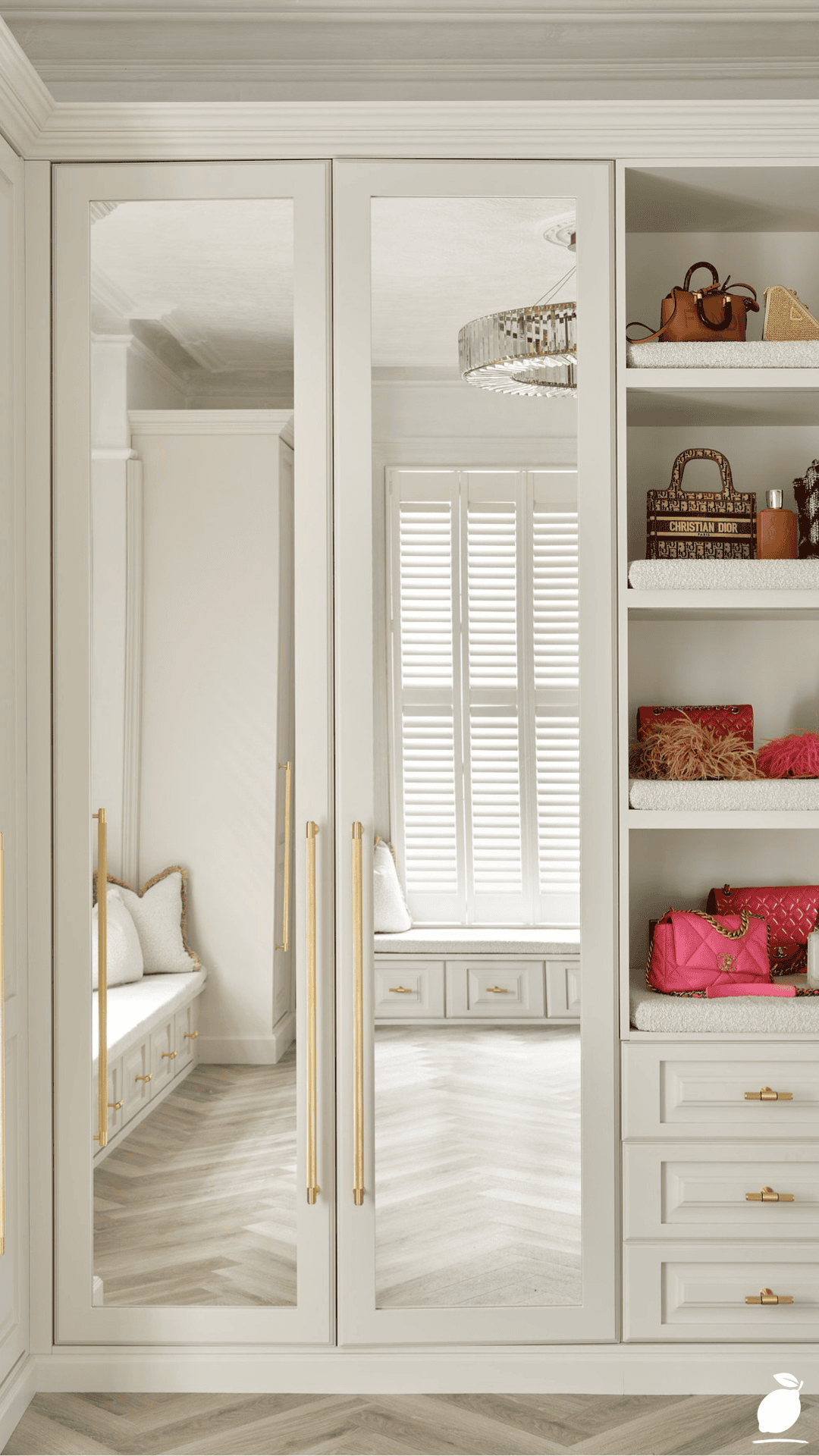
Pro-Tips for a Better Result
Match the covering choice to the room’s visual weight. A bedroom with existing heavy furniture and dark tones benefits from a mirror closet covering that is lighter and more reflective, such as frosted film or sheer curtains, to maintain the room’s light quality. A bedroom with light-toned furniture and soft colors can absorb a heavier mirror closet covering, such as velvet curtains, or opaque art panels without the room feeling dark or visually compressed. The mirror closet covering should balance the room’s existing visual weight rather than adding to one extreme.
Keep the mirror closet track system accessible during any curtain or panel installation. Curtain rods and ceiling tracks installed in front of mirror closet doors must allow the doors to slide fully open without the curtain system blocking the travel path. Test the door’s full sliding range before finalizing the curtain rod or track position; the rod needs to be positioned far enough in front of the door to allow the door to slide behind it without contacting the curtain fabric.
Use the mirror closet reflection strategically before covering it. Before committing to any mirror closet covering approach, spend a week deliberately considering what the mirror is reflecting what the room looks like in the mirror, which elements of the room read beautifully in the reflection, and whether any of those reflected elements might be enhanced by adjusting their position rather than covering the mirror entirely. Some mirror closets that initially feel like a problem become a feature when the elements they reflect are styled deliberately, as in the featured image.
Common Mistakes to Avoid
Don’t apply standard wallpaper paste directly to a mirror closet surface. Standard wallpaper paste does not adhere reliably to non-porous glass surfaces and produces wallpaper that falls away from the mirror closet surface within days. Any paper-based covering for a mirror closet must use a glass-specific adhesive or must be applied to a board backing that is then mounted to the door using appropriate adhesive strips.
Don’t hang curtains at window height in front of mirror closet doors. Curtains hung at standard window height, typically 200cm from the floor, in front of a mirror closet that extends to 240cm or 260cm leave a visible gap of exposed mirror above the curtain heading that completely undermines the covering effect. Curtains covering mirror closet doors must be hung at ceiling height or at the full door height to eliminate the mirror’s visual presence.
Don’t use extremely heavy covering panels on sliding mirror closet doors without verifying the track’s weight capacity. Sliding mirror closet door systems are rated for specific weight loads, and adding heavy wooden panels or multiple layers of material to the existing doors may exceed this rating, causing the track rollers to fail and the doors to derail. Check the manufacturer’s specifications for the existing door system before applying any substantial added weight, and prioritize lightweight covering materials (thin MDF, adhesive film, fabric) over solid timber construction.
Why Mirror Closet Matters
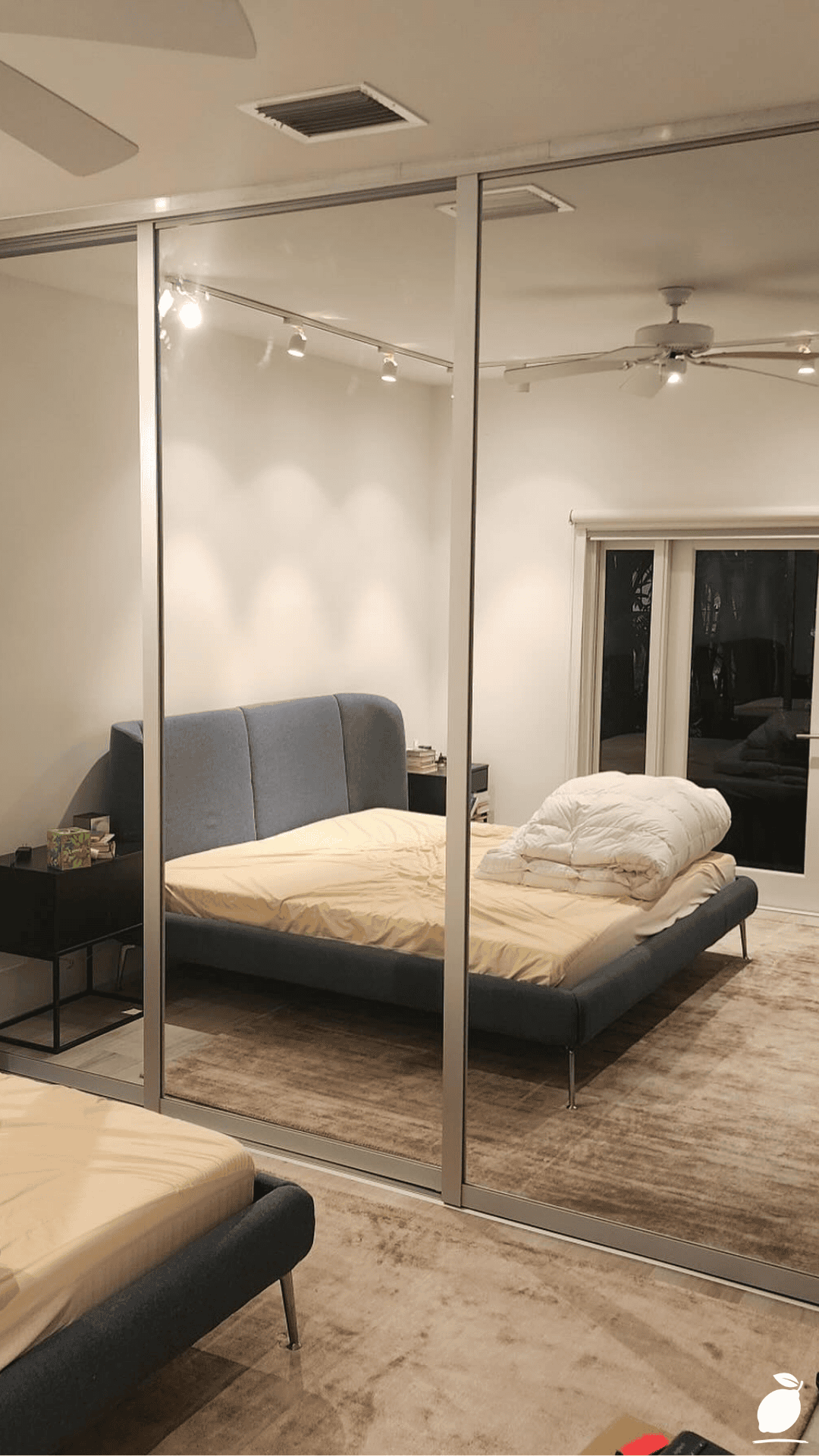
The bedroom is the most private room in a home, the space where the household’s most vulnerable and most restorative moments occur. Its visual quality affects sleep quality, morning emotional tone, and the general sense of inhabiting a space that was made with personal care rather than built to generic specification. A mirror closet that doesn’t suit the room, creating a visual tension rather than a visual contribution, is not a trivial aesthetic concern. It is a daily disruption to the specific quality of privacy and personal expression that a bedroom needs to provide.
Research in residential environment psychology identifies the degree to which people feel they have made their bedroom their own, that it reflects their personal aesthetic rather than a generic specification, as one of the most significant predictors of how effectively the room functions as a restorative space. A mirror closet that is left in its original builder-standard configuration in a room that has been otherwise personalized creates a specific sense of incompleteness that compounds with the room’s other qualities to reduce its restorative capacity. Addressing it through any of the approaches in this guide restores the sense of a room that is fully yours.
Easy Peasy Life Matters is built on the conviction that home improvements done with intention produce homes that genuinely support the people living in them. A mirror closet covering project completed well, whether it takes an afternoon of adhesive film application or a weekend of curtain installation, produces a bedroom that feels finished in the way that the original mirror closet was always preventing it from being. That quality of completion, experienced every morning you open your eyes, is a more significant quality-of-life contribution than its modest project scope suggests.
Frequently Asked Questions
Can I remove mirror closet doors entirely and replace them?
Yes, most mirror closet door systems use a standard track and roller mechanism that allows the doors to be lifted out of the track and stored or disposed of. The track itself (top and bottom) can typically be removed with a screwdriver, leaving wall and floor surfaces that may require patching and painting. Replacement options range from standard pre-hung wardrobe doors in standard sizes to custom-built units. This is the most permanent and most expensive approach but produces the most complete transformation. Check your building lease before removing any mirror closet doors in a rental property.
What is the easiest way to cover mirror closet doors in a rental?
The easiest removable covering for a mirror closet in a rental property is frosted or opaque adhesive film applied directly to the mirror surface. High-quality removable adhesive film leaves no residue on the mirror when removed and fully restores the original mirror closet appearance when the tenancy ends. Alternatively, a freestanding room divider or a tension rod curtain system positioned in front of the mirror closet requires no adhesive or wall installation and is completely reversible.
Will covering mirror closet doors make the room feel smaller?
Covering mirror closet doors with an opaque material removes the light-multiplying and space-expanding effect of the mirrors, which may make a small bedroom feel slightly more compact. In a small bedroom, frosted film (which maintains light transmission while eliminating the reflective quality) is a better covering choice than opaque curtains or panel overlays. Alternatively, hanging a large art piece or light-colored fabric in front of the mirror closet rather than against it, leaving the mirror visible at the sides, preserves some of the light-expanding effect while reducing the full-wall-mirror visual impact.
How do I clean and maintain mirror closet doors before applying film or panels?
Before applying any adhesive film or surface treatment to mirror closet doors, clean the mirror surface with a glass cleaner to remove any grease, dust, or residue, then wipe with isopropyl alcohol on a lint-free cloth for a completely oil-free surface. Allow to dry a minimum of 30 minutes in a fully ventilated room before applying any adhesive material. Fingerprints and oil residue under an adhesive film cause bubbling and lifting within days of application; the alcohol wipe is the preparation step that determines whether the film application will last months or begin failing within weeks.