For the longest time, my coffee table was where good intentions went to disappear. Remote controls, a half-read book, a charging cable that had migrated from the bedroom, a coaster being used as a bookmark, a candle that hadn’t been lit in three weeks, and at the center of it all, a tray I had purchased specifically to organize the chaos, which had itself become part of the chaos. Every time I tidied the table before guests arrived, I was struck by how different the room felt without the accumulated daily debris. Calm. Considered. Like a room someone had thought about. And every time, within forty-eight hours, the surface had absorbed another layer of the ordinary and lost that quality entirely.

What I hadn’t understood until I started genuinely researching around coffee table decor is that a styled coffee table is not about removing the objects you use; it’s about establishing a visual anchor strong enough that those objects don’t define the space. The right coffee table decor creates a foundation that the room orbits around, a curated still life that communicates intentionality so clearly that the remote control and charging cable cease to be the first things anyone notices. The surface is still in use. It simply has a composition underneath all of that use, and the composition holds even when life gets layered on top. That distinction between a cleared table and a composed one changed how I thought about the whole project.
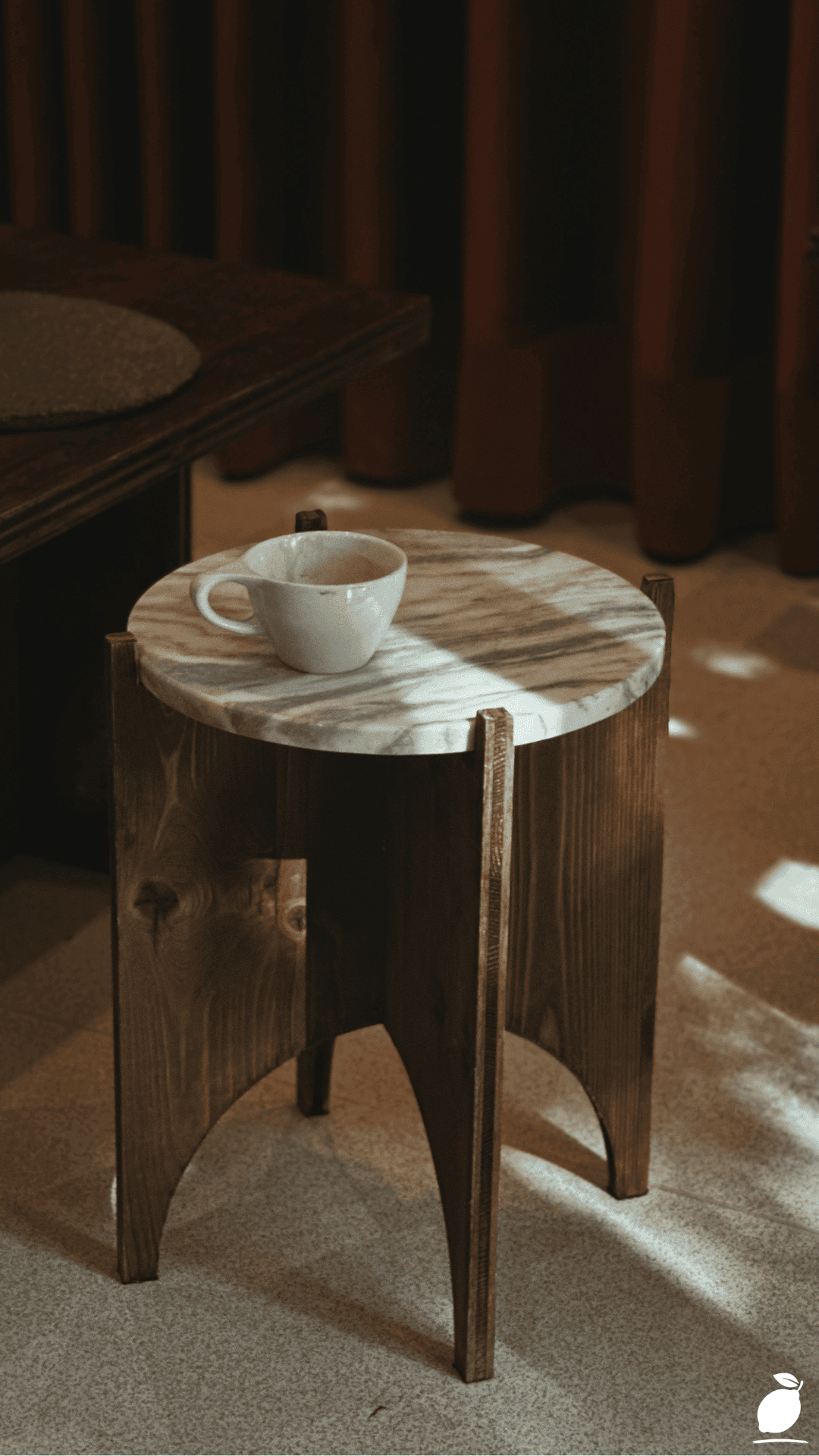
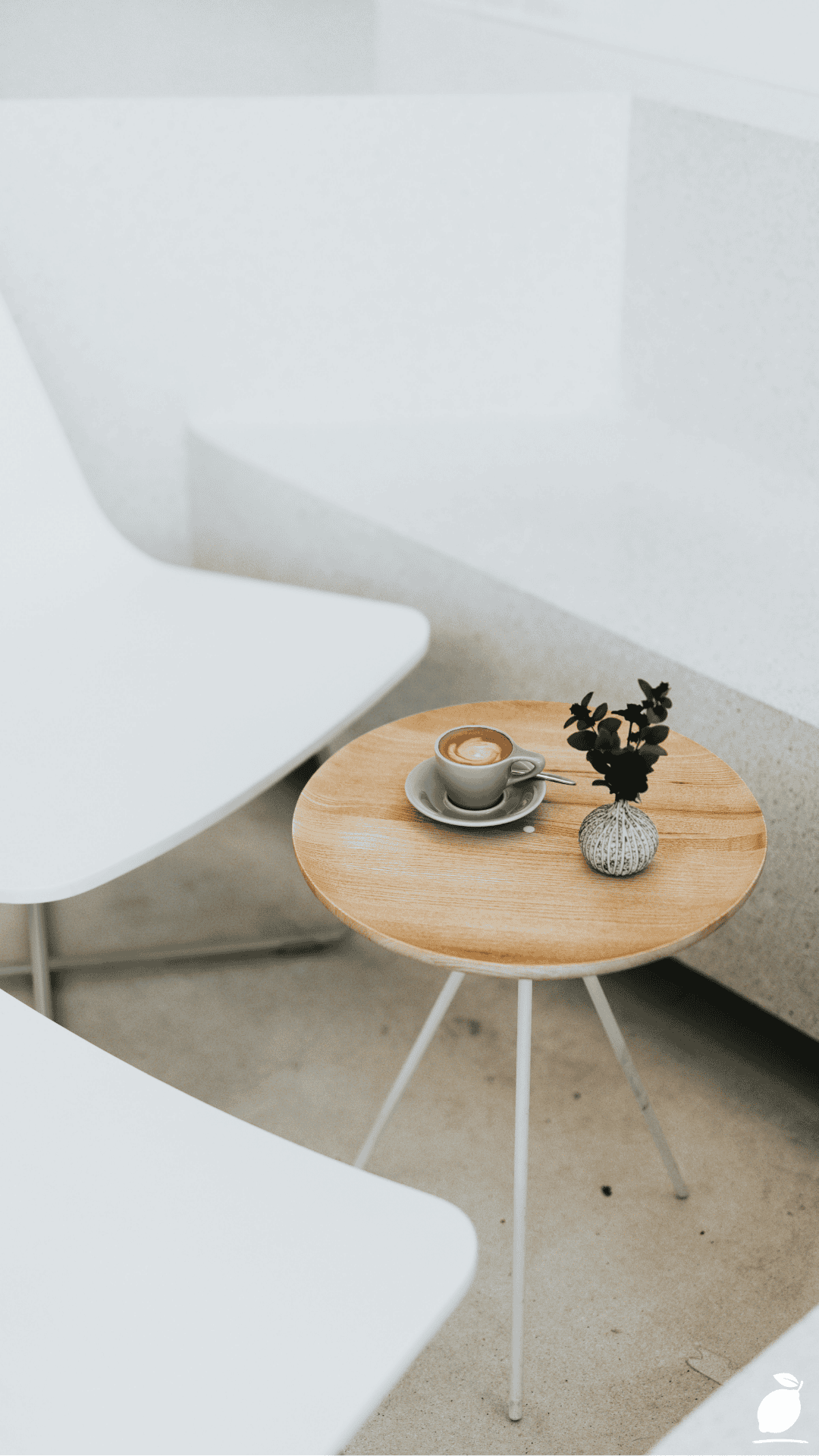
The image that anchors this post is the distillation of that principle: a round light-oak side table on white metal legs, positioned in a clean white corner, holding exactly two objects: a latte with latte art in a white cup and saucer, and a small grey vase with dark green stems. Every element is doing something. The circular table form echoes the circle of the cup and the roundness of the vase. The warm oak tone bridges the white walls and the polished concrete floor. The green plant stem provides the only color that isn’t neutral. The lighting is soft. The shadows are deliberate. Nothing is accidental, and nothing is excessive. This guide is the step-by-step system that produced that result in my room and can produce it in yours.
The Coffee Table Decor Blueprint
Step 1: Clear the Coffee Table Completely and Assess the Surface
Round coffee table decor begins not with adding objects but with removing every existing one. This step is the diagnostic that all subsequent coffee table decor decisions depend on. A completely cleared surface reveals what you’re actually working with: the table’s finish and material quality, its exact diameter, how it sits in relationship to the sofa and the floor, and how much visual weight it has on its own before anything is placed on it.
A round coffee table, in particular, has a visual logic that other shapes don’t share: it has no corners, no long axis, no hierarchy of position. Every point on a circle is equidistant from the center. This matters for coffee table decor because it means compositions on round tables must be organized around a central focal point or a balanced grouping that respects the table’s radial geometry, not aligned to a long edge the way rectangular table decor often is.
Photograph the cleared table from above, from standing height at sofa distance, and from seated height. The seated photograph is the most important: it shows you exactly how the coffee table decor will be perceived during the room’s primary use, when you’re sitting on the sofa looking across at the table surface. This view, rather than the bird’s-eye view most styling guides use, is the one that matters most and the one all your coffee table decor decisions should be tested against.
Step 2: Choose a Single Focal Point Object for the Center
Every successful round coffee table decor composition begins with a single anchor object positioned at or near the center of the table. This is the object the eye finds first and returns to the piece around which everything else in the coffee table decor arrangement is organized. In the featured image, the latte cup and saucer occupy this role: white, circular, elevated on a saucer that gives it height, and positioned slightly off-center in a way that creates a dynamic rather than static composition.
For your own round coffee table decor, the central focal point object should be chosen with three qualities in mind: sufficient visual presence to anchor the composition (too small and it disappears; too large and it overwhelms the table’s diameter), a form that complements the circle of the table (round objects bowls, spheres, candles in circular holders, books stacked in a square block all work with the table’s geometry; angular objects work against it), and a material or color that either extends the room’s existing palette or provides one clearly intentional accent.
Practical central coffee table decor anchor objects include: a ceramic or stone decorative bowl, a sculptural candle in a circular holder, a low vase with a single large botanical stem, a stack of three oversized books with visually interesting spines, or a tray that itself serves as the anchor and contains secondary coffee table decor elements within its boundary.
Step 3: Add a Single Secondary Object for Scale and Contrast
The featured image’s second object, the small grey vase with dark green stems, is the coffee table decor decision that makes the primary object readable. Without it, the latte cup reads as a single item left on a table. With it, both objects read as a composed arrangement. This is the fundamental principle of coffee table decor: objects in deliberate relationship to each other read as design; objects in isolation read as deposition.
The secondary coffee table decor object should contrast with the primary in at least one quality: height, material, color, or organic versus geometric form, while sharing at least one other quality that connects them visually. In the featured image: the vase is taller than the cup (height contrast), grey versus white (subtle color contrast), and ceramic versus ceramic (material connection). Two points of contrast, one point of connection. This is the coffee table decor formula that produces cohesion without monotony.
For round coffee table decor, position the secondary object slightly behind and to one side of the primary rather than directly beside it at equal height, creating a diagonal of varying heights that gives the arrangement a sense of depth and movement when viewed from the seated angle. Two objects at the same height on a round table read as twins; two objects at different heights in a diagonal arrangement read as a composition.
Step 4: Apply the Rule of Odd Numbers and Negative Space
Round coffee table decor that follows the rule of odd numbers, one object, three objects, or five objects, rather than two or four, produces arrangements that are visually more dynamic and less static than even-numbered groupings. Two objects are symmetrical and stable; three objects create a triangle of visual interest that the eye travels between continuously, which is the specific quality that makes a coffee table decor arrangement feel alive rather than placed.
If expanding beyond the two-object composition of the featured image, add a third coffee table decor element that forms a triangle with the existing two. For a round table, this triangle should be loose and asymmetrical rather than a precisely geometric one object slightly closer to the viewer, one slightly left of center, and one toward the back of the table. The imprecision of the arrangement is intentional; rigid geometric placement on a curved surface reads as forced.
Negative space, the clear table surface visible between and around the coffee table decor objects, is as important as the objects themselves. A round coffee table fully covered in objects has no visual breathing room and no focal point; the eye moves across the surface without settling. Reserve a minimum of 40% of the table surface as clear space, and ensure the negative space is distributed around and between the objects rather than pushed to one side.
Step 5: Ground the Arrangement with a Tray or Natural Material Layer
A tray is the coffee table decor element that transforms a collection of objects into a unified composition. It creates a defined boundary around the arrangement that signals intention, makes the entire coffee table decor grouping moveable as a unit, and provides a base-level material that grounds the objects placed within it. In round coffee table decor, a circular tray (in natural wood, white ceramic, or woven rattan) placed slightly off-center on the table and containing two or three of the coffee table decor objects creates a composition within a composition, a contained arrangement within the larger space of the round table surface.
For coffee table decor without a tray, a natural material layer fulfills the same grounding function: a circle of woven rattan beneath a vase, a small linen square beneath a stack of books, a stone coaster beneath a candle. The featured image achieves this grounding effect through the saucer beneath the coffee cup, a visual boundary that contains the primary object and gives the arrangement a clear bottom edge.
Step 6: Introduce a Living Element for Organic Warmth
The dark green plant stems in the featured image’s grey vase are the coffee table decor element with the highest return per unit of visual space. A single small plant, a stem or two of foliage, or a cut flower in a compact vase introduces the organic quality that no ceramic, candle, or book arrangement can replicate. Living elements in coffee table decor signal that the space is inhabited and cared for rather than merely decorated, a distinction that is immediately sensed rather than consciously registered.
For round coffee table decor, choose plant elements that are proportional to the table’s diameter. A tall, dramatic stem works beautifully on a large-diameter round coffee table; the same stem overwhelms a small table and breaks the composition’s scale logic. Small architectural foliage eucalyptus, dark green monstera cuttings, rosemary sprigs, and a single bare branch work at almost any scale and in any coffee table decor palette. Succulents in small ceramic pots are a reliable low-maintenance alternative when fresh stems aren’t practical.
Step 7: Edit the Composition and Maintain It Seasonally
The final step in round coffee table decor is the most ongoing: the discipline of editing and seasonal refreshment that keeps the composition working throughout the year. A coffee table decor arrangement installed in spring and never revisited reads as stale by summer; the plant stems have dried, the candle has been burned to an awkward height, and the books are no longer seasonal references. A coffee table decor arrangement refreshed seasonally with new flowers in spring, a summer succulent, an autumn-toned candle, and a winter botanical print leaning against the vase reads as alive and continuously cared for.
The editing discipline is equally important. Every object added to the coffee table decor arrangement beyond the core composition should justify its presence by either adding a quality the existing arrangement lacks or replacing a quality the arrangement has lost. Objects that don’t justify their presence, the seasonal decoration that stayed past its season, the book that’s been there so long it’s invisible, should be removed. A round coffee table decor arrangement of three deliberate objects is more powerful than one of seven accumulated ones.
Expert Secrets for Success
Pro-Tips for a Better Result
Style your round coffee table decor from the seated viewing angle exclusively. The photograph from sofa height, not from above, not from standing, is the only view that shows you how the coffee table decor reads during actual use. A composition that looks beautifully balanced from above can read as a flat, one-dimensional row when viewed from seated height. Adjust object heights, positions, and the diagonal arrangement until the seated-angle view is the one you’re satisfied with, and don’t be distracted by how it looks from any other perspective.
Match the coffee table decor scale to the table diameter. The most consistent round coffee table decor mistake is placing objects that are correctly sized for a rectangular table onto a round one, where the proportions are entirely different. A round table’s visual center is also its physical center, and objects that would look appropriately scaled along the length of a rectangular table read as undersized when concentrated in the circular space of a round one. Choose objects that individually occupy 15 to 25% of the table’s diameter, large enough to read clearly, small enough to leave negative space around them.
Use a single accent color and repeat it in at least two coffee table decor elements. The featured image’s only non-neutral color is the dark green of the plant stems, and that green appears in one location only. This restraint is the decision that keeps the coffee table decor feeling calm rather than busy. When introducing color into round coffee table decor, choose one accent color and use it in two places (a book spine and a vase, a candle and a botanical stem, a tray and a decorative object). The repetition creates a connection; the restraint prevents competition.
Rotate one coffee table decor element seasonally to refresh without redesigning. Rather than replacing the entire coffee table decor arrangement each season, identify the most seasonal element, typically the plant or the candle, and replace only that one element. The stable elements remain as the composition’s anchor; the rotating element signals that the arrangement is maintained and current. This is the coffee table decor maintenance approach that requires the least effort and produces the most consistently updated result.
Common Mistakes to Avoid
Don’t place objects in a straight line across a round table. The round table’s geometry resists linear arrangement; objects placed in a straight line across a circular surface look rigidly imposed rather than naturally composed. Round coffee table decor always works in triangles, clusters, and diagonals that respond to the curved boundary. If your coffee table decor arrangement looks like a row, rotate one object forward or backward to create the off-axis diagonal that the round table’s form invites.
Don’t use too many different materials simultaneously. A round coffee table decor arrangement that combines wood, ceramic, glass, metal, and woven rattan in a limited surface area creates a material cacophony that reads as collected rather than composed. Limit the materials in your coffee table decor to two or three that share a quality: all warm-toned (wood, terracotta, brass), all cool-toned (grey ceramic, white porcelain, chrome), or all natural (wood, stone, organic fiber). Material coherence is the invisible quality that distinguishes a styled coffee table decor arrangement from a curated one.
Don’t neglect the relationship between the coffee table decor and the floor. The polished concrete floor in the featured image is as much a part of the coffee table decor composition as the objects on the table surface. Its reflective quality and neutral tone frame the table from below, and the table’s white metal legs create a visual connection between the tabletop arrangement and the floor. In your own room, consider whether the floor beneath and around the round coffee table supports or undermines the decor above it. A rug that connects to the coffee table decor palette, a floor surface that reflects light upward, or simply a clear and uncluttered floor area beneath the table all contribute to the composition’s overall reading.
Don’t over-decorate the coffee table when the room is already visually complex. Round coffee table decor in a room with patterned textiles, gallery walls, or bold furniture should be more restrained than in a minimalist room like the featured image. The coffee table decor arrangement should be the room’s quiet moment, not another competing focal point. A single object on a clear, round coffee table surface is not an under-decorated table in a busy room; it is the visual rest that allows everything else in the room to be perceived clearly.
Why Coffee Table Decor Matters
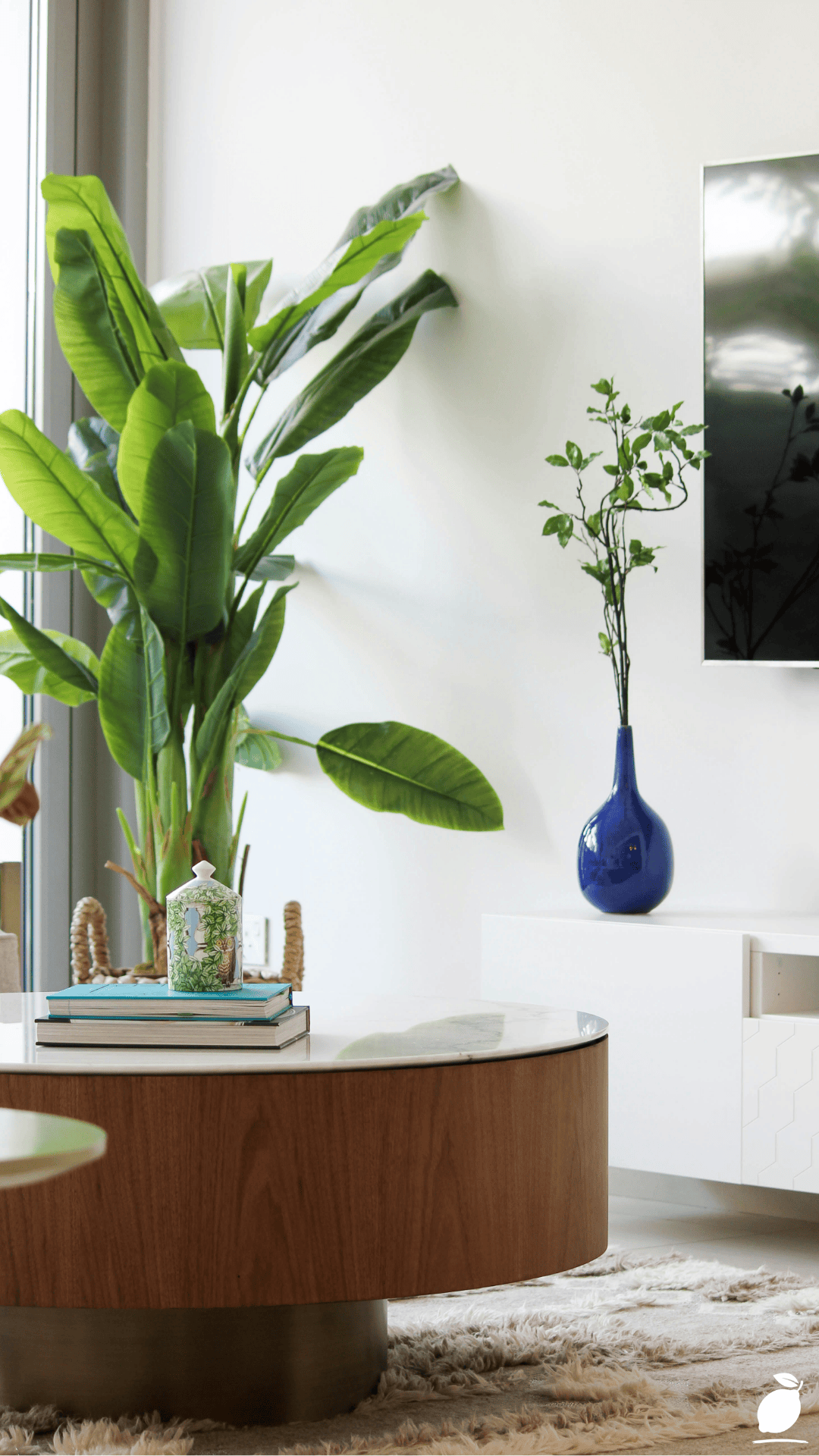
The coffee table is the room’s gathering point, the surface that chairs and sofas orient toward, the center around which conversation arranges itself, the first place eyes land when entering a living space. Its condition communicates something about the room and about the household before anyone has consciously registered the furniture, the wall color, or the art. A coffee table buried in debris says one thing. A coffee table with a composed, maintained arrangement says another. The message isn’t about cleanliness or wealth; it’s about attention, and attention is something every visitor, every family member, and every moment of daily life in the room responds to even when it can’t be named.
For households where the living room is genuinely shared, where multiple people’s rhythms intersect on the same surfaces and in the same space, round coffee table decor that is simple enough to maintain without effort and clear enough to compose quickly after daily use becomes a genuine contribution to the room’s atmosphere. A parent who can reset the coffee table decor in three minutes each evening creates a room that feels managed rather than chaotic for the hours that follow. That quiet reset- setting the cup and vase back in position, the remote tucked away, the arrangement restored- is an act of care for the shared space that compounds over days and weeks into a room that feels genuinely looked after.
Easy Peasy Life Matters is built on the conviction that small, repeatable, intentional acts are the foundation of a home that feels good to live in. Round coffee table decor is one of those acts: a composition that takes ten minutes to establish, thirty seconds to reset, and delivers continuous visual calm to every moment spent in the room. The image above is not aspirational. It is achievable today, with a cleared round table, two thoughtfully chosen objects, and the patience to sit across from the arrangement and ask whether it’s working. It is, in its way, the easiest peasy home upgrade available.
Frequently Asked Questions
How many items should be on a round coffee table?
The optimal number for round coffee table decor is one to five objects, with three being the most visually satisfying for most table diameters. One object reads as intentional and very minimal, appropriate for small tables or very calm, spare rooms. Three objects arranged in a loose triangle give the round coffee table decor arrangement its most dynamic quality. The eye travels between the three points in a continuous circuit that makes the arrangement feel alive. Five objects work on larger round tables when organized into a central grouping plus two satellite elements. More than five objects on a round coffee table typically produce visual clutter, regardless of how carefully each piece is chosen.
What is the best centerpiece for a round coffee table?
The best round coffee table decor centerpiece is one that has visual weight proportional to the table’s diameter, a form that complements the circle of the table (round, low, and contained rather than tall and angular), and a material or finish that connects to the room’s existing palette. A low ceramic bowl in a neutral or accent color is the most universally successful round coffee table decor centerpiece. It has visual presence, sits stable and secure, and provides a container that can hold secondary elements (decorative objects, fresh flowers, seasonal items) that change without requiring a new centerpiece each time.
How do I style a round coffee table that is also used daily?
The round coffee table decor approach for tables in active daily use is to establish a permanent composed core of two or three objects that form the arrangement’s foundation and that live on the table permanently, and manage the daily-use additions around that core rather than replacing it. The permanent core (vase, decorative bowl, candle) occupies the center and back of the table; the daily-use items (remote, book, drink) are placed at the table’s edges and cleared at the end of each day. The core composition is always present; the daily layer is understood as temporary. This approach keeps the round coffee table decor legible and intentional even during active use.
Should coffee table decor match the room’s color scheme?
Round coffee table decor doesn’t need to match the room’s color scheme, but it should connect to it. The most effective coffee table decor is either fully within the room’s existing palette (using the same tones in smaller-scale objects) or introduces a single new accent color that is used deliberately and consistently across two or three coffee table decor elements. Introducing multiple new colors through coffee table decor in a room with an established palette creates competition between the table arrangement and the room’s existing visual hierarchy. Choose connection over matching and restraint over variety.
How do I make a small round coffee table look intentional rather than crowded?
For small round coffee table decor, the principle is one strong object rather than multiple small ones. A single ceramic bowl of appropriate diameter, a compact vase with two or three stems, or a cylindrical candle in a simple holder each gives a small round table a complete, composed quality. Two objects, at most one primary, one secondary, at different heights, maintain the negative space that prevents a small round coffee table from reading as cluttered. Avoid trays on very small round tables; the tray takes up table space that the objects themselves should occupy and reduces the clear surface area that makes a small round coffee table feel generous rather than cramped.