The transition happens gradually and then all at once. One morning, you walk past your son’s bedroom door and the cartoon character bedding, the plastic storage bins in primary colors, and the glow-in-the-dark star stickers on the ceiling, which you installed together on a Saturday afternoon that felt recent, all suddenly look wrong in a way they didn’t last year. The room still functions. Everything in it still technically belongs to the same person. But that person is fourteen now, or fifteen, and the room is communicating something about who he was rather than who he is becoming, and somewhere in the daily friction of a teenager who spends increasing time in that room but seems vaguely uncomfortable in it, you recognize the disconnect. The space needs to grow. The question is how to do it without a complete renovation budget, without an argument about taste, and without producing a room that looks like a magazine feature he’ll outgrow in another three years.
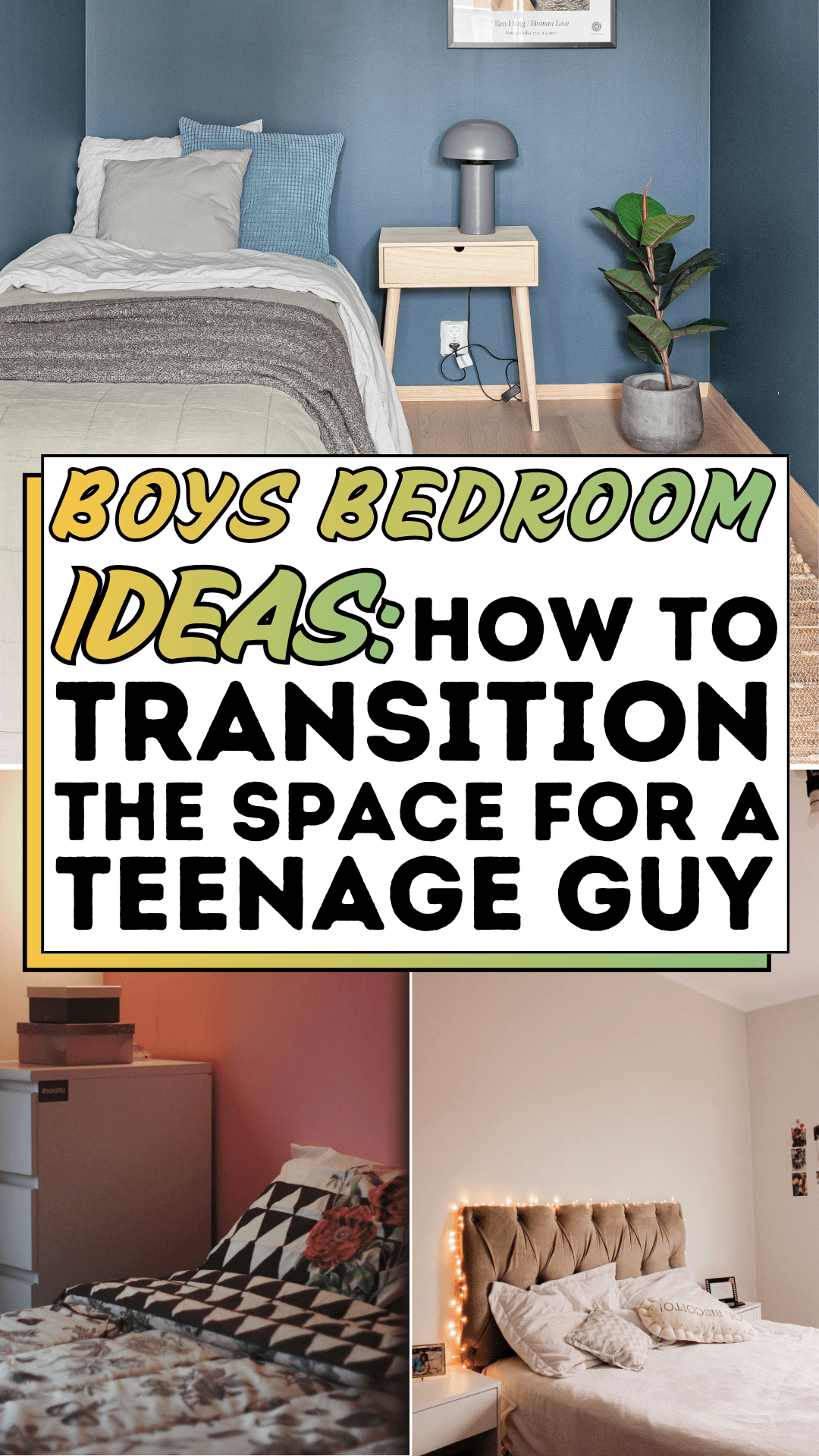
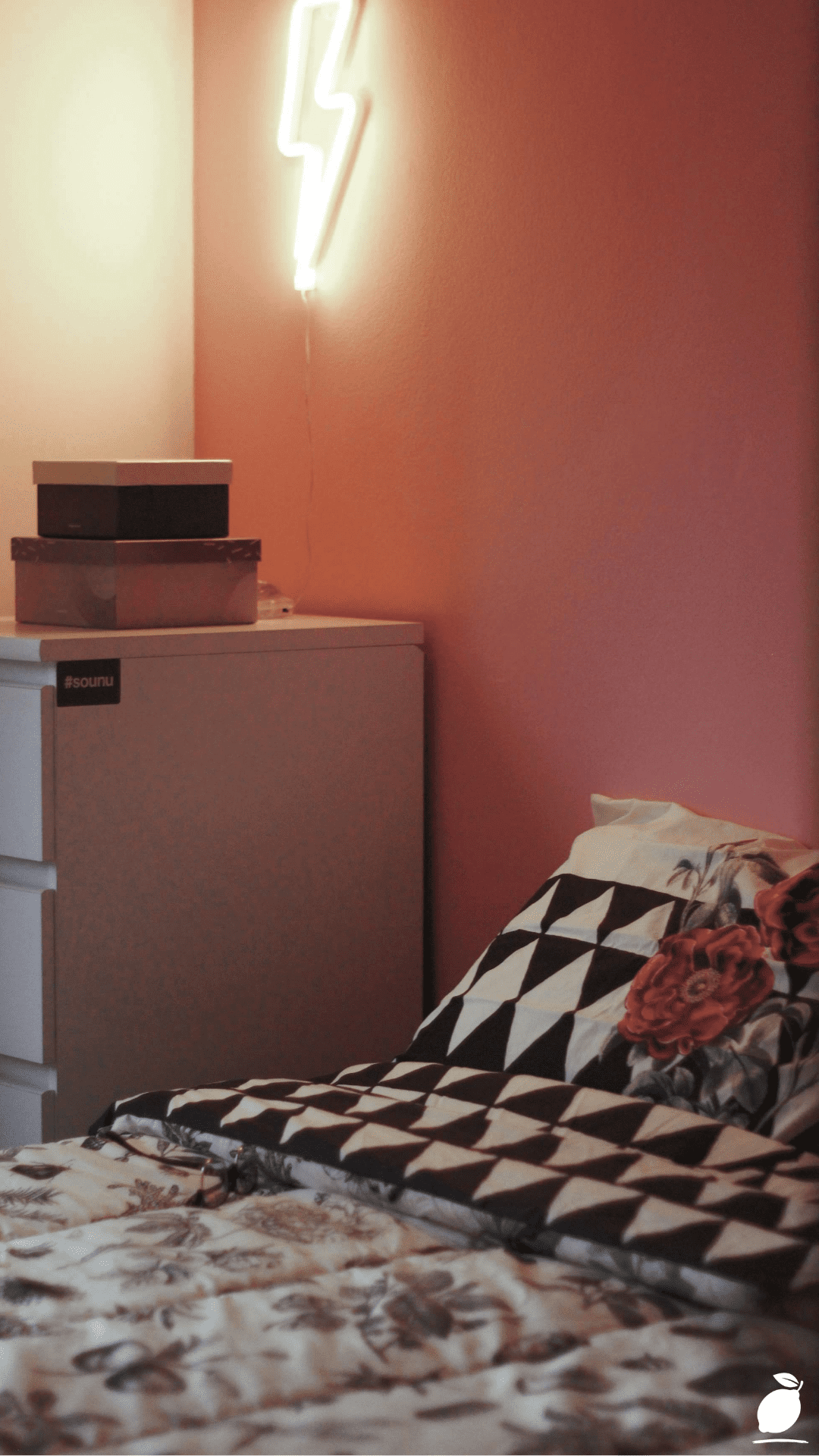
The bedroom in the image above answers that question with a specific kind of clarity. It is not a neutral, safe room; it is a room with a point of view. The pink-tinted wall reads as bold rather than juvenile because it is paired with white furniture and black-and-white bedding that give the color room to be intentional rather than childlike. The neon lightning bolt sign on the wall does the work that sports posters and band stickers used to do; it declares personality and casts atmosphere, but it does it with the design language of a space that was thought about rather than accumulated. The geometric triangle pillow and the floral bedding coexist because they share a monochromatic black-and-white palette that holds the room’s eclecticism in check. Nothing in the image is expensive. Everything in it is deliberate. That combination of personality plus intention is the core of every boys bedroom idea that actually ages well through the teenage years.
These boys bedroom ideas are built for the transition phase, specifically: the space between a child’s room and a room a young adult would genuinely choose for himself. They work with whatever the room currently has, they build in flexibility for the taste shifts that are a guaranteed feature of the next five years, and they produce a result that a teenager will feel proud of rather than merely present in. The best boys bedroom ideas don’t decorate a room; they build a room that belongs to its occupant. This guide shows you exactly how.
The Boys Bedroom Ideas Blueprint
Step 1: Have the Conversation Before Making Any Design Decisions
The single most important of all boys bedroom ideas for the transition phase is the one that happens before any paint is chosen or any furniture is moved: a genuine conversation with the teenager about what he actually wants the room to feel like. This is not a negotiation; it is a listening exercise. Ask open questions rather than multiple-choice ones. Not “do you want blue or gray?” but “what do you want the room to feel like when you walk in?” Not “should we get rid of the old posters?” but “what do you want on the walls?”
Teenagers in transition resist rooms imposed on them, even well-designed ones, because the room’s function at this stage is specifically about the expression of an emerging identity that is not yet fully formed and is therefore sensitive to override. A teenage boy who had no input in his room’s redesign occupies it differently than one who made real choices within it. He is more likely to maintain it, more likely to feel settled in it, and significantly less likely to begin the gradual re-personalization via miscellaneous objects stuck to surfaces that undoes a careful redesign within six months.
Write down what emerges from the conversation, even rough phrases like “dark and moody,” “looks like a music studio,” “not babyish,” “has my stuff in it,” because these phrases are the actual brief for the room. They are more useful than any boys bedroom ideas sourced from Pinterest, because they are specific to the person the room needs to belong to.
Step 2: Clear the Room to Its Architectural Bones
Once the conversation has produced a direction, the room needs to be seen clearly before any new boys bedroom ideas are introduced. Remove everything that is not architecturally fixed furniture, bedding, wall art, storage, accessories, and photograph the empty room from each corner. The empty-room photographs reveal the actual spatial assets and constraints that boys bedroom ideas need to work with: the natural light quality and direction, the ceiling height, the size of the window relative to the wall, the floor condition, and any architectural features, such as alcoves, built-in shelving, and sloped ceilings that should be designed with rather than around.
Sort the cleared contents into three categories: keep and reuse, keep and store until he leaves home, and donate or discard. Be ruthless with the third category on behalf of the room, but let him make the final call on the first two, particularly on items with sentimental or identity significance. The goal is not to erase the previous room but to create genuine space for the next one. Items that no longer belong in the room’s new design but that matter to him can be stored rather than discarded, which removes the all-or-nothing quality that makes transition room projects feel like loss rather than progress.
Step 3: Commit to a Wall Color That Does Real Work
Wall color is the highest-impact, lowest-cost element of any bedroom transition, and the boys bedroom ideas that produce the most dramatic before-and-after results almost always begin here. The pink-tinted wall in the image is an instructive example: it reads as mature and intentional because it is applied confidently and because everything placed against it is calibrated to it. The color does real atmospheric work; it creates the warm, slightly moody quality that the room’s neon light and black-and-white palette then respond to rather than existing as a passive background.
For a teenage boy’s bedroom, the most versatile wall color choices sit in the deep, atmospheric end of each color family rather than the bright or primary end: a deep slate blue rather than royal blue, a charcoal with warm undertones rather than black, a dusty mauve or muted clay rather than pink, a dark forest green rather than lime. These tones read as sophisticated at any age and do not require significant repainting when taste evolves; they age forward rather than backward.
If a single deep-toned accent wall is a more accessible starting point than repainting all four walls, apply it to the wall the bed sits against, the wall most visible from the room’s entry point, and the one that creates the strongest first impression. The remaining walls in a neutral white or pale gray allow the accent wall to anchor the room’s color story without overwhelming a smaller space.
Step 4: Update the Bedding as the Room’s Primary Pattern Statement
The bed is the largest single visual element in most bedrooms and the piece most immediately associated with the room’s occupant, which makes bedding one of the most important boys bedroom ideas in the transition toolkit and one of the most frequently overlooked. Cartoon and character bedding reads as juvenile regardless of how mature everything else in the room becomes. Replacing it with bedding that has a genuine graphic or textural quality is the single most effective change available for transforming the feel of a teenager’s room without touching a wall.
The bedding in the image demonstrates exactly what transition-appropriate boys bedroom ideas look like in practice: a geometric triangle pillow in black and white alongside a floral bedding set in the same monochromatic palette. The pattern combination works because the colors are unified; both pieces speak black-and-white, so the different patterns read as considered rather than mismatched. For a teenage boy’s room, the most durable bedding approach uses a dominant neutral base, charcoal, navy, warm white, or stone with one graphic element introduced through a pillow, a throw, or a pattern in the duvet cover itself.
Budget for good quality bedding that doesn’t pill, fade, or lose its structure within a year is a false economy in a room that will be seen and used daily. A single quality duvet cover in a graphic black-and-white or deep-toned solid, paired with two to three pillow combinations from the same palette, is a complete and durable bedroom textile investment at under $150 in most retail categories.
Step 5: Replace Childlike Wall Décor With Personality-Driven Pieces
Wall décor is where the teenage room’s personality lives most visibly, and it is the category where boys bedroom ideas most dramatically diverge between approaches that date quickly and approaches that hold up over the transition years. Posters that feature specific cultural moments, a current band, a sports season, or a film release are personal and immediate but age rapidly and create a room that looks like a specific year rather than a specific person. Object-based wall décor, a neon sign, a wall-mounted shelf with curated objects, a large-format typographic print, and a custom framed collection of meaningful items personalized without timestamping.
The neon lightning bolt sign in the image is the room’s most distinctive single element, the piece that most makes the room feel like it belongs to someone with a perspective. Neon signs have become genuinely accessible through the proliferation of LED neon alternatives at $40 to $120 for custom or standard designs. They provide the same atmospheric effect as the image’s sign, warm, intimate light against a textured wall, casting soft shadows that make the room feel experiential at night, at a fraction of the previous neon sign costs. Custom LED neon signs with a word, symbol, or phrase that is specifically meaningful to the room’s occupant are among the most personal and most impactful single-object boys bedroom ideas available in the current market.
Supplement the statement piece with two to three smaller wall elements that hold the room’s secondary visual interests: a framed print, a mounted shelf with books and objects, a pinboard where current inspiration and memorabilia can rotate without requiring repainting or re-framing each time taste evolves.
Step 6: Address Storage With Furniture That Earns Its Place Aesthetically
Storage is the operational infrastructure of any functional teenager’s room, and boys bedroom ideas that address only the aesthetic layer without solving the storage problem produce rooms that look good briefly and gradually revert to the chaotic condition that motivated the refresh. The white dresser in the image is pulling both functional and aesthetic weight: it provides drawer storage while presenting a clean white surface that anchors the room’s color palette and provides a display platform for the stacked boxes above it.
For the transition bedroom, replace any storage furniture that was chosen for function alone, the plastic drawer units, the wire mesh bins, the freestanding shelving that was sized for toys rather than clothes and equipment, with pieces that perform both functions. A tall white or dark-toned dresser provides clothing storage while contributing to the room’s palette. A platform bed with integrated under-bed drawers maximizes storage without adding furniture footprint. A wall-mounted desk with a minimal shelf unit consolidates work and storage into a single wall area, which keeps the floor area as open as possible and makes the room feel larger than its measurements.
The stacked dark boxes on the dresser in the image demonstrate the boys bedroom ideas principle of making storage part of the composition: identical boxes in the same color and material stack into a visual element rather than a clutter indicator. Apply the same logic throughout the room, uniform storage containers in a consistent color family, labeled and positioned as part of the room’s visual arrangement rather than as an afterthought to it.
Expert Secrets for Success
Pro-Tips for a Better Result
Invest in lighting before accessories. The single change that most dramatically shifts a bedroom from childlike to atmospheric is lighting, specifically, the replacement of the overhead-only lighting setup of most children’s rooms with a layered system that includes a secondary source at bed or desk level. The neon sign in the image provides exactly this secondary layer: a warm, directional light source at wall height that transforms the room’s atmosphere at night in a way that no overhead fixture can replicate. An LED neon sign, a desk lamp with warm-temperature bulbs, or a plug-in bedside sconce costs $30 to $80 and produces a more significant atmospheric shift than any accessory purchase at the same price point.
Use the 60-30-10 color rule to hold the palette together. Assign the dominant tone to the wall color or the neutral backdrop 60 percent of the room’s visual field. Assign the secondary tone to the bedding base, the furniture color, 30 percent. Reserve 10 percent for the accent elements: the neon color, the pillow graphic, the stacked box color. Teenage rooms that feel chaotic almost always fail the 60-30-10 proportion, with too much happening at equal visual weight. The discipline of proportion is what makes the image’s eclectic combination of pink wall, black-and-white bedding, and neon sign feel composed rather than cluttered.
Let the pinboard do the rotating. A large corkboard or magnetic board mounted on one wall, framed to look intentional rather than functional, gives the room’s occupant a designated surface for the current-moment personalization that is developmentally appropriate and practically inevitable in a teenage room. Band tickets, photographs, current inspiration images, and notes all of these rotate through the pinboard rather than being taped directly to the wall. The rest of the room’s wall décor remains stable. The pinboard is the room’s evolving layer, and its presence prevents the gradual accumulation of adhesive residue and nail holes that characterize a teenager’s walls when no designated personalization surface exists.
Match the dresser hardware to the room’s metallic accent. Dresser drawer pulls and cabinet hardware are a small detail with a disproportionate impact on the room’s perceived cohesion. Replacing builder-grade or mismatched hardware across all furniture pieces with a single consistent finish, matte black for a dark, moody palette, brushed brass for a warmer palette, and chrome for a cooler, more minimal palette takes under an hour with a screwdriver and costs $20 to $60 in hardware for a standard dresser and nightstand combination. It is among the highest-return-per-dollar boys’ bedroom ideas available.
Common Mistakes to Avoid
Don’t design a room that the teenager will feel is yours rather than his. The most common failure mode in parent-driven teenage room makeovers is a room that is beautifully designed in the parents’ aesthetic rather than the teenager’s, a room that earns compliments from adults and produces a teenager who quietly doesn’t use it in the way it was intended. The conversation in Step 1 is not optional. A room that reflects the occupant’s emerging taste, even imperfectly, even eclectically, produces more behavioral investment from a teenager than a room that reflects a parent’s careful design instinct.
Don’t try to solve the clutter problem with more storage alone. Adding more storage to a teenager’s room without addressing the underlying organizational habits the room needs to support is among the most frequently repeated boys’ bedroom ideas mistakes. More bins produce more bins full of undifferentiated objects rather than a more organized room. The effective approach pairs storage solutions with a clear placement logic: this surface is for display only, this drawer is for school materials, this shelf is for books. The logic needs to be agreed on and visible to work consistently, not assumed.
Don’t use accent lighting with a color temperature that fights the wall color. A pink-toned wall illuminated by a cool-white LED strip light reads muddy and unresolved; the same wall illuminated by a warm-white source reads rich and intentional. Match the color temperature of all secondary light sources, neon signs, desk lamps, and under-shelf lighting to the wall color’s undertone: warm white (2700K to 3000K) for warm-toned walls, neutral white (3500K to 4000K) for cool or neutral walls. The image’s warm neon against the pink wall succeeds precisely because of this undertone alignment.
Don’t neglect the floor when transitioning the room. A carefully updated teenage room sitting on the same children ‘s-room rug, a primary-colored ABC print, a cartoon character design, and a worn-out sports-field pattern carry the visual remnant of the previous room into the new one in a way that no amount of new bedding or wall color fully resolves. Replacing or removing the rug is among the highest-impact and most frequently deferred boys’ bedroom ideas in the transition checklist. A large-format geometric rug in neutral tones, charcoal, ivory, warm gray, and black-and-white grounds the room’s new palette and covers most of whatever flooring condition exists beneath it.
Why Boys Bedroom Ideas Matter
A teenager’s bedroom is the only space in a family home that belongs, unambiguously, to one person. Every other room is shared, negotiated, and organized around collective function. The bedroom is the one environment where a young person in the process of figuring out who he is gets to externalize that process to build a visual representation of his emerging identity and live inside it. Research in adolescent development is consistent on this point: the degree to which a teenager feels genuine ownership of his physical environment is directly correlated with his sense of identity stability, his willingness to spend time at home rather than seeking belonging elsewhere, and his ability to use his own space as a genuine retreat from the social complexity of school and peer environments.
A room that has been transitioned thoughtfully that reflects current taste, supports current needs, and communicates that the people who live with him took his growing up seriously enough to change the room around it does something more than improve the aesthetics of a single bedroom. It tells a story about the household’s relationship to this particular person’s development. It says: we see who you are becoming, and we made space for it. That message, delivered through a neon sign and a new duvet cover and a wall color chosen together on a Saturday afternoon, is felt in ways that neither the parent nor the teenager will fully articulate but both will remember.
Easy Peasy Life Matters exists for exactly these moments: the domestic investments that look like home décor decisions and are actually family decisions, choices about how a home holds its people, how it grows with them, and how the daily quality of living in it changes when someone pays attention. These boys’ bedroom ideas are the practical mechanics of that attention. The room in the image is proof that the attention is worth it.
Frequently Asked Questions
What is the best wall color for a teenage boy’s bedroom?
The most versatile wall colors for a teenage boy’s bedroom transition are deep, atmospheric tones that read as mature without being neutral to the point of blandness: dark slate blue, charcoal with warm undertones, dusty mauve, muted sage, or deep warm gray. These colors create the moody, intimate quality that most teenage boys describe when asked what they want their room to feel like, and they age forward rather than backward, they will still be appropriate at eighteen and beyond. Avoid primary colors and bright saturated tones, which read as juvenile regardless of the room’s other design decisions, and avoid very pale pastels unless the teenager specifically chooses them.
How do I involve a teenage boy in his bedroom redesign without losing design control?
The most effective approach is structured choice rather than open-ended design collaboration. Present two or three concrete options for each major decision: wall color, bedding palette, and lighting style that you have pre-selected as viable within the design direction established by the Step 1 conversation. This gives him real agency within a curated set of options, produces a room that works aesthetically, and prevents the decision paralysis or design conflict that fully open-ended collaboration with a teenager can produce. The feeling of genuine choice in each decision is what generates ownership of the result; the specific options chosen matter less than the fact that he made the choices.
How much does a teenage bedroom transition typically cost?
A meaningful teenage bedroom transition, new wall color, bedding replacement, updated lighting, new wall décor, and storage refresh typically costs between $200 and $600 USD when executed with budget-conscious boys’ bedroom ideas. The highest-impact investments at the lowest cost are wall paint ($30 to $60 for a quality paint and supplies), a new duvet cover and pillow combination ($60 to $120 for quality bedding), and an LED neon sign ($40 to $90). Furniture replacement is the most significant cost variable; transitioning the room with existing furniture updated through hardware changes and strategic placement typically produces 80 percent of the visual impact of full furniture replacement at 10 percent of the cost.
What lighting works best in a teenage boy’s bedroom?
Layered lighting, an overhead ambient source plus one or two secondary sources at lower heights, is the most effective lighting approach for a teenage bedroom because it creates the atmospheric quality that distinguishes a room that feels like a genuine retreat from one that feels like a functional space. A ceiling fixture on a dimmer for ambient light, an LED neon sign or plug-in wall sconce for atmosphere, and a task lamp at the desk for work lighting provide all three functional layers. Use warm-temperature bulbs (2700K to 3000K) in all sources for a teenage bedroom. Cool-white bulbs flatten the wall color and produce the institutional quality that is exactly the opposite of what teenage boys describe wanting in their room.
How do I make a teenage boy’s bedroom look bigger on a budget?
The most effective space-expanding boys bedroom ideas for a budget context are: a large-format neutral rug that covers most of the floor area (exposed floor around a rug makes the room feel smaller than a rug that extends close to the walls); a mirror positioned to reflect natural light from the window; furniture with visible legs rather than floor-to-platform contact, which makes the floor read as larger; a wall color applied to all four walls and the ceiling in the same tone, which dissolves the visual boundaries that make a small room feel enclosed; and the removal of one large piece of furniture that is being used for storage but could be replaced by vertical wall-mounted shelving, which returns floor area without losing storage capacity.