The summer porch looked fine in July. The geraniums were doing their thing, the ferns were full, and the whole arrangement communicated a kind of cheerful seasonal competence that felt deserved after the effort of planting in May. Then August happened, then September happened, and the geraniums that had been fine in July were looking decidedly less fine in September, leggy and pale from the heat, some of them gone to seed and looking self-conscious about it. The ferns had the texture of something that had survived a very long time on not quite enough water. The porch, which was supposed to be a welcoming entrance to the house, had become the horticultural equivalent of a polite apology. The summer arrangement had run its course, and the fall arrangement had not been planned, and the gap between those two facts was now visible to everyone who approached the front door.
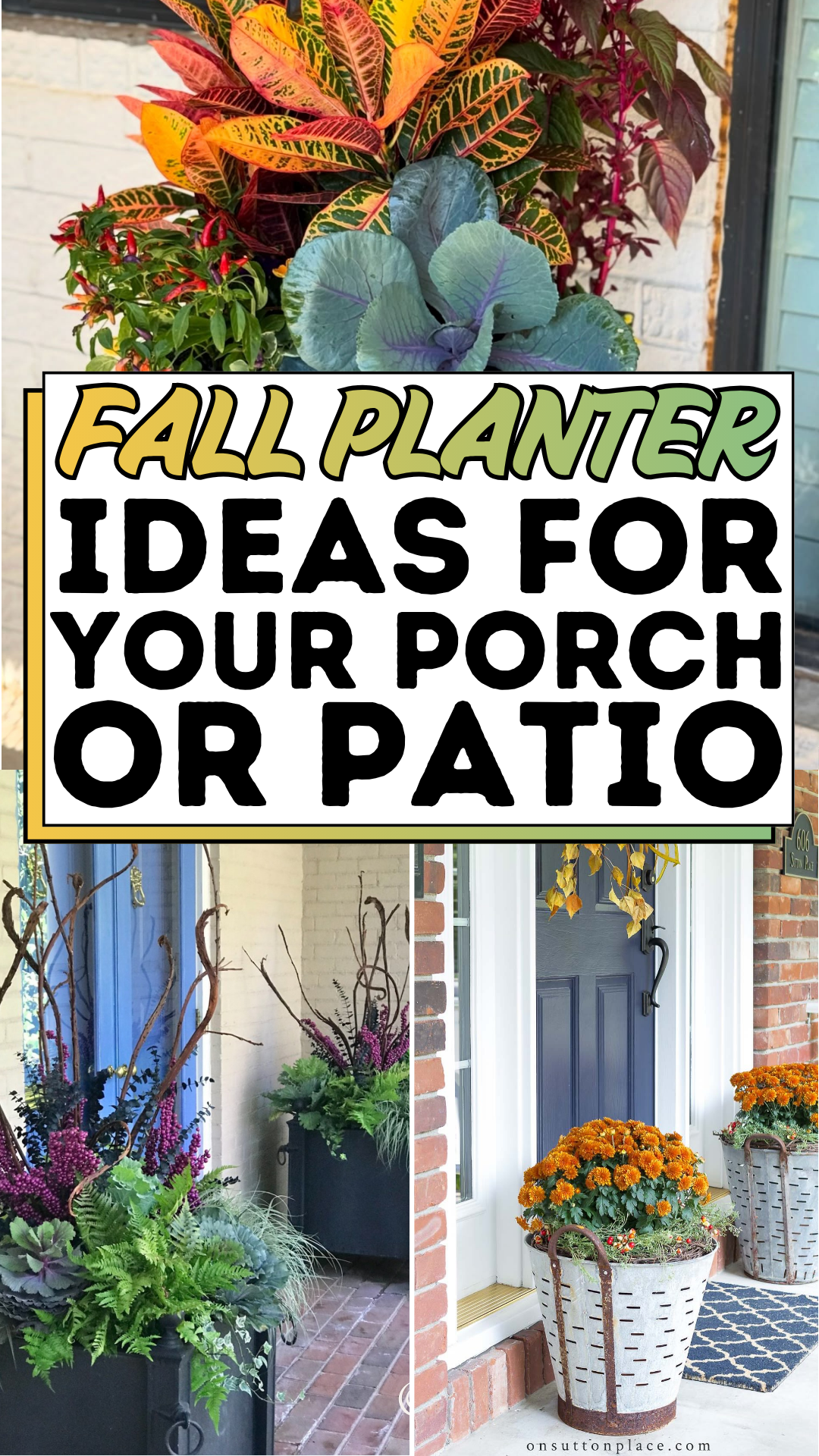
The fall planter transition is the seasonal gap that catches most households by surprise even when they know it is coming. The summer plants are clearly done, the garden center’s fall section is full of appealing options, but the composition question what goes together, what container suits the scale of the porch, how many plants create abundance without crowding, what the finished fall planter should actually look like goes unanswered until the moment has partially passed. A trip to the garden center with no plan produces either too little (one lone mum in an existing container) or too much (four containers in three different sizes that do not relate to each other), and neither is the fall planter entrance experience the season deserves.
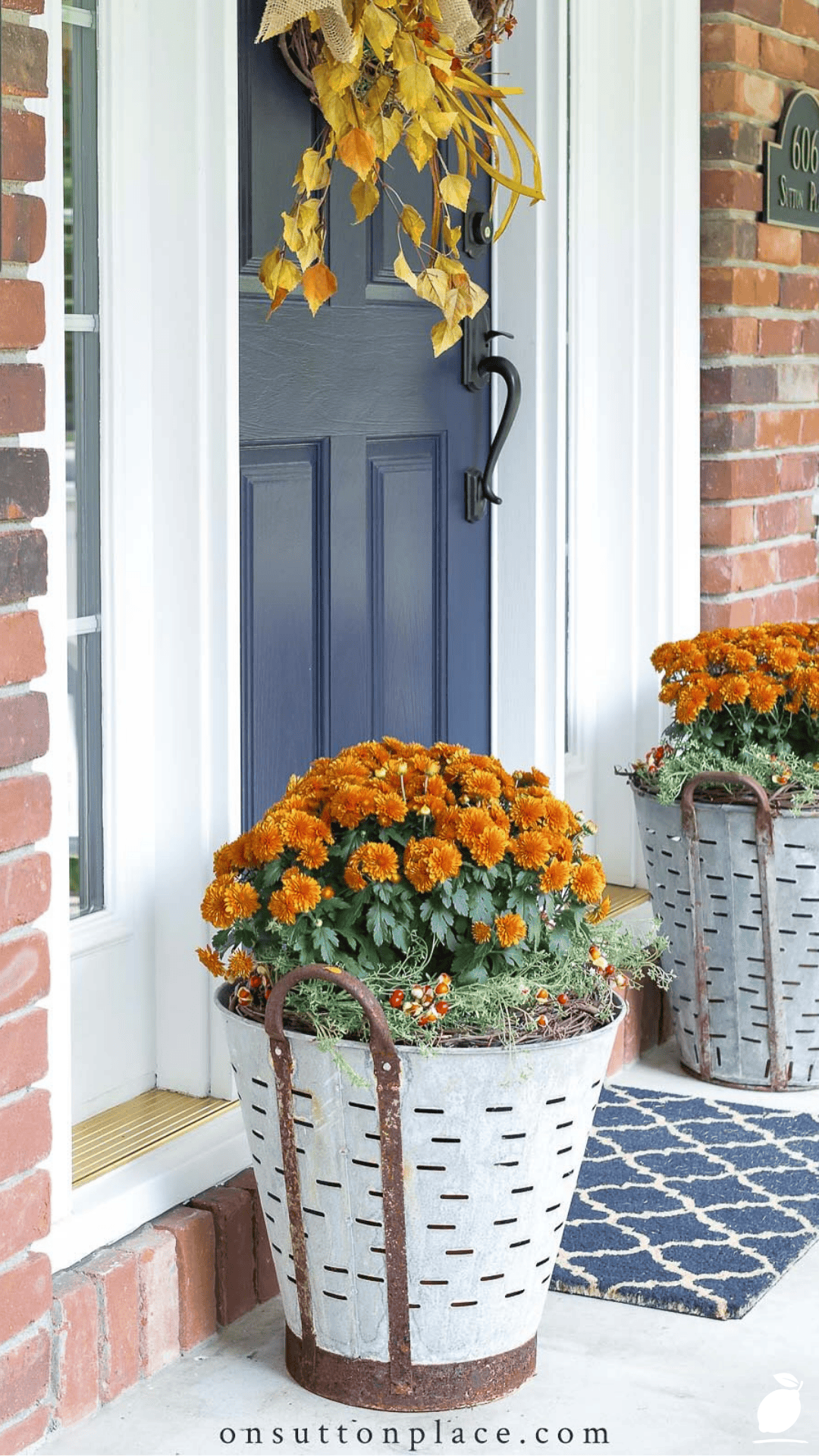
The entrance in the image resolves all of those questions in a single glance. Two oversized galvanized metal containers flank a navy blue door, each filled with vibrant orange mums in full bloom, sitting on a concrete slab with a patterned mat beneath them. The autumn wreath on the door echoes the orange of the mums and the golden-yellow of fallen leaves. The scale of the containers matches the scale of the entrance. The simplicity of the arrangement two matching containers, one plant type, maximum color impact is what makes it work. That simplicity is not the absence of thought. It is the result of it. Here is the blueprint for achieving the same result on any porch or patio.
The Fall Planter Blueprint
A fall planter for a porch or patio entrance is a project with a clear logic: container choice first, plant selection second, arrangement third, and maintenance fourth. Following this sequence produces a fall planter that looks designed rather than assembled.
Step 1: Assess the Scale and Symmetry of Your Porch
Before selecting any container or plant for a fall planter, assess the specific scale of the porch or patio entrance it will occupy. A fall planter that is correctly sized for its position reads as intentional and generous; one that is too small reads as tentative; one that is too large obstructs the entry and competes with the architecture.
Measure the width of the area available on each side of the front door. For a porch entrance, the fall planter’s diameter or width should be approximately 30 to 40% of the available width on each side, large enough to make a visual statement without blocking the path to the door. The height of the fall planter, including the plant material, should be proportionate to the door height, approximately 30 to 40% of the door height as a visual guideline for the total planter-plus-plant composition.
Decide on the symmetry structure: two matching fall planters flanking the door (as in the image) is the most formal and most impactful arrangement, particularly for an entrance with a center-positioned door and equal space on both sides. A single large fall planter to one side of the door suits an asymmetric porch where space is limited or where the design aesthetic is less formal. Mixed-size groupings, such as a large fall planter with two smaller ones, suit wider porch entries where a single planter on each side would look insufficient.
Step 2: Choose the Container for Maximum Visual Impact
The container is the most permanent element of the fall planter and the one that most directly communicates the entrance’s aesthetic character. A fall planter container choice that relates to the house’s exterior materials and colors creates a composed visual relationship between the entrance and the architecture; one that does not relate creates a “placed object” quality that no amount of beautiful plant selection can overcome.
For a traditional brick or stone exterior (like the house in the image): galvanized metal or antique zinc containers, aged terracotta, stone-effect concrete, and dark-glazed ceramic all relate naturally to the masonry texture. The oversized galvanized metal containers in the image are specifically right for the brick-walled house; their industrial material echoes the permanence of the brick while their casual scale prevents the entrance from reading as too formal.
For a painted timber or clapboard exterior: wooden planters, painted galvanized containers, and ceramic pots in colors that reference the house trim or door color all work. A fall planter in a navy-painted timber planter beside a navy front door creates a visual continuity between the entrance elements that reads as deliberately coordinated.
For a contemporary stucco or rendered exterior: smooth-sided concrete pots, geometric metal containers, and large terracotta cylinders in a clean profile suit the minimalist aesthetic without competing with the architectural simplicity.
Size up where uncertain: a fall planter that is slightly larger than initially planned is almost always more visually successful than one that is slightly smaller.
Step 3: Select Plants for Color, Texture, and Duration
The plant selection for a fall planter is a combination of four elements: a thriller (tall, architectural), a filler (rounded, abundant), a spiller (trailing, softening edges), and a seasonal accent (a non-plant element that completes the fall theme).
The orange mum in the image is functioning as both the thriller and the filler simultaneously; its dense, rounded form and vibrant orange color are the visual center of the fall planter without requiring a separate architectural element above it. Chrysanthemums (mums) are the most reliable and most widely available fall planter plant, available in colors from pure white through cream, yellow, bronze, rust, and deep burgundy. For the warmest autumn palette, use orange and deep rust mums; for a more refined autumn palette, use cream and bronze mums with dark foliage accents.
Complementary fall planter plants for a layered arrangement:
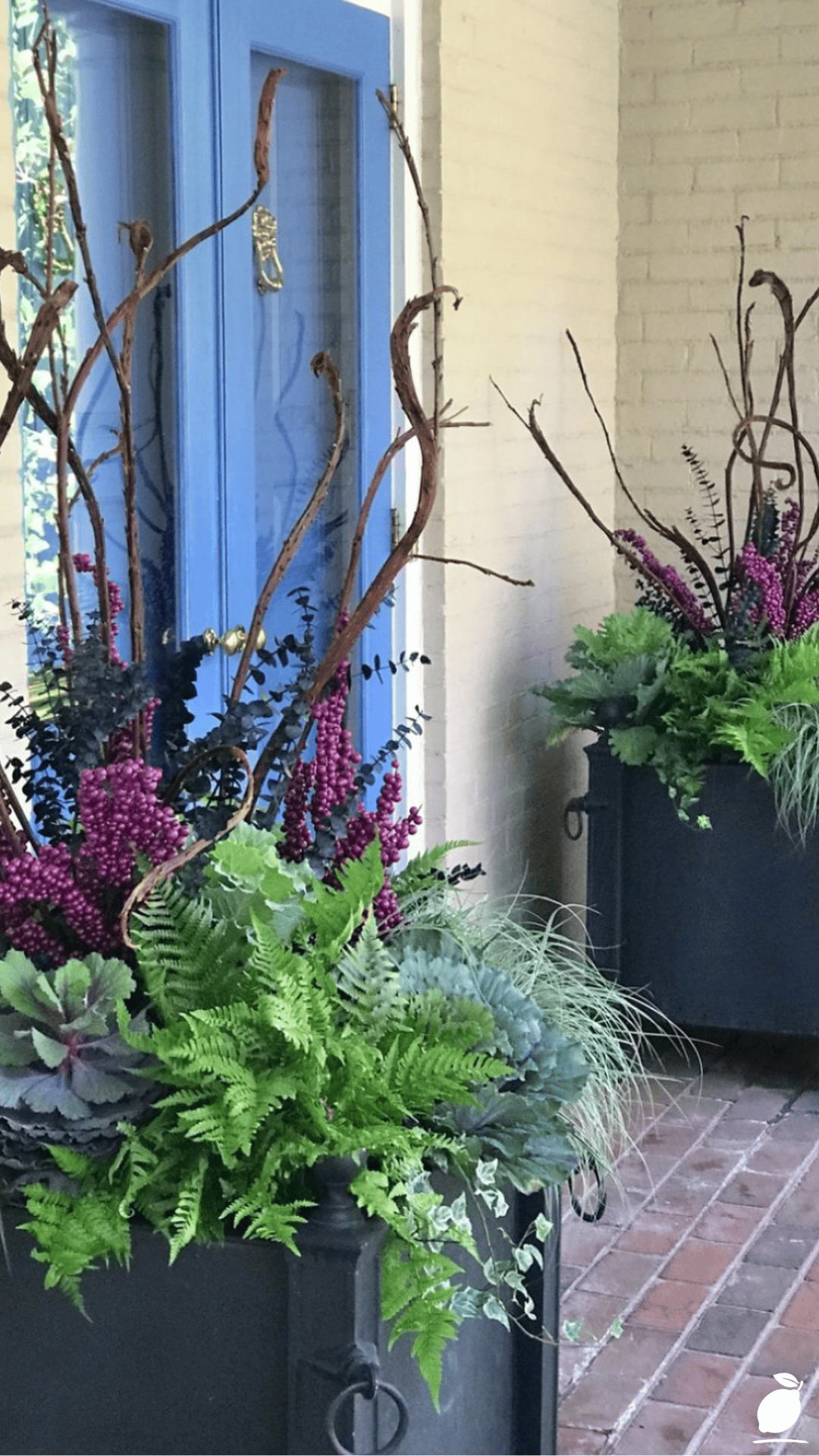
- Ornamental kale or cabbage adds purple-grey foliage that contrasts with orange mums
- Dusty miller silver-grey foliage that reflects light and brightens the arrangement
- Creeping Jenny lime-green trailing foliage that spills over the planter edge
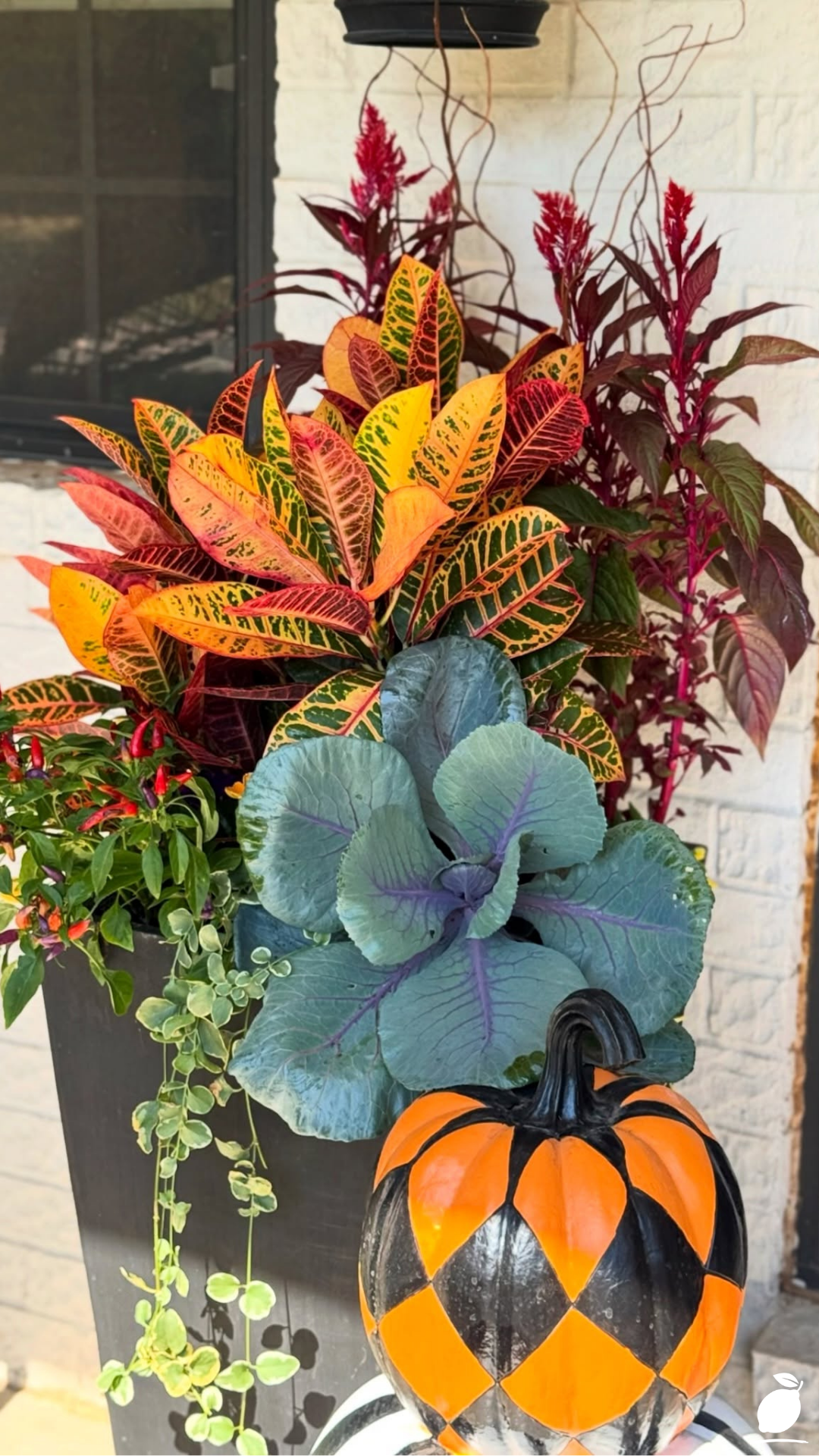
- Croton dramatic multicolor foliage in orange, red, and yellow for a tropical-autumn feel
- Ornamental grass upright, arching, textural height at the back of a large fall planter
Seasonal accents: Small pumpkins or gourds placed at the base of the fall planter, dried corn stalks tied to a porch column, or a branch of rosehips tucked into the arrangement extend the fall theme beyond the plant palette into the season’s characteristic seasonal materials.
Step 4: Prepare the Container and Plant Correctly
A fall planter that is over-watered or poorly drained will decline within the first week of its display season, regardless of how beautifully it was arranged. Proper container preparation is the step that determines how long the fall planter maintains its appearance through October and into November.
Ensure the container has adequate drainage holes, a minimum of one hole per 15cm of container diameter, drilled or knocked through the base if not already present. Cover drainage holes with a piece of landscape fabric or a coffee filter before adding potting mix; this prevents the mix from washing through while allowing water to drain freely.
Fill the container with a high-quality, peat-free potting mix rather than garden soil; garden soil compacts in a container environment, restricts root development, and retains moisture unevenly. For fall planter containers that will be outdoors through the full autumn season, add a granular slow-release fertilizer to the potting mix at the manufacturer’s recommended rate to support plant health through the cooler weeks.
Plant at the correct spacing for the fall planter’s size: mums planted at 15 to 20cm centers in a large container will fill the available space within two to three weeks of planting and reach the lush, dense appearance of the image by the time of their first display. Planting too loosely produces a fall planter that looks sparse rather than abundant through the early weeks of the season.
Step 5: Position and Style the Completed Fall Planter
Place the completed fall planter in its position at the entrance and step back to assess the composition from the approach angle the viewpoint from which most visitors and all photographs will see it. The fall planter should read as part of the entrance composition, not as an object placed in front of it.
Adjust the height of the fall planter if necessary by placing it on a brick, a stone, or a low platform; a fall planter raised slightly from the ground reads as deliberately positioned rather than simply rested there. Add a doormat beneath or in front of the fall planter arrangement (as in the image) to anchor the ground-level composition and create a defined zone of the entrance styling.
Complete the fall planter entrance with coordinated door décor; a seasonal wreath that echoes the fall planter’s colors is the most immediate way to create visual continuity between the door and the planter arrangement. The golden-yellow leaf wreath in the image relates directly to the orange mums in the fall planter, creating the unified entrance palette that makes the whole composition feel designed.
Expert Secrets for Success
Pro-Tips for a Better Result
- Water fall planter mums from below, not above. Mums in a fall planter are prone to botrytis (grey mold) when their dense foliage and flower heads are repeatedly wetted from overhead watering. Place the fall planter in a shallow tray and water from below, or water at the soil level using a watering can with a long spout that reaches beneath the foliage canopy. Bottom-watering or targeted watering prevents the moisture accumulation in the flower heads that causes premature browning and mold in cool autumn conditions.
- Buy fall planter mums in bud, not in full bloom. A chrysanthemum purchased in full bloom in late September has already used a significant proportion of its display potential. A mum purchased with most buds still closed extends its fall planter display season by two to three weeks relative to a fully open equivalent. Squeeze the bud clusters gently to check firmness; firm, tightly closed buds indicate maximum remaining display potential; loose or already-partially-open buds indicate a shorter remaining season.
- Use oversized containers for maximum visual impact. The galvanized metal containers in the image are significantly larger than standard nursery containers; they are tub- or barrel-sized, which is why two of them flanking a standard-width door create such strong visual presence. A fall planter in an oversized container reads as a design decision; one in a standard-sized nursery pot reads as a plant purchase. If in doubt, choose the larger container size; fall planter compositions almost always benefit from more volume rather than less.
- Deadhead mums weekly to extend their bloom period. Remove spent flower heads on a fall planter mum weekly by pinching them off at the base of each individual flower stem. Deadheading diverts the plant’s energy from seed production into the continued opening of remaining buds, extending the fall planter’s display season by one to three weeks beyond an undeadheaded equivalent.
- Bring tender fall planter elements indoors before the first frost. Crotons, ornamental basil, and certain trailing plants used in fall planter arrangements are frost-tender and will be killed by the first hard frost if not moved indoors. Identify the frost-tender elements of the fall planter at the point of planting and plan their indoor transition so that many survive and thrive as houseplants through winter when the autumn display season ends.
Common Mistakes to Avoid
- Choosing a container that is too small for the porch scale. A fall planter in a 25cm diameter pot on a wide porch flanking a full-size front door reads as inadequate regardless of how beautiful the plant arrangement within it is. The container scale must match the architectural scale of the entrance. When the porch is large, the fall planter must be commensurately large; the image demonstrates this with containers that appear to be 50 to 60cm in diameter, sized to a wide brick wall entrance.
- Over-mixing plant types in a single fall planter. A fall planter containing five different plant species in a single container often reads as visually restless, each species competing for attention rather than contributing to a unified composition. The most impactful fall planters use one dominant plant type (the mum in the image) with at most one or two supporting plant types. The restraint produces abundance; the variety produces confusion.
- Neglecting to deadhead and water consistently. A fall planter that looked magnificent at installation and has been left unattended for three weeks is a fall planter whose spent brown flower heads are visible from the street and whose remaining buds have not opened due to drought stress. A fall planter requires more consistent attention than a garden bed because the contained soil volume dries out faster and the plant density creates higher moisture competition between plants. Check soil moisture every two to three days and deadhead weekly as a minimum maintenance commitment.
- Placing the fall planter in a position that contradicts the entrance’s symmetry. A single fall planter placed off-center at an entrance that is architecturally symmetrical creates a visual imbalance that draws attention to the asymmetry rather than the beauty of the fall planter. Either place two matching fall planters symmetrically, or place one fall planter on the side of the entrance where the asymmetry of the porch design already accommodates a single object (a bench, a column, an existing planting bed).
- Using potting mix from a previously used container without refreshing it. Potting mix from a previous season’s container planting is depleted of nutrients, possibly harboring disease organisms, and structurally degraded; it compacts in the container during the growing season and no longer provides the free-draining, nutrient-available medium that a fall planter plant needs to establish and perform quickly. Use fresh potting mix for the fall planter season, incorporating a slow-release fertilizer for maximum performance through the autumn months.
Why Fall Planter Matters
A fall planter at the front entrance of a home is the most public expression of seasonal care that a household makes the declaration, visible from the street and experienced by every visitor, that the people who live here have marked the change of season with intention and attention. The two orange mum planters in the image are not just plants. They are a welcome signal that the entrance has been thought about, that the season has been noticed, and that arriving here is arriving somewhere that is tended and loved. That signal is received before anyone knocks, before a word is spoken, before the door opens.
For families, the fall planter project is one of the most accessible seasonal decorating activities available across age ranges. Older children can help with the planting; younger ones can choose between the white pumpkin and the orange one for the ground-level accent. Partners can divide the labor of container selection and plant arrangement. The completed fall is a household achievement that everyone contributed to, and everyone benefits from in the daily experience of leaving and returning home through the autumn months. It grounds the household in the season and in the shared effort of making the home welcoming.
And for the person who selects the containers, chooses the mums in bud, mixes the potting medium, plants at the right spacing, and positions the finished fall planter at the correct height beside the door, the result is the specific satisfaction of a home improvement that produces its return immediately and continuously. Every morning departure and every evening return through October and November encounters the fall planter at its best. The season is marked. The entrance is welcoming. The simple, repeatable act of making the outside of the home reflect the care that goes into the inside has been completed for another autumn.
Frequently Asked Questions
How long do fall planter mums last outdoors?
Chrysanthemums purchased in late September or early October with most buds still closed typically display for four to six weeks outdoors before frost damage or natural bud exhaustion ends the primary display. With weekly deadheading and consistent bottom-watering, fall planter mums can extend their display period to six to eight weeks in mild autumn conditions. The first hard frost (below -2°C / 28°F) typically ends the outdoor display season for most chrysanthemum varieties, though hardy garden mum varieties can survive light frosts and extend the fall season into November in temperate climates.
What is the best fall planter alternative if mums are unavailable?
If chrysanthemums are unavailable or if a more unusual fall planter composition is preferred, the most effective alternatives are: ornamental kale or cabbage (vibrant purple-grey rosette form that provides bold color without flowers), asters (small daisy flowers in purple, pink, and white that bloom in autumn), rudbeckia (black-eyed Susan, golden-yellow flowers available into October in mild climates), and crotons (tropical foliage in autumn colors that provides visual warmth without seasonal bloom). Any of these can anchor a fall composition with the same visual impact as mums when planted at sufficient density in a correctly scaled container.
Can I reuse a fall planter container for winter and spring seasonal displays?
Yes, a container purchased for a fall planter is one of the most reused seasonal décor investments available. After the autumn display season ends, remove spent mum plants, refresh the potting mix, and replant with winter pansies, ornamental cabbages, or evergreen trailing ivy for a winter fall planter display. In spring, replant with tulip or daffodil bulbs (planted in autumn beneath winter plants for spring flowering), polyanthus, or early geraniums. The oversized galvanized containers in the image are particularly valuable for seasonal replanting because their scale suits generous displays in every season and their material ages attractively over multiple years of outdoor use.