When we found out we were expecting, the first question everyone asked after “How are you feeling?” was some variation of “So pink or blue?” We had decided not to find out the sex before birth, which we thought was a perfectly reasonable choice until we were standing in a big-box baby store surrounded by two completely separate universes: one drowning in pink ruffles and princess graphics, the other buried under navy blue trucks and superhero logos. Neither felt like us. Neither felt like the calm, warm, personal space we wanted to create for a brand-new person who had not yet had a single opinion about their own aesthetic. We walked out without buying anything and spent the next two weekends scrolling through imagery of rooms that felt right, soft, bright, sweet without being saccharine, and slowly, the vision for a gender neutral nursery began to take shape.

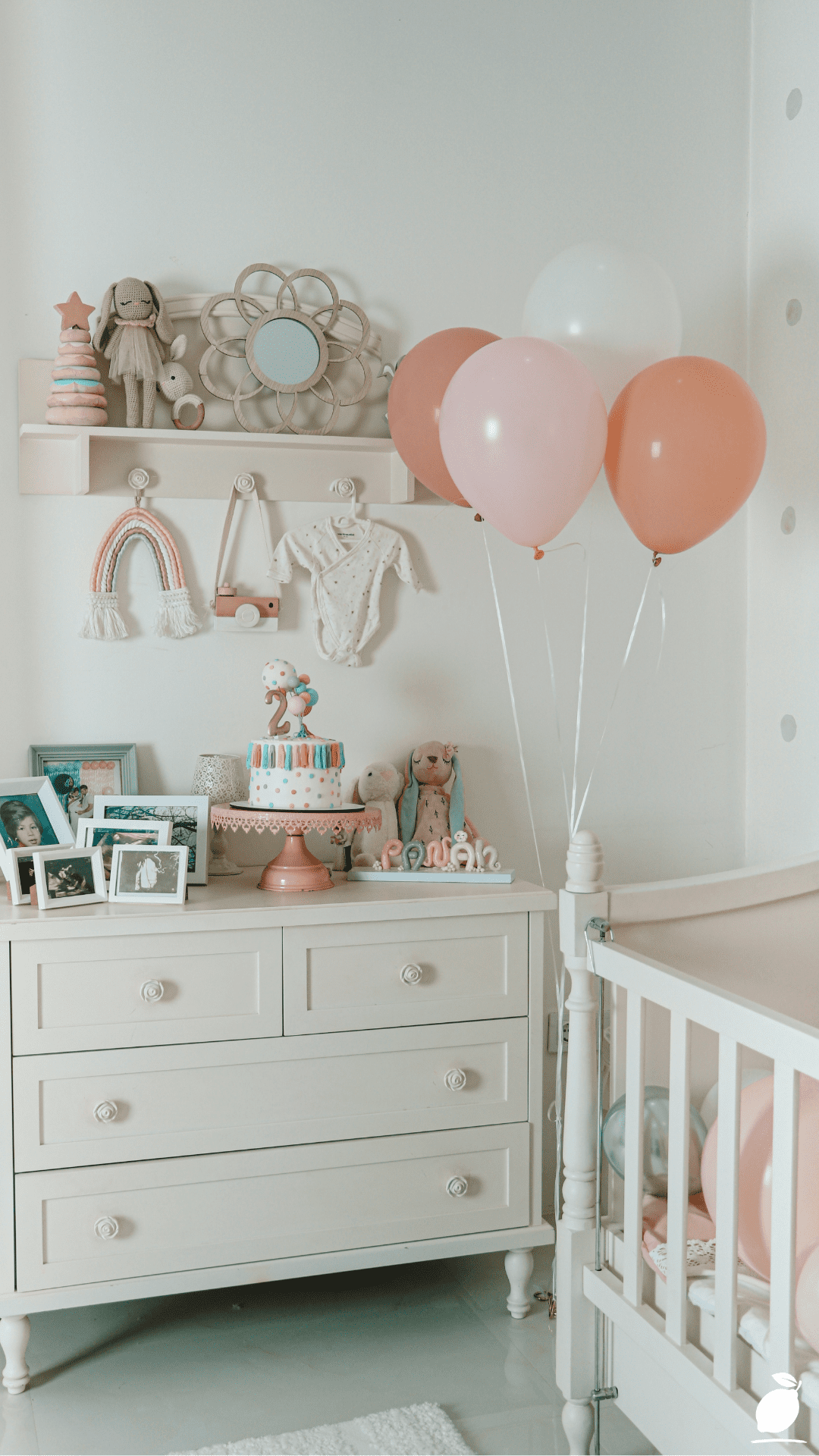
The nursery in the image above is that vision made real. It is a gender neutral nursery in the fullest and most beautiful sense, not a compromise between pink and blue, but a completely independent, wholly considered palette that belongs to no gender binary and every child simultaneously. White walls and light wood floors form the serene base. A white wooden dresser against one wall holds a cluster of small framed photographs, a small striped birthday cake on a pink scalloped stand, a brown teddy bear in a soft blue-and-white outfit, and a cheerful wooden “LOVE” block on a dresser top that tells a whole story of love and celebration without a single gendered element.
Above and beside the dresser, a wall-mounted shelf holds a wooden star-shaped tower, a plush bunny, and a round mirror with a decorative, scalloped wooden frame. A rainbow mobile with white tassels hangs from the wall alongside a white lace baby onesie on a hook. In the corner, a white wooden crib with vertical slats and a curved headboard holds several large peach and light pink translucent balloons that float softly above the mattress. Three more of those same balloons drift in the open space of the room, their warm peach and blush tones catching the soft, diffused light. This gender neutral nursery is not a room built around a gender. It is a room built around a feeling of warmth, wonder, and the particular tenderness of waiting for someone you already love.
Creating a gender neutral nursery is one of the most creatively satisfying decorating projects you can undertake, precisely because it removes the binary shortcut and asks you to make real decisions about what you actually want the room to feel like. The answer, for almost everyone who tries it, is some version of what this image shows: soft, light, whimsical, warm, and personal, a room that could belong to any child because it belongs to this one specifically, filled with objects chosen for their beauty and meaning rather than their gender-coded color. This guide will walk you through every step of building that room, from palette to furniture to finishing details.
The Gender Neutral Nursery Blueprint
Step 1 — Build the Gender Neutral Nursery Palette Around Warmth, Not Neutrality
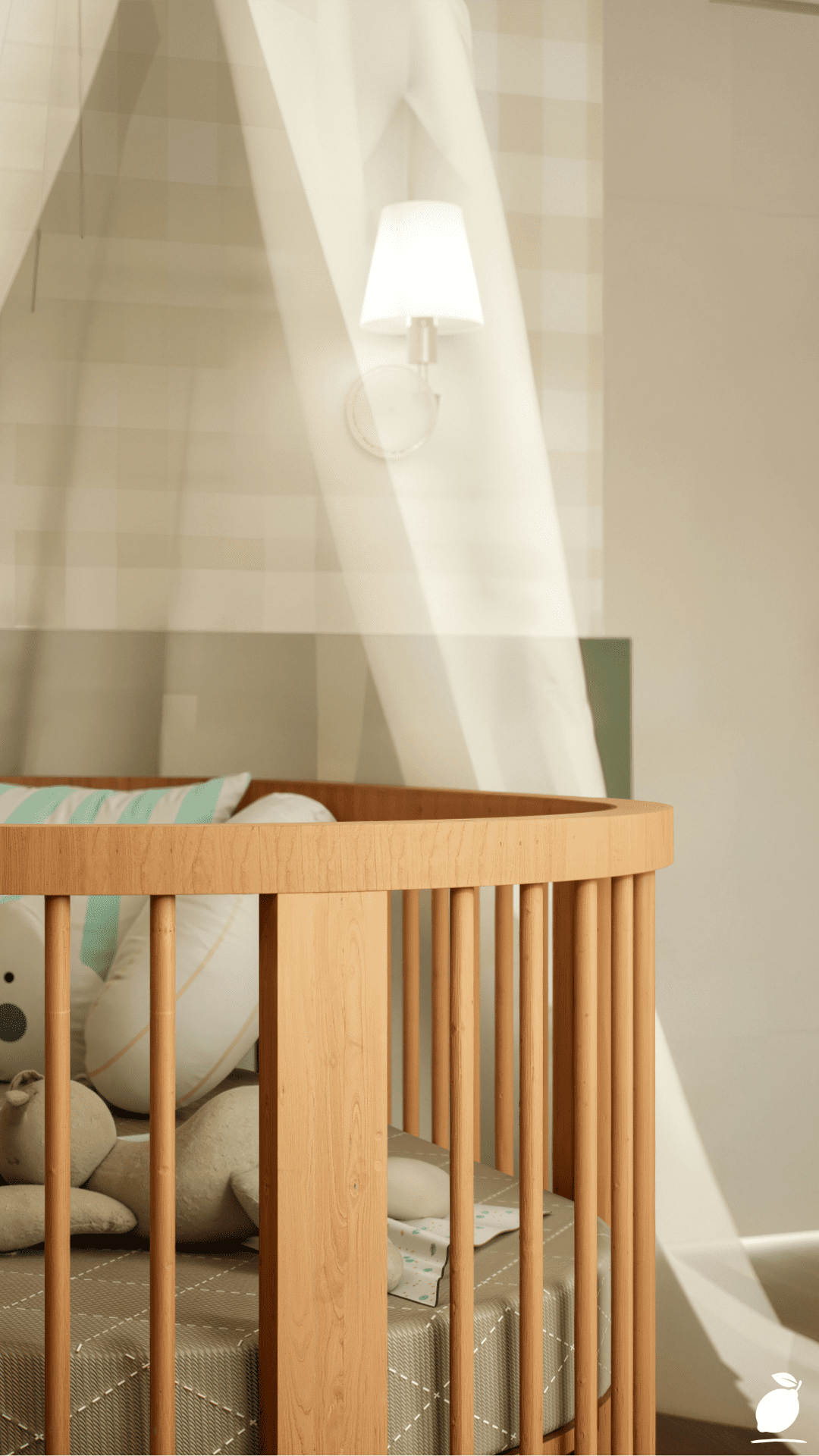
The most common mistake in this style begins at the palette stage: choosing colors that are neutral in the sense of being colorless, gray, greige, or stark white in an attempt to avoid pink or blue entirely. The nursery in the image takes a completely different and more successful approach. Its gender neutral nursery palette is built around warm, soft, muted tones: peach (), blush pink (), warm white (), and the natural honey of light wood. These colors are warm rather than cold, soft rather than saturated, and they belong to no gender exclusively. Peach and blush are equally at home in any child’s room. Choose your palette by asking what feeling you want the room to produce, not which gender category each color belongs to.
Step 2 — Choose White Furniture as the Gender Neutral Nursery Anchor
White furniture is the single most versatile and enduring choice for a gender neutral nursery, and the image demonstrates exactly why. The white wooden dresser and the white wooden crib with its vertical slats and curved headboard are both beautiful in their own right and completely invisible as gender signals; they contribute structure, warmth, and timeless quality without pushing the room toward any particular identity. Choose a white crib and white dresser as your primary furniture pieces. White also has a practical advantage: it grows with the room. When the space eventually transitions to a toddler room and then a child’s bedroom, white furniture adapts to every iteration without replacement.
Step 3 — Layer the Gender Neutral Nursery Walls with Meaningful, Non-Gendered Elements
The wall arrangement in the gender neutral nursery image is a masterclass in whimsical, personal decoration that carries no gender coding whatsoever. A scalloped-frame round mirror, a rainbow mobile with white tassels, a wooden star tower, a plush bunny, and a hanging white lace onesie. Each element is sweet and nursery-appropriate, and none of them signals boy or girl. For your walls, choose decorative elements from the natural and whimsical world: rainbows, stars, moons, animals, clouds, botanical shapes, and geometric forms all feel at home in any such space. Arrange them at varying heights and in varying scales, a mix of wall-mounted shelves, hooks, and directly hung pieces to create the layered, collected quality that makes a room feel personal rather than catalog-generic.
Step 4 — Use Balloons as an Affordable, Impactful Gender Neutral Nursery Statement
The large translucent peach and blush pink balloons in the gender neutral nursery image, three floating freely in the room, several more arranged inside the crib, are one of the most visually dramatic and least expensive design elements in the entire space. In pastel, translucent finishes, balloons read as decorative art objects rather than party accessories, and they introduce a sense of lightness and whimsy that permanently installed elements simply cannot replicate. For a photoshoot, a milestone celebration, or simply an occasional refresh of the room’s festive atmosphere, large translucent or matte balloons in peach, blush, sage green, cream, or lavender are an inexpensive and endlessly repeatable accent. Choose colors within your established palette and allow them to float at different heights for maximum visual effect.
Step 5 — Style the Gender Neutral Nursery Dresser as a Personal Gallery
The top of the white dresser in the gender neutral nursery image tells a story in miniature: a cluster of small framed photographs captures the family’s love and history, a striped birthday cake on a pink scalloped stand marks a milestone, a plush teddy bear in a soft outfit brings warmth and softness, and a wooden “LOVE” block states the room’s governing emotion directly. Treat this surface as a curated display of love rather than a storage surface or a themed vignette. Choose five to seven objects that are meaningful to your family: a photo of each parent, a keepsake from the birth, a toy with a story, a small plant, and arrange them with intention. The dresser top should be the room’s most personal corner.
Step 6 — Introduce Natural Wood Elements Throughout the Gender Neutral Nursery
Natural wood is one of the most powerful and universally appropriate materials in a gender neutral nursery because it is warm without being gendered, organic without being rustic, and beautiful at every budget level. In the image, it appears in the star-shaped toy tower on the shelf, in the scalloped mirror frame, in the dresser’s turned legs, and in the light wood floor that grounds the entire composition. Introduce it in your own space through a floating shelf, a rocking chair, a wooden letter or word sign, a toy storage unit, or even small decorative objects. Wood does the same work that strong color does in a traditionally themed room. It makes the space feel alive, personal, and welcoming without any gender association.
Step 7 — Complete the Gender Neutral Nursery with Soft Textiles and Plush Accents
The gender neutral nursery in the image is softened at every scale by plush and textile accents: the plush bunny on the shelf, the teddy bear on the dresser, the white lace onesie hung decoratively on the wall hook, and the balloon strings trailing softly toward the floor. Soft textiles, a woven swaddle blanket draped over the crib rail, a sheepskin rug on the floor, a macramé wall hanging, a knitted stuffed animal, add tactile warmth that no hard-surface element can provide. Choose your textiles in the same warm palette as your walls and furniture: cream, blush, peach, oat, and sage are all beautiful choices that feel at home across every season and every stage of early childhood.
Expert Secrets for Success
Pro-Tips for a Better Result
Pro Tip 1 — Use a Rainbow as the Gender Neutral Nursery’s Signature Motif. The rainbow mobile in the image is not a coincidence; it is one of the most beloved and effective gender neutral nursery motifs precisely because it contains every color simultaneously and belongs to no gender exclusively. A rainbow says joy, wonder, and the full spectrum of possibility without saying boy or girl. Introduce the rainbow motif through a mobile, a wall print, a wooden cutout, a woven textile, or even a subtle paint treatment on one wall. It is the one decorative choice that will never need to be changed or justified as children grow and gender expressions evolve.
Pro Tip 2 — Frame Small Photographs as Gender Neutral Nursery Wall Art. The cluster of small framed photographs on the dresser in the image is one of the most beautiful and most overlooked art strategies for a gender neutral nursery. Real photographs of the family, the pregnancy, the birth, and the early days are, by definition, the most personal and most appropriate art for any nursery; they are specific to this child rather than generic to a theme. Use white or natural wood frames in a mix of sizes, arrange them in an organic cluster rather than a rigid grid, and update them regularly as the child grows. No purchased art print will ever be as meaningful as a real family photograph.
Pro Tip 3 — Choose a Scalloped or Organic Mirror Shape for the Gender Neutral Nursery. The round mirror with a decorative, scalloped wooden frame in the gender neutral nursery image introduces visual softness and playful character without any gender association. Round and scalloped shapes are particularly well-suited here because their organic, non-angular forms echo the soft, rounded quality of the rest of the palette. A scalloped round mirror above or beside the dresser serves multiple functions: it reflects light and makes the room feel larger, adds a decorative element with visual weight, and introduces natural wood in a format that reads as art rather than furniture.
Pro Tip 4 — Plan the Gender Neutral Nursery for Longevity, Not Just Infancy. The most practical gender neutral nursery design principle is also the most overlooked: the room should be beautiful and functional, not just in the newborn stage but through toddlerhood and into early childhood. The white furniture, natural wood accents, rainbow motifs, and warm pastel palette in the image will all remain appropriate and beautiful as the child grows from infant to toddler to preschooler. When making every decision, furniture, paint color, wall art, storage, ask whether it will still feel right in three years. Choices that pass that test are the ones that make the space a genuinely long-term investment rather than a room that needs redesigning in eighteen months.
Common Mistakes to Avoid
Mistake 1 — Defaulting to Gray as the Gender Neutral Nursery Color. Gray has become the default color choice for parents simply trying to avoid pink and blue, and it is one of the most common gender neutral nursery design regrets. Gray nurseries tend to feel cold, flat, and clinical, the opposite of the warm, nurturing atmosphere that a newborn’s room should embody. The room in the image proves that warmth and gender neutrality are not mutually exclusive: peach, blush, cream, and warm white are all completely gender-neutral in their cultural associations and infinitely warmer in their visual effect than gray. Choose warmth over safety.
Mistake 2 — Over-Theming the Gender Neutral Nursery A gender neutral nursery that is themed around woodland animals, geometric shapes, or celestial motifs to the exclusion of all other elements can feel as restrictive as a traditionally gendered room, just in a different direction. The room in the image avoids this by mixing motifs freely: a rainbow mobile alongside a star tower alongside a bunny alongside a “LOVE” block alongside family photographs. No single theme dominates. Allow the room to be a collection of objects you genuinely love rather than a curated execution of one concept, and it will feel more personal and more lasting as a result.
Mistake 3 — Forgetting That Storage Is Part of the Gender Neutral Nursery Design. A gender neutral nursery that is beautifully styled at the beginning and chaotic with toys, diapers, and baby equipment six weeks later is not a success; it is a staged photograph. Plan your storage with the same care as your styling: the white dresser with four drawers in the image provides substantial storage while remaining a beautiful visual element. Add baskets, bins, and shelving in your palette colors (white, natural wood, cream) to maintain the room’s visual coherence as real life fills it. Beautiful storage is the difference between a nursery that photographs well and one that feels genuinely livable.
Mistake 4 — Purchasing gender-neutral nursery furniture before measuring the Room. The gender neutral nursery in the image achieves its airy, spacious quality partly because the furniture, the dresser, and the crib are proportioned correctly for the room’s dimensions. One of the most common regrets is purchasing furniture before measuring carefully, resulting in a crib that crowds the dresser, a changing table that blocks the window, or a glider that leaves no floor space for play. Before buying a single piece of furniture, draw your room to scale and place furniture shapes within it. The calm, uncluttered quality depends on getting proportion right before anything else.
Why Gender Neutral Nursery Matters
A gender neutral nursery is, at its heart, a declaration about what you believe a child deserves from their very first room: a space designed around their personhood rather than their gender, built for warmth and wonder rather than conformity to a color binary that someone else invented before they were born. That declaration matters more than most parents realize in the planning stage. Such a room belongs genuinely to the specific child who will grow up in it, filled with objects chosen for their beauty, their meaning, and their capacity to delight, not for their adherence to a marketing category. That quality of genuine intention is something children feel before they can name it, and it shapes the earliest sense they develop of home as a place made with love.
For parents navigating the overwhelm of expecting a new baby, the decisions, the purchases, the opinions from every direction, the gender neutral nursery offers something genuinely valuable: freedom. Freedom from the pink aisle and the blue aisle, freedom from the pressure to know the sex early or to reveal it publicly, freedom to make a room that reflects your family’s actual aesthetic rather than a demographic assumption. That freedom is not trivial. The period of preparing this kind of space can be one of the most creatively joyful experiences of new parenthood, a chance to make something beautiful and permanent before the beautiful, permanent person arrives to inhabit it.
And in practical terms, a well-designed gender neutral nursery is one of the most financially sound decisions a family can make. A room built on a palette of warm whites, natural wood, and soft pastels rather than a strongly gendered theme will not need to be repainted, refurnished, or re-accessorized if a second child of a different sex arrives. It grows with the child, adapts to the family, and ages gracefully rather than requiring the wholesale redesign that a heavily themed room almost inevitably demands. It is beautiful now, and it remains beautiful later, which is the highest standard any room in a home can meet.
Frequently Asked Questions
What colors work best in a gender neutral nursery?
The most successful gender neutral nursery palettes are built around warm, soft, muted tones rather than cold neutrals. Peach, blush, sage green, warm cream, soft lavender, oat, and muted terracotta are all beautiful color choices that feel warm and welcoming rather than sterile or bland. Warm white is almost always the right choice for walls and large furniture, with the palette’s warmth introduced through textiles, accessories, and accent colors. The key color principle: warm trumps neutral, and soft trumps saturated.
How do I make a gender neutral nursery feel personal and not generic?
The most powerful gender neutral nursery personalization strategies are: displaying real family photographs rather than purchased art prints, choosing one or two motifs that have genuine meaning to your family (a rainbow, a star, an animal your family loves), incorporating handmade or inherited objects rather than all-new purchased items, and styling the dresser top as a curated display of love objects rather than a themed vignette. A gender neutral nursery feels personal when it contains things that could only belong to this specific family, not when it executes a trend correctly.
What furniture is essential for a gender neutral nursery?
The three essential gender neutral nursery furniture pieces are a crib (or bassinet for the early weeks), a dresser or chest of drawers for clothing and diaper storage, and a comfortable chair or glider for feeding and soothing. In a gender neutral nursery, choose all three in white-painted wood or natural wood to create a cohesive, timeless look. A changing table is optional; many parents use a changing pad on top of the dresser to save space. Beyond these three pieces, resist the urge to fill the room with furniture before you know how you will actually use the space.
Can a gender neutral nursery include pink or blue without becoming gendered?
Absolutely. The gender neutral nursery in the image includes clear pink and peach tones in the balloon colors, the cake stand, and the overall palette, and reads as completely gender neutral because those tones are soft, warm, and balanced rather than dominant and saturated. Pink becomes a gendered color when it is the overwhelming organizing principle of a room, not when it appears as one warm tone among several. In a gender neutral nursery, soft pink, soft blue, soft sage, and soft peach can all coexist because none of them is claiming exclusive ownership of the room’s identity.
How do I transition a gender neutral nursery as the child grows?
A well-designed gender neutral nursery is built for longevity and transitions naturally through three stages: the infant stage (crib, changing station, feeding chair, soft textiles), the toddler stage (toddler bed conversion, accessible toy storage, floor space for play), and the early childhood stage (a real bed, a small desk, bookshelf, personal artwork). In each stage, the white furniture and warm neutral palette of a gender neutral nursery remain appropriate, requiring only the addition of age-appropriate accessories and storage rather than a full redesign. Choose furniture with conversion capabilities, cribs that convert to toddler beds, dressers that grow with the child, and the room will serve beautifully for years rather than months.