The guest bathroom is the room you stop thinking about the moment the company stops coming. Between visits, it becomes a holding area for the extra shampoo bottles that didn’t fit under the main bathroom sink, the spare towels folded imprecisely on a shelf that was installed as a temporary measure three years ago, the soap dish that came with the house and that you’ve never liked but have never replaced.

The walls are whatever color the previous owners chose, which was not a color chosen so much as a color accepted. There is a mirror. There is a light. There are the functional elements of a room that work without ever being a room that welcomes. Then someone calls to say they are staying for the weekend, and you walk into that bathroom with a stranger’s eyes and understand, in about four seconds, exactly how much has been left undone.
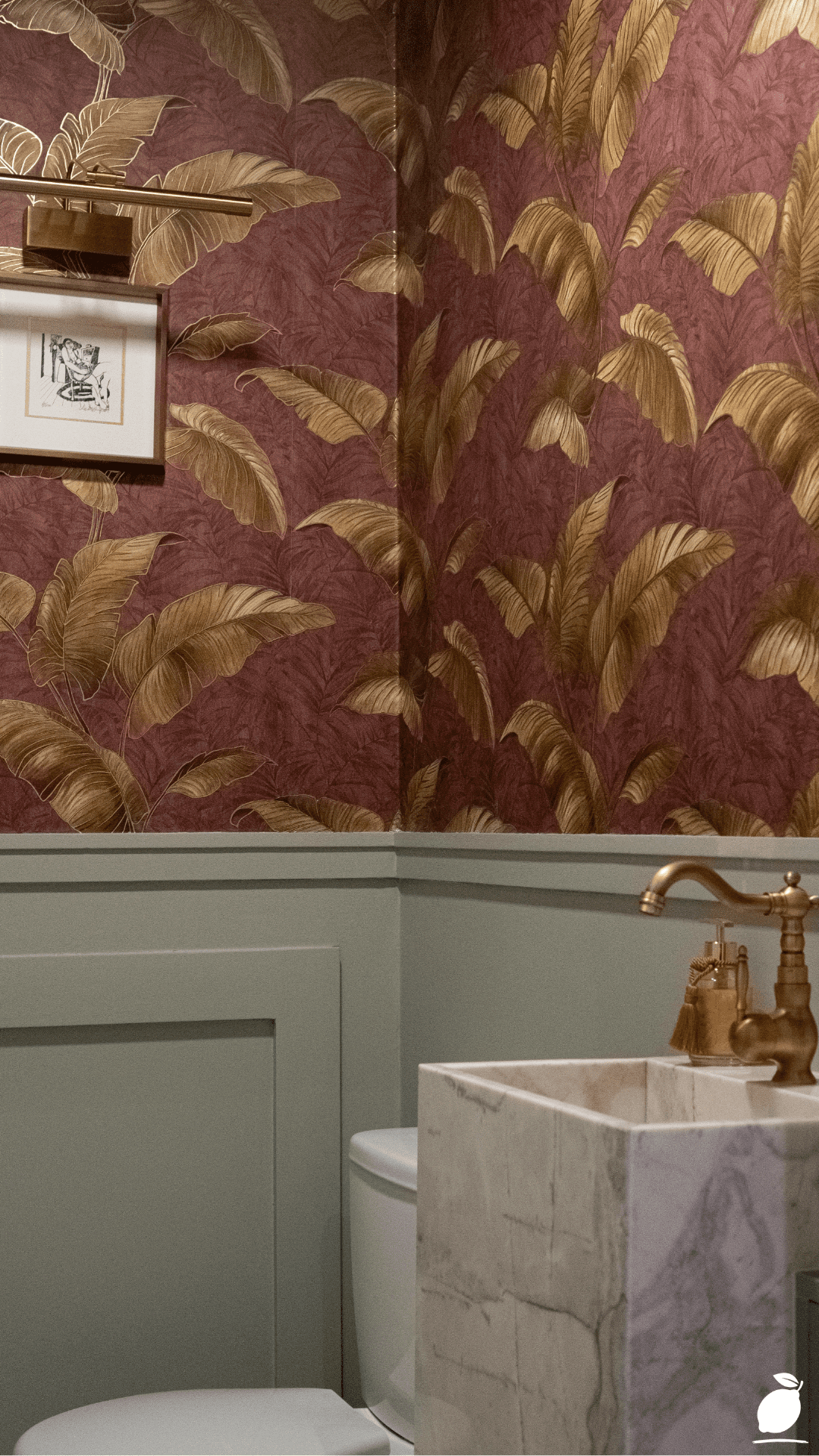
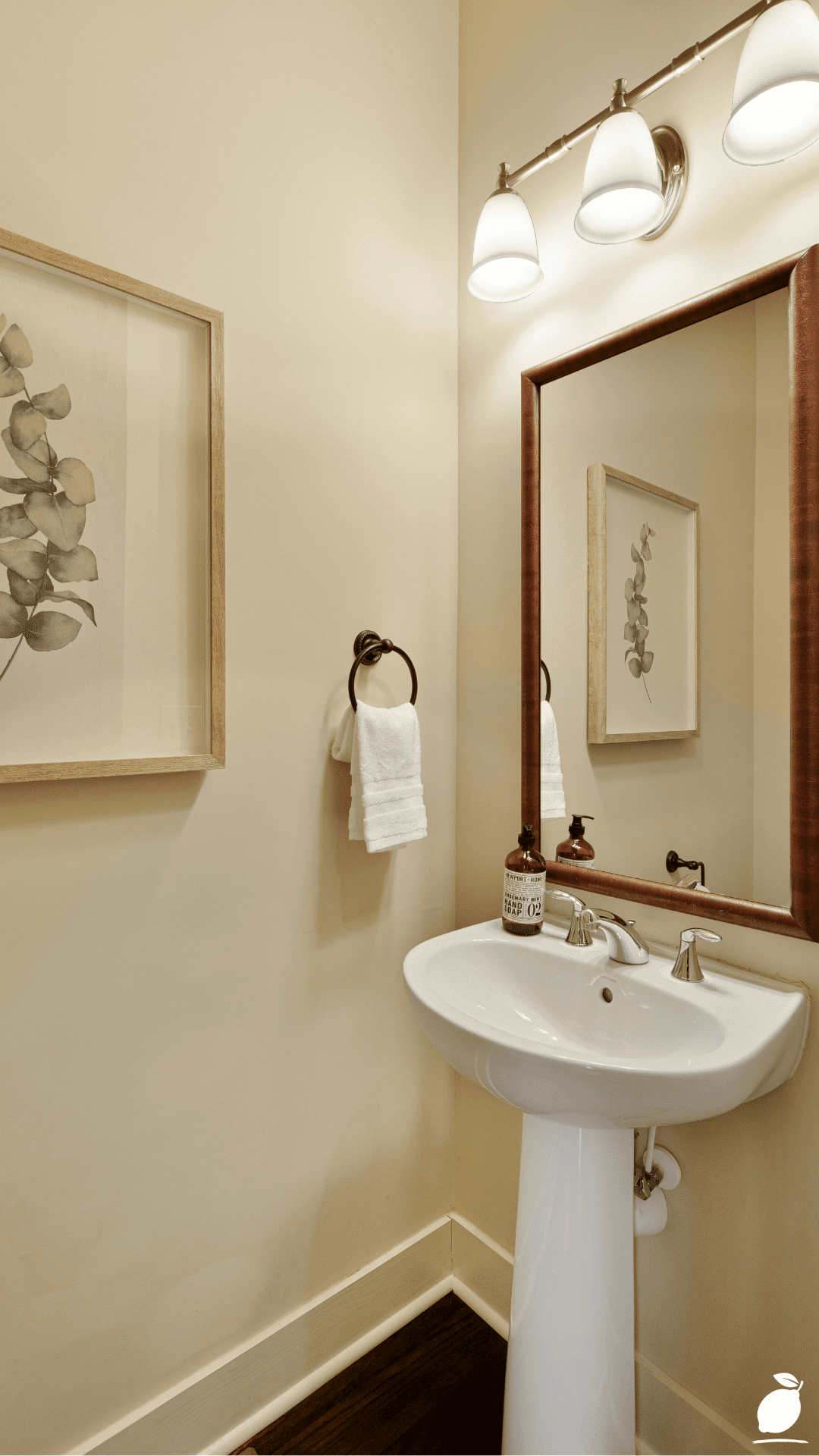
The distance between that bathroom and the one in the image above is not a gut renovation. It is a sequence of deliberate, budget-conscious decisions stacked into a result that feels considered rather than assembled. The powder room in the image achieves what the best guest bathroom ideas always achieve: a strong visual identity built from a small number of high-impact choices.
Dramatic burgundy and gold banana leaf wallpaper on the upper half of the walls. Sage green paint with crisp white wainscoting below. A marble pedestal sink that reads as an investment piece and costs a fraction of a full vanity replacement. Brass hardware that ties the warmth of the wallpaper to the cool white of the marble. Every element is doing real work, and the cumulative effect is a room that feels like a destination rather than an afterthought.
The guest bathroom ideas in this guide follow the logic of that image exactly, layered, intentional, and achievable without a contractor or a significant renovation budget. What transforms a neglected guest bathroom is not square footage or new plumbing. It is the willingness to treat a small room as worthy of real design attention, and the knowledge of which changes deliver the most visual impact per dollar spent. These guest bathroom ideas give you both.
The Guest Bathroom Ideas Blueprint
Step 1: Clear the Guest Bathroom and Assess What You’re Actually Working With
The first of all practical guest bathroom ideas is the one that costs nothing and changes everything: empty the room completely and see it as a space rather than a storage annex. Remove every item that is not architecturally fixed, the overflow products, the mismatched towels, the candle that has been on the back of the toilet since a holiday two years ago. Photograph each wall. Stand in the doorway and look at the room the way a guest would look at it, arriving for the first time.
What you see in that cleared state is the actual canvas for your guest bathroom ideas. The things that will not change without significant expense are the tile, the toilet position, the window location, and the existing light fixture mounting point, which define the constraints within which every other guest bathroom idea will operate. The things that can change the wall color, the hardware, the mirror, the textiles, and the accessories are the levers that this guide works with. Knowing the difference between fixed and flexible is the foundational step that makes every subsequent guest bathroom idea more effective and more budget-efficient.
Note the ceiling height, the natural light quality, and the dominant undertone of any existing tile. These three factors determine which guest bathroom ideas will work in your specific space: a dark wallpaper like the one in the image reads differently in a room with a tall ceiling and natural light than in a low-ceilinged, windowless powder room. Your cleared-room assessment tells you which direction to go before you spend a dollar.
Step 2: Choose a Strong Visual Concept Before Buying Anything
The guest bathroom ideas that fail on a budget share a common cause: purchases made without a governing concept. A mirror was bought because it was on sale. A hand towel was chosen because the color seemed close. A soap dispenser was selected because it was inexpensive. Individual pieces that are fine in isolation but produce, in aggregate, the same slightly random quality the room had before the refresh. Budget guest bathroom ideas require more concept discipline than expensive ones, not less, because when you cannot buy your way out of a design mistake with volume and layering, every piece has to earn its place in a clear visual logic.
The image establishes its concept in a single decision: the wallpaper. Every other element in the powder room, the sage green paint, the white wainscoting, the brass fixtures, the marble sink, is a response to the wallpaper’s color story. Burgundy and gold dictated warm metallic hardware. The deep background tone dictated a light, counterbalancing wall color below. The organic leaf pattern dictated the marble’s natural veining as a material complement. One strong concept element, chosen first, made every subsequent guest bathroom idea decision easier and cheaper because it narrowed the field from infinite options to the correct ones.
Choose your concept anchor before purchasing anything else for the guest bathroom. It can be a wallpaper, a tile pattern, a statement mirror, or a paint color, whatever has enough visual authority to organize everything around it. Write it down. Test it against the fixed elements of your specific guest bathroom. Then shop for everything else as a response to that anchor, not as a parallel and independent search.
Step 3: Apply a Two-Zone Wall Treatment
Among all guest bathroom ideas, the two-zone wall treatment with different finishes or colors above and below a horizontal dividing line delivers the most dramatic visual transformation at the lowest materials cost. It is the structural logic behind the image’s most striking quality: the room feels layered and designed rather than simply painted because two distinct zones of wall treatment create a visual rhythm that a single color cannot.
The most accessible version of this guest bathroom idea uses paint alone: a deeper, more saturated tone on the lower half of the wall paired with a lighter, related tone above, divided at chair-rail height (typically 90cm from the floor). A more impactful version of the one demonstrated in the image uses wallpaper above and paint below, with a physical wainscoting panel or chair-rail molding as the dividing element. The wainscoting in the image is standard MDF beadboard paneling, available at any home improvement center in pre-primed sheets and paintable in any color. Installed at chair-rail height and painted white, it creates the impression of architectural detail that most guest bathrooms were built without.
For wallpaper selection, apply the pattern above the chair rail only; this dramatically reduces the quantity of wallpaper required, typically cutting material cost by 40 to 60 percent compared to papering all four walls. A bold pattern like the banana leaf print in the image reads best in partial application: it provides visual drama without overwhelming a small guest bathroom space.
Step 4: Update Hardware and Fixtures Without Replacing Them
Replacing the faucet, towel bar, toilet paper holder, and light fixture in a guest bathroom is among the highest-impact, most budget-accessible guest bathroom ideas available, and it is routinely underestimated because hardware feels like a detail rather than a design decision. It is not a detail. Hardware is the jewelry of a bathroom, and mismatched or dated hardware is the equivalent of wearing mismatched accessories over an otherwise considered outfit. Cohesive hardware in a single finish, the aged brass in the image, for example, connects every element in the guest bathroom into a single material conversation.
Brass and unlacquered brass hardware have experienced a significant design renaissance and are now widely available at accessible price points from suppliers like Amazon, Wayfair, and Rejuvenation. A complete set of faucet, towel ring, toilet paper holder, and robe hook can be sourced in matching brass finish for $150 to $350 total, depending on brand and quality level. The visual return on that investment in a small guest bathroom is disproportionate to its cost: it is the change most guests notice without being able to articulate why the room looks more expensive than it did.
Replace the light fixture as part of the same hardware update. The wall-mounted fixture in the image, a simple brass rectangular frame with a single bulb, is a style available from multiple suppliers at $60 to $120. Replacing a builder-grade vanity bar with a fixture that has design intent transforms the wall above the sink from functional to composed.
Step 5: Source or Style a Statement Sink Moment
The marble pedestal sink in the image is the room’s single most expensive-looking element, and in the context of a guest bathroom idea executed on a budget, it demonstrates the most important principle of budget-conscious design: invest in one thing that carries the room’s luxury impression and economize on everything around it. A pedestal sink with genuine visual weight marble, or a high-quality composite that reads as marble, anchors the guest bathroom in a way that no combination of accessory updates can replicate.
If a sink replacement is within budget ($200 to $600 for a quality pedestal unit), it is among the highest-ROI guest bathroom ideas for a space that will be used by guests whose first impression of the room is formed largely by the sink area. If replacement is not within budget, the same principle applies in reverse: invest in the accessories and styling of the existing sink area. A small framed artwork above the sink, as in the image, a black-and-white print in a simple frame, adds the layer of intentionality that elevates the sink from fixture to feature. A quality hand soap dispenser, a single stem in a bud vase, and a neatly folded hand towel in a considered color complete the vignette without requiring any permanent changes.
Step 6: Edit Accessories to a Composed Vignette
The final and most sustainable of all guest bathroom ideas is the discipline of editing rather than adding. The guest bathroom in the image holds exactly what it needs and nothing it doesn’t: the sink, the faucet, the light, the small artwork, and the implicit promise of soap and towels that aren’t pictured because they will be there when needed. No collection of products on the counter. No multiple mirrors competing for wall space. No towel bar loaded with several slightly different towel colors. The restraint is the design decision.
In your own guest bathroom, apply the same discipline after every other step is complete. Place only what belongs in a framed artwork, one soap dispenser, one candle or bud vase, two hand towels in a single color folded identically, and leave every other surface bare. The negative space in a small guest bathroom is as important as the objects in it. A room that holds only intentional things reads as curated. A room that holds everything reads as busy. These are the same guest bathroom ideas applied differently, and the difference between them is editing.
Expert Secrets for Success
Pro-Tips for a Better Result
Install wallpaper above the chair rail only and use a removable peel-and-stick version for rental properties or commitment-averse redecorating. Peel-and-stick wallpaper technology has improved dramatically and now produces results indistinguishable from traditional wallpaper at close range in most patterns. Applied above the chair rail only, a single roll of peel-and-stick covers a standard guest bathroom in one to two hours with no paste, no soaking, and no professional installation. This is among the most transformative of all budget guest bathroom ideas precisely because the pattern scale does all the work that expensive fixtures and materials would otherwise do.
Match the undertone of your paint color to the warmth of your hardware finish. The sage green in the image reads warm rather than cool because its yellow-green base is harmonious with the amber warmth of the brass fixtures. A cool blue-green sage against warm brass would create the subtle discord that makes a room feel almost right without being identifiably wrong. Before committing to a paint color for your guest bathroom, hold a piece of your chosen hardware against the paint sample. If they share an undertone temperature, both warm or both cool, the pairing will work. If they conflict, one needs to change.
Use a single large mirror rather than two small ones. Guest bathroom ideas that involve mirror replacement almost universally improve by going larger rather than smaller. A single mirror that spans most of the wall above the sink or one that extends from counter to ceiling makes a small guest bathroom feel significantly larger, reflects more light, and reads as a single composed design decision. Two smaller mirrors above a single sink create visual competition and break the wall surface into segments that reduce perceived space.
Layer lighting with a secondary source below the primary fixture. The wall-mounted fixture in the image provides primary light from above. In a guest bathroom used for more than hand-washing, where guests apply makeup, style hair, or perform close-range grooming, supplementary light at mirror level dramatically improves both function and atmosphere. A simple plug-in sconce on either side of the mirror, or a backlit mirror that provides edge lighting, adds the warmth and directionality that an overhead-only light source cannot deliver.
Common Mistakes to Avoid
Don’t mix metal finishes without a clear intentional logic. Chrome faucet, brass towel ring, brushed nickel toilet paper holder, and matte black robe hook in the same guest bathroom reads as accumulated rather than designed. Choose one primary finish for all hardware and apply it consistently. If mixing is unavoidable because the toilet flush hardware cannot be replaced without high cost, for example, choose a secondary finish that is tonally related rather than contrasting: aged brass and matte black coexist because they share a dark, warm register; chrome and brass compete because they are different temperatures and values.
Don’t use overhead lighting as the only light source. A single ceiling fixture over a guest bathroom produces flat, shadowless light that makes everything in the room, including guests’ faces in the mirror, look institutional rather than inviting. It is the fastest way for a guest bathroom to feel like a public restroom, regardless of how well every other guest bathroom idea in this guide has been executed. Add a secondary light source at eye level before considering the lighting in the room resolved.
Don’t skip the wainscoting measurement step. Wainscoting installed at the wrong height, too high, cutting into the visual field where wallpaper should dominate; too low, creating a narrow band that reads as a mistake rather than a design feature, undermines every other guest bathroom idea built around the two-zone wall treatment. The correct height for a standard guest bathroom is 90cm from the floor for chair-rail height, or one-third of the total wall height. Measure and mark before cutting a single piece of beadboard.
Don’t accessorize before editing. The instinct when refreshing a guest bathroom is to add a new soap dish, a new diffuser, a new artwork, and a new plant. Adding without editing first produces a more decorated version of the original problem: a room with more things rather than a room with the right things. Complete every structural step, wall treatment, hardware, and fixture update before placing a single accessory. Then edit to the minimum that creates a sense of composition. Add only if something is genuinely missing after that edit.
Why Guest Bathroom Ideas Matter
The guest bathroom is the room that tells visitors something about you before you have said anything about yourself. It is the first space they occupy alone, without you present to narrate or contextualize it, and the impression it makes is entirely on its own terms. A guest bathroom that is clean but unloved communicates something. A guest bathroom that has been genuinely considered, where someone made decisions and followed through on them, communicates something entirely different. It says that the people who live here extend the same care they give themselves to the spaces they offer others. That is not a small thing. It is hospitality made physical, and it is felt even when it cannot be articulated.
Beyond what the guest bathroom communicates to visitors, there is what it communicates to the people who live in the house. Homes that contain one unloved, unfinished room carry a low-grade awareness of that incompleteness in the people who inhabit them, a background awareness that something has been deferred, that the house is not quite finished, that there is still a task outstanding. Completing a guest bathroom refresh, even a modest one executed with budget guest bathroom ideas, resolves that awareness in a way that is disproportionately satisfying relative to the effort and cost involved. The room is small. The resolution it provides is not.
Easy Peasy Life Matters exists for exactly this kind of project: the one that feels like it is only about a bathroom and turns out to be about the ease of having people over, the peace of a home that feels complete, and the particular satisfaction of a space that was ignored and then,, through a sequence of specific, budget-conscious decisions, became a room worth showing. The guest bathroom ideas in this guide are the decisions that get you there. The powder room in the image is proof that they work.
Frequently Asked Questions
How much does it cost to refresh a guest bathroom on a budget?
A meaningful guest bathroom refresh, new wall treatment, updated hardware, refreshed accessories, and improved lighting typically costs between $300 and $800 USD for a standard small powder room or guest bathroom when executed with the budget guest bathroom ideas in this guide. The primary cost variables are the wallpaper or paint choice, the hardware replacement set, and whether a sink or light fixture update is included. The highest-impact single investment is hardware cohesion, a matching faucet, towel bar, and toilet paper holder set in a unified finish, which typically costs $150 to $350 and produces a visual return that exceeds its price point in nearly every guest bathroom context.
What is the best wallpaper style for a small guest bathroom?
Bold, large-scale patterns perform better in small guest bathrooms than small-scale or geometric patterns, which can feel busy and visually fragmented at close range. The banana leaf pattern in the image is a classic example: its scale is large relative to the room, but its colors are limited to a contained palette, such as burgundy, gold, and green, that creates drama without visual noise. Botanical and nature-inspired patterns, vintage-style illustrated prints, and abstract watercolor designs all work well in small guest bathroom spaces when applied above a chair rail rather than floor-to-ceiling. Avoid very tight repeating geometric patterns in small spaces, as they amplify rather than expand the perceived size of the room.
Can I install wainscoting in a guest bathroom myself?
Yes, standard beadboard wainscoting is among the most accessible DIY home improvement projects and requires only basic carpentry skills, a miter saw, or a hand saw with a miter box, a nail gun or finish nailer, and a spirit level. Pre-primed MDF beadboard panels are available in 4×8 sheets from most home improvement centers and can be cut to chair-rail height, adhered to the wall with construction adhesive, and finished with a cap molding at the top and a base molding at the bottom for a result that reads as built-in architectural detail. The full installation in a standard guest bathroom takes one day for a first-time DIYer and produces a visual transformation that significantly exceeds its material cost.
What color should I paint a guest bathroom with no natural light?
Guest bathrooms without natural light perform best with wall colors that reflect available artificial light rather than absorbing it. Warm whites and very pale warm-toned cream, soft ivory, and warm greige keep the space from feeling cave-like under artificial light. If color is desired, choose tones with a warm undertone rather than cool: a warm sage green, a soft terracotta, a pale warm yellow, all read warmer and more inviting under incandescent or warm LED light than cool blues, cool grays, or cool greens. Pair any wall color in a windowless guest bathroom with warm-temperature bulbs at 2700K to 3000K and ensure the light fixture provides adequate lumens for the room’s square footage.
What are the most important accessories for a guest bathroom?
The guest bathroom accessories that have the greatest impact on a guest’s experience are, in order of importance: quality hand soap (a refillable ceramic or glass dispenser with a premium soap, rather than a plastic pump bottle); fresh hand towels in a single coordinating color, folded uniformly; a waste bin that is neither overflowing nor absent; and adequate toilet paper more than one roll visible or accessible. Beyond these functional essentials, a single piece of small-format artwork, a bud vase with a stem or two, and a single candle (unlit but present) complete the vignette that distinguishes a considered guest bathroom from a merely functional one. Resist the temptation to add more than these; restraint in a small guest bathroom is always the correct instinct.