When I moved into my apartment, it looked exactly the way most rentals do: white walls, beige carpet, lighting that felt vaguely institutional, and all the personality of a doctor’s waiting room. I tried the obvious things: a throw blanket here, a candle there, a poster I bought at a street market, and stuck up with removable strips. None of it cohered. The space felt like a collection of objects rather than a home, and every time I sat down on my couch to relax, I found myself looking around at four walls that had nothing to say about who I was or how I wanted to live. It was comfortable in the purely functional sense, and quietly depressing in every other way.
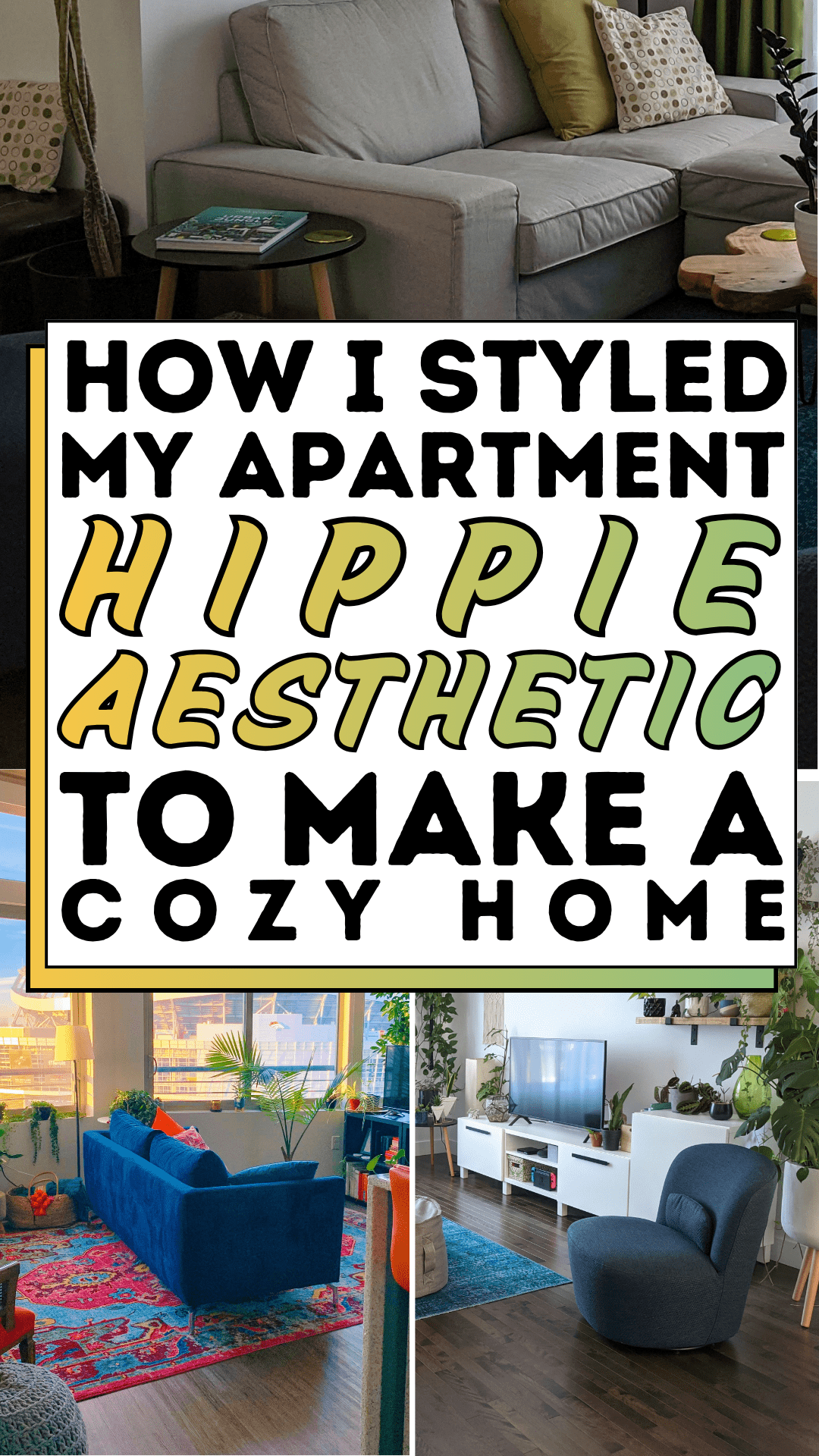
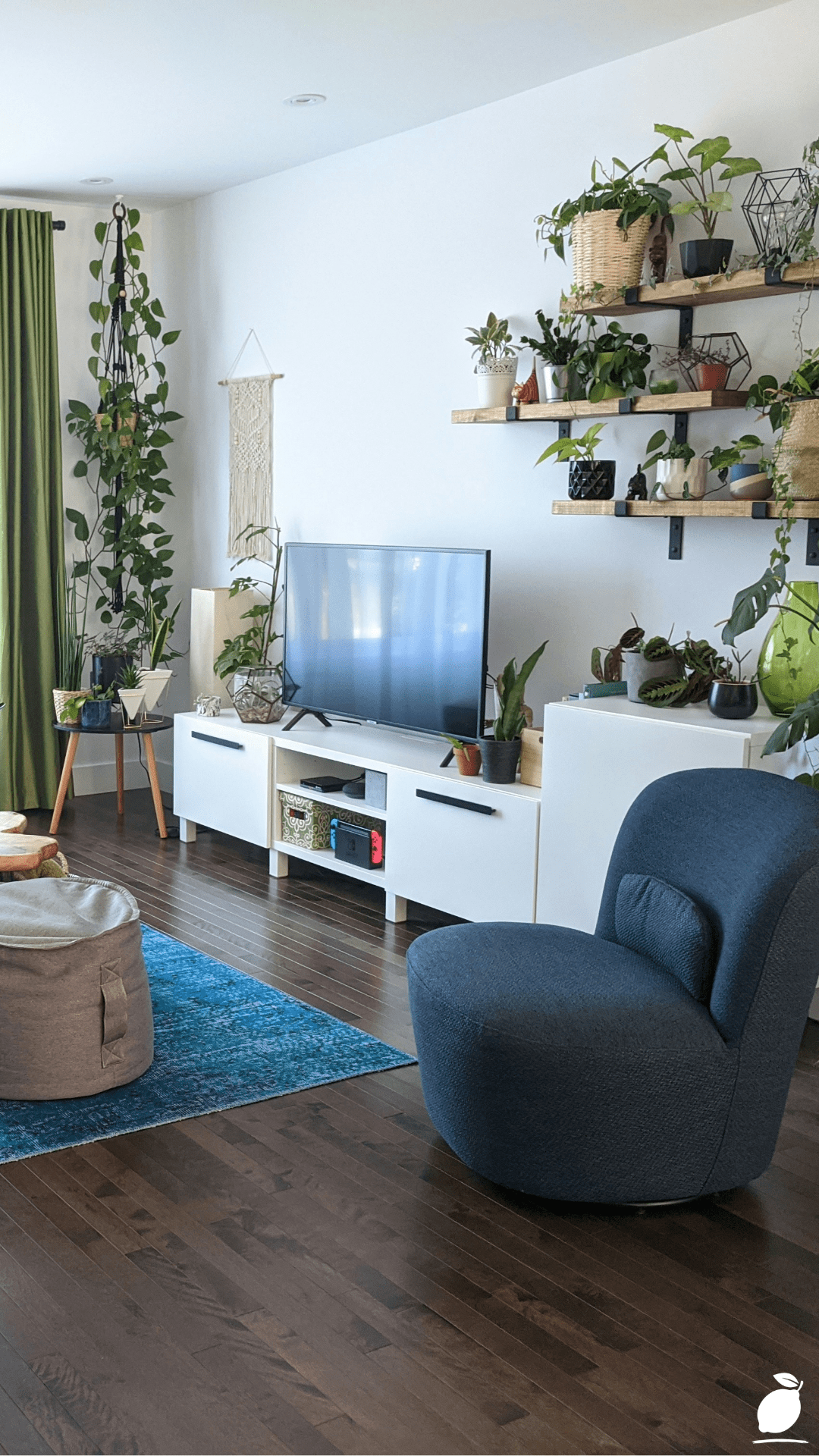
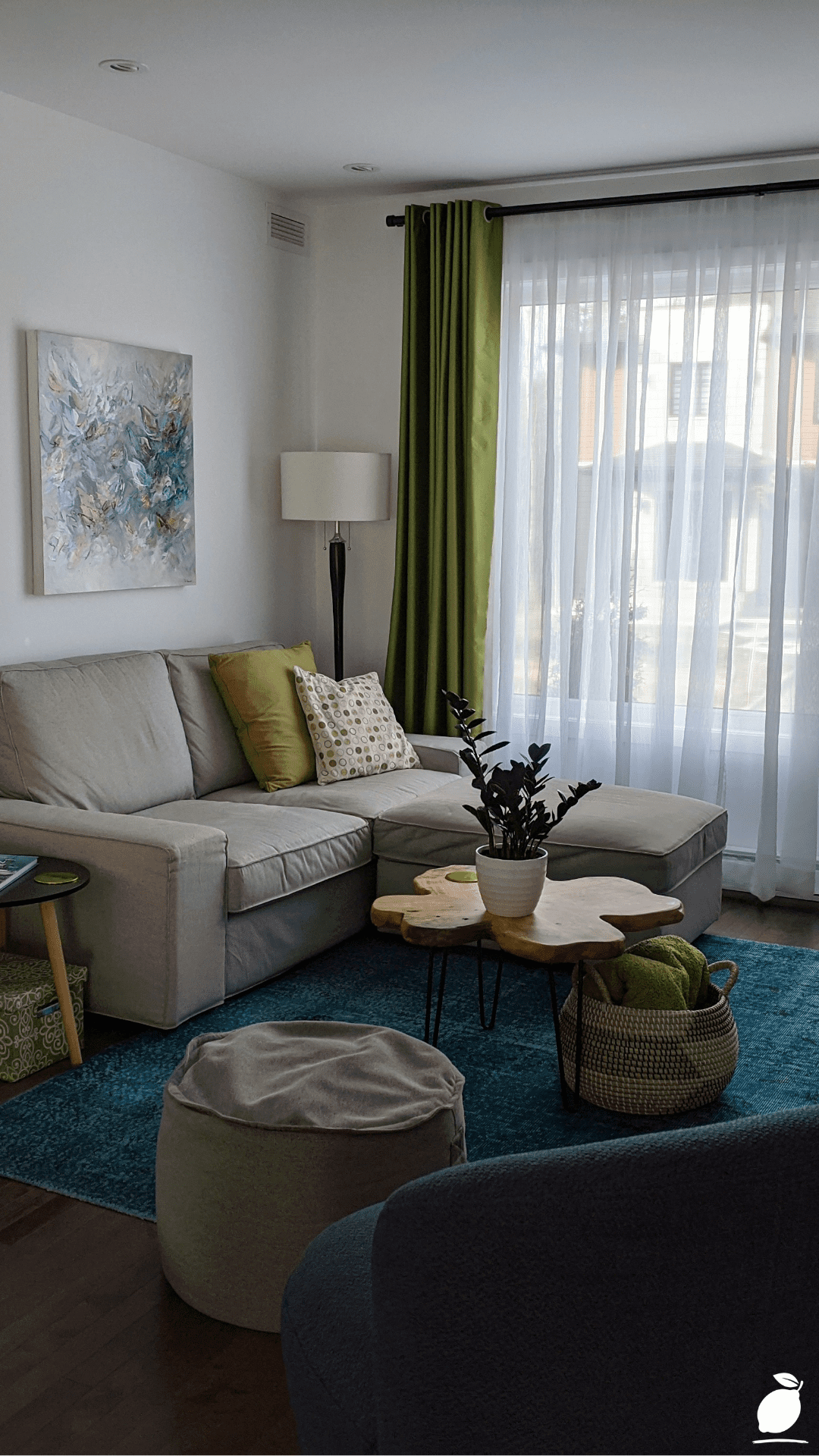
What I was trying to create, without knowing the name for it yet, was a hippie aesthetic home. Not the clichéd version with tapestries stapled to every surface and incense burning around the clock, but the real version: the kind of space that feels alive, layered, and unapologetically warm. The living room in the image above is exactly that. A grey sectional anchors the room while a bold blue armchair pulls the eye. A teal rug grounds everything. Deep green curtains frame a large window. Indoor plants, a tall slender grass near the sofa, a sprawling fiddle-leaf fig in the foreground, and a snake plant contributing quiet structure bring the outside in. An abstract painting above the sofa ties the blues, greens, and earthy reds together into a palette that feels both collected and intentional. A green-faced wall clock, a woven basket of green gourds, a small wooden coffee table with an organic shape; every detail contributes to a room that breathes.
Getting here did not require a designer, a big budget, or a complete apartment overhaul. It required understanding how hippie aesthetic styling actually works: layering natural materials, building a cohesive color story from the earth and the forest, filling a space with living things, and allowing your personal collection of meaningful objects to do the decorating. This is the exact method I followed step by step and the one you can use to transform any apartment into a home that feels genuinely, deeply like you.
The Hippie Aesthetic Blueprint
Step 1 — Define Your Color Story Around Nature’s Palette
The hippie aesthetic is rooted in the natural world, and its color palette reflects that directly. Begin by identifying your three core colors: a neutral base, an earthy mid-tone, and a botanical accent. In the image, the base is the warm white of the walls and the light grey of the sectional. The mid-tone is the teal of the rug and the deep blue of the armchairs. The botanical accent is everywhere: olive green throw pillows, dark green curtains, the green-faced clock, the fiddle-leaf fig. Your palette does not need to be identical, but it should draw from the same well: warm neutrals (sand, linen, cream), earthy mid-tones (teal, terracotta, rust, dusty blue), and botanical greens (sage, olive, forest, moss). Once you have your three-color system, every purchase decision becomes easier.
Step 2 — Anchor the Room with One Statement Textile
The teal rug in the image is doing more work than almost any other element in the room. It physically anchors the seating arrangement, visually connects the sofa and armchairs into one cohesive conversation zone, and introduces the room’s most saturated color in a way that feels grounded rather than chaotic. Choose your statement textile first, a rug in a bold earthen or jewel tone, a large woven wall hanging, or a quilt draped over a sofa, and build the rest of the room around it. In hippie aesthetic interiors, the textile is almost always where the most expressive color and pattern live, which frees every other surface to play a supporting role.
Step 3 — Mix Seating Styles with Intentional Contrast
One of the most recognizable signatures of a hippie aesthetic living room is seating that feels collected rather than coordinated. The image pairs a large light-grey sectional practical, soft, generous, with two deep blue armchairs that have a completely different shape and visual weight. Add to that the olive-green pouf on the rug, and you have four distinct seating pieces that share a color family but not a matching set. The key to making this work is contrast in form (boxy vs. rounded, low vs. tall) paired with harmony in color temperature (all warm, all earth-shifted). Avoid purchasing a sofa-and-loveseat set; instead, source pieces independently from thrift stores, vintage markets, and independent retailers.
Step 4 — Hang One Large Piece of Art and Let It Lead
The abstract painting above the sofa in the image is doing something specific: it introduces every color that appears elsewhere in the room, the blues of the armchairs, the greens of the plants and curtains, hints of warm red in one unified composition. This is the hippie aesthetic approach to art: one large, expressive piece that acts as the room’s color map rather than a gallery wall of perfectly spaced frames. Choose a canvas or print that contains your three core palette colors, hang it at eye level above your largest seating piece, and let it be the visual anchor that everything else references. Markets, local artists, and even large-format printable art make this step accessible at almost any budget.
Step 5 — Bring In Plants at Multiple Heights and Scales
No element defines the hippie aesthetic more immediately than abundant plant life, and the key is variety in both scale and placement. The image layers a tall, slender grass-like plant on a side table near the sofa, a fiddle-leaf fig with broad sculptural leaves in the foreground, and a small potted plant on the coffee table, three distinct scales creating a sense of layered, living abundance. Start with one large statement plant (fiddle-leaf fig, rubber plant, or monstera), one medium floor plant (snake plant, bird of paradise), and two or three small tabletop plants (pothos, succulents, air plants). Group them at varying heights using plant stands and furniture to create depth. If natural light is limited, focus on low-light varieties, such as snake plants, pothos, and ZZ plants, which thrive in almost any apartment condition.
Step 6 — Layer Natural Materials for Texture
The hippie aesthetic lives in its textures. Smooth surfaces feel cold and modern; layered natural materials feel warm and alive. In the image: a woven wicker basket holds green gourds on the rug, a small woven basket sits on the wooden side table, and the organic-shaped coffee table in light wood introduces tactile contrast against the fabric of the rug and sofa. Build your material palette around wood (raw, warm-toned, or whitewashed), wicker and rattan, cotton and linen textiles, ceramic and clay objects, and macramé or woven fiber accents. The goal is not to cover every surface but to ensure that nearly every object in the room has visible material character, grain, weave, texture, rather than a uniform synthetic finish.
Step 7 — Light the Room in Layers
The floor lamp with the white drum shade and dark wooden base in the image is a perfect example of hippie aesthetic lighting: warm-toned, organic in material, and positioned to create a soft pool of light rather than overhead glare. Avoid relying on a single overhead fixture for all your lighting. Layer instead: a floor lamp for ambient warmth, small table lamps for intimacy, and string lights or candles for the softest evening atmosphere. Use bulbs with a color temperature of 2,700K or lower, in the warm amber range, and you will find that even a plainly furnished room begins to feel immediately cozier and more intentional after dark.
Expert Secrets for Success
Pro-Tips for a Better Result
Pro Tip 1 — Shop Secondhand First, Always. The hippie aesthetic is philosophically aligned with sustainability, and secondhand shopping happens to produce the most authentic results. Thrift stores, estate sales, Facebook Marketplace, and vintage markets yield exactly the kind of imperfect, characterful pieces the woven basket, the organic coffee table, and the oversized armchair give a room its collected-over-time quality. New matching sets, however well-priced, always read as new matching sets.
Pro Tip 2 — Use Green as a Through-Line. If you look at the image as a whole, green appears in at least eight distinct places: the curtains, the clock face, the throw pillow, the rug’s teal undertone, the book on the side table, the plants, the gourds in the basket, and the painting. Green is the connective tissue of hippie aesthetic interiors. Use it at every scale, large (curtains, rug), medium (plants, art), and small (a book spine, a small ceramic bowl), and it will unify a room that might otherwise feel eclectic to the point of chaos.
Pro Tip 3 — Add One Unexpected Round Element The green-faced round wall clock, the organic multi-lobed coffee table, and the olive pouf in the image all introduce circular forms that soften the right angles of walls, windows, and the sectional sofa. In hippie aesthetic design, round and organic shapes signal nature and ease. Add at least one round mirror, a circular rug, an organic-shaped side table, and watch how it immediately relaxes the room’s energy.
Pro Tip 4 — Let Objects Tell Stories. The wicker basket of green gourds on the rug, the green book on the side table, the small potted plant on the coffee table, none of these are styled props from a home goods store. They are the kinds of objects that accumulate when someone actually lives in and loves a space. Populate your surfaces with things that mean something to you: a rock you picked up on a hike, a candle in a clay holder from a local market, a plant you propagated from a cutting. The hippie aesthetic rewards personal history displayed with confidence.
Common Mistakes to Avoid
Mistake 1 — Confusing Maximalism with Clutter The hippie aesthetic is layered, but it is not chaotic. Every element in the image serves a function: the plants bring life, the art brings color, and the textiles bring warmth. When a room tips from layered to cluttered, it is usually because too many objects compete for attention at the same visual level. Vary the heights, group related objects together, and give each major element breathing room. The goal is abundance that still feels intentional.
Mistake 2 — Over-Relying on Bohemian Clichés Mandala tapestries, mass-produced dreamcatchers, and “good vibes only” signs are to the hippie aesthetic what barrel-roll wine racks are to the wine lover’s kitchen: a shortcut that signals the idea without embodying it. Lean into the substance of the aesthetic: natural materials, living plants, meaningful art, and handmade or vintage objects. The authenticity of the style comes from the objects’ origins and your relationship to them, not their category.
Mistake 3 — Neglecting Scale One of the most common failures in hippie aesthetic apartments is using too many small objects and not enough large ones. A single small plant on a shelf, a tiny piece of art on a large wall, a too-small rug that floats under the furniture, these mistakes make even a beautifully curated collection feel timid. The fiddle-leaf fig in the image is large enough to partially block the view of the room. That scale is intentional and necessary. Size up your plants, your art, and your rugs; they can almost always be larger than you think.
Mistake 4 — Using Cool White Lighting. Cool, bright overhead lighting is the single fastest way to strip the warmth from a hippie aesthetic interior. The plants look more plastic, the textiles look more synthetic, and the entire room loses the golden, cozy quality that makes the aesthetic so appealing. Replace any cool-white bulbs with warm-white alternatives (2,700K or lower) before doing anything else, and consider whether any overhead fixture can be supplemented or replaced with floor lamps and table lamps entirely.
Why Hippie Aesthetic Matters
There is a reason that millions of people are drawn to the hippie aesthetic right now, and it is not purely visual. We are living through a period of relentless screen time, ambient digital noise, and environments engineered more for productivity than for peace. A home styled with intention, with living plants that breathe, natural materials that ground you, art that speaks, and light that warms is an act of quiet resistance against all of that. It is a declaration that the space you inhabit at the beginning and end of every day deserves to nourish you, not just shelter you.
For families and roommates sharing a space, the effect is compounding. When a living room feels genuinely warm and welcoming, when the rug invites you to sit on the floor, when the plants make the air feel cleaner, when the lighting makes everyone look a little softer and more relaxed, the quality of time spent together in that space changes. Conversations feel easier. Evenings feel longer and less rushed. Children who grow up in spaces filled with living things, natural materials, and personal meaning carry a relationship with their environment into adulthood that shapes how they build their own homes.
And on an individual level, the act of intentionally creating a space that reflects your values, your love of nature, your comfort with beauty, your preference for warmth over sterility is a form of self-knowledge. You learn what you care about by choosing it repeatedly, deliberately, and placing it where you can see it every day. The hippie aesthetic is, at its core, about living consciously in the spaces you occupy. That practice does not end when the decorating is done. It continues every morning when you walk into a room that knows exactly who you are.
Frequently Asked Questions
What exactly is the hippie aesthetic in interior design?
The hippie aesthetic in interior design is a style rooted in natural materials, earthy and botanical color palettes, abundant plant life, vintage and handmade objects, and a layered, collected-over-time feel. It draws from 1960s and 70s counterculture values, connection to nature, individual expression, rejection of corporate uniformity, and translates them into spaces that feel warm, alive, personal, and slightly untamed. It overlaps with bohemian and eclectic styles but is distinguished by its specific emphasis on organic forms, living plants, and a philosophy of sustainability and intentional living.
How do I start building a hippie aesthetic apartment on a budget?
Start with three high-impact, low-cost moves: replace your lighting bulbs with warm-white options (immediate transformation, under $15), buy one large secondhand rug in an earthy or jewel tone, and bring in two or three affordable plants like pothos, snake plants, or spider plants. These three changes address color, warmth, and life simultaneously, the three pillars of the aesthetic, without requiring any furniture purchases. From there, thrift and vintage shop for textiles, ceramics, and art rather than buying new.
What plants work best for a hippie aesthetic living room?
Fiddle-leaf figs, monstera deliciosas, rubber plants, snake plants, trailing pothos, and bird of paradise are all excellent choices. For a true hippie aesthetic layering effect, combine one large floor plant (fiddle-leaf fig or monstera for dramatic scale), one medium structural plant (snake plant or rubber plant), and several trailing or tabletop varieties (pothos, heartleaf philodendron, small succulents). If your apartment has limited natural light, focus on snake plants, ZZ plants, and pothos, which thrive in low-light conditions.
Can I achieve a hippie aesthetic in a rental without painting the walls?
Absolutely, and the room in the image is proof. The walls are plain white, and the hippie aesthetic character comes entirely from furniture, textiles, plants, art, and accessories. The key is to use large elements to compensate for neutral walls: oversized art, floor-to-ceiling curtains in deep green or terracotta, large plants that draw the eye upward, and a statement rug that provides the boldest color in the room. White walls are actually an advantage in hippie-aesthetic spaces because they let every other element breathe and pop without competing.
How is hippie aesthetic different from bohemian or boho style?
Hippie aesthetic and bohemian style are closely related but have distinct differences in emphasis. Bohemian style tends to lean more heavily into global patterns, layered textiles, and maximalist visual complexity, think Moroccan rugs, embroidered cushions, and heavily draped rooms. Hippie aesthetic is more specifically oriented toward the natural world: living plants, organic shapes, sustainable materials, and earthy color palettes rooted in greens, teals, and warm neutrals. Hippie aesthetic spaces tend to feel slightly more pared back and nature-forward, while bohemian spaces often feel more globally influenced and pattern-dense. The two overlap considerably and can be blended beautifully.