The living room had not become cluttered all at once. It happened in the gradual, reasonable way that most domestic chaos happens: a cushion added here, a side table shifted there, a plant bought because the corner looked bare, a basket introduced to hold the remote controls that had multiplied somehow into six. Each addition made sense in isolation. The room, accumulated in this reasonable way over three years, made no sense at all. Too many surfaces, each holding something. Too many tones, none of them chosen in relation to the others. The room was full in a way that felt empty, full of things, empty of the quality of calm that is supposed to make a living room worth living in.
The specific frustration of a room that has been thoughtfully accumulated into disorder is that the solution is not obvious. It is not a matter of tidying the room, which is not dirty or disorganised, exactly, just visually loud in a way that is hard to diagnose or address without either buying new things or getting rid of things you still like. Whole-room renovation is expensive and disruptive. Incremental improvement by rearranging and editing never seems to reach the threshold of actually feeling different. The room stays in its accumulated state, tolerated rather than enjoyed, because the path from where it is to where it could be is not clear.
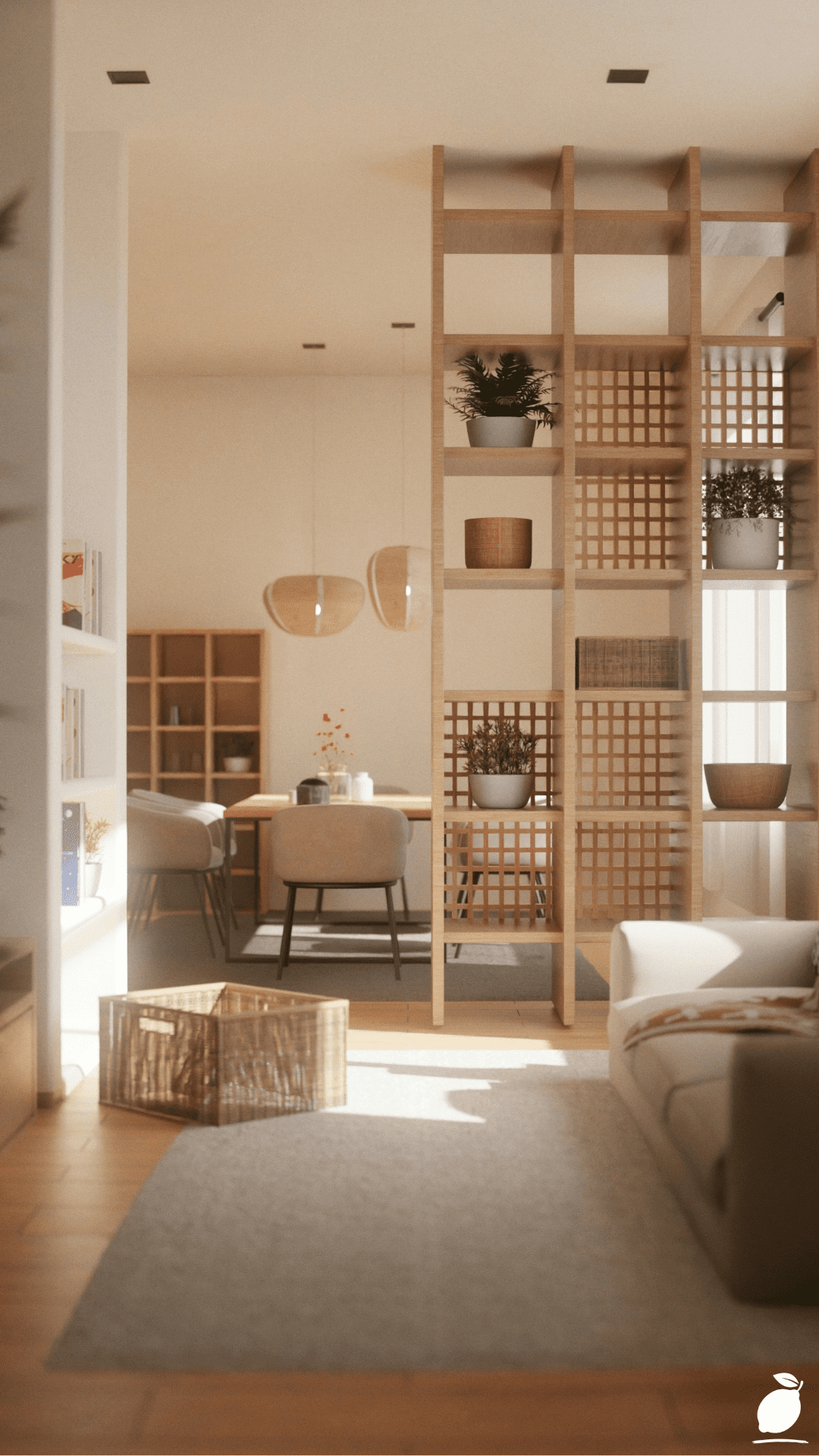
Japandi living room ideas gave me that path. Japandi, the design philosophy that fuses Japanese wabi-sabi aesthetics with Scandinavian hygge sensibility, is not a decorating trend in the Instagram sense. It is a set of principles for creating spaces that feel genuinely restful: natural materials, earned simplicity, functional objects chosen for their beauty, and the structural clarity of a room where every element is present with intention and nothing is present by accident. The living room in the image above, the oak lattice room divider, the grey sofa, the rattan box on a neutral rug, the palm, and the warm white walls are Japandi in practice. Calm, considered, and achievable. Here is the exact blueprint I followed.
The Japandi Living Room Ideas Blueprint
Japandi living room ideas are not about buying a set of specific furniture; they are about applying a set of decisions in a specific order. This blueprint covers each decision in sequence, from the foundational choices that everything else depends on to the finishing touches that complete the transformation.
Step 1: Edit Before You Add — Audit Every Object in the Room
The first and most important of all Japandi living room ideas is subtractive rather than additive. Before a single new object enters the room, everything currently in it must be evaluated against one question: Does this object earn its place through beauty, function, or both? Japandi design is not minimalism for its own sake; it is not the elimination of everything, but it is ruthless about the distinction between objects that contribute and objects that merely occupy.
Remove everything from the living room: every cushion, every plant, every decorative object, every piece of furniture that is not structural and set it aside. Stand in the empty room and look at it. The proportions become visible. The natural light source becomes clear. The floor area reveals itself. This moment of emptied clarity is the starting point from which Japandi living room ideas can be applied meaningfully. Return items one by one, and return only those that satisfy the beauty-or-function test. The items that do not return are not failures; they are the first and most valuable contribution to the Japandi transformation.
Step 2: Establish the Warm Neutral Base — Walls and Floor
Japandi living room ideas begin with a specific tonal commitment: warm neutrals, not cool ones. The walls in the image are warm white, not bright white, not grey-white, but a white with warmth that holds the natural light without flattening it. The floor is light oak, warm, natural, and horizontal in its movement across the space. Together, these two surfaces establish the Japandi living room’s foundational tone: quiet, warm, and natural.
If repainting, choose warm white paints Benjamin Moore White Dove, Farrow and Ball Wimborne White, or equivalent that have a slight cream or yellow warmth rather than a blue-white brightness. For flooring, light oak or ash in a natural or lightly oiled finish is the most authentically Japandi choice. If the existing floor cannot be changed, a large light-toned natural rug, jute, wool, or cotton in a warm beige or grey can establish the Japandi tonal foundation over a floor that does not naturally deliver it.
Step 3: Choose One Architectural Statement Piece
The most recognisable Japandi living room ideas typically feature a single architectural statement, one piece that establishes the room’s structural character and around which everything else is organised. In the image, that piece is the floor-to-ceiling oak lattice room divider: a functional and beautiful object that simultaneously divides the living and dining zones, provides display and storage, and delivers the Japanese-influenced geometric craft detail that Japandi living room design is built on.
The statement piece in a Japandi living room does not need to be a room divider. It might be a substantial handcrafted shelving unit in solid oak, a stone or plaster fireplace surround, a built-in window bench with clean lines and natural cushion, or a significant piece of furniture whose material quality and craftsmanship read as the room’s central design intention. Whatever it is, it should be: made from natural material, functional as well as beautiful, and singular. The room should have one architectural statement, not several competing ones.
Step 4: Select the Sofa and Primary Seating in Japandi Proportions
The sofa in a Japandi living room is the room’s primary colour investment and its largest soft furnishing. Japandi living room ideas consistently favour sofas with low-profile seat heights of 35 to 45cm rather than the deeper, higher profile of a conventional Western sofa, clean lines without scrolled or ornate arms, and upholstery in the muted, natural tones that Japandi design favours: warm grey, linen beige, sage green, or charcoal.
The sofa in the image is a low-profile grey upholstered piece with straight lines and a restrained cushion arrangement, two or three cushions in coordinating neutral tones rather than the layered, maximalist cushion arrangements that Japandi living room ideas specifically avoid. Choose a sofa whose profile is proportionate to the room’s ceiling height in a standard room with a 2.4 to 2.7 metre ceiling. A sofa above 85cm in height becomes visually dominant in a way that the Japandi proportion does not accommodate.
Step 5: Introduce Natural Materials in Layers — Rattan, Wood, Linen, Stone
Japandi living room ideas achieve their distinctive warmth and texture through the layering of natural materials, not in a maximalist way but in a deliberate, restrained way where each material is present for a specific reason and contributes a specific texture or tone. The Japandi material palette includes light oak or ash timber for structural pieces, rattan or wicker for storage and accent items, linen or wool textiles for cushions and throws, natural stone or ceramics for decorative objects, and woven natural fibre for rugs and baskets.
In the image, this layering is precisely executed: oak lattice divider (timber), rattan storage box (wicker), grey upholstery (wool or boucle weave), jute or wool rug (natural fibre). Each material is distinct, each relates to the others through their shared natural origin, and none competes for dominance. The Japandi living room ideas principle here is that materials should be varied enough to create tactile and visual richness but unified enough through their natural quality to feel like a coherent whole rather than an eclectic assemblage.
Step 6: Place Plants with Architectural Intention
Plants in a Japandi living room are not incidental; they are structural. The tall palm in the image’s left corner is not there to fill a space; it is there because its vertical form, its particular quality of filtered shadow, and the specific green of its fronds contribute to the room’s composition in a way that nothing inanimate could replicate. Japandi living room ideas use plants as architectural elements: one or two significant specimens positioned with the same intention as furniture, rather than collections of small plants scattered across surfaces.
Choose plants with strong architectural form, fiddle leaf figs, snake plants, olive trees, palms, and large-leaf monsteras are all authentically Japandi in their structural presence. Place the primary specimen in the corner with the most natural light, at a height proportionate to the room. Add one or two smaller plants on the shelving unit at different heights to create a vertical dialogue without creating visual clutter. Contain plants in planters that match the room’s material palette, matte ceramic, handthrown stoneware, or natural terracotta in neutral tones. Metallic or brightly coloured planters read against the Japandi palette rather than within it.
Expert Secrets for Success
Pro-Tips for a Better Result
- Keep the colour palette to three tones maximum. The most successful Japandi living room ideas operate within a strict tonal discipline: one dominant neutral (warm white or light oak), one secondary neutral (warm grey or greige), and one accent (sage green, terracotta, or charcoal). More than three tones in a Japandi living room creates the visual competition that Japandi design exists to resolve. Choose three and apply them deliberately across every object in the room.
- Leave deliberate negative space. Japandi living room ideas are as much about the empty wall section as the filled one, as much about the clear floor area as the furnished one. Negative space surfaces and areas that contain nothing are not wasted space in a Japandi room. It is the visual breathing room that makes the objects that are present read as considered rather than incidental. Resist the urge to fill every corner, surface, and shelf.
- Choose furniture with visible joinery and craft detail. Japandi design honours the craft of making the dovetail joint, the hand-turned leg, the woven rattan pattern in a way that mass-produced furniture does not. When selecting pieces for Japandi living room ideas, prioritise furniture where the construction is visible and beautiful: through-tenon joints on oak furniture, hand-woven cane backs, hand-formed ceramic surfaces. The craft detail is what gives Japandi rooms their quality of depth and authenticity.
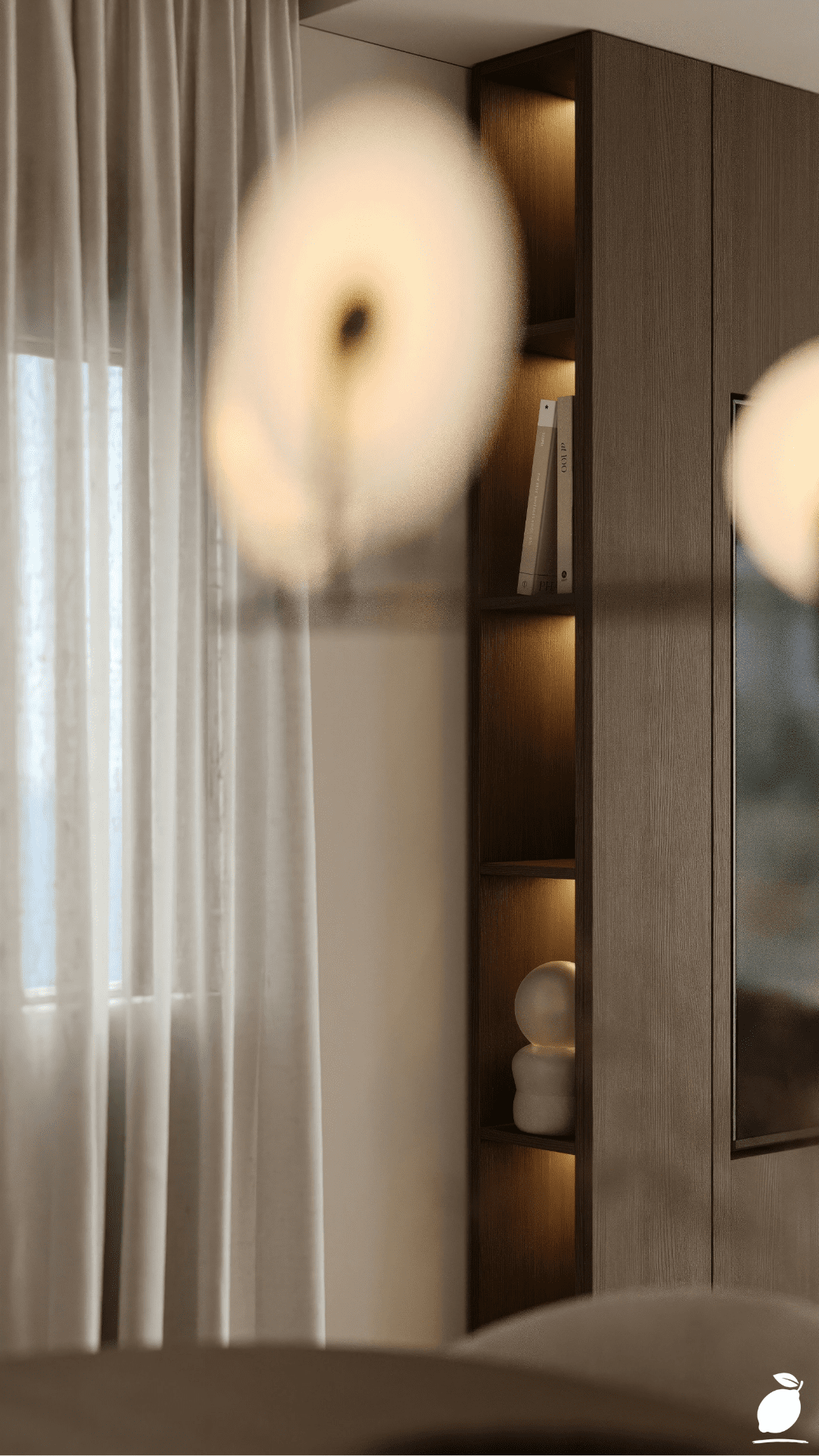
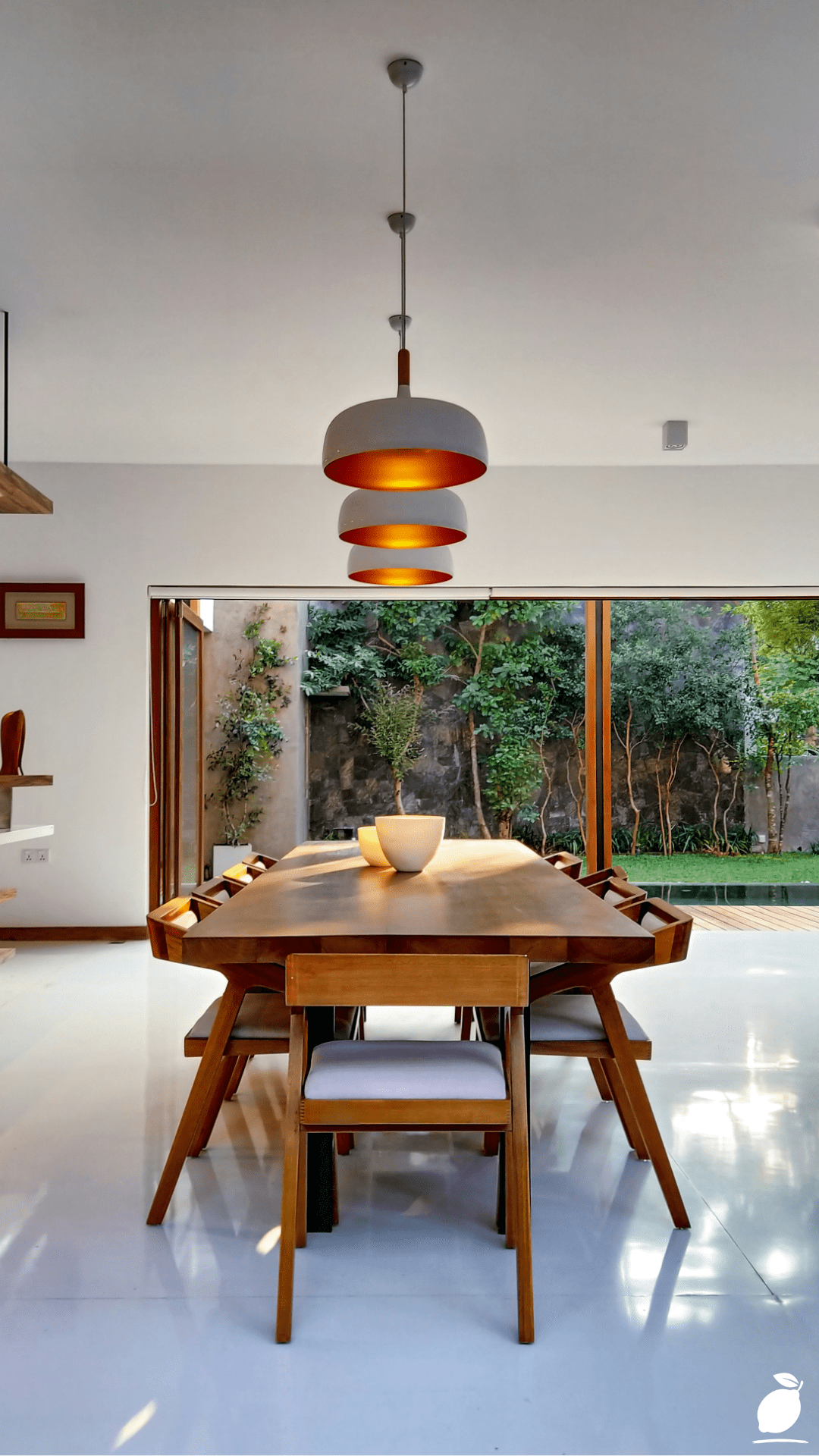
- Use pendant lighting, not just recessed lighting. The warm pendant lights above the dining area in the image have simple beige shades on pendant drops, delivering the quality of warm, directional light that recessed ceiling fixtures cannot. Japandi living room ideas benefit from lighting that creates warm pools of light at human height rather than uniform overhead illumination. A single statement pendant or two coordinated pendants at different heights provide the atmospheric quality that makes a Japandi living room feel genuinely calm in the evening.
- Introduce wabi-sabi through imperfect objects. Wabi-sabi, the Japanese aesthetic that finds beauty in imperfection and impermanence, is one half of the Japandi philosophy. Include one or two objects in the living room that carry the marks of making: a handthrown ceramic bowl with an uneven glaze, a hand-carved wooden object with visible tool marks, or a textile with the slight irregularity of hand-weaving. These objects provide the warmth and humanity that prevent a Japandi living room from reading as cold or sterile.
Common Mistakes to Avoid
- Confusing Japandi with empty minimalism. Japandi living room ideas are not about having as little as possible; they are about having exactly the right things. A room stripped to bare walls and a single sofa is not Japandi; it is simply empty. Japandi requires the considered presence of natural materials, beautiful objects, and living plants in a space that feels complete rather than depleted. The goal is warmth and simplicity together, not one at the expense of the other.
- Using cool-toned whites and greys. Japandi living room ideas require warm neutrals, the grey-beige, the warm white, the light oak, not the cool whites, pure greys, or blue-toned neutrals associated with Scandinavian minimalism alone. Cool tones create a clinical quality that contradicts the wabi-sabi warmth that makes Japandi living room design feel genuinely restful rather than simply sparse. Always choose the warmer of two comparable neutral options.
- Over-accessorising the shelving unit. The shelving unit or room divider in a Japandi living room, often the room’s most significant structural piece, is styled most effectively at fifty to sixty per cent of its capacity, with clear open sections providing the negative space that makes the displayed objects read as curated rather than stored. A fully loaded shelving unit in a Japandi room negates the simplicity that the Japandi framework is designed to create.
- Mixing too many wood tones. Japandi living room ideas depend on material cohesion, and wood tone consistency is its most visible expression. A room with light oak shelving, dark walnut coffee table, warm pine flooring, and bleached ash furniture is fighting itself tonally, regardless of how well each piece is made. Choose one primary wood tone; light oak is the most authentic Japandi, and apply it consistently across all timber elements in the room.
- Choosing mass-produced wicker or rattan without quality assessment. Rattan and wicker are key Japandi living room materials, but mass-produced versions in synthetic or poorly constructed natural fibre read as decorative props rather than genuine craft objects. Assess rattan and wicker pieces for the quality of the weave, the integrity of the form, and the naturalness of the finish before purchasing. A single well-made rattan basket contributes more to the Japandi living room aesthetic than three low-quality versions combined.
Why Japandi Living Room Ideas Matter
Japandi living room ideas matter because the living room is not just a room. It is the space where the household exhales, where the day’s demands are set aside, where family members occupy the same space without agenda, where the quality of the surrounding environment either supports or resists the rest that everyone in the home needs. A living room that creates visual calm through its Japandi principles, natural materials, warm neutrals, and earned simplicity contributes to the well-being of everyone who spends time in it in a way that is felt rather than articulated. The Japandi living room is not an aesthetic choice separate from life quality. It is, in the most direct sense, a life-quality choice expressed through design.
For families, the Japandi living room creates a shared space that works for multiple generations and multiple activities simultaneously because its simplicity is not about restriction but about creating a visual foundation that any activity or any person can inhabit without conflict. A child doing homework at the dining table is visible through the oak lattice divider. An adult is reading on the grey sofa with a single lamp on. The room holds both without the visual competition that a cluttered, over-furnished space creates. The Japandi living room’s lack of excess gives every person and every activity in it more room to be itself.
And for the person who undertakes the Japandi transformation who edits the room, chooses the materials carefully, places the statement piece with intention and the plants with architectural thought, there is the particular satisfaction of having made a room that works on every level simultaneously: aesthetically, functionally, and emotionally. Japandi living room ideas do not produce rooms that look designed and feel uncomfortable to use. They produce rooms that look exactly as calm as they feel to be in. That alignment between appearance and experience is the quality that separates a designed room from a merely decorated one, and it is what Japandi living room ideas, applied with patience and intention, reliably produce.
Frequently Asked Questions
What is the difference between Japandi and Scandinavian minimalism?
Japandi living room ideas combine two distinct design traditions: the Scandinavian emphasis on functional simplicity, natural light, and clean lines (hygge) with the Japanese emphasis on imperfect beauty, material craft, and the acceptance of time’s effect on objects (wabi-sabi). Scandinavian minimalism tends toward cooler tones, more architectural precision, and a lighter, brighter aesthetic. Japandi living room design introduces warmer wood tones, handcrafted imperfections, and a slightly more organic quality. The result is a living room that feels warmer and more human than pure Scandinavian minimalism while retaining its structural clarity.
How do I start applying Japandi living room ideas on a small budget?
The most budget-accessible entry point for Japandi living room ideas is the edit, removing, rearranging, and editing what is already present in the room, which costs nothing and can produce a significant transformation. After editing, the highest-impact low-cost additions are: a warm neutral paint coat on the walls, a single large-leaf plant in a ceramic planter, and the replacement of cushion covers in coordinating neutral tones. These three additions, applied after a thorough room edit, deliver the majority of the Japandi living room effect for a fraction of the cost of purchasing new furniture.
What plants work best in a Japandi living room?
The plants most aligned with Japandi living room ideas are those with strong architectural form and natural Japanese or Scandinavian associations: fiddle leaf figs (Ficus lyrata), snake plants (Sansevieria), Japanese maple in a bonsai form for tabletop placement, tall palms, and olive trees in large floor containers. All are available from standard garden centres and houseplant retailers. Choose one large statement specimen for floor placement and one or two smaller plants for shelf or surface positioning. Contain all plants in matte ceramic, unglazed stoneware, or natural terracotta planters in neutral tones.
How do I incorporate storage in a Japandi living room without creating visual clutter?
Japandi living room ideas solve the storage-versus-simplicity tension through two strategies: contained storage and displayed storage. Contained storage items hidden inside furniture, behind cupboard doors, or in closed baskets contribute nothing to the visual character of the room and can hold as much as the household needs without disrupting the Japandi aesthetic. Displayed storage open shelving, lattice dividers, and visible baskets are curated to fifty to sixty per cent capacity, with items chosen for their visual contribution as well as their practical function. The rattan storage box on the rug in the image is the perfect example: functional storage that earns its visible place through the beauty of its craft and material.