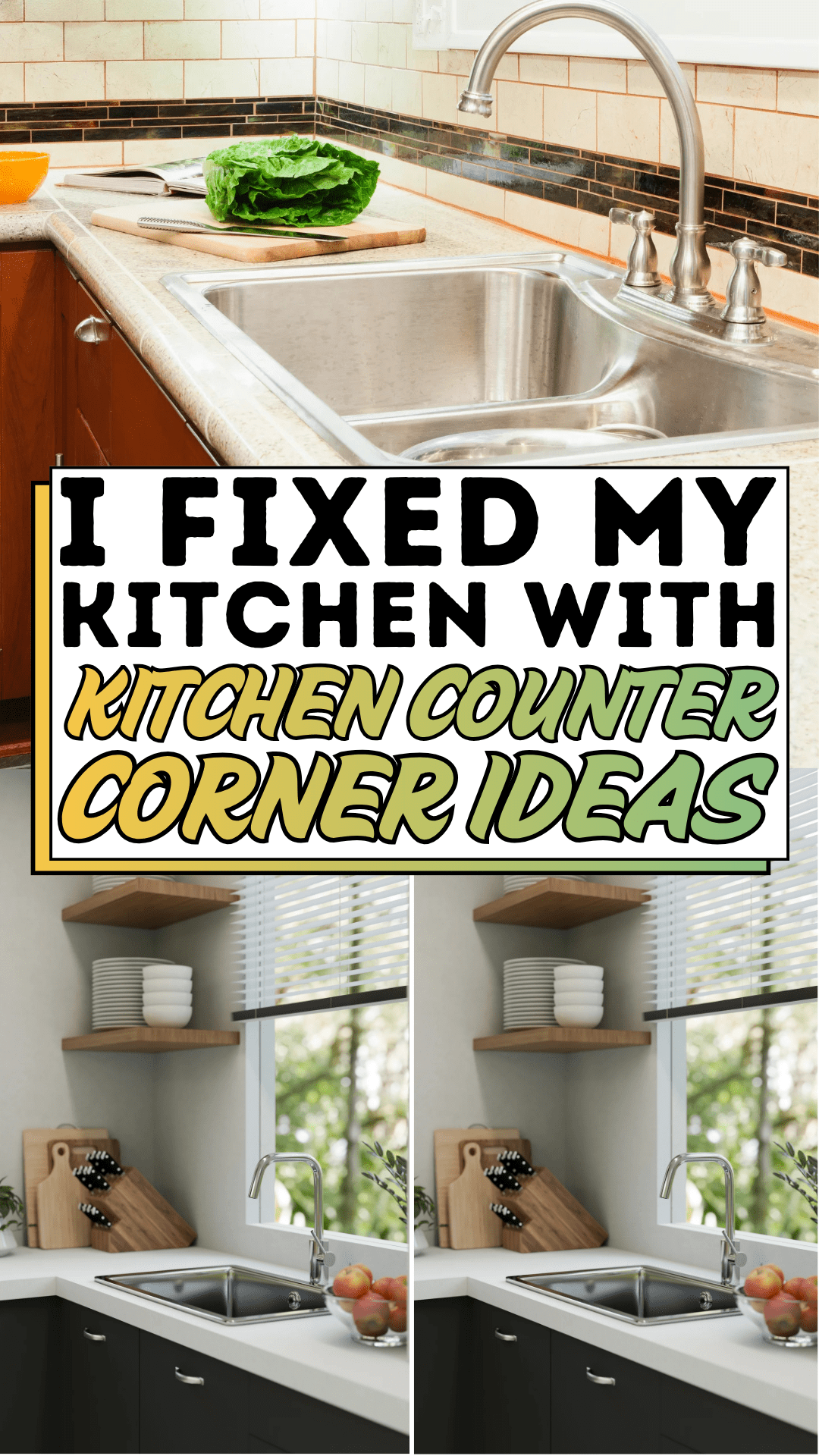
The corner of my L-shaped kitchen counter had become a dead zone disguised as storage space. Not literally dead things accumulated there constantly but functionally dead in the specific way that deep inside corners always become: the mail that needed sorting, the appliance that got used twice a year and never put away because retrieving it from the corner cabinet required a specific contortion I avoided, the general sediment of kitchen counter clutter that finds its way to the spot furthest from where anyone is actually working. Every L-shaped kitchen I had seen in magazines made the corner look effortless, a clean transition between two counter runs, sometimes even a feature in its own right. My corner looked like the place where the organization had been abandoned. I had looked into kitchen counter corner ideas more than once, gotten as far as researching corner cabinet hardware, and stalled out every time because the gap between the Pinterest-board corner and my actual cluttered one felt too wide to close without a full kitchen renovation, which I was not prepared to undertake.
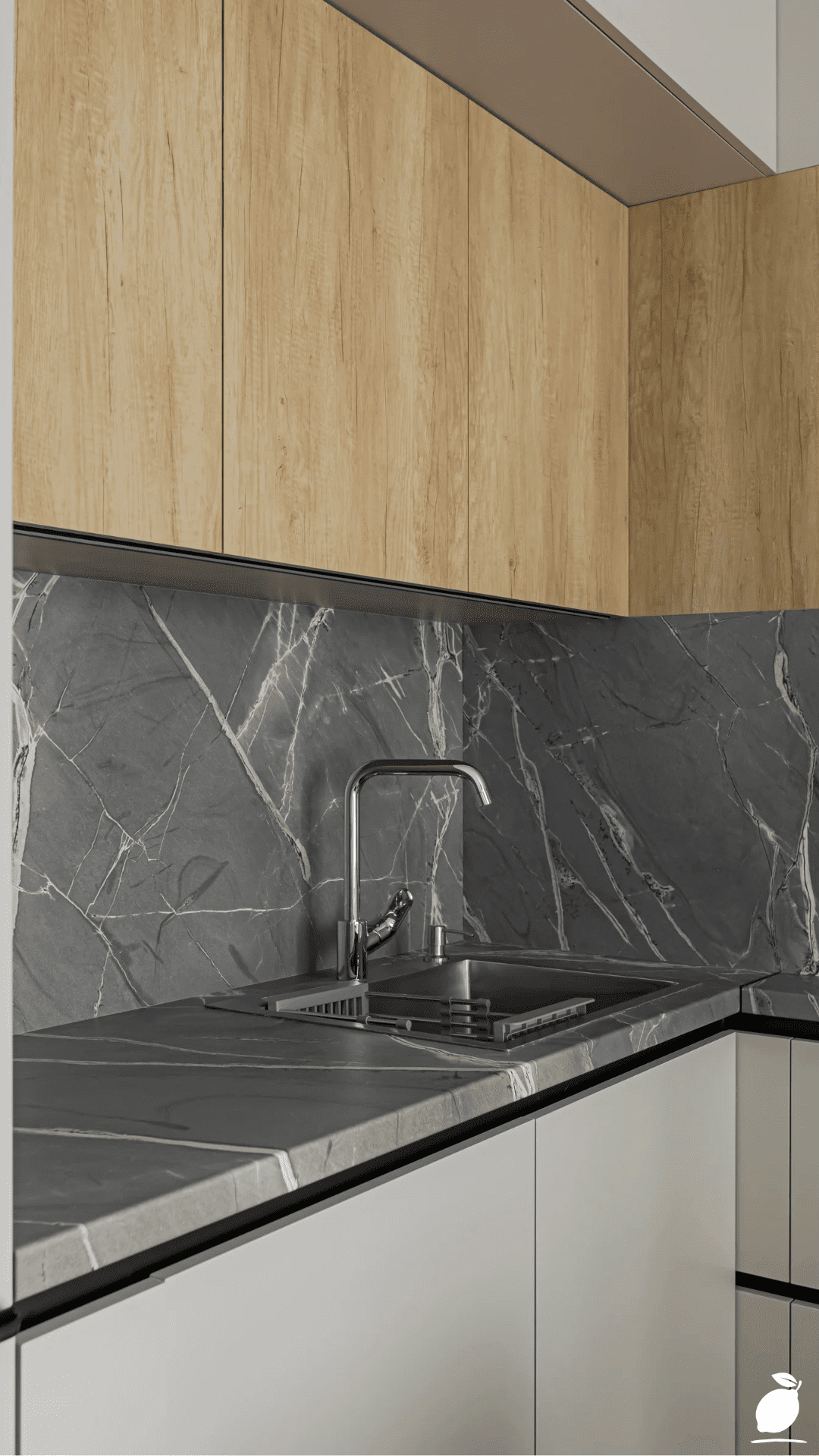
The kitchen in the image above proved that the gap was closeable without a full renovation. A dark gray marble backsplash with white veining extending continuously from the counter up to the upper cabinets, the same marble material used for the countertop, creating an uninterrupted stone surface that makes the entire corner read as a single considered material statement rather than two surfaces that happen to meet. Light oak upper cabinets with visible natural grain providing warmth against the cool marble; matte white lower cabinets providing the clean, light-reflecting surface that makes a corner zone feel open rather than cramped. A sleek chrome gooseneck faucet positioned with clear intention at the sink. The kitchen counter corner ideas in the image are not corner-specific tricks or clever cabinet inserts; they are the product of material continuity and clean material contrast applied consistently through the entire L-shaped run, including and especially the corner, which is treated not as a problem to be hidden but as a feature to be designed.
The kitchen counter corner ideas in this guide address both registers that the image demonstrates: the material and surface decisions that make a corner read as intentional rather than awkward, and the practical organizational and functional decisions that make a corner genuinely usable rather than a storage dead zone. Whether your kitchen counter corner challenge is primarily aesthetic (a corner that looks unfinished or disconnected from the rest of the counter) or primarily functional (a corner cabinet that has become inaccessible storage), these kitchen counter corner ideas address the specific geometry that makes corners the most consistently underperforming zone in any L-shaped or U-shaped kitchen layout.
The Kitchen Counter Corner Ideas Blueprint
Step 1: Assess Your Kitchen Counter Corner’s Specific Challenge
Kitchen counter corner ideas that successfully transform a problem corner begin with a precise diagnosis of which specific challenge the corner presents, because the corner of an L-shaped or U-shaped kitchen can fail in several distinct ways that each requires different kitchen counter corner ideas to resolve. A corner can fail aesthetically (the materials or surfaces do not flow continuously through the corner, creating a visual seam or disjunction), functionally (the corner cabinet beneath the counter is genuinely difficult to access, producing the dead-zone storage problem), or both simultaneously.
Stand in the kitchen’s main work zone and look toward the corner. Does the eye register the corner as a continuation of the counter and backsplash material, or as a place where the materials change or interrupt? This assessment identifies whether a material continuity kitchen counter corner idea (Step 2) is needed. Then, physically test the corner cabinet’s accessibility: open the cabinet door or drawer and reach to the cabinet’s deepest interior point. If this requires significant reaching, kneeling, or contorting, the corner has a functional accessibility problem that a hardware-based kitchen counter corner idea (Step 4) needs to address.
The kitchen in the image demonstrates a corner that has been resolved primarily at the aesthetic and material level. The marble and cabinet materials flow continuously through the corner without any visual break, which is the foundation that every other kitchen counter corner idea in this guide builds upon. Address material continuity first, because it is the kitchen counter corner idea that most affects the kitchen’s overall visual quality, then layer functional improvements on top of that resolved material foundation.
Step 2: Extend Material Continuity Through the Kitchen Counter Corner
The single most transformative kitchen counter corner idea the image demonstrates is material continuity: the same dark gray marble used for the countertop continues, without interruption, into the backsplash, creating a single unbroken stone surface from the counter’s working height up to the upper cabinets. This continuous material treatment is the kitchen counter corner idea that most directly resolves the visual disjunction problem that makes many kitchen corners feel unresolved or awkward when the counter material and backsplash material change at the corner, or when the backsplash material is genuinely different from the counter (a common cost-saving kitchen design choice), the corner reads as a seam rather than a feature.
For kitchen counter corner ideas prioritizing material continuity, specify the same stone or quartz material for both countertop and backsplash at the point of initial material selection, rather than treating the backsplash as a separate decision made after the countertop is installed. Full-height marble or quartz backsplash extending from the countertop to the underside of the upper cabinets as in the image costs more in material (a typical 60cm to 90cm height of additional stone coverage) than a standard 10cm to 15cm backsplash strip, but the kitchen counter corner idea’s visual payoff at the corner specifically justifies the additional material cost for kitchens where the corner is a significant visual element of the overall space.
For kitchen counter corner ideas in kitchens with existing material discontinuity (different counter and backsplash materials already installed), a kitchen counter corner idea that does not require full material replacement is a continuous painted or wallpapered backsplash treatment that wraps the corner without seam choosing a backsplash material independent of the counter material, but ensuring that material itself flows continuously and seamlessly through the corner, addresses the visual continuity principle even when the counter and backsplash materials differ from each other.
Step 3: Apply Contrasting Cabinet Materials to Frame the Kitchen Counter Corner
The light oak upper cabinets and matte white lower cabinets in the image demonstrate the kitchen counter corner idea of material contrast as a framing device — the visual distinction between the two cabinet materials creates a horizontal datum line through the kitchen that draws the eye along the full counter run, including through the corner, rather than allowing the corner to become a visual stopping point or dead zone. This two-tone cabinet approach is among the most popular kitchen counter corner ideas in contemporary kitchen design, specifically because it performs this corner-resolving function so effectively.
For kitchen counter corner ideas using contrasting cabinet materials, choose an upper cabinet material or finish that is lighter or more visually active (natural wood grain, as in the image, or a lighter paint color) and a lower cabinet material or finish that is more visually grounded (a solid color, typically white or a deep neutral, as in the image’s matte white lower cabinets). This light-above, grounded-below relationship creates a sense of visual lift at the corner, where the upper cabinets appear to float above the lower mass that prevents the corner from reading as heavy or closed-in, which is the specific visual problem that monochromatic, single-material cabinets often produce at a kitchen’s corner.
For kitchen counter corner ideas where a full cabinet material change is beyond the project’s scope, applying the contrast principle at a smaller scale, different cabinet hardware finishes between upper and lower cabinets, or a contrasting interior cabinet paint visible when corner cabinet doors are open, provides some of the same visual benefit at a fraction of the investment.
Step 4: Solve the Kitchen Counter Corner’s Cabinet Accessibility Problem
Beneath the kitchen counter corner’s visual surface, the corner cabinet is frequently the kitchen’s least functional storage space, a deep, awkward-shaped cavity that standard shelving makes genuinely difficult to access fully. Kitchen counter corner ideas that address this functional problem use specialized corner cabinet hardware specifically engineered to make the corner’s full storage volume accessible rather than abandoned.
The most effective kitchen counter corner ideas for cabinet accessibility are: a lazy Susan (a rotating circular or kidney-shaped shelf system that brings stored items to the cabinet opening through rotation rather than requiring reach into the cabinet’s depth) the most widely available and most cost-effective kitchen counter corner idea for accessibility, typically $80 to $200 for a quality unit; a magic corner pull-out system (articulated shelving that extends out of the cabinet on a pivoting mechanism when the door opens, then folds back into the corner space when closed) the most space-efficient kitchen counter corner idea for accessibility, capturing close to 100 percent of the corner’s storage volume as usable space, at $250 to $500 per unit; and blind corner pull-out systems for kitchens with a blind corner configuration (where one cabinet run extends behind the adjacent cabinet face, creating storage that is genuinely invisible without a pull-out mechanism) specialized hardware at $300 to $600 per unit that is essential for blind corner configurations, where no standard shelving solution provides reasonable access.
For kitchen counter corner ideas on a more limited budget, a diagonal corner cabinet with a single door and standard shelving rather than the L-shaped or blind corner configurations that require specialized hardware provides simpler, more direct access at standard cabinet cost, sacrificing some storage volume efficiency for dramatically simpler and cheaper hardware requirements.
Step 5: Position the Sink and Faucet to Optimize the Kitchen Counter Corner Work Zone
The sink and gooseneck faucet positioned at the corner-adjacent counter run in the image demonstrates a kitchen counter corner idea that addresses workflow rather than storage: positioning the kitchen’s primary water-use fixture near but not directly at the corner itself, which preserves the corner’s full counter surface for food preparation while keeping the sink within efficient reach of both counter runs that meet at the corner.
For kitchen counter corner ideas involving sink placement, position the sink at a minimum of 45cm to 60cm from the inside corner point close enough that someone working at the sink can reach across to the adjacent corner-zone counter for staging dishes or ingredients, far enough that the sink’s basin and the cabinet doors beneath it do not create the access conflict that occurs when sink plumbing and corner cabinet hardware compete for the same below-counter space. This kitchen counter corner idea spacing principle is the reason most well-designed L-shaped kitchens position the sink along one leg of the L rather than directly at the corner apex.
A gooseneck or pull-down faucet, as in the image, provides the kitchen counter corner ideas’ most practical fixture choice for kitchens where the sink sits near a corner the gooseneck’s height and reach allow filling large pots and accessing the full sink basin width without requiring the user to stand at an awkward angle relative to the adjacent corner cabinetry, which lower-profile or fixed-spout faucets sometimes require in corner-adjacent sink positions.
Step 6: Light the Kitchen Counter Corner for Both Function and Atmosphere
The soft, even lighting in the image highlights the marble’s natural veining, which is the kitchen counter corner idea that completes the corner’s transformation from a potentially shadowed, under-lit zone into a fully integrated part of the kitchen’s design and function. Corners in L-shaped kitchens frequently receive less direct light than the kitchen’s main work zones, particularly when upper cabinets extend into the corner and block ambient light from fixtures positioned elsewhere in the room.
For kitchen counter corner ideas addressing lighting, under-cabinet LED strip lighting installed beneath the upper cabinets through the full corner run not stopping short of the corner, which is a common installation error that leaves the corner specifically under-lit relative to the rest of the counter provides task lighting exactly where the kitchen counter corner’s work surface needs it, while also highlighting the backsplash material’s texture and pattern in the specific way the image demonstrates with the marble veining. Warm-white LED strips at 2700K to 3000K provide the most flattering illumination for natural stone and wood materials in a kitchen counter corner ideas lighting plan.
Expert Secrets for Success
Pro-Tips for a Better Result
Order extra marble or stone slab material at the time of initial countertop fabrication to ensure full vein-pattern continuity through the corner. The seamless appearance of the marble backsplash and countertop in the image, with consistent veining flowing through the corner transition, requires careful slab selection and cutting at the fabrication stage. The fabricator needs to plan the cuts so that the same slab’s veining pattern continues logically from counter to backsplash without an abrupt pattern break at the corner seam. Discuss this specific continuity requirement with your stone fabricator before cutting begins, and request to see the planned cut layout (a “waterfall” or continuous-grain layout) before fabrication proceeds.
Install corner cabinet pull-out hardware before final cabinet installation, not as a retrofit. Magic corner and blind corner pull-out systems are significantly easier to install correctly during initial cabinet installation, when the cabinet box can be positioned and secured with the hardware’s specific clearance requirements already accounted for. Retrofitting corner pull-out hardware into already-installed cabinetry frequently requires modification to the cabinet box itself, adding cost and complexity that proper sequencing avoids entirely.
Use a single consistent cabinet hardware finish across both the upper and lower cabinet materials at the kitchen counter corner. While the image’s cabinets contrast in material (oak above, white below), the round black knobs maintain a single consistent hardware finish across both materials. This consistency is the detail that prevents a two-material cabinet approach from reading as two unrelated cabinet systems that happen to share a kitchen. Choose one hardware finish for the entire kitchen, including both the contrasting upper and lower cabinet materials at the corner, to maintain the cohesive design language that makes the material contrast read as an intentional design choice rather than a mismatched combination.
Position task lighting to specifically illuminate the inside corner work surface, not just the adjacent counter runs. Standard under-cabinet lighting plans sometimes treat the corner as a transition point between two lighting runs rather than a work surface requiring its own dedicated illumination. Specify continuous LED strip lighting that runs through the full corner transition without a gap, ensuring the corner counter surface receives the same task lighting quality as the rest of the kitchen counter.
Common Mistakes to Avoid
Don’t install standard cabinet doors on a deep corner cabinet without any pull-out or rotating hardware. A standard hinged door on a deep corner cabinet, with fixed interior shelving and no rotating or pull-out mechanism, makes the cabinet’s rear two-thirds genuinely inaccessible for regular use items placed there are effectively in storage rather than active use. This is the single most common kitchen counter corner ideas failure, producing exactly the dead-zone problem this guide addresses. Always specify lazy Susan, magic corner, or blind corner pull-out hardware for any deep corner cabinet in a kitchen renovation or new installation.
Don’t change the backsplash material at the corner transition point. Stopping one backsplash material at the inside corner and beginning a different material on the adjacent wall, a cost-saving or design-simplification choice some kitchens make, produces the specific visual seam and disjunction that undermines the corner’s overall design coherence. If the budget requires different materials in different zones of the kitchen, change materials at a point well away from the corner itself (such as where the backsplash meets a different counter section entirely), not at the corner transition where visual continuity matters most.
Don’t position upper cabinets so deep into the corner that they create a head-clearance hazard at the work surface below. Corner cabinet configurations that extend cabinet doors or shelving deep into the inside corner can create a lower-clearance zone at the counter surface beneath them, where a person working at that section of counter risks contacting the cabinet’s lower edge. Verify that any kitchen counter corner ideas involving deep corner cabinet configurations maintain the standard 45cm minimum clearance between the counter surface and the underside of upper cabinets throughout the full corner transition, not just at the cabinet runs away from the corner.
Don’t neglect grout line and seam maintenance, specifically at the kitchen counter corner. The corner is the kitchen zone where countertop and backsplash seams, grout lines (if tile rather than slab material is used), and cabinet joints are most concentrated, making it the area most vulnerable to moisture infiltration and the area requiring the most attentive maintenance. Inspect the corners’ seams and grout lines twice annually, and re-seal natural stone surfaces at the corners (and throughout the kitchen) annually to maintain the moisture resistance that prevents staining and degradation at this high-concentration seam zone.
Why Kitchen Counter Corner Ideas Matter
The kitchen corner is a small fraction of the kitchen’s total square footage, but it occupies an outsized position in how the kitchen as a whole is experienced visible from nearly every angle of the room, frequently positioned at the transition point between the kitchen’s primary work zones, and disproportionately likely to become either a celebrated design feature or a chronically neglected storage problem depending on how thoughtfully it has been addressed. Kitchen counter corner ideas that successfully resolve the corner’s specific aesthetic and functional challenges produce a kitchen that feels complete and considered throughout its full footprint, rather than a kitchen with one carefully designed zone and one neglected afterthought. Kitchen counter corner ideas are, in this sense, disproportionately valuable relative to the square footage they address.
Research in kitchen design and household efficiency has consistently identified storage accessibility as among the most significant factors in daily kitchen satisfaction and functional efficiency. Kitchens where every storage zone, including the difficult corner spaces, is genuinely accessible reduce the daily friction of meal preparation and kitchen maintenance in ways that compound across years of daily use. A corner addressed by genuine kitchen counter corner ideas is a corner that gets used rather than avoided, storing items that are genuinely retrieved rather than forgotten, and contributing to the kitchen’s overall sense of order rather than undermining it as a persistent reminder of unaddressed clutter. Kitchen counter corner ideas that ignore this functional dimension and address only the corner’s visual presentation produce a beautiful zone that remains, beneath its surface, exactly as inaccessible as it was before.
Easy Peasy Life Matters is built on the conviction that every zone of the kitchen, including the corners that are easiest to overlook in both initial design and ongoing maintenance, deserves the same quality of intentional attention as the kitchen’s primary work surfaces. Kitchen counter corner ideas executed with the material continuity, functional hardware, and lighting principles, this guide provides a transformation of the corner from the kitchen’s most consistently underperforming zone into a genuine asset, exactly as the image demonstrates, where the corner is not hidden or minimized but treated as a feature worth designing well. The best kitchen counter corner ideas make that single observation the entire project’s organizing principle: design the corner as if it matters, because it does.
Frequently Asked Questions
What is the best storage solution for a deep kitchen counter corner cabinet?
For most deep corner cabinet configurations, a magic corner pull-out system provides the highest storage efficiency, capturing close to 100 percent of the cabinet’s interior volume as genuinely accessible storage through its articulated pull-out shelving mechanism. For a lower-cost kitchen counter corner ideas solution, a quality lazy Susan (rotating shelf system) provides good accessibility at a significantly lower price point, though it captures slightly less of the corner’s total storage volume than a magic corner system due to the circular or kidney-shaped rotating shelf’s geometry within a square or rectangular cabinet space. Blind corner cabinets specifically (where one cabinet run extends behind an adjacent cabinet face) require blind corner pull-out hardware, as standard lazy Susan or magic corner systems are not compatible with this specific cabinet configuration.
How do I make a kitchen counter corner look less awkward without a full renovation?
The most impactful kitchen counter corner ideas achievable without full renovation are: ensuring consistent lighting through the corner transition (adding or extending under-cabinet LED strip lighting if the corner is currently under-lit relative to adjacent counter sections), styling the corner counter surface with one or two well-chosen functional or decorative objects (a cutting board on display, a small plant, a ceramic utensil holder) rather than leaving it as accumulated clutter, and addressing any visual material discontinuity through paint or removable backsplash products (peel-and-stick tile or marble-effect contact paper) where full material replacement is not within the project scope. These kitchen counter corner ideas address the corner’s visual and functional presentation without requiring countertop or cabinet replacement.
Should kitchen counter corner ideas include a sink at the corner itself?
Most kitchen design professionals recommend positioning the sink along one leg of an L-shaped or U-shaped kitchen counter rather than directly at the inside corner apex, for two practical reasons: a sink positioned directly at the corner creates plumbing access conflicts with corner cabinet storage hardware (lazy Susan or magic corner systems require the full cabinet depth that sink plumbing would otherwise occupy), and a corner-positioned sink reduces the available counter space on both adjacent counter runs simultaneously rather than preserving full counter length on at least one run. Position the sink 45cm to 60cm from the inside corner point for kitchen counter corner ideas that balance sink accessibility with corner storage functionality.
What countertop materials work best for kitchen counter corner ideas with a continuous backsplash?
Natural stone (marble, granite) and engineered quartz are the most common kitchen counter corner ideas materials for continuous countertop-to-backsplash treatments, because both materials are fabricated and installed as large-format slabs that can be cut to flow continuously around an inside corner with minimal or carefully planned seaming. Marble, as in the image, provides the most dramatic veining pattern continuity but requires more careful maintenance (regular sealing, avoidance of acidic substances that etch the surface) than quartz, which is engineered for greater stain and etch resistance while sacrificing some of natural marble’s organic pattern variation. For kitchen counter corner ideas prioritizing low maintenance with a similar aesthetic result, quartz in a marble-look pattern provides a practical alternative to genuine marble.
How much does it cost to upgrade the kitchen counter’s corner functionality?
Kitchen counter corner ideas focused specifically on functional improvement (rather than full material replacement) typically range from $150 for a basic lazy Susan retrofit to $600 for a premium magic corner or blind corner pull-out system professionally installed. Kitchen counter corner ideas focused on the full aesthetic transformation. The image demonstrates continuous marble or quartz from counter to backsplash, contrasting cabinet materials, and corner-specific lighting represent a more significant investment, typically $3,000 to $8,000 for the corner zone specifically within a broader kitchen counter and cabinet project, depending on material selection and the extent of cabinet replacement involved.