The living room felt fine. That was the problem, fine. The walls were white, the sofa was grey, the coffee table was functional, and the whole space had a quality of perfectly adequate neutrality that made it neither enjoyable to be in nor easy to identify what was missing. It did not feel like the rooms in the interiors I had been saving for two years, the ones with warmth and depth and something that could be loosely described as character. Those rooms felt alive in a way mine did not, and I could not name the difference. Not color, my room had a reasonable color palette. Not furniture, the pieces were fine. Something in the quality of the materials, the combination of the natural and the refined, the particular way those rooms felt simultaneously modern and grounded, was not present in mine.
The missing quality had a name I did not know yet: organic modern. It is not a style in the way that Scandi or mid-century are styles with their defining silhouettes and signature pieces. Organic modern living room ideas operate instead on a set of material and compositional principles: natural textures in a contemporary framework, raw and refined in deliberate tension, living elements alongside clean geometry. The rooms that had been stopping me mid-scroll were not decorated with the specific furniture I needed to buy. They were assembled from specific decisions I needed to understand, decisions about how natural materials relate to white walls, how dried and living plants coexist in the same space, and what it means to bring an earthiness into a room without sacrificing its modern clarity.
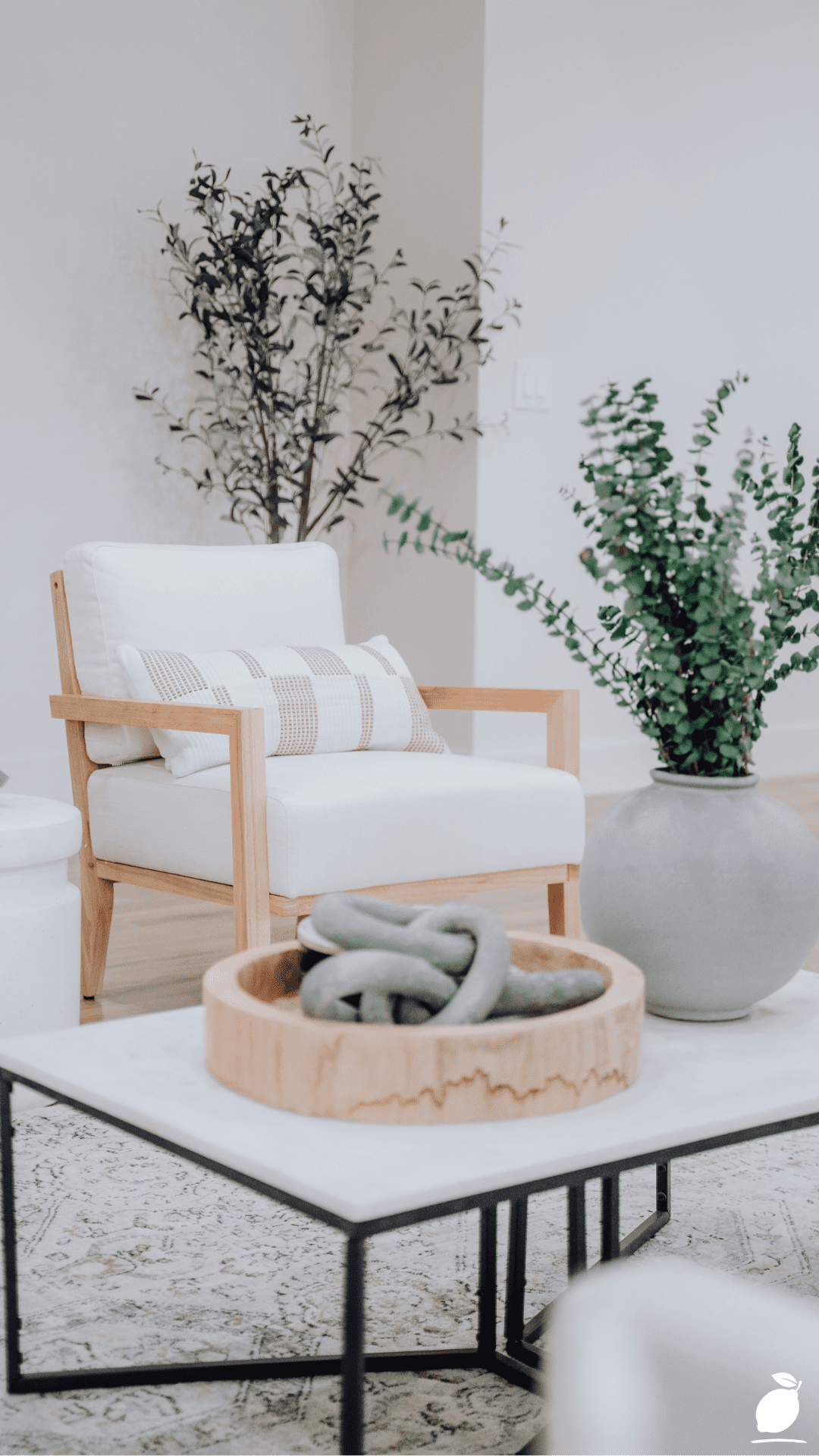
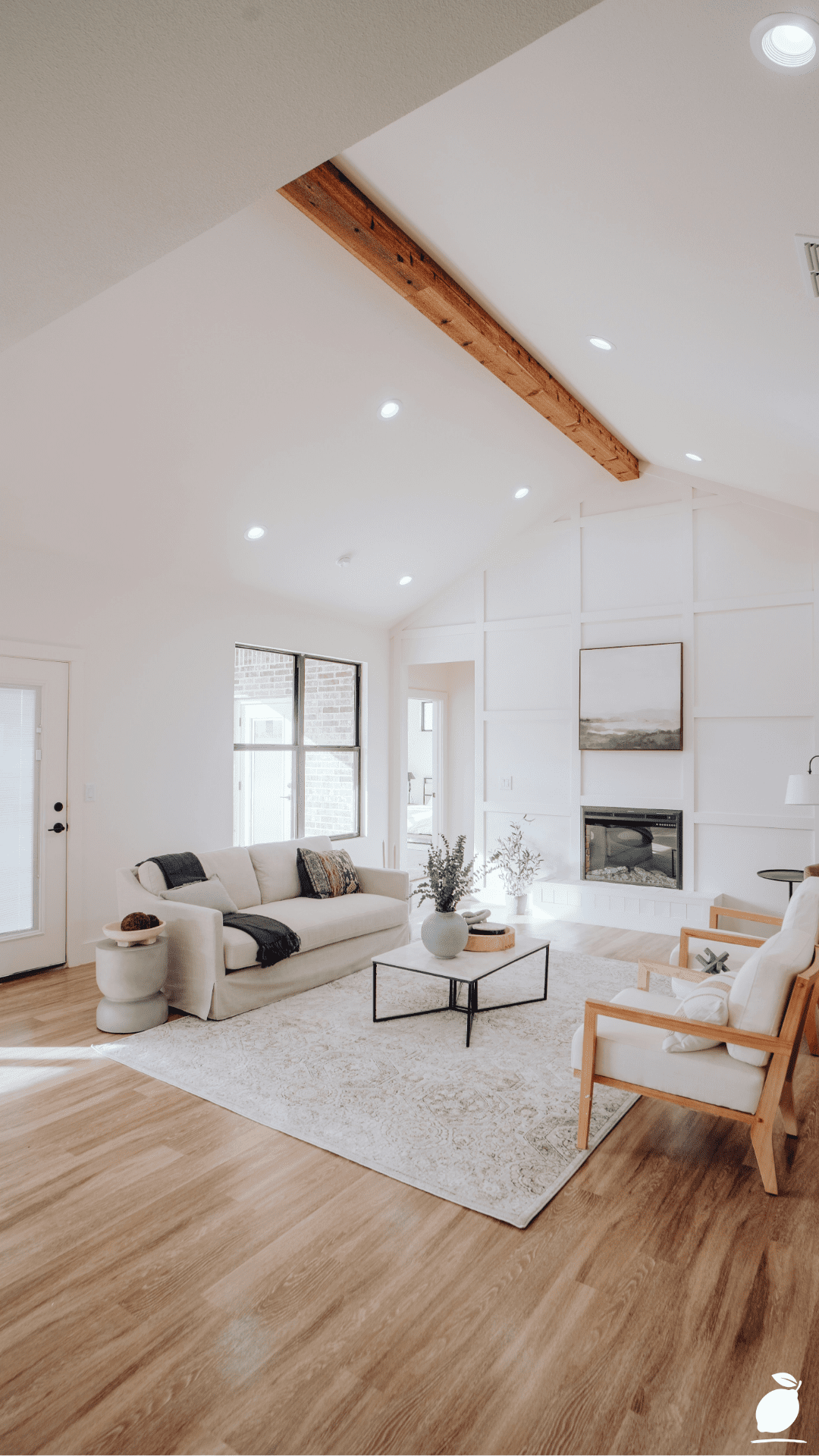
Organic modern living room ideas gave me the framework for those decisions, one element at a time. The room in the image above is the result: a white chair with light oak arms, a marble-top coffee table on a black metal frame, eucalyptus in a grey ceramic vase, rope knots in a wooden bowl, dried branches in a white container against white walls. Natural, contemporary, and earthy in a way that feels genuinely effortless because every element was chosen with the same set of principles behind it. This is how I applied those principles and how you can too.
The Organic Modern Living Room Ideas Blueprint
Organic modern living room ideas are applied in a specific sequence, establishing the material foundation first, then layering natural objects and living elements in a progression that builds depth without adding complexity. These steps follow the order in which decisions compound on each other most effectively.
Step 1: Start With the Organic Modern Material Foundation
The first of all organic modern living room ideas is the one that determines every subsequent decision: the material palette. Organic modern design operates from a specific material vocabulary, white or warm white as the dominant backdrop, light natural timber for furniture frames and accent pieces, grey or warm greige for upholstery and soft furnishings, black or dark metal for structural accents, and white marble or stone for horizontal surfaces. These five material categories appear consistently across every well-executed organic modern living room, and establishing them as the framework before any purchasing or styling begins prevents the material drift that makes rooms look assembled rather than designed.
In the image, all five are present with precision: white walls (dominant backdrop), light oak chair frame and wooden bowl (natural timber), white upholstery with grey woven rug (textile layer), black metal coffee table frame (structural accent), and white marble coffee table top (stone surface). No material in the room falls outside this palette. The power of organic modern living room ideas comes precisely from this material discipline, not restriction, but coherence. Commit to the palette before choosing any individual piece.
Step 2: Choose the Primary Seating as the Organic Modern Statement
In organic modern living room ideas, the primary seating piece is typically the room’s clearest aesthetic statement, the piece that most visibly expresses the organic-modern tension between natural material and contemporary form. The ideal organic modern chair or sofa has a light timber frame (oak, ash, or beech) with clean, architectural lines, upholstered in a neutral white, cream, warm grey, or undyed linen that keeps the silhouette crisp and the natural material of the frame legible.
The white armchair with light oak arms in the image is an almost textbook expression of this principle. The frame is visible and beautiful, the grain of the wood is a feature, not a hidden structural necessity, and the white upholstery in its restrained stripe keeps the chair contemporary rather than rustic. When selecting the primary seating for organic modern living room ideas, look specifically for pieces where the timber frame is an aesthetic choice rather than merely a structural one, and where the upholstery tone allows the natural material of the frame to read clearly.
Step 3: Select the Coffee Table as an Organic-Contemporary Moment
The coffee table in an organic modern living room is typically where the natural-refined tension is expressed most explicitly, where a raw or organic material (marble, stone, reclaimed wood, travertine) meets a refined structural form (black powder-coated metal frame, slender legs, geometric profile). The combination reads as simultaneously grounded and sophisticated in a way that a purely wooden or purely glass coffee table does not.
In the image, the black metal frame with white marble top delivers exactly this tension: the industrial precision of the metal frame against the organic veining of the marble surface. For organic modern living room ideas applied on different budgets, this principle translates readily to a concrete-look top on slender metal legs, a raw wood slab on hairpin legs, or a travertine oval on a brushed bronze base, all of which express the same organic-contemporary composition at different price points.
Step 4: Introduce Living Plants as Architectural Elements
Organic modern living room ideas consistently use plants as architectural contributors, not decorative accents scattered across surfaces, but deliberate specimens chosen for their form and placed with the same intention as furniture. The eucalyptus in the tall grey ceramic vase in the image is precisely this: its arching, irregular branches and grey-green leaf color contribute a quality of organic movement and natural life that no inanimate object in the room could provide, and the tall grey ceramic vessel grounds it structurally in the room’s material palette.
Choose plants for organic modern living room ideas based on their architectural quality rather than their care requirements, though many naturally architectural plants are also low-maintenance: eucalyptus (fresh or dried), olive branches in water, large-leaf monsteras in a single statement planter, or structured succulents in ceramic pots. Each specimen should be placed in a container that belongs to the organic modern material palette: grey, white, or terracotta ceramic, raw stoneware, or natural wood, rather than in decorative or brightly colored pots that compete with the room’s tonal restraint.
Step 5: Layer Dried and Natural Object Arrangements
The dried plant arrangement in the background of the image, delicate branches in a white container, spare and structural against the white wall, represents one of the defining characteristics of organic modern living room ideas: the deliberate use of dried, preserved, or raw natural objects as part of the room’s visual composition. Where living plants provide movement and color, dried arrangements provide texture, permanence, and a particular quality of quiet beauty that living plants do not.
Dried elements in organic modern living room ideas include dried pampas grass in a ceramic vase, preserved magnolia or eucalyptus branches, dried seed heads displayed in a clear glass vessel, or sculptural branches of dried wood arranged in a tall container. The key is placement: dried arrangements in organic modern living room design are positioned against plain walls or in corners where their silhouette is clearly readable, rather than crowded among other objects where the delicate forms are lost. The negative space around the dried arrangement is as important as the arrangement itself.
Step 6: Complete With Tactile Object Layering
The final step in the organic modern living room ideas sequence is the layering of tactile natural objects at the horizontal surface level: the coffee table, the side table, and the shelf. These objects, the wooden bowl with rope knots in the image, the marble surface itself, and the grain of the oak arms provide the close-range tactile richness that the eye seeks in the absence of color and pattern.
In organic modern living room ideas, coffee table styling follows the same principle as the Japandi approach but with an explicitly organic emphasis: one natural vessel (a wooden bowl, a ceramic dish, or a stone tray), one collection of natural objects within it (smooth stones, rope knots, pine cones, driftwood pieces), and one living or dried botanical element nearby. The arrangement is minimal, with three elements at most, and everything present is chosen as much for its texture as its form. The rope knots in the wooden bowl in the image are not an arbitrary decoration. They are a deliberate contribution of tactile contrast: the roughness of natural rope inside the smooth grain of a turned wooden bowl, both sitting on the cool, veined marble of the table surface.
Expert Secrets for Success
Pro-Tips for a Better Result
- Limit the organic modern palette to five material categories and apply them consistently. The five materials established in Step 1, warm white, light timber, neutral upholstery, dark metal, stone, or marble, are the complete material vocabulary for an organic modern living room. Any object introduced that falls outside these five categories will read as a visual inconsistency that the room’s otherwise cohesive aesthetic cannot absorb. When assessing a potential purchase for an organic modern living room, ask whether it belongs to one of the five material categories. If not, reconsider.
- Use height variation to create an organic modern visual rhythm. The image demonstrates a specific height composition: the tall eucalyptus vase at standing height, the wooden bowl at coffee table height, the dried arrangement in the background at mid-wall height. These three heights create a vertical rhythm across the room that gives the space depth and energy without requiring multiple objects at the same level. Apply this height principle to every vignette in an organic modern living room, varying the heights of plants, objects, and vessels to create the layered depth that distinguishes an organic modern room from a flat, uniformly arranged space.
- Choose one imperfect handmade object for every surface. The handmade quality, the slightly uneven ceramic rim, the organic form of a turned wooden bowl, the irregular grain of a raw edge are what introduce the wabi-sabi warmth that prevents an organic modern living room from reading as cold or clinical. Include at least one handmade or hand-formed object on every styled surface: a handthrown vase, a hand-carved wooden object, a hand-woven textile. These objects provide the human scale that machine-made precision cannot.
- Apply the organic modern aesthetic to lighting as well as furniture. Pendant lights with natural material shades, woven rattan, ceramic, and hand-blown glass contribute to the organic modern composition in a way that standard recessed or track lighting does not. A single ceramic pendant above a reading chair, or a rattan pendant in the corner above a floor plant, provides the warm, directional light that the organic modern aesthetic requires and is consistent with the room’s material vocabulary. Lighting is a material choice in organic modern living room ideas, not merely a functional one.
- Photograph the room from a low angle to assess the organic modern composition. Organic modern living room ideas create their most distinctive impression from a slightly low angle, the angle at which the horizontal surfaces, the plant forms, and the furniture silhouettes are simultaneously visible and readable. Photograph the room from hip height before considering the styling complete. At this angle, the layering of the composition, the marble table top in front, the eucalyptus at height, and the white wall behind is visible as a unified composition rather than as individual elements. Adjust accordingly.
Common Mistakes to Avoid
- Introducing warm brown or dark wood tones against the light timber palette. Organic modern living room ideas depend on a specific timber tone light oak, ash, or blond timber that reads as natural without being heavy. Introducing dark walnut, rich mahogany, or warm reddish-brown timber tones alongside light oak creates a visual conflict within the material palette that undermines the serene, contemporary quality organic modern design requires. Keep all timber in the light-to-medium oak range and address the desire for depth through grey upholstery and dark metal accents rather than through darker wood.
- Over-filling the organic modern living room with natural objects. The organic-in-modern part of organic modern living room ideas requires restraint with natural objects precisely because natural objects have high visual weight the grain of a wooden bowl, the texture of rope, the form of dried branches that accumulates quickly into visual noise if too many are present. Apply the one-significant-object-per-surface rule: one vessel, one arrangement, one collection and then stop. The empty space around each natural object is what gives it the clarity to read as beautiful rather than simply present.
- Using colored or patterned cushions against the organic modern palette. Cushions in bright colors, bold patterns, or warm terracotta tones that fall outside the white-grey-natural spectrum of organic modern living room ideas introduce a visual energy that works against the earthiness and restraint the style requires. Keep cushions in the organic modern textile range undyed linen, warm white boucle, tonal stripe in beige and ivory and resist the temptation to introduce color or pattern at this scale. Color in an organic modern living room comes from the natural materials themselves: the marble veining, the wood grain, the eucalyptus grey-green.
- Choosing artificial plants instead of real or dried botanical material. Artificial plants read as artificial in the organic modern context the slightly synthetic quality of the material, the perfect uniformity of the leaf shape, and the absolute color consistency are all inconsistent with the organic irregularity that authentic organic modern living room ideas require. Use real plants where care is possible; use genuinely dried or preserved botanical material where a living plant is not practical. The specific quality of imperfection the slight natural asymmetry, the variance in leaf color is what makes botanical elements contribute authentically to organic modern living room design.
- Ignoring the floor as a material element. In organic modern living room ideas, the floor is a significant material contribution light oak or ash flooring reads as a foundational natural element that supports the entire palette, while darker flooring, patterned tile, or grey laminate creates a material conflict at the room’s base. If the existing floor cannot be changed, a large, neutral natural-fiber rug grey wool, undyed jute, or natural cotton in a subtle texture can establish the organic modern floor tone over an incompatible existing surface.
Why Organic Modern Living Room Ideas Matter
Organic modern living room ideas matter because they resolve a specific tension that most modern living rooms never fully address: the tension between the clean, ordered quality we seek in a contemporary home and the warmth, texture, and connection to the natural world that we equally need but rarely know how to provide without visual contradiction. Pure minimalism delivers order but can feel cold and unwelcoming. A room filled with natural materials without a coherent framework can feel busy and unresolved. Organic modern living room ideas find the exact intersection of natural in its material, modern in its composition, that provides both.
For families, an organic modern living room creates a shared space that feels genuinely restful, not the performed restfulness of a show-home aesthetic that discourages actual use, but the real restfulness of a room whose materials are pleasant to touch, whose composition does not demand visual attention, and whose warmth makes staying in the room the natural preference over retreating to a screen. The eucalyptus in the grey vase is not decorative in the showroom sense; it changes the quality of the air, introduces a natural scent, and provides a quality of organic movement in response to air currents that gives the room a sense of being alive. These are the details that make the difference between a room that is photographed and a room that is lived in with genuine contentment.
And for the person who takes the time to understand and apply organic modern living room ideas who edits the room, chooses the materials with the vocabulary in mind, and places each natural object with architectural intention the result is a particular kind of satisfaction that design trends rarely provide: the sense of having created something with principles rather than impulses, a room whose coherence is permanent rather than temporary, and whose calm quality does not depend on the room being empty to be felt. That is the gift of organic modern living room ideas done well, a living room that earns its name by being genuinely worth living in.
Frequently Asked Questions
What is the difference between organic modern and Japandi design?
Both organic modern living room ideas and Japandi design favour natural materials, neutral palettes, and simplicity over excess. The primary distinction is in their warmth, temperature, and philosophical emphasis. Japandi leans cooler and more restrained, drawing on Japanese wabi-sabi and Scandinavian hygge with a strong emphasis on craft and imperfection. Organic modern living room ideas tend slightly warmer, with a stronger emphasis on the specific combination of raw natural materials (marble, rope, dried botanicals) with contemporary structural forms (black metal frames, clean geometric silhouettes). Japandi rooms often feel more meditative; organic modern rooms often feel slightly more polished while retaining their natural warmth.
How do I apply organic modern living room ideas in a small space?
In smaller living rooms, organic modern living room ideas scale down effectively by reducing the number of objects applied to each principle rather than eliminating principles. A small organic modern living room might have one significant plant specimen instead of two, a single coffee table vignette instead of multiple surface arrangements, and one botanical wall arrangement instead of several. The material palette includes warm white, light timber, grey upholstery, dark metal accent, and stone surface applies at any scale. Prioritise vertical elements (a tall plant, a floor-standing lamp) over horizontal ones to create the sense of height that makes small rooms feel more spacious.
What are the most important organic modern living room pieces to invest in?
Among organic modern living room ideas, the pieces with the highest impact-to-cost ratio are the primary seating (the chair or sofa with a visible light timber frame), the tall grey or white ceramic vase for botanical display, and the coffee table with a natural stone or marble top on a dark metal base. These three pieces deliver the organic-modern visual language most directly and most durably. Secondary investments, such as the wooden bowl, the natural rug, the dried botanical arrangement, can be assembled from lower price points without compromising the overall organic modern aesthetic, because their natural material quality is accessible at a wide range of budgets.
How do I maintain the organic modern living room aesthetic over time as the room is used daily?
Organic modern living room ideas are sustained daily by the same material discipline that creates them, returning objects to their designated positions, replacing wilted botanical elements with fresh or dried alternatives, and periodically editing additions that have accumulated over time against the five-material-category test. Fresh eucalyptus in the tall vase lasts approximately two weeks before it should be replaced with a fresh bunch or allowed to dry in place as a preserved botanical element. The rope knots and wooden bowl require no maintenance. The grey rug benefits from a weekly vacuum. The natural discipline of the palette only applies to objects belonging to the five material categories is self-maintaining when the rule is applied consistently.