My bedroom used to be the room I spent the least time thinking about and the most time regretting. It had light grey walls that came with the apartment and furniture I had accumulated without a plan, a desk that was too big, a chair that did not match it, bedding in a color I had picked in five minutes because the set was on sale. Every time I sat down to work or tried to unwind at the end of the day, the room felt like it was working against me. Not ugly, exactly. Just wrong, mismatched in a way I could not quite name, lacking any visual thread that tied the pieces together into something that felt intentional or alive. I would scroll through bedroom inspiration images late at night and feel simultaneously excited by what I saw and frustrated that I could not figure out how to get there.

The room in the image above is where that frustration was finally resolved for me, not because it is grand or expensive, but because it is coherent. A sage green and grey bedroom, executed with restraint and real thought. Light grey walls and pale wood plank floors form the quiet base. A large white upholstered bed dressed in light blue sheets, a beige blanket, and sage green and soft blue pillows anchors the room with warmth and softness. A light green metal chair sits in front of a small, round wooden desk holding a laptop and a dark green mug.
A dome-shaped woven pendant light hangs from the ceiling, casting the room in warm, diffused glow. A black wire bookshelf mounts cleanly on the wall beside a window where a small cactus in a grey square pot sits at the sill. A geometric wire side table holds a dark blue vase, a small plant, and a few quiet decorative objects. Every element earns its place. Nothing shouts. The whole room breathes. This is what a sage green and grey bedroom looks like when it is done right, and this guide will show you exactly how to build one.
The sage green and grey bedroom combination works because it operates on a principle that the most restful spaces all share: the colors are close enough in temperature and softness to feel unified, and different enough in hue to create gentle visual interest without tension. Grey provides the cool, grounding neutrality. Sage green provides the organic warmth and life. Together, they create a palette that reads as both modern and natural, both calm and quietly energized, the exact combination most people are searching for when they want a bedroom that finally feels like a real sanctuary. Here is how to build it from the ground up.
The Sage Green and Grey Bedroom Blueprint
Step 1 — Establish Your Sage Green and Grey Bedroom Base with Walls and Floors
Every sage green and grey bedroom starts with the same foundation: a grey wall that reads warm rather than cold, paired with a floor that brings natural material warmth into the space. In the image, the light grey walls are soft and slightly warm-shifted; there is no blue or violet undertone pulling them toward cool or clinical. The light-colored wood plank floors add organic texture and warm contrast. If you are choosing your grey, aim for shades with beige or green undertones (warm greige-grey, green-grey, or soft neutral grey) rather than those with blue or purple bases. Pair with warm wood flooring in honey, blonde, or whitewashed tones, or with light grey tile if wood is not an option. This pairing is the structural envelope that makes every sage green and grey bedroom element you add afterward feel instantly at home.
Step 2 — Choose Your Sage Green and Grey Bedroom Anchor Piece
In any sage green and grey bedroom, one piece should serve as the room’s clearest statement of the palette, the element that announces the color story to anyone who walks in. In the image, the light green metal chair is that anchor: compact, distinctly colored, and positioned at the desk where it is immediately visible from the doorway. Your anchor piece does not have to be a chair. It could be a sage green duvet cover, a set of linen curtains in a muted green, a painted dresser, or even a large ceramic planter. The key is that it introduces your specific sage green, not mint, not olive, not army green, but the specific muted, grey-shifted sage clearly and confidently. Once your anchor is in place, every other green in the room can refer back to it.
Step 3 — Build Your Sage Green and Grey Bedroom Bed as a Layered Textile Story
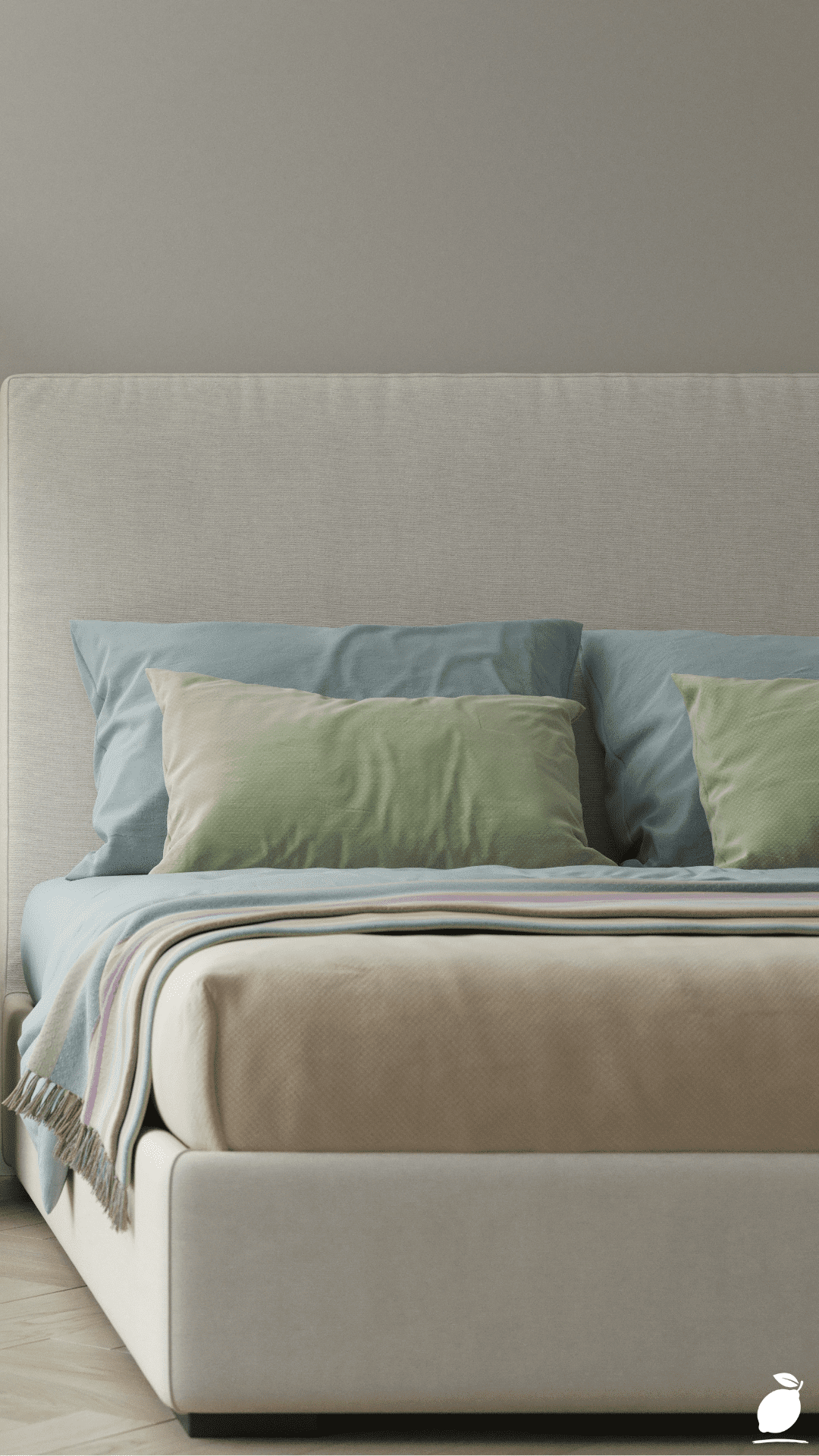
The bed is the largest surface in any sage green and grey bedroom, and the image treats it accordingly. A tall light grey upholstered headboard provides structure and repeats the wall’s grey tone in a slightly warmer, more tactile material. Light blue sheets form the base layer, a color adjacent to both grey and sage that keeps the palette cohesive without being monotonous. A beige blanket drapes over the foot, adding warmth and a break from the cooler tones. Sage green and soft blue pillows complete the layering, bringing the accent colors forward right where the eye naturally rests. Replicate this logic in your own sage green and grey bedroom: grey or white for the headboard and base layer, beige or cream for the warm mid-layer, and sage green as the final accent through pillows or a throw.
Step 4 — Introduce Natural Texture Through a Statement Light Fixture
One of the most transformative single decisions you can make in a sage green and grey bedroom is the overhead light fixture. The large dome-shaped woven pendant in the image does several things at once: it introduces an organic natural material (woven fiber or rattan) that softens the room’s modern lines, it provides warm diffused light that flatters both the grey walls and the sage green accents, and it adds vertical visual interest that draws the eye upward and makes the ceiling feel higher. In a sage green and grey bedroom, a woven, rattan, or linen pendant light is almost always the right choice; it bridges the natural and modern qualities of the palette in a single object. Avoid glass or metallic pendants in cool finishes; they push the grey toward cold and flatten the warmth of the sage.
Step 5 — Incorporate a Functional Work Zone That Fits the Sage Green and Grey Bedroom Palette
The small round wooden desk and light green metal chair in the image demonstrate one of the most underappreciated principles of a well-designed sage green and grey bedroom: functional furniture should extend the palette, not interrupt it. The desk’s warm wood top and black metal base echo the room’s natural-meets-modern character. The chair’s sage green finish directly mirrors the room’s accent color. The black laptop and dark green mug keep the surface purposeful without becoming visually noisy. When adding a work zone to your sage green and grey bedroom, choose a desk in warm wood tones or matte white, pair it with a chair in your accent green or a neutral linen, and keep the surface clear of anything that introduces a competing color. The work zone should feel like a natural extension of the room’s visual story, not a departure from it.
Step 6 — Use Black Accents as a Grounding Framework in the Sage Green and Grey Bedroom
The black wire bookshelf and geometric wire side table in the image introduce a grounding contrast that prevents the sage green and grey bedroom from feeling too soft or washed out. Black in this quantity thin wire frames, minimal footprint, never solid or heavy, acts as a visual outline that sharpens the room’s definition without adding visual weight. In your own sage green and grey bedroom, use black sparingly and structurally: picture frames, light fixture hardware, a mirror frame, slender furniture legs, or open wire shelving. Avoid solid black furniture or large black surfaces, which will overpower the palette’s inherent quietness.
Step 7 — Complete the Sage Green and Grey Bedroom with Plants and Organic Accessories
The finishing layer of any sage green and grey bedroom is the one that makes it feel genuinely alive: plants, natural objects, and accessories with organic forms. In the image, a small cactus in a dark grey square pot sits on the window ledge, a small potted plant rests on the wire side table alongside a dark blue vase, and the room’s woven pendant light contributes its own organic material warmth. Each of these elements extends the sage green and grey bedroom palette into the natural world, a principle that is core to why this palette feels so restorative. Add one to three plants in grey, terracotta, or matte black ceramic pots. Choose accessories in dark blue, warm beige, or natural wood tones to stay within the room’s color family. Let each object be small, purposeful, and breathing.
Expert Secrets for Success
Pro-Tips for a Better Result
Pro Tip 1 — Test Your Sage Green and Grey Bedroom Grey in Natural Light First. Grey is the most light-sensitive neutral in any palette, and the wrong grey can undermine an entire sage green and grey bedroom before a single piece of furniture is moved in. Warm, slightly green-shifted greys like those used in the image work because they share undertones with sage green itself, creating a natural unity. Cool or blue-shifted greys will push sage green toward mint or army and make the whole room feel disconnected. Always test your grey swatch on the actual wall in actual daylight before committing.
Pro Tip 2 — Keep Your Sage Green and Grey Bedroom Green Muted, Not Bright. The sage in a sage green and grey bedroom should always lean muted and grey-shifted, never bright, never lime, never kelly. True sage green contains grey in its formula, which is exactly what makes it harmonize so effortlessly with a grey-walled room. If your green sample looks vivid or saturated next to your grey wall, it is not sage. Keep searching. Brands like Benjamin Moore, Farrow & Ball, and Sherwin-Williams all offer excellent sage options; look for names that reference herbs, mist, or stone rather than “bright” or “vivid.”
Pro Tip 3 — Use Warm Wood Tones to Bridge the Sage Green and Grey Bedroom Palette. One of the most common struggles in styling a sage green and grey bedroom is preventing the combination from feeling cold. The solution is warm wood in the floor, in the desk, in a side table, and in picture frames. Warm wood tones introduce yellow and orange undertones that counteract any coolness in the grey and complement the earthy undertones in the sage. Even a single warm wood piece, a bedside table, a small shelf, or a decorative tray changes the temperature of the whole room noticeably.
Pro Tip 4 — Layer Soft Blue as a Third Color in the Sage Green and Grey Bedroom. The image uses soft, muted blue as a third color alongside sage and grey in the bedsheets, the pillow accents, and the dark blue vase on the side table. This is not an accident. Soft blue is adjacent to both grey and sage on the color spectrum, so it extends the palette without creating contrast. In your sage green and grey bedroom, introduce soft blue through bedding, a ceramic vase, a single throw pillow, or a piece of art. Keep it muted and slightly grey-shifted. The same rule applies to blue that applies to sage: the color should contain grey, not fight it.
Common Mistakes to Avoid
Mistake 1 — Using Too Many Competing Accent Colors in the Sage Green and Grey Bedroom. The sage green and grey bedroom palette works because of its restraint. When additional accent colors mustard yellow, terracotta, blush pink, and coral are introduced alongside the sage and grey, the palette loses its coherence, and the room’s calming quality disappears. Stick to sage green as your primary accent, soft blue as your optional secondary, and warm beige or natural wood as your neutral support. Every additional color beyond this dilutes what makes a sage green and grey bedroom so distinctively peaceful.
Mistake 2 — Choosing a Grey That Is Too Dark for the Sage Green and Grey Bedroom. Deep charcoal or dark grey walls require high-contrast elements to prevent a room from feeling cave-like, and those high-contrast elements immediately work against the quiet, organic character of sage green. In a sage green and grey bedroom, the grey should always be light to medium, airy enough that the sage reads as a warm accent rather than competing with neutral. If you want a more dramatic sage green and grey bedroom, introduce darkness through furniture and accessories, not through the wall color.
Mistake 3 — Neglecting Texture in the Sage Green and Grey Bedroom. A sage green and grey bedroom built entirely from flat, smooth surfaces, painted walls, polyester bedding, and lacquered furniture will feel sterile regardless of how accurate the colors are. Texture is what gives the palette its warmth and depth. The woven pendant light, the upholstered headboard, the geometric wire furniture, and the linen and cotton layering of the bedding in the image are all texture-forward choices that make the sage green and grey bedroom feel tactile and inviting. Aim for at least three distinct textures in every sage green and grey bedroom: something woven or natural, something soft and fabric-based, and something with a structural geometric quality.
Mistake 4 — Over-Accessorizing the Sage Green and Grey Bedroom. The minimalist quality of the sage green and grey bedroom in the image is inseparable from its calm. The bookshelf has a manageable number of books. The side table holds three or four small objects. The desk surface is clear except for the laptop and a mug. The window ledge has one cactus. This restraint is not accidental; it is the design principle that allows each element to be seen and appreciated individually. When a sage green and grey bedroom is over-accessorized, even with the right colors, the visual noise cancels out the palette’s quietness. Edit ruthlessly: if an object does not contribute color, texture, or personal meaning, it does not belong in the room.
Why Sage Green and Grey Bedroom Matters
There is a growing body of research confirming what most of us have felt intuitively for years: the colors we surround ourselves with in the spaces where we sleep and rest have a measurable effect on our nervous systems. Cool, muted greens, the family that sage belongs to, are consistently associated with reduced cortisol levels, slower heart rate, and faster sleep onset. Soft grey, as a visual neutral, reduces cognitive stimulation and allows the mind to decelerate in a way that brighter, more saturated colors do not. A sage green and grey bedroom is not just aesthetically appealing. It is physiologically designed for rest in a way that most bedroom palettes are not.
For anyone navigating the particular stress of modern life, remote work that bleeds into the bedroom, screens that stay on too late, the difficulty of mentally leaving the day behind when the day happened in the same room where you sleep, a sage green and grey bedroom offers something genuinely valuable: a visual off switch. When the room you enter at the end of the day is quiet, coherent, and soft in exactly the right ways, your nervous system reads the environment as a permission slip to decompress. That transition from wired to rested happens faster. Sleep quality improves. The morning that follows feels different. These are not small things.
And beyond the individual, a sage green and grey bedroom creates something that shared living spaces rarely achieve spontaneously: a shared retreat. When a bedroom feels genuinely designed, when both people in a partnership can walk in and exhale, when children who come in for morning cuddles find a room that is calm and welcoming, the bedroom becomes the emotional center of the home in the best possible way. Choosing to create a sage green and grey bedroom is, at its core, a choice to invest in the quality of your rest, your relationships, and your daily experience of the place where you live. It is one of the most quietly powerful home improvements you can make.
Frequently Asked Questions
What makes sage green and grey bedroom combinations work so well together?
Sage green and grey bedroom pairings work because both colors share grey undertones. True sage green is itself a grey-shifted green, which means it harmonizes with grey walls and grey-toned furniture rather than competing with them. The combination also bridges the gap between cool and warm: grey provides a cool, calming neutrality while sage introduces just enough organic warmth to prevent the room from feeling sterile. The result is a palette that feels modern, natural, and deeply restful all at once.
What shade of grey works best in a sage green and grey bedroom?
Light to medium greys with warm or green undertones work best in a sage green and grey bedroom. Avoid greys with strong blue or purple undertones; they will push the sage toward mint or army and create visual tension rather than harmony. Look for greys described as “warm grey,” “greige,” or “soft grey” with a barely perceptible green or yellow shift. Brands like Farrow & Ball (Purbeck Stone, Mole’s Breath in lighter tones), Benjamin Moore (Revere Pewter, Pale Oak), and Sherwin-Williams (Agreeable Grey, Worldly Grey) offer excellent options for a sage green and grey bedroom.
What bedding colors work best in a sage green and grey bedroom?
The most successful sage green and grey bedroom bedding follows a three-layer approach: a white or light grey base (sheets and main duvet) for brightness and contrast, a warm beige or cream mid-layer (a throw or blanket) for depth and warmth, and sage green and soft blue accents through pillows or a lightweight coverlet. Avoid bedding in colors that fall outside the sage-grey-blue-beige family; even beautiful colors like terracotta or blush will introduce a competing warmth that disrupts the palette’s coherence.
Can I style a sage green and grey bedroom on a budget?
Absolutely. The three highest-impact and most accessible changes for a sage green and grey bedroom are: repainting one accent wall in your chosen warm grey (a single wall, not the entire room, to minimize cost and commitment), swapping your existing bedding for a sage green pillow set and beige throw in affordable cotton or linen, and adding one or two plants in matte grey or ceramic pots. These three moves, new paint on one wall, updated textiles, and living greenery, will transform the feel of a sage green and grey bedroom for well under a hundred dollars combined.
What accent colors complement a sage green and grey bedroom?
The best accent colors for a sage green and grey bedroom are those that share the palette’s muted, cool-shifted quality: soft dusty blue (as seen in the image’s bedding and vase), warm beige and natural linen, dark navy used sparingly in small objects, and natural wood tones in warm honey or blonde. Black works beautifully in structural accents like wire furniture and mirror frames. Avoid warm accent colors like mustard, terracotta, and coral, as they introduce a temperature conflict with the sage and grey that disrupts the room’s essential calm.