The closet had not been fully opened in eight months. Not because anything in it was frightening exactly, but because every time the door swung back, the specific quality of disorder inside the stacked bags on the upper shelf that had avalanched into the hanging section, the shoes arranged in no system except the order in which they had been removed from their boxes years ago, the drawer in the middle that technically closed only if you didn’t think too hard about what was behind it created an immediate desire to close it again and deal with it later. Later kept moving. The closet stayed. And somewhere in the middle of the sixth month, the word “decluttering” started appearing in browser searches that were opened and closed without resulting in any action, because the gap between “I need to sort this out” and “here is specifically how I do that” had no obvious bridge.
The problem with most decluttering approaches is not a lack of motivation; it is a lack of a decision-making framework that works in real time, in the actual space, with the actual objects being assessed. The advice to “only keep what sparks joy” sounds like a principle but does not explain what to do with the bag that sparked joy three years ago, is perfectly functional, and has not been used since the trip to Portugal. The advice to “ask if you’ve used it in the last year” provides a rule but no category for the item that fails it because “throw it away” and “keep it” are not the only options, and treating them as if they are produces either hoarding or guilt-driven disposal of things that actually had further use. What is missing is not energy or intention. It is a system of boxes.
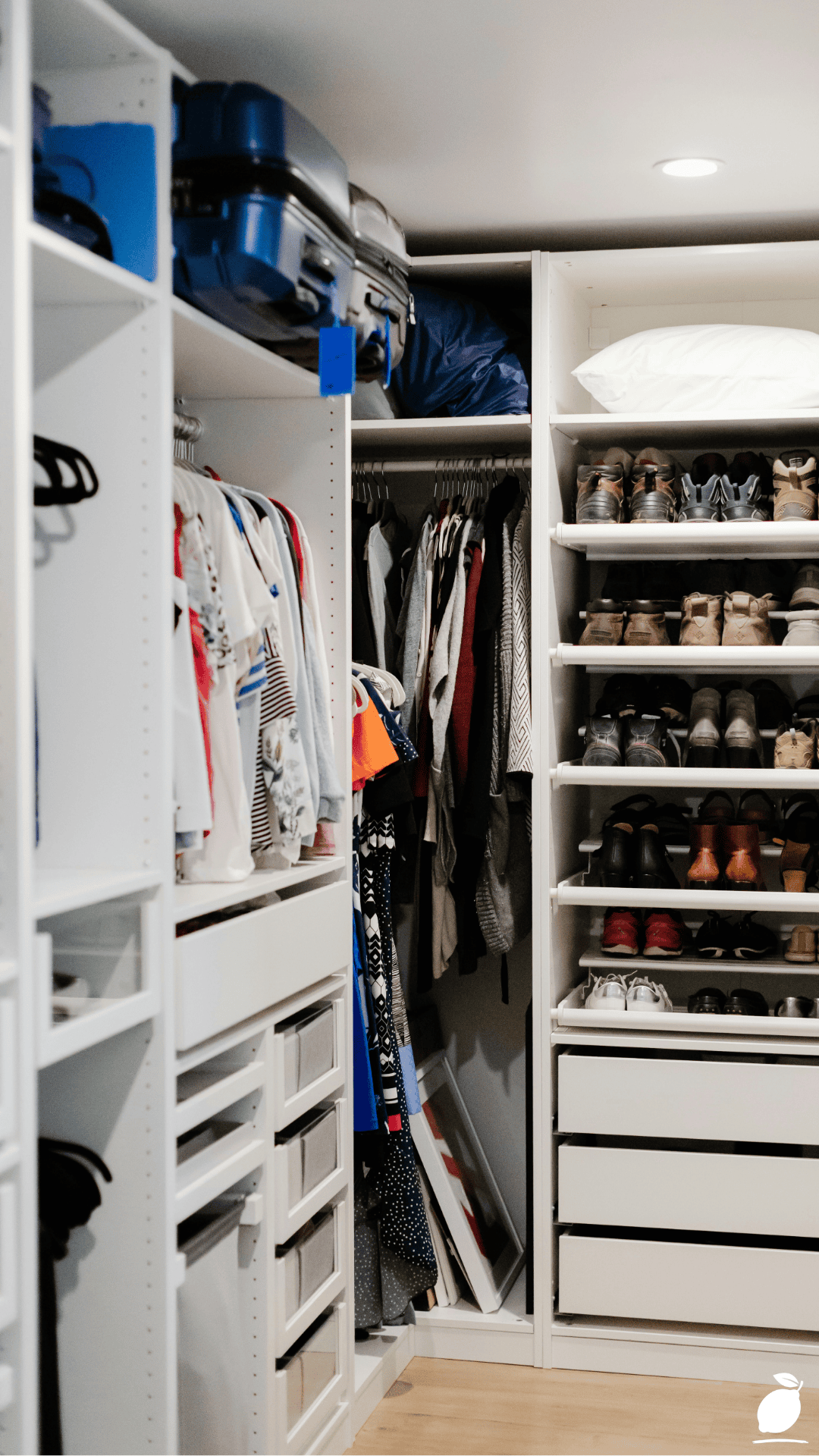
The Four-Box Method provides exactly that: not a philosophy, not a mood, but a physical sorting system that makes every decluttering decision binary and immediate. Look at the organized walk-in closet in the image: hanging clothes arranged by category, shoes on dedicated shelving, drawers and storage items in place, everything visible and retrievable without digging. That result did not happen through willpower or through vague aspirations toward neatness. It happened through a sequence of specific decisions about specific objects, each made once and made clearly. The Four-Box Method is how those decisions get made. Here is the complete guide.
The Four-Box Method Blueprint
The Four-Box Method is a decluttering system that replaces the paralyzing binary of “keep or throw” with four clear, actionable categories that accommodate the full range of decisions any real household’s objects actually require. The method is applied room by room, category by category, in the sequence below.
Step 1: Prepare Your Four Boxes Before You Begin
The Four-Box Method requires physical preparation before any sorting begins. Gather four containers: boxes, laundry baskets, bags, or bins, and label them clearly with the four categories: Keep, Donate, Relocate, and Discard. This preparation step is not optional or cosmetic; it is the mechanism by which the method works. Having the four categories physically present in the space means every object picked up has an immediate destination, and the decision-making process is completed by placing the item rather than by setting it down and returning to it later.
The four categories address four distinct real-world situations that standard decluttering approaches collapse into two:
Keep objects that belong in this room, in this space, and will be actively used or displayed here. These are returned to their designated position within the room.
Donate objects that are in good condition, have functional life remaining, and are genuinely useful to someone else but are not needed by this household. These leave the house via a charity shop, a community exchange, or a specific recipient.
Relocate objects that belong in the home but not in this specific room or space. The winter boots in the bedroom, the kitchen tool in the bathroom, the book that belongs on the living room shelf currently occupying drawer space in the study. These are moved, not discarded.
Discard objects that are broken, expired, genuinely unsalvageable, or whose function has been fully superseded. These are disposed of responsibly, recycled where possible, and binned where not.
The specific power of The Four-Box Method is the Relocate category, which provides a home for the large number of objects that are not truly clutter but are in the wrong place and whose presence in the wrong place is a significant contributor to the feeling of disorder without being a genuine decluttering decision.
Step 2: Choose One Space and Commit to Completing It
The Four-Box Method works by space, not by category. Choose a single clearly defined space as the starting point a wardrobe, a bathroom cabinet, a kitchen drawer, a bookshelf and commit to completing it entirely before moving to the next space. Starting with multiple spaces simultaneously produces the chaotic mid-process state where everything has been disturbed. Still, nothing has been resolved, which is exactly the feeling The Four-Box Method is designed to prevent.
Choose the most manageable space available for the first session, not the most urgent or the most overwhelming. The Four-Box Method builds momentum through completion, and completing a small space quickly (a single bathroom cabinet, a single wardrobe section) produces the motivational state that makes the larger, more daunting spaces accessible in subsequent sessions. The walk-in closet in the image is a significant space that contains multiple micro-spaces: the hanging section, the drawer section, the shoe section, and the upper storage, each of which can be treated as an individual Four-Box Method application within the larger project.
Step 3: Handle Every Object Once — The One-Touch Rule
The central discipline of The Four-Box Method is the one-touch rule: every object picked up during a sorting session is placed directly into one of the four boxes before the next object is picked up. It is not set on a surface “for a moment.” It is not held while you think about it and then set aside. It is assessed, decided, and placed in a single action.
This rule eliminates the secondary pile that forms in most decluttering sessions: the pile of objects that were too difficult to decide about immediately and were set aside for reconsideration. In most decluttering experiences, this secondary pile eventually gets returned to the “keep” category by default, because the energy required to make a second decision is greater than the energy required to avoid deciding at all. The Four-Box Method prevents the secondary pile from forming by requiring a placed decision for every object the first time it is touched.
For objects that feel genuinely difficult the item with sentimental value that is no longer functional, the expensive purchase that was used twice and stored since the Four-Box Method provides the “Box Five” option informally used by experienced practitioners: a temporary holding container for objects requiring more time. Box Five items are revisited at the end of the session with the benefit of the clarity that completing the rest of the space has produced, and virtually all of them become easier to decide about in that context.
Step 4: Process Each Box Completely Before the Session Ends
The Four-Box Method session is not complete when the sorting is done; it is complete when the boxes have been processed. The Keep box is returned, item by item, to its designated position in the newly sorted space. The Relocate box is walked around the house and each item placed in its correct location. The Donate box is bagged and placed at the front door or in the car for the next trip to the charity shop. The Discard box goes directly to the bin or recycling.
This processing step is what prevents The Four-Box Method from producing the common outcome of other decluttering approaches: the sorted boxes that sit in the hallway for three weeks until the Donate box is quietly merged back with the Keep box. Box processing is completed before the session ends because the energy and clarity that sorting produced is at its peak immediately after sorting and diminishes with delay.
Step 5: Designate a Permanent Home for Everything That Remains
After the Four-Box Method sorting and processing is complete, the objects that remain in the space are returned to designated positions, not placed approximately, but placed with intention. Every category of object that the space contains gets a specific, defined area: in the walk-in closet of the image, hanging clothes by category on the hanging rail, shoes on their dedicated shelves, bags in their positions, accessories in their drawer zones.
This designation step is what converts a decluttered space into an organized one and what ensures that The Four-Box Method produces a lasting result rather than a temporary improvement. When every object in a space has a designated home, the Return Rule becomes possible: every object goes back to its home after use, not to the nearest available surface. The designated home is the mechanism by which The Four-Box Method’s result is maintained across weeks and months rather than days.
Step 6: Maintain With a Monthly Four-Box Review
The Four-Box Method is most powerful as a maintenance practice rather than a crisis intervention. Schedule a brief Four-Box Method review session once per month fifteen to thirty minutes per room in which the four categories are mentally or physically applied to any objects that have drifted from their designated positions, accumulated since the last session, or whose status has changed (the item purchased with high expectations that has not been used, the gift that has been waiting for a decision since the previous quarter).
The monthly review keeps the sorting decisions current with the household’s actual needs rather than allowing a gap to develop between the organized state and the lived-in one. Closets, kitchens, and home offices benefit most from the monthly Four-Box Method review; living spaces and bedrooms typically require less frequent maintenance once the initial sorting and designation has been completed.
Expert Secrets for Success

Pro-Tips for a Better Result
- Sort by micro-category within each space. Within a wardrobe, the Four-Box Method is more efficient when applied to one clothing category at a time: all tops first, then all trousers, then all shoes, rather than to the wardrobe as a single undifferentiated whole. Sorting within categories makes comparison easier (you are assessing similar items against each other rather than dissimilar ones) and produces better decisions with less decision fatigue across the session.
- Schedule a Donate box removal date before you begin sorting. The Donate box has no value until it leaves the house. Schedule the removal a charity shop drop-off appointment, a community exchange pickup, or a specific trip before the Four-Box Method session begins. Knowing the Donate box has a departure date prevents the psychological pull to retrieve items from it in the days between sorting and removal, which is the mechanism by which most decluttering sessions partially reverse themselves before they are complete.
- Use The Four-Box Method on sentimental objects last. Sentimental objects childhood belongings, gifts with emotional weight, and inherited items require the most decision-making energy and the clearest state of mind. Apply The Four-Box Method to these categories only after completing the easier, more functional categories within the space. The clarity produced by completing straightforward sorting in the same session makes sentimental object decisions significantly easier and more accurate.
- Take a before photograph at the start of every Four-Box Method session. A photograph of the space before The Four-Box Method sorting begins provides two things: a reference image that documents the transformation when the session is complete, and a visual reminder of the before-state that motivates continued progress when mid-session energy begins to flag. The before photograph also serves as a quality check; comparing the in-progress state to the before image confirms whether the session is improving the space or simply redistributing its disorder.
- Give every Relocate item a destination before it is placed in the box. The Relocate box only works if every item in it has a specific, known home to be relocated to. An item placed in Relocate because “it doesn’t belong here” but without a known destination elsewhere in the house is either a Keep item or a Donate item in disguise. Apply the destination rule: if you cannot name the specific location this item belongs in, it does not go in Relocate.
Common Mistakes to Avoid
- Starting with the hardest room first. The room with the most accumulated disorder, the most sentimental content, or the most ambiguous ownership of shared objects is the worst starting point for The Four-Box Method. Beginning with this room produces the slowest progress, the most decision fatigue, and the greatest likelihood of abandoning the session before completion. Start with the easiest room or the smallest space and build momentum before addressing the most challenging areas.
- Sorting without the actual boxes present. The Four-Box Method is a physical system; its decisions are completed by placement, not by thought. Attempting to apply The Four-Box Method mentally, or with one box and a plan to remember the others, produces the same indecision loop that characterizes most unsuccessful decluttering attempts. The four physical containers must be present in the space before any sorting begins.
- Allowing the Donate box to re-enter the house. The most common Four-Box Method failure mode is the Donate box that never leaves and sits in the hallway or the garage until its contents are gradually retrieved and returned to circulation. The Donate box exits the house within 48 hours of the session that filled it. No exceptions, no retrievals, no second-guessing after placement.
- Decluttering on behalf of other household members. The Four-Box Method applies to your own belongings. Applying it to a partner’s, child’s, or housemate’s belongings even with good organizational intentions violates the ownership principle that makes the method’s decisions legitimate and lasting. Invite other household members to participate in their own Four-Box Method sessions rather than making decisions about their objects on their behalf.
- Treat the Relocate box as a secondary Keep box. The Relocate category is for objects with a specific, named home elsewhere in the house. It is not for objects you are uncertain about keeping. If an object placed in Relocate cannot be given a specific destination within the same session, it is reassessed against the Keep, Donate, or Discard categories before the session ends.
Why The Four-Box Method Matters
The Four-Box Method matters because physical disorder is not just an aesthetic inconvenience; it is a documented stressor that affects mood, sleep quality, decision-making capacity, and the general experience of being at home. Research published in the Personality and Social Psychology Bulletin found that women who described their homes as cluttered or filled with unfinished projects had significantly higher cortisol levels throughout the day than those who described their homes as restful and restorative. The physical environment of the home is not background noise to daily life; it is an active participant in the quality of daily experience, and The Four-Box Method provides the most accessible, immediately actionable tool for improving it.
For families, the impact of The Four-Box Method extends beyond individual relief into the shared experience of household life. A home with organized, accessible storage where children can find what they need without assistance, where the morning routine is not complicated by a search for the specific bag or shoe or item that is technically in the house but practically unfindable, runs with a different quality of ease than one that has accumulated disorder over years of insufficient organization. The Four-Box Method applied systematically to shared household spaces produces this ease not as a one-time event but as an ongoing condition maintained through the monthly review that the method’s final step establishes.
And for the person who undertakes it, who labels the four boxes, sorts the wardrobe section by section, processes each box before the session ends, and designates a specific home for every remaining item, the Four-Box Method delivers something that goes beyond the organized closet in the image. It delivers the specific, verifiable experience of having made a series of clear decisions and having the physical environment reflect those decisions immediately and completely. In a daily life that often provides little feedback between effort and outcome, The Four-Box Method is one of the most direct available demonstrations that what you do changes what you come home to. That is not a small thing. That is the difference between a house and a home.
Frequently Asked Questions
How long does a typical Four-Box Method session take?
The duration of a Four-Box Method session depends on the size and density of the space being sorted. A single wardrobe rail of hanging clothes typically takes 20 to 40 minutes. A full walk-in closet like the one in the image, sorted section by section, typically takes 2 to 4 hours in total across one or two sessions. A kitchen, applied category by category, typically takes 3 to 5 hours. The most important timing principle of The Four-Box Method is completing the chosen space in a single session; starting and stopping mid-space produces the disrupted, mid-process state that the method is designed to avoid. Choose a space that can be completed in the time available rather than beginning a larger space and leaving it partially sorted.
What if a household member disagrees with a decluttering decision?
The Four-Box Method applies to objects within your own ownership or objects that both household members agree to assess together. For shared objects, the Four-Box Method sessions work best when both household members are present and make decisions jointly with the understanding that both members have an equal voice and no item moves to Donate or Discard without mutual agreement. Objects where agreement cannot be reached in a single session are placed in the temporary Box Five category for a defined review period (typically 30 days) rather than defaulting to Keep by the objecting member’s veto.
Can The Four-Box Method be applied digitally to email inboxes, digital files, and subscriptions?
Yes, the Four-Box Method translates directly to digital decluttering, with the four categories adapted for digital objects: Keep (retain in its current location), Relocate (move to the correct folder or category), Archive (move to long-term storage or backup without active access), and Delete (permanent removal). Digital Four-Box Method sessions are applied folder by folder or inbox section by section using the same one-touch rule and completion discipline as physical sessions. The primary challenge of digital Four-Box Method application is the ease of indefinite deferral that digital environments allow; maintaining the one-touch rule requires deliberate discipline without the physical constraint of a real box to fill.
How do I prevent spaces from re-cluttering after applying The Four-Box Method?
The Four-Box Method’s maintenance strategy has three components: designated homes for every retained item (so the Return Rule is possible), a monthly review session (so drift is caught early rather than accumulated over seasons), and an “one in, one out” policy applied to high-clutter-risk categories (for every new item of clothing, shoe, or bag purchased, one item departs via the Donate box). These three practices together prevent the re-accumulation that follows most decluttering approaches and maintain the organized state that The Four-Box Method’s initial session produces.