My bathroom had a design identity crisis that had been ongoing for years. The fixtures were contemporary, a chrome faucet, a wall-mounted toilet with a clean rectangular profile, but the tiles were traditional, with a floral pattern that belonged to a different decade and a different design conversation entirely. The towels were a set I had bought because they were on sale, in a color that matched nothing and conflicted with everything.
The mirror was round, which I liked, but the vanity was boxy, which I didn’t, and the framed print above the towel bar was too small for the wall it occupied and had been placed there as a placeholder that had become permanent. I had looked at bathroom renovation inspirations for the better part of two years and could not settle on a direction because every bathroom that felt right belonged to a category I could not fully commit to: too modern, too traditional, too minimalist, too ornate. What I eventually understood was that I had been looking for a style when I should have been looking for a philosophy. The philosophy that finally resolved the impasse was transitional bathroom design.
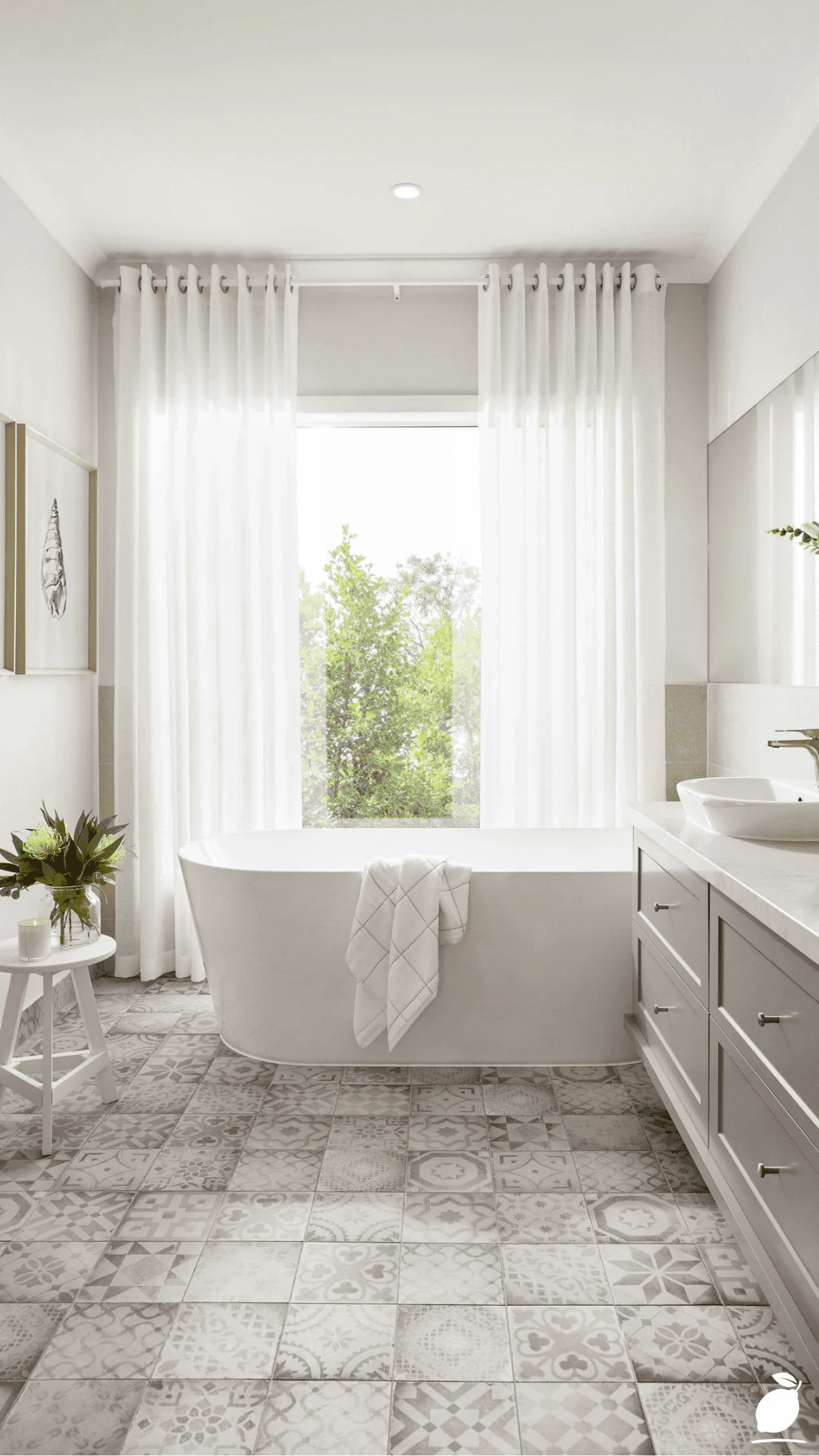
Transitional bathroom design is not a compromise between traditional and contemporary; it is a synthesis of the qualities each does best. The bathroom in the image above demonstrates this synthesis with the specific clarity that only a well-executed transitional bathroom design can produce. A freestanding white oval bathtub positioned under a large window with sheer white curtains, a form that belongs to the bathing tradition of the Victorian era, is presented in the clean white oval profile of contemporary design. A patchwork floor of gray and white decorative tiles in geometric and floral designs, the pattern complexity and variety of traditional tilework is expressed through the restrained gray-and-white palette of contemporary interiors.
A white vanity with gray cabinet drawers and a white marble countertop is the transitional bathroom design’s defining material pairing, bridging the warmth of classic marble with the precision of modern cabinet construction. Two framed black and white botanical prints in thin wooden frames: personal, characterful, and period-appropriate in subject while minimal and contemporary in presentation. A small white round side table holding a green plant and a white candle. White vase with white flowers on the vanity. Sheer curtains at the window let the green foliage outside become part of the room’s palette. Every transitional bathroom design decision in the image holds exactly this quality: traditional in warmth and reference, contemporary in scale and restraint.
The transitional bathroom design ideas in this guide follow the image’s governing principle, traditional warmth delivered through contemporary restraint in a sequence organized around the decisions that most determine the finished result’s quality: the palette first, then the statement piece, then the floor, then the vanity and fixtures, then the artwork and accessories, then the living organic layer. These transitional bathroom design steps are achievable in any bathroom, at any stage of renovation, because transitional bathroom design is more of a curation philosophy than a renovation project. It asks of each element only one question: does this belong to both registers, the warmth of tradition and the clarity of the contemporary, simultaneously? The bathroom that answers yes to that question in enough of its elements is a transitional bathroom design. These steps show you how to build one.
The Transitional Bathroom Design Blueprint
Step 1: Establish the Transitional Bathroom Design’s White and Gray Palette Foundation
Transitional bathroom design begins with its palette, and the palette the image demonstrates pure white walls, chrome fixtures, gray and white floor tile, white marble countertop, and white ceramic fixtures is the transitional bathroom design’s most fundamental and most versatile expression: white as the primary field, gray as the grounding secondary tone, and chrome as the cool metallic accent that bridges contemporary precision with traditional reflectivity. This three-element palette, white, gray, chrome, is the transitional bathroom design foundation that accepts the widest range of accessory and accent additions (the green plant, the botanical prints, the white flowers) without any of those additions disrupting the room’s coherent visual identity.
For transitional bathroom design palette decisions, apply the white-and-gray combination with the specific quality the image demonstrates: white that is warm rather than cool (the pure white of the walls and fixtures carries enough natural warmth from the window light to prevent the clinical quality that cool optical white produces in a predominantly white room), and gray that appears in pattern rather than as a solid field (the gray and white patchwork tile floor creates visual complexity at the floor level without introducing a competing color palette at the wall or ceiling level). This distribution of color complexity at the floor, simplicity above, is the transitional bathroom design structural principle that makes the room feel layered without feeling busy.
Paint the transitional bathroom design walls in a warm white Benjamin Moore Chantilly Lace (OC-65) or Sherwin-Williams Alabaster (SW 7008) rather than a pure optical white with cool undertones. The warm white wall surface is the transitional bathroom design decision that most prevents the room’s predominantly white palette from reading as institutional, creating the specific quality visible in the image: white that feels luminous and inhabited rather than sanitized and clinical.
Step 2: Position the Transitional Bathroom Design’s Statement Piece as the Room’s Focal Anchor
The freestanding white oval bathtub in the image is the transitional bathroom design’s statement piece, the single element that most completely defines the room’s character and organizes every other element in the space around it. In transitional bathroom design, the statement piece performs the same function that the focal wall performs in living room design: it establishes the room’s design identity at first glance and gives every subsequent purchase or placement decision a reference point. The oval tub in the image is the transitional bathroom design statement piece that most naturally bridges traditional and contemporary registers: its form is a contemporary interpretation of the Victorian clawfoot’s freestanding bathing tradition, rendered in the smooth white oval profile that contemporary design requires.
For transitional bathroom design where a freestanding bathtub is not within the project’s scope, the statement piece function can be performed by: a large-format framed mirror with a distinctive shape above the vanity, an antique or reproduction console sink in a traditional form, a significant piece of art that anchors one wall, or a distinctive floor tile installation that becomes the room’s most memorable visual element. The transitional bathroom design statement piece does not need to be the most expensive element in the room; it needs to be the most considered, the most specifically chosen, and the most clearly intentional in its design reference.
Position the transitional bathroom design statement piece in relation to the room’s natural light source. The freestanding tub in the image sits directly under the large window, the most natural light in the room at any time of day, which makes the tub’s white surface the room’s most luminous object and amplifies the transitional bathroom design’s bright, airy quality through the reflected window light on the tub’s curved surface. In transitional bathroom design, placing the statement piece at the primary natural light position is the decision that most dramatically amplifies the statement piece’s visual authority.
Step 3: Select the Transitional Bathroom Design Floor Tile as the Room’s Pattern Layer
The patchwork floor of gray and white decorative tiles in various geometric and floral designs is the transitional bathroom design element that most specifically demonstrates the aesthetic’s synthesis of traditional pattern richness and contemporary palette restraint. Traditional bathroom design achieves its richness through saturated color in complex patterns; contemporary bathroom design achieves its impact through large-format tile in minimal patterns; transitional bathroom design achieves its balance through complex patterns in restrained palettes. The image’s patchwork of geometric and floral tiles is complex enough in pattern to read as traditional in its richness and restrained enough in its gray-and-white palette to read as contemporary in its restraint simultaneously.
For transitional bathroom design floor selection, the patchwork or encaustic tile approach, with multiple pattern tile designs in a consistent color palette, is the specific floor treatment that most effectively produces this balance. Source patchwork tile sets or mix individual encaustic tiles from the same color family: gray, white, and soft charcoal. The variation in pattern between individual tiles (geometric in some, floral in others, abstract in others) provides the visual richness; the consistency in palette across all tiles provides the contemporary restraint that prevents the pattern richness from becoming overwhelming.
For transitional bathroom design floor tiles at an accessible budget, peel-and-stick vinyl tile in patchwork or encaustic patterns now produces results indistinguishable from ceramic tile at close range and is available in a wide range of gray-and-white designs appropriate to the transitional bathroom design aesthetic. Applied over a clean, flat existing floor, peel-and-stick transitional bathroom design floor tiles transform the room’s primary surface character at a fraction of the material and installation cost of ceramic tile.
Step 4: Install the Transitional Bathroom Design Vanity With Marble and Gray Cabinet
The white vanity with gray cabinet drawers and white marble countertop in the image is the transitional bathroom design’s most functional element and one of its most characterful. The material pairing of white marble (traditional, natural, warm) and gray painted cabinet (contemporary, precise, cool) is the transitional bathroom design’s signature material combination at the vanity level. This combination reads as transitional because it holds both registers simultaneously: the marble communicates the warmth and natural variation of traditional material; the gray painted cabinet communicates the clean, painted precision of contemporary furniture design.
For transitional bathroom design vanity selection, choose a cabinet profile that is neither ornately traditional (no decorative carved details or heavily profiled door frames) nor starkly contemporary (no handleless push-to-open doors or seamless flat slab fronts) but occupies the transitional middle ground of simple shaker-style cabinet doors with visible frame-and-panel construction and discrete hardware. The shaker cabinet profile is the transitional bathroom design’s most versatile vanity door choice because it references the simplicity of Arts and Crafts furniture tradition (its historical antecedent) while reading as clean and contemporary in its minimal, unornamented execution.
For the vanity surface material in transitional bathroom design, white marble or a high-quality white marble-effect porcelain provides the warm, natural variation that the transitional bathroom design palette’s cool gray and white elements specifically require as a softening contrast. A solid-surface white countertop or a white quartz countertop provides the same visual quality with greater durability and lower maintenance than natural marble, the practical transitional bathroom design choice for bathrooms that receive heavy daily use.
Step 5: Select Chrome Fixtures and a Vessel Sink for the Transitional Bathroom Design Vanity
The white vessel sink and chrome faucet in the image are the transitional bathroom design fixture choices that confirm the room’s contemporary register, while the marble countertop and botanical prints confirm its traditional warmth, a balance of registers that is the transitional bathroom design’s defining quality at the fixture level. Chrome is the transitional bathroom design fixture finish that most naturally bridges the traditional (chrome was the standard finish for bathroom fixtures throughout the twentieth century and reads as period-appropriate across a wide range of historical references) and the contemporary (chrome’s precision and reflectivity communicate the clean, high-specification quality of contemporary bathroom design).
For transitional bathroom design where brushed nickel or matte black hardware is already established in the room, use that existing finish throughout rather than introducing chrome. The transitional bathroom design principle is finish consistency rather than specific finish choice. A transitional bathroom design with all-matte-black hardware is fully authentic to the aesthetic; a transitional bathroom design with three different metallic finishes is not, regardless of how individually well-chosen each finish is.
The white vessel sink in the image is the transitional bathroom design fixture choice that most communicates a considered aesthetic decision: vessel sinks reference the traditional wash basin, a fixture that predates the integrated drop-in sink by centuries, while their contemporary bowl profiles and clean ceramic surfaces communicate the contemporary preference for visible form over concealed function. A vessel sink in a transitional bathroom design is the fixture equivalent of the freestanding bathtub, a traditional bathing reference rendered in contemporary material and form.
Step 6: Complete the Transitional Bathroom Design With Botanical Art, Plants, and Organic Accents
The two framed black and white botanical prints in thin wooden frames, and the green plant in the white pot on the round side table are the transitional bathroom design’s most personal and most characterful elements, the layer that moves the bathroom from a well-executed design project into a room that feels genuinely inhabited by someone with a specific aesthetic sensibility and a specific relationship with the natural world. Botanical art and living plants are the transitional bathroom design accessories that most naturally bridge the traditional (botanical illustration is one of the oldest European decorative art traditions) and the contemporary (the graphic black and white presentation and the clean white frames read as unmistakably current).
For transitional bathroom design artwork selection, botanical prints in black and white or in the soft, slightly desaturated palette of vintage botanical illustration provide the most versatile and authentic print subject for the aesthetic. Frame in thin black metal or thin natural wood frames rather than ornate gilded or heavyweight frames that would push the transitional bathroom design toward traditional territory, or in a frameless float-mount that would push it toward contemporary. The thin wooden frames in the image occupy the transitional middle ground: natural material that is warm but not ornate, structured but not heavy.
Place botanical prints in the transitional bathroom design at wall positions that are clearly art-placement positions centered on a wall, at eye level, with adequate space around them, rather than in the fill-the-space positions that make art look like it was placed because something was needed on the wall. The transitional bathroom design relationship between art and wall is the same as in any other designed interior: art placed with intention reads as art; art placed without intention reads as decoration.
Expert Secrets for Success
Pro-Tips for a Better Result
Invest in a single large-format transitional bathroom design element rather than multiple medium-sized ones. The freestanding tub in the image earns its visual authority partly through its scale; it is large enough to be unmistakably the room’s primary piece rather than one element among equals. Transitional bathroom design that distributes its investment across multiple medium-scale purchases consistently produces rooms that feel considered in their parts and undistinguished in their whole. Choose the single element that most completely expresses the transitional bathroom design’s synthesis of traditional warmth and contemporary restraint: the statement bathtub, the significant mirror, the distinctive floor tile, and invest primarily there.
Use the sheer white curtain as the transitional bathroom design’s most versatile window treatment. The sheer white curtain at the large window in the image simultaneously provides privacy, diffuses natural light to the specific soft quality that transitional bathroom design requires, and maintains the visual connection to the green foliage outside that gives the room its organic, living quality. Sheer linen or cotton curtains hung from a simple white or natural wood curtain rod are the transitional bathroom design window treatment choice that most consistently relates to both the traditional (curtained bathroom windows are a Victorian-era domestic tradition) and the contemporary (the sheer fabric’s transparency and the simple hardware relate to the contemporary preference for lightness and minimal visual weight).
Choose botanical print art in a scale large enough to read as significant from the bathroom’s entry point. The two framed botanical prints in the image are sized at approximately A2 (42cm × 59cm), large enough to be clearly visible from the bathroom’s entry point as specific, readable images rather than small rectangles of dark and light. Transitional bathroom design artwork that is too small for the wall it occupies reads as decorative rather than designed. A single A1 (59cm × 84cm) print, or two A2 prints as in the image, provides the visual weight that transitional bathroom design requires from its art layer.
Position the transitional bathroom design’s living plant element at a height that relates visually to the freestanding tub or the vanity, not floating independently in space. The green plant in the white pot sits on a small white side table at approximately the same height as the bathtub’s rim, a position that creates a visual relationship between the organic element and the bathing piece rather than leaving the plant isolated as a separate decorative object. Transitional bathroom design accessories that relate spatially to the room’s primary pieces read as composed; accessories that are positioned wherever there is space read as placed.
Common Mistakes to Avoid
Don’t mix more than two metallic finishes in a transitional bathroom design. The transitional bathroom design in the image uses chrome throughout the faucet, towel bar, and all visible plumbing without introducing any secondary metallic finish. Transitional bathroom design that mixes chrome faucets with brass towel bars and matte black toilet paper holders produces a metallic complexity that conflicts with the aesthetic’s fundamental commitment to restraint and clarity. Choose one primary finish and apply it to all hardware elements; introduce a secondary finish only if it appears in at least three places in the room and shares the temperature register of the primary finish.
Don’t use heavily patterned textiles in transitional bathroom design. The towels in the image are white and gray with a simple geometric pattern, the maximum pattern complexity that transitional bathroom design’s neutral palette and patterned floor can accommodate without visual competition. Heavily patterned towels, bold-colored bath mats, or multicolored textile elements introduced into a transitional bathroom design’s white-and-gray palette create a pattern conflict that the aesthetic cannot absorb. Keep all transitional bathroom design textiles within the white, gray, and cream register, with pattern at the level of texture rather than graphic complexity.
Don’t place the transitional bathroom design’s botanical prints at different heights. The two botanical prints in the image are hung at the same height, their top edges aligned horizontally, creating the visual coherence of a considered pair rather than the randomness of two independently placed objects. Transitional bathroom design art arrangements where each frame occupies a different height position, read as accidental rather than planned, which conflicts with the transitional bathroom design’s commitment to restraint and compositional intentionality. Align the tops or centers of grouped frames horizontally before finalizing the hanging position.
Don’t use artificial or silk plants in a transitional bathroom design. The green plant in the white pot on the side table in the image is a living plant, with its specific organic quality, the way its leaves catch the window light, its evident aliveness, and this quality is the element that most prevents the transitional bathroom design from reading as a staged photograph rather than an inhabited bathroom. Silk or artificial plants in transitional bathroom design settings are immediately apparent in person, even when they photograph convincingly, and they produce the specific quality of a room that is trying to appear lived-in rather than actually being so. Choose a low-maintenance genuine plant, a pothos, a ZZ plant, or a small succulent in a white ceramic pot rather than any artificial alternative.
Why Transitional Bathroom Design Matters
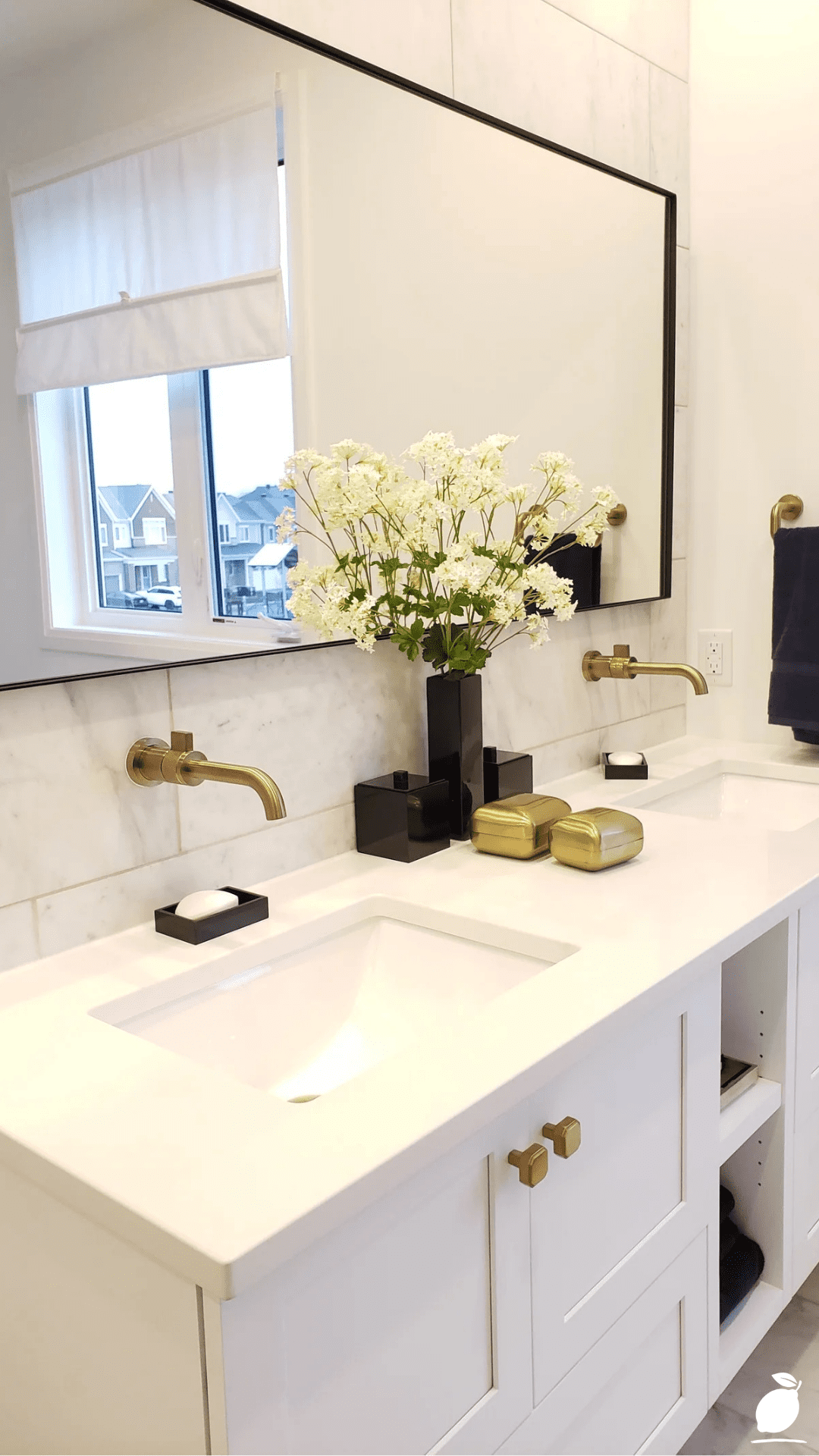
Transitional bathroom design matters because most people are not fully traditional in their aesthetic or fully contemporary, and the bathrooms they build in either direction consistently produce rooms that feel slightly incomplete, a traditional bathroom where the ornate fixtures feel like a costume, or a contemporary bathroom where the minimal precision feels like a hospital. The transitional bathroom design is the aesthetic of most people’s actual preference: a room that feels warm and characterful without feeling historical, clean and precise without feeling cold, personal without being precious, and designed without being decorated. This is not a compromise between styles. It is the accurate description of how most people want their bathrooms to feel.
Research in residential design psychology has consistently identified the quality of personal care environments, the bathroom, most specifically, as having a disproportionate effect on self-perception and daily well-being. The bathroom is where the household’s members evaluate themselves physically and prepare themselves psychologically for the day. A bathroom that feels genuinely designed, not aspirationally styled, but actually resolved in its visual identity, supports those daily acts of self-preparation with an environmental quality of care and consideration that an unresolved bathroom cannot provide. Transitional bathroom design, at its best, produces exactly that quality: a bathroom that feels like it was designed specifically for the person who uses it, warm enough to feel personal, clean enough to feel considered.
Easy Peasy Life Matters is built on the conviction that the home’s bathroom is among the most intimate and most consequential spaces for daily wellbeing and that transitional bathroom design, executed with the palette discipline, material intelligence, and accessory restraint this guide provides, produces the specific quality of bathroom environment that most people have been trying to achieve through successive rounds of partial improvement. These transitional bathroom design steps are not a renovation; they are a philosophy applied to a room. The bathroom in the image is the result of that philosophy applied completely. Your bathroom can be that result too.
Frequently Asked Questions
What is the difference between transitional bathroom design and contemporary or traditional bathroom design?
Transitional bathroom design is distinguished from both contemporary and traditional by its deliberate synthesis of their defining qualities: the warmth, pattern richness, and material tradition of traditional bathroom design expressed through the restrained palette, clean lines, and minimal ornamentation of contemporary design. A contemporary bathroom achieves its quality through precision and reduction; a traditional bathroom achieves its quality through ornament and historical reference; a transitional bathroom achieves its quality through the balance of warmth and clarity that neither extreme alone produces. The image’s combination of a traditional form bathtub with contemporary white oval profile, traditional patchwork tile in a contemporary gray-and-white palette, and traditional botanical art in contemporary thin frames demonstrates this balance at every element.
How do I start a transitional bathroom design project without a full renovation?
Transitional bathroom design is particularly accessible as an incremental project because its palette (white, gray, chrome) is neutral enough to be applied through accessory and textile updates without requiring any structural change. Start by painting the walls in a warm white, replacing existing towels with white or gray alternatives in natural fiber, adding a botanical print in a thin frame to one wall, and introducing one living plant in a white ceramic pot. These four transitional bathroom design updates cost under $200 total and shift the room’s visual register significantly toward the transitional aesthetic without touching any plumbing or tile. Add the floor tile, vanity update, or statement piece as subsequent seasonal projects when budget allows.
What plants work best in a transitional bathroom design?
The most effective transitional bathroom design plants are those with clean form and either trailing or architectural growth habits: pothos (Epipremnum aureum) for trailing organic form in low-light conditions, ZZ plant (Zamioculcas zamiifolia) for architectural upright form with high gloss leaves, snake plant (Sansevieria) for the most architectural silhouette and the lowest maintenance, and small-leafed ferns for the most traditionally romantic form in bathrooms with adequate humidity. All transitional bathroom design plants should be potted in white, gray, or natural stone ceramic pots, never in colored pots that introduce a competing palette element, and should be appropriately sized for the surface they occupy rather than scaled to the room’s overall dimensions.
What tile patterns work best for transitional bathroom design floors?
The most effective transitional bathroom design floor tile patterns are those with pattern complexity in restrained palettes: encaustic cement tiles in geometric or floral patterns limited to gray, white, black, and cream; patchwork tile sets combining multiple patterns in a consistent color family; Victorian-style octagon and dot tiles in black and white; and large-scale geometric tiles in gray and white. All of these transitional bathroom design floor options provide the pattern richness that distinguishes transitional from purely contemporary, while the palette restraint distinguishes them from traditional tile’s saturated color tradition. Avoid brightly colored encaustic tiles, patterned tiles with warm or cool color accents, and highly reflective polished tile that conflicts with the matte quality of the transitional bathroom design’s walls and fixtures.
How do I incorporate color into a transitional bathroom design without disrupting its palette?
The most effective way to introduce color into a transitional bathroom design is through the organic layer, the living plant, and fresh or dried flowers rather than through permanent or semi-permanent surface treatments. The green plant in the image provides the room’s primary color accent; the white flowers on the vanity provide a secondary one. These organic color elements belong to the transitional bathroom design’s natural palette reference and can be changed seasonally without any commitment to a specific color. For rooms that want a consistent color accent in a non-organic form, introduce it through a single accessory object, a ceramic soap dish in a specific warm tone, a hand towel in a specific muted green, rather than through multiple objects that accumulate into a competing color palette.