The bedroom had been a project in progress for three years that had never reached the condition of being done. Not from lack of effort, I had painted it twice, replaced the bedding twice, changed the curtains, added art, removed art, and spent more time than I will admit to rearranging the objects on the single shelf above the bed in an attempt to produce the composed, intentional look that appeared effortlessly in the rooms I was using as reference. The problem was the reference material itself: every bedroom that I tried to recreate required a level of visual perfection that was incompatible with a room where someone actually slept and worked and read and occasionally used as a general overflow space for the household.
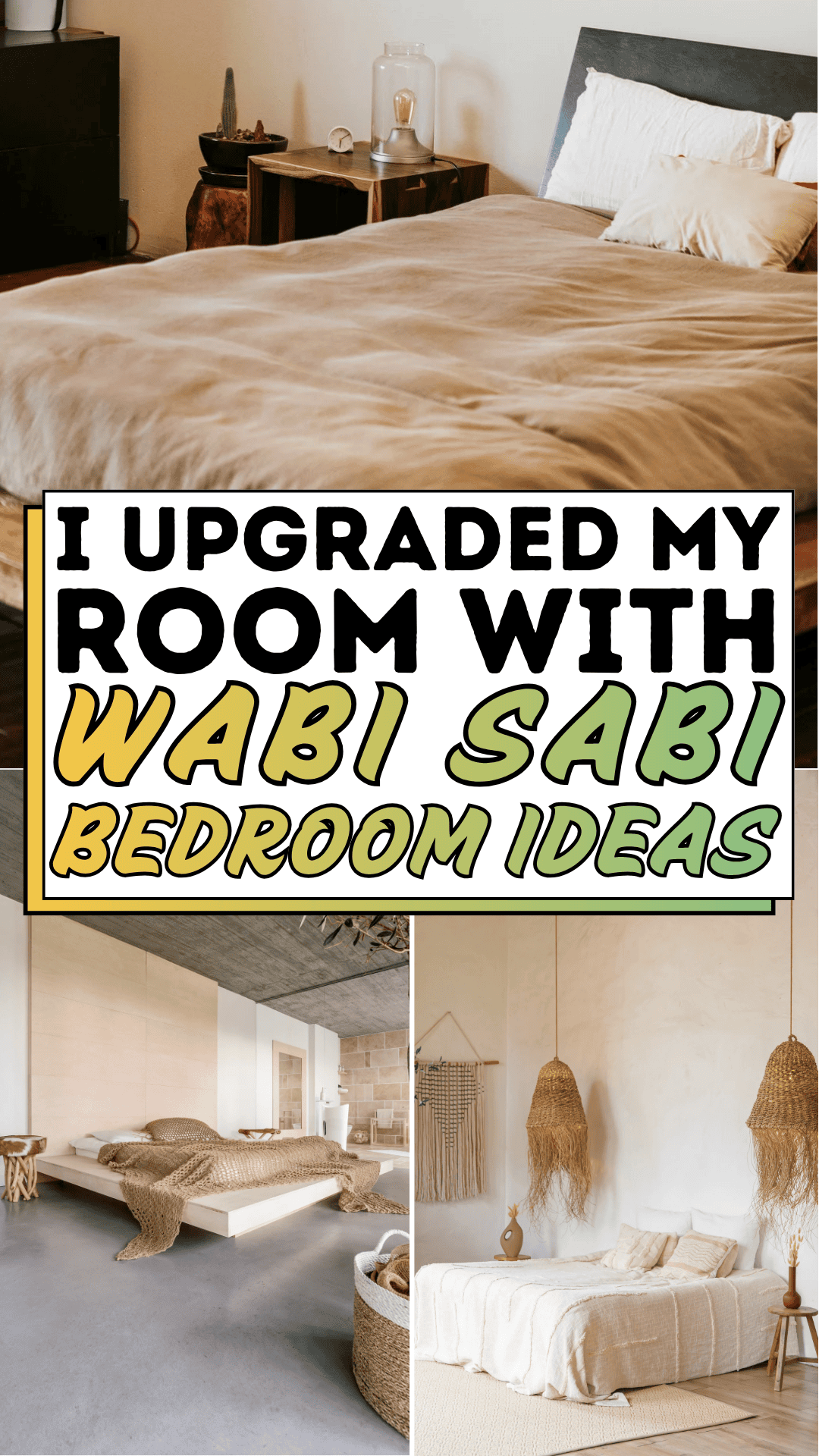
The “perfect” bedroom of my reference boards was a room with no evidence of habitation, and every attempt to produce it in my actual bedroom ended in the familiar frustration of a room that looked staged for a brief period after a cleaning session and then reverted immediately to the honest condition of a room that was being lived in. Wabi sabi bedroom ideas were not on my radar until a designer friend described the aesthetic as “the beauty that comes from imperfection, incompleteness, and impermanence,” and I immediately recognized that this was the bedroom I had been trying not to make.
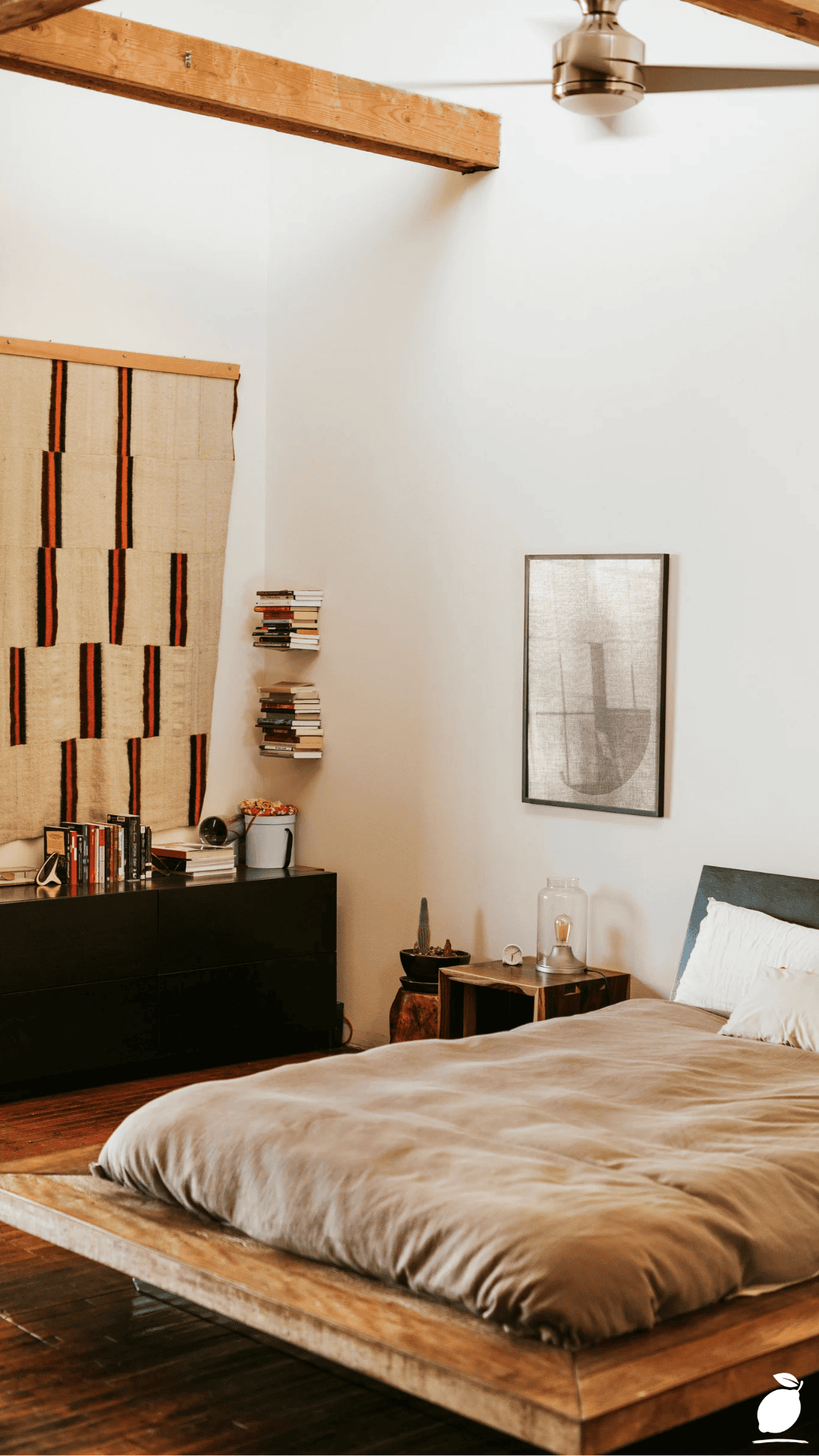
The bedroom in the image above is the wabi sabi bedroom philosophy fully realized in contemporary domestic form. Exposed wooden ceiling beams the architectural element that most communicates the wabi sabi aesthetic’s relationship with natural, honest, structurally visible materials. A low-profile platform bed with a natural wooden frame and beige bedding that carries the warmth of linen and cotton without the rigidity of a perfectly made hotel bed.
A large beige textile art piece with black and red geometric stripes hanging above the bed, handmade in its feel, imprecise in the best sense, the kind of textile that communicates craft rather than manufacture. A black media console with stacked books and a small potted plant. A ceiling fan with a metallic finish that is functional rather than ornamental. Polished hardwood flooring in warm brown. A small wooden side table with a glass jar. White walls. The wabi sabi bedroom in the image is not the absence of design; it is design that has accepted the honest character of natural materials and functional objects as the room’s primary aesthetic content, and stopped trying to make them into something more perfect than their nature allows.
The wabi sabi bedroom ideas in this guide follow the room’s governing philosophy through every specific design decision: natural materials over synthetic, visible structure over concealed construction, functional objects treated as design elements over purely decorative objects with no functional identity, and the specific restraint of not trying to make the bedroom anything other than what a bedroom actually is the room where rest happens in the presence of the natural world’s material warmth. These wabi sabi bedroom ideas are organized in the sequence that builds the room’s philosophy from the floor up and the walls out, foundation materials first, functional furniture second, textile art and surface art third, and the small personal objects that give the wabi sabi bedroom its specific, inhabited, gently imperfect quality last.
The Wabi Sabi Bedroom Blueprint
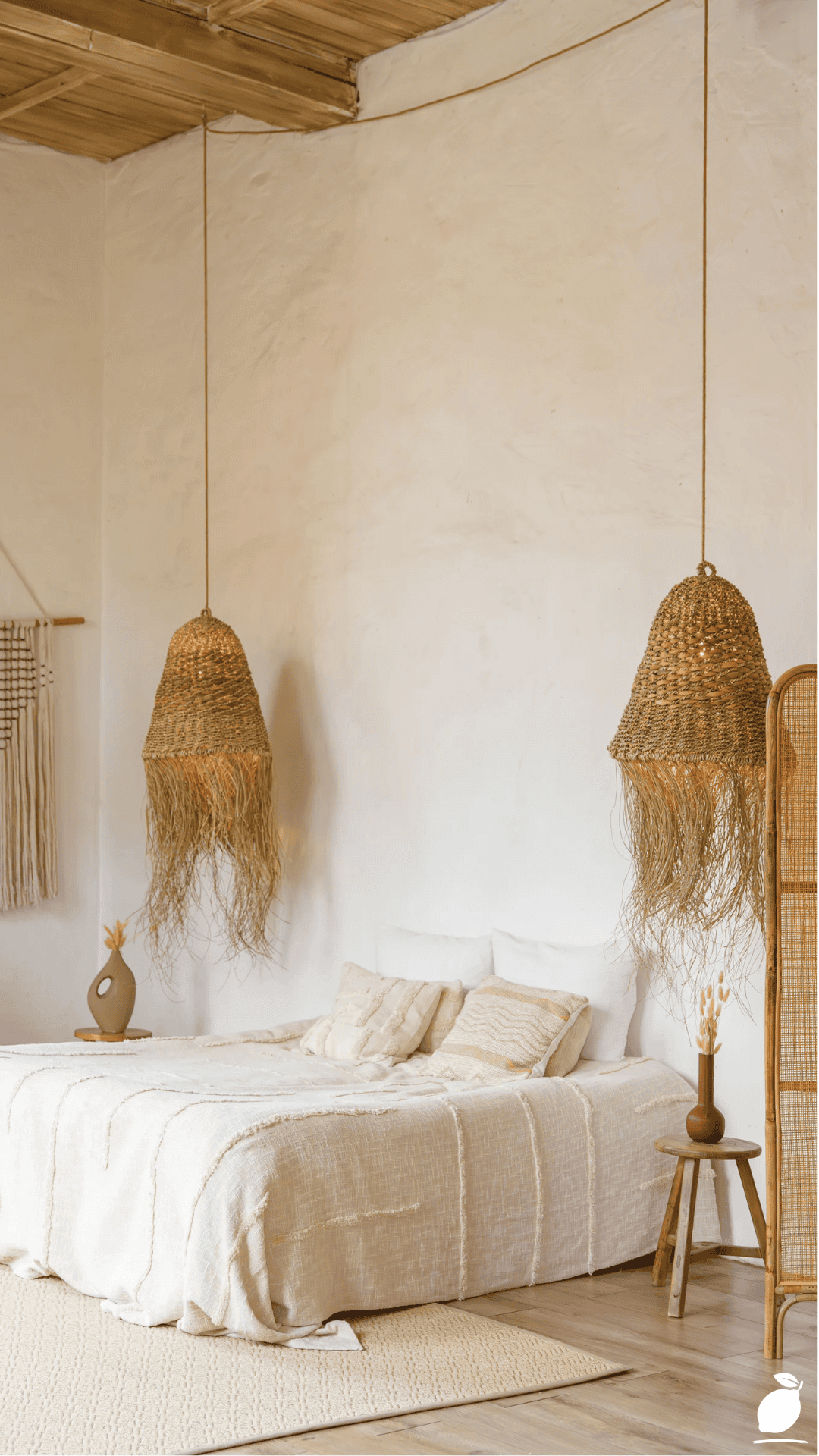
Step 1: Establish the Wabi Sabi Bedroom’s Natural Material Foundation
The wabi sabi bedroom begins from the floor and ceiling, the materials that provide the room’s fundamental relationship with the natural world, before any furniture is placed or any art is hung. The exposed wooden ceiling beams in the image are the wabi sabi bedroom’s most structurally significant natural material decision: they reveal the room’s construction rather than concealing it, they bring the warmth and grain variation of real wood into the room’s overhead plane where architectural elements typically provide only painted plaster or drywall, and they communicate the wabi sabi aesthetic’s core principle of honest material expression more completely than any accessory or textile could.
For wabi sabi bedroom implementations in existing rooms without exposed beams, the natural material foundation is established through the flooring and the ceiling’s material quality rather than through the structural exposure, as the image demonstrates. Polished hardwood flooring in warm brown tones, as in the image’s floor, is the wabi sabi bedroom’s most important single material element, providing the natural material warmth that the room’s white walls and neutral bedding require as a ground-level anchor. For rooms with carpet or cold-tile flooring where hardwood installation is not currently within the project scope, a large-format natural fiber rug (jute, sisal, or seagrass) in warm neutral tones provides the same natural material quality at floor level without permanent installation.
White walls the clean, undecorated white of the image are not a wabi sabi bedroom paradox despite their manufactured quality: white paint in a wabi sabi bedroom serves the same function that lime wash and whitewash have served in traditional Japanese and Mediterranean architectural contexts for centuries the neutral, light-reflecting surface that allows natural materials to read as the room’s primary aesthetic content rather than competing with a colored or patterned wall for visual attention.
Step 2: Choose the Wabi Sabi Bedroom’s Low-Profile Platform Bed
The low-profile platform bed with natural wooden frame in the image is the wabi sabi bedroom’s most characteristic furniture choice low to the floor in the tradition of Japanese sleeping culture, honest in its material (the wooden frame’s grain is visible and celebrated rather than painted or upholstered over), and proportionally restrained in a way that allows the room’s other natural materials to be seen rather than being dominated by an oversized or heavily upholstered bed.
For wabi sabi bedroom bed selection, choose a platform or low-profile frame in solid wood rather than in upholstered, lacquered, or metal-frame versions. The wabi sabi bedroom’s material philosophy specifically celebrates natural wood’s grain, knots, and the slight variations that communicate the tree’s actual growing history rather than a manufactured uniform surface. Solid oak, walnut, or teak platform beds in natural or lightly oiled finishes (not dark-stained, not painted, not urethane-lacquered to a mirror finish) are the wabi sabi bedroom bed materials that most specifically align with the aesthetic’s material values.
For wabi sabi bedroom bedding, choose natural fiber materials in undyed or minimally processed colors. The beige of the image’s bedding is the specific wabi sabi bedroom linen tone that results from natural fiber in its processed-but-undyed or minimally bleached condition. Stonewashed linen, undyed cotton, and natural hemp bedding all provide the wabi sabi bedroom’s characteristic material warmth at the bedding scale. Avoid synthetic fiber bedding, heavily pattern-printed bedding, and bedding in saturated or bright colors. These materials communicate manufacturing rather than nature, which is the specific communication that the wabi sabi bedroom aesthetically avoids.
Step 3: Install the Wabi Sabi Bedroom’s Textile Art as the Primary Wall Element
The large beige textile art piece with black and red geometric stripes above the bed in the image is the wabi sabi bedroom idea that most specifically expresses the aesthetic’s relationship with handicraft, imprecision, and the value of human-made objects. Textile art woven, knotted, stitched, or printed on natural fiber is the wabi sabi bedroom’s preferred wall element because it brings a third natural material (fiber, alongside the wood and linen already present) into the room’s material vocabulary. After all, its textile nature communicates the warmth and tactility of a handmade object in a way that canvas or paper art cannot, and because its geometric patterns in the tradition of global artisanal weaving reference the wabi sabi aesthetic’s cultural roots in craft traditions that value the beautiful imperfection of a hand-produced pattern.
For wabi sabi bedroom textile art selection, look for pieces that demonstrate one or more of the following wabi sabi qualities: visible warp and weft structure (the weave’s construction is part of the piece’s beauty rather than concealed beneath a smooth surface); natural fiber material (wool, cotton, linen, jute, or sisal rather than synthetic fiber); handmade or artisanal production (slight irregularities in the pattern, the weave, or the color distribution that communicate a human hand’s involvement); and a palette that references natural materials (the image’s beige, black, and red geometric pattern references the specific palette of traditional textile traditions that wabi sabi interior design most frequently draws from).
Source wabi sabi bedroom textile art from artisan textile markets, handcraft retailers, or online artisan platforms that represent weavers directly. The specific wabi sabi quality of a handmade textile piece is immediately apparent in person in a way that online photographs cannot fully convey. Budget for this as the wabi sabi bedroom’s most significant individual purchase, as the quality of the textile art piece most directly determines whether the wabi sabi bedroom reads as authentic or as a manufactured approximation of the aesthetic.
Step 4: Choose Wabi Sabi Bedroom Functional Furniture That Has Material Honesty
The black media console with stacked books and a small potted plant in the image is the wabi sabi bedroom idea that most directly addresses one of the aesthetic’s specific contributions to interior design: the principle that functional objects, displayed honestly rather than hidden in storage, are the room’s most legitimate and most interesting decorative elements. Books, a plant, and a media console are all functional objects with functional identities, and the wabi sabi bedroom displays them as such rather than hiding them in closed storage or staging them as purely decorative props.
For wabi sabi bedroom functional furniture, choose pieces that are honest about their material and their function: solid wood side tables, steel or iron-frame media consoles, wood-and-steel shelving that shows its construction rather than concealing it behind cabinet doors. The wabi sabi bedroom is not the bedroom that hides things; it is the bedroom that shows things honestly and trusts that the things being shown are worth seeing. A collection of books with worn spines on a media console is more wabi sabi than a collection of decorative objects arranged to look artful; the plant on the console is more wabi sabi than a faux succulent that requires no care; the glass jar on the side table is more wabi sabi than a ceramic vase purchased for its appearance rather than its function.
Step 5: Introduce the Wabi Sabi Bedroom’s Plant and Organic Element Layer
The small potted plant on the media console in the image is the wabi sabi bedroom idea that provides the room’s most direct connection to the living, growing natural world and it is positioned among the functional objects (books, a media console, the bedroom’s entertainment and intellectual life) rather than isolated as a decorative accent, which is the specific wabi sabi bedroom plant placement principle: the living thing belongs with the living elements of the room rather than being displayed as an ornament.
For wabi sabi bedroom plants, choose species that demonstrate the wabi sabi aesthetic’s acceptance of imperfection and natural change: a bonsai whose asymmetric growth reflects its specific growing history, a small monstera whose leaves are slightly varied in size and shape, a cactus or succulent whose form is entirely determined by its own biological logic rather than by pruning or training. The wabi sabi bedroom plant does not need to be perfectly symmetrical, perfectly shaped, or perfectly healthy at every moment. A plant with a yellowing leaf here or a slightly leggy stem there is more wabi sabi than a perfectly manicured plant that has been trained out of its natural growth pattern.
For the organic element at the side table scale, the glass jar in the image is the perfect wabi sabi bedroom object transparent (you can see through it to what it contains), simple in form, functional in purpose (it can hold water, dried flowers, cotton balls, or whatever the room’s daily use requires), and honest in its material (glass communicates its own making through its slight imperfections and the way it catches and diffracts light).
Step 6: Complete the Wabi Sabi Bedroom With Restraint and Intentional Imperfection
The final wabi sabi bedroom step is the one that the aesthetic most specifically demands and that most counterintuitively requires active effort: doing less. The wabi sabi bedroom in the image contains fewer objects than a comparable bedroom decorated in any other style. The objects that are present are natural, functional, honest, and intentionally chosen, and the space between and around those objects is as designed as the objects themselves. This space, the Japanese concept of ma, or negative space, is the wabi sabi bedroom’s most important and most actively resisted design element, because the instinct to fill space with additional objects is among the strongest impulses in domestic decoration.
For the wabi sabi bedroom’s final styling pass, remove one object from every surface that holds more than three objects, and remove one wall element from every wall that holds more than two. Stand at the room’s entry point and assess what remains: if every remaining object has a natural material, a functional identity, or a genuine personal significance (and preferably all three), and if the space between objects feels like breathing room rather than deficiency, the wabi sabi bedroom is complete. If it still feels like something is missing, nothing is missing; the feeling of incompleteness is the wabi sabi bedroom’s most honest and most fundamental quality.
Expert Secrets for Success
Pro-Tips for a Better Result
Introduce the wabi sabi bedroom’s natural material layer in three distinct scales. The image demonstrates this three-scale principle: the exposed wood ceiling beams provide natural material at the architectural scale, the wooden bed frame and hardwood floor provide natural material at the furniture scale, and the glass jar and wooden side table provide natural material at the object scale. A wabi sabi bedroom that has natural material at only one or two scales reads as incomplete; natural material at all three scales produces the pervasive, atmospheric quality that defines the aesthetic’s most successful implementations.
Allow the wabi sabi bedroom’s bedding to be slightly rumpled rather than hotel-pressed. The specific quality of lived-in naturalness that the wabi sabi bedroom requires at the bedding scale is actively prevented by perfectly smooth, tightly made bedding the condition that most people default to when making the bed for photographs or guest visits. The wabi sabi bedroom’s bedding is made, but not perfectly: the linen is smoothed but not ironed, the pillows are arranged but not stacked symmetrically, the throw is placed with casual intention rather than folded with retail precision. This slight imperfection communicates the wabi sabi bedroom’s fundamental quality of authenticity that the room is inhabited by a real person rather than maintained as a display.
Choose the ceiling fan over a pendant light for the wabi sabi bedroom’s overhead fixture. The ceiling fan in the image is the wabi sabi bedroom choice that most directly embodies the aesthetic’s preference for functional objects displayed honestly over ornamental objects with concealed function. A ceiling fan is what it is it moves air, it is visible as a mechanism, and its metallic finish and visible blade structure communicate functional honesty rather than decorative pretension. This is more wabi sabi than a chandelier or a pendant light that aestheticizes the light source into decoration.
Source the wabi sabi bedroom’s textile art from a different cultural tradition than your own. The geometric black and red stripes of the textile art in the image reference artisanal textile traditions that are not specifically Japanese despite the wabi sabi philosophy’s Japanese origins and this cross-cultural material reference is part of the contemporary wabi sabi bedroom’s specific richness. Global artisanal textile traditions from West Africa, South America, Central Asia, and the American Southwest all produce textile art that embodies the wabi sabi principles of craft visibility, natural fiber, and pattern imperfection, and sourcing from these traditions adds genuine cultural material to the wabi sabi bedroom’s aesthetic conversation.
Common Mistakes to Avoid
Don’t confuse wabi sabi bedroom with minimalist bedroom. The wabi sabi bedroom and the minimalist bedroom share the quality of restraint in object quantity, but they are fundamentally different aesthetics: minimalism values the absence of material, the reduction of form to its essence, and the elimination of ornament; wabi sabi values the presence of natural material, the beauty of imperfect form, and the acceptance of the organic variation that manufactured perfection eliminates. A wabi sabi bedroom with cold concrete floors, white lacquered furniture, and no organic material is a minimalist bedroom, not a wabi sabi bedroom. The natural material layer wood grain, linen warmth, living plants, handmade textiles is non-negotiable in the wabi sabi bedroom.
Don’t purchase new objects to create the wabi sabi bedroom’s lived-in quality. The wabi sabi bedroom’s characteristic objects the worn book cover, the slightly asymmetric ceramic jar, the plant with one yellowing leaf are authentic precisely because they have been used and are showing the evidence of use. Purchasing new objects specifically to represent the worn, used, imperfect quality of the wabi sabi aesthetic produces the opposite of the intended effect: a room full of objects performing imperfection rather than expressing it. The most successful wabi sabi bedrooms are built partly from objects already in the household that have genuine histories of use.
Don’t add color to the wabi sabi bedroom’s palette beyond the natural material range. The wabi sabi bedroom’s palette the beige of the linen, the warm brown of the wood, the white of the walls, the black of the functional furniture, and the red of the textile art’s accent stripe is the range of natural material colors rather than a chosen design palette. Introducing colors outside this range (a teal throw pillow, a yellow ceramic pot, a bright green rug) introduces manufactured color into a palette that is specifically natural in its origin and disrupts the wabi sabi bedroom’s fundamental material coherence.
Don’t use synthetic materials in the wabi sabi bedroom’s primary textile layer. The wabi sabi bedroom’s bedding, curtains, area rug, and textile art all need to be natural fiber materials the specific organic quality of the wabi sabi aesthetic is expressed through natural fiber’s behavior (the way linen wrinkles, the way jute’s texture catches light, the way wool’s pile varies across the weave) rather than through synthetic fiber’s uniformity and surface consistency. Synthetic bedding in the same beige as the image’s linen will read as visually correct but materially wrong the wabi sabi bedroom is an experience of material quality as much as a visual composition.
Why Wabi Sabi Bedroom Matters
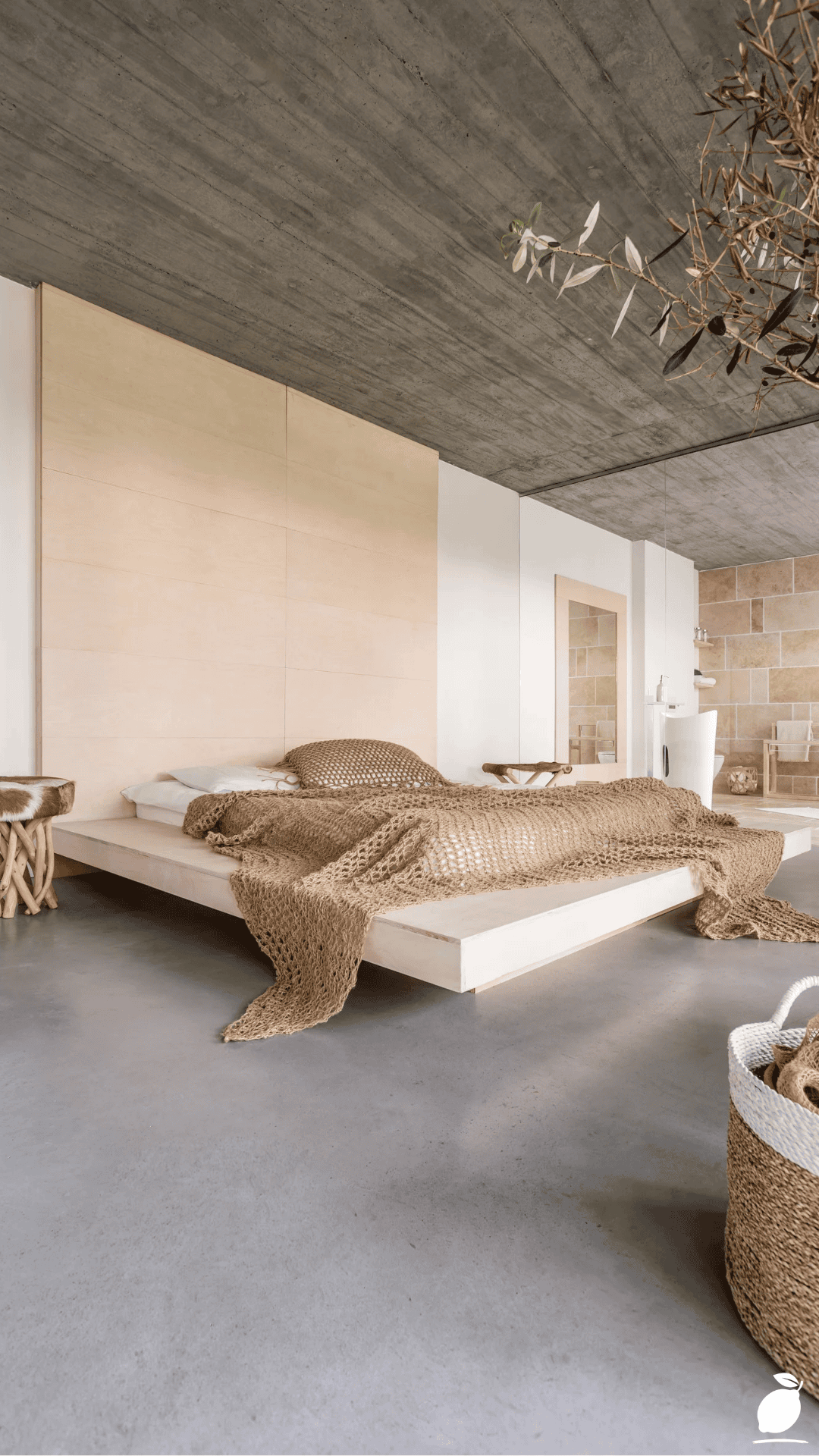
The wabi sabi bedroom matters because it offers something that no other bedroom aesthetic, no matter how beautiful, how sophisticated, or how carefully executed, can offer in the same way: permission. Permission to stop trying to make the bedroom perfect, permission to let the natural materials show their imperfection, permission to display the books you’re actually reading alongside the plant that needs water and the linen that wrinkled in the wash. The wabi sabi bedroom is the aesthetic that recognizes the daily bedroom as a daily room rather than a magazine feature, a room where the philosophy of beauty is not contingent on perfection but is specifically located in the evidence of genuine occupation.
Research in environmental psychology and restorative space design has identified natural materials, visible imperfection, and the presence of living organic elements as significant contributors to the specific quality of psychological restoration that the bedroom is supposed to provide, the unwinding of daily tension, the loosening of performance and productivity orientation, and the transition toward the genuine rest that the body requires. The wabi sabi bedroom, with its warm wood and honest linen and slightly imperfect handmade textile and living plant, creates the specific sensory conditions that this research identifies as restorative: organic material warmth, sensory variety (the variation in wood grain, fiber texture, and plant form), and the absence of the visual perfection that keeps the conscious mind engaged rather than releasing it toward rest.
Easy Peasy Life Matters is built on the conviction that the bedroom deserves a design philosophy as much as a design aesthetic, a governing idea about what the bedroom is for and what makes it good at being that, and that the wabi sabi bedroom provides the most honest, most materially intelligent, and most humanly compatible of all available bedroom design philosophies. The exposed wooden beams, the linen bedding, the handmade textile, and the potted plant in the image are not compromises; they are the wabi sabi bedroom’s most complete expression of what beauty in a bedroom looks like when it has been released from the requirement to be perfect. These wabi sabi bedroom ideas are how that release is built.
Frequently Asked Questions
What exactly is the wabi sabi aesthetic, and how does it apply to a bedroom?
Wabi sabi is a Japanese aesthetic philosophy that finds beauty in imperfection, incompleteness, and impermanence, the specific qualities of natural materials, handmade objects, and living things that manufactured perfection eliminates. In a wabi sabi bedroom, the aesthetic is expressed through natural material choices (solid wood rather than lacquered MDF, linen rather than polyester, living plants rather than artificial ones), functional objects displayed honestly rather than hidden in storage, and the deliberate acceptance of the imperfections that natural materials and daily use produce. The wabi sabi bedroom is not the same as the imperfect bedroom; it is the bedroom that has been deliberately designed to accept and celebrate imperfection as a quality rather than a deficiency.
How is a wabi sabi bedroom different from a Japandi bedroom?
Wabi sabi and Japandi bedroom aesthetics share the influence of Japanese design philosophy and the preference for natural materials and restraint in object quantity, but they differ in their relationship to perfection. Japandi bedroom design, the blend of Japanese and Scandinavian design principles maintains a commitment to clean lines, precise proportions, and the elimination of visible imperfection that is more specifically Scandinavian than Japanese; the Japandi bedroom is beautiful in a controlled, curated way. The wabi sabi bedroom is beautiful in an organic, slightly imprecise way. The imperfection is not eliminated but celebrated. A wabi sabi bedroom may have a slightly asymmetric textile art piece, a plant with visible growth asymmetry, and bedding that wrinkles in use; a Japandi bedroom would address all three to maintain its visual precision.
Can a wabi sabi bedroom have a TV or media console?
Yes, the media console in the image demonstrates that the wabi sabi bedroom is not the bedroom that rejects technology in favor of an exclusively analog environment. The wabi sabi aesthetic’s relevant principle is honesty of display rather than absence of technology: a media console that shows what it is (a functional piece of furniture that holds a screen and media) and that has material honesty (the image’s black console with stacked books and a plant) is compatible with the wabi sabi bedroom. What would be incompatible is a media console specifically designed to look like something other than what it is, a media console disguised as a sideboard, for example, or a TV hidden behind a motorized art panel, because the deception of function is specifically contrary to the wabi sabi principle of honest material and functional expression.
What is the best wood tone for a wabi sabi bedroom?
The most authentic wabi sabi bedroom wood tone is natural, unaltered, or minimally oiled, the wood in its most honest processed state, rather than in a stained or colored version of itself. Light oak (the most available natural finish in contemporary furniture), walnut in its natural dark brown, and teak in its natural warm honey-brown are all wabi sabi bedroom appropriate wood tones when finished with a clear or lightly tinted oil rather than a dark stain that covers the wood’s natural color or a urethane lacquer that creates a plastic-looking barrier between the wood surface and the room’s air. The image’s platform bed and side table both demonstrate natural wood tones in the warm-to-medium brown range that most directly communicate the wabi sabi aesthetic’s material values.
How many objects should a wabi sabi bedroom have?
The wabi sabi bedroom’s object quantity is governed by the ma principle (negative space as a designed element) rather than by a specific number, but in practical terms, the wabi sabi bedroom has significantly fewer objects than a maximalist or even a moderately furnished bedroom of the same size. For a standard bedroom, the wabi sabi object count is typically: one or two pieces of wall art (as in the image), one to three objects on each functional surface (the image’s side table holds a glass jar; the media console holds books and a plant), and no purely decorative objects that lack natural material quality or functional identity. This restraint is not minimal in the contemporary design sense; it is specific: the right objects in the right number, with space intentionally preserved between them.