The herb drawer has been a source of low-level domestic shame for longer than anyone in the household is comfortable admitting. Dried basil that expired in 2023 sharing a shelf with three different jars of cumin, one of which is definitely from a previous address. A bag of something that was supposed to be chamomile, possibly, now indistinguishable from dried grass. Turmeric staining everything it touches. The corner of the cabinet where the loose-leaf tea lives has developed its own internal ecology. None of this was intentional. It evolved the way kitchen chaos always evolves incrementally, purchase by purchase, without a system to absorb and organize what the enthusiasm for cooking and herbal wellness kept accumulating.
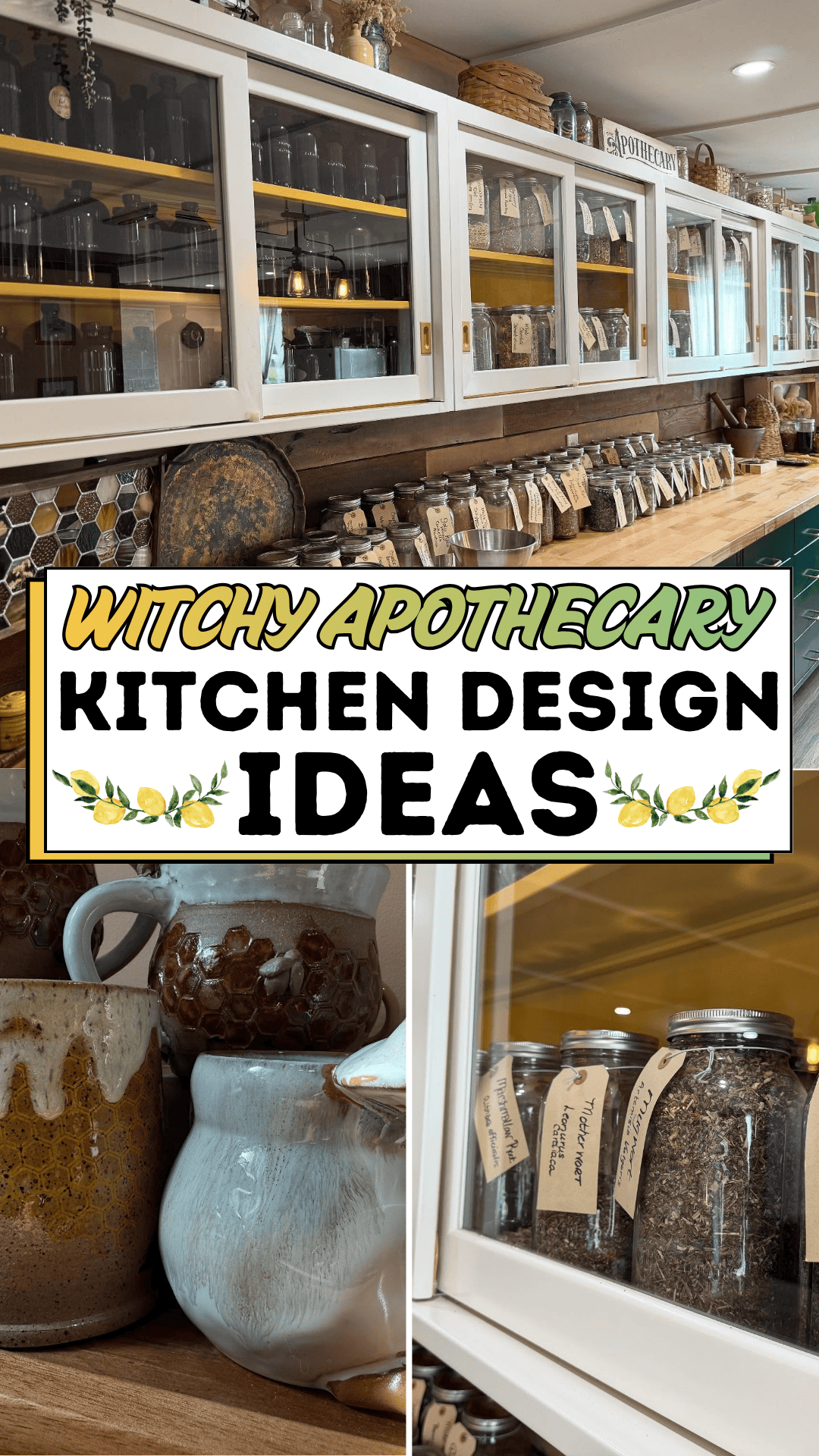
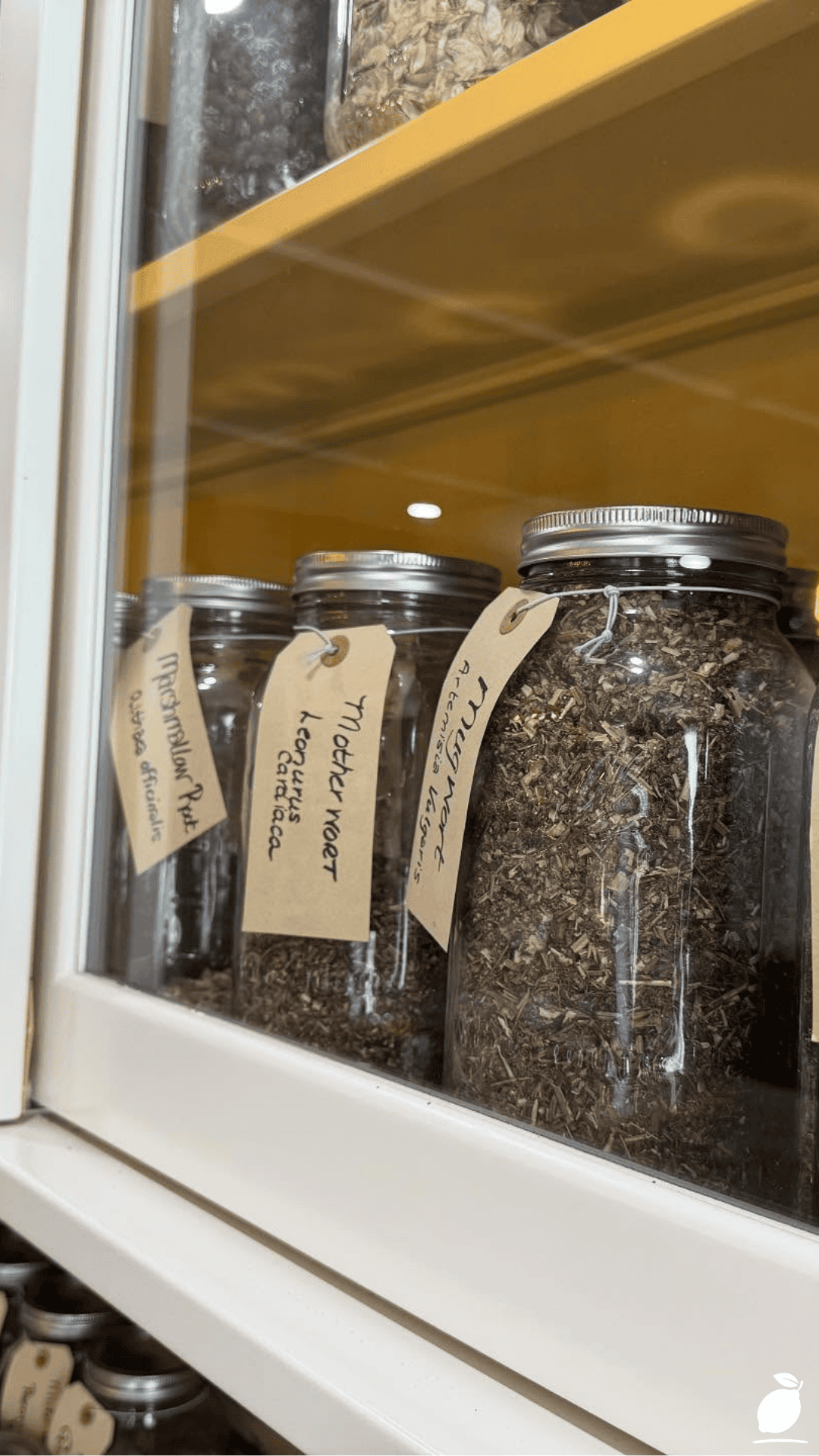
The apothecary kitchen is the organized alternative to this specific kind of kitchen chaos, and the witchy apothecary aesthetic is the version that makes organization feel like ritual rather than obligation. The image above captures this quality precisely: glass jars lined up on yellow shelving in front of white cabinetry, each labeled in handwriting that makes the contents feel gathered rather than purchased, herbs like nettle and yellow root and stinging nettle visible through the clear glass in a palette of organic greens and browns. There is nothing technically complicated about a row of labeled glass jars. What makes it a design system rather than a storage solution is the consistency: the same jar format, the same label style, the same organizational logic applied to every single item, and the aesthetic intention behind it that transforms a kitchen cabinet into something that feels genuinely curated.
An apothecary kitchen in the witchy design tradition is not about performance or aesthetics alone. It is about the specific relationship between how things are stored and how confidently and how frequently they are used. Herbs and spices kept in an apothecary kitchen system are visible, labeled, organized by category, beautiful to look at and get used. Herbs kept in a chaotic drawer get forgotten. The organization serves the practice, and the practice of cooking with fresh intention, of using plants medicinally and culinarily, of treating the kitchen as the center of a thoughtful household is exactly what the witchy apothecary kitchen is designed to support.
The Apothecary Kitchen System
Step 1: Prepare — Audit, Edit, and Gather Your Apothecary Kitchen Materials
The preparation step in building an apothecary kitchen is the step that most people want to skip and the step that determines whether the finished system works or simply looks beautiful for three weeks before reverting to the drawer chaos it replaced. Before a single jar is purchased or a single label is written, the full inventory of herbs, spices, dried botanicals, teas, and any other apothecary-kitchen-adjacent items in the kitchen needs to be laid out, assessed, and edited.
Remove every herb, spice, dried botanical, and loose tea from every cabinet, drawer, and container in the kitchen. Smell each dried herb and spices that have lost their aromatic potency have lost most of their culinary and medicinal value and should be discarded rather than decanted into a beautiful jar. Check expiry dates where visible. Consolidate any duplicates. What remains after this edit is the actual inventory your apothecary kitchen system needs to accommodate, which is almost always significantly smaller than the pre-edit collection suggested.
With the edited inventory in hand, assess the available display space: the shelving dimensions, the cabinet depth, the height clearance. The apothecary kitchen aesthetic in the featured image uses a single shelf of consistent glass jars; this works because the jar selection is uniform and the shelf is sized to accommodate the full inventory. Measure the available space, count the edited inventory, and calculate what jar size and quantity the space requires before purchasing anything.
Gather materials: matching glass jars with airtight lids (wide-mouth mason jars, Weck preserving jars, or pharmacy-style amber glass jars are all appropriate to the witchy apothecary kitchen aesthetic), adhesive labels or plain paper with an adhesive backing, a fine-point black pen or a calligraphy pen for handwritten labels, and any decorative additions that extend the apothecary kitchen aesthetic small bundles of dried herbs, a mortar and pestle for display, dark bottles for tinctures.
Step 2: Implement — Decant, Label, and Arrange the Apothecary Kitchen System
The implementation step is the creative heart of the apothecary kitchen project: the hour or afternoon spent decanting, labeling, and arranging that produces the satisfying visual result of the featured image. The quality of this step determines the system’s visual coherence and its long-term usability.
Decant each herb and spice from its original packaging into the designated apothecary kitchen jar. Fill jars to approximately 80% capacity; a jar filled to the brim is more difficult to measure from and prevents the contents from being clearly visible through the glass. Seal each jar immediately after filling to preserve the contents’ aromatic properties.
Label each apothecary kitchen jar in a consistent format: the common name of the herb or spice as the primary label (written large enough to be readable from 60cm), and any additional information: the Latin name, the date of purchase, and the source written smaller beneath. The handwritten labels in the featured image are the detail that most clearly communicates the apothecary kitchen’s relationship to craft and intention: they signal that someone made a considered choice about each jar’s contents rather than simply placing a product on a shelf. Use the same pen, the same label format, and the same handwriting style (or a consistent printed font if handwriting isn’t preferred) across every jar in the system.
Arrange the labeled jars on the designated apothecary kitchen shelving in a sequence that serves both daily use and visual composition. The most functional arrangement for an apothecary kitchen places the most frequently used herbs and spices at the most accessible height and within the clearest sight line, with less-used botanicals at the periphery. Within the functional arrangement, group by color or by plant family to create the visually coherent display that distinguishes an apothecary kitchen from a generic spice rack.
Step 3: Maintain — Keep the Apothecary Kitchen System Functional and Beautiful
The maintenance step is the system’s long-term sustainability plan: the simple habits and regular checks that prevent the apothecary kitchen from drifting back toward the pre-system disorder over the months and years of daily use.
Establish a refill routine: when an apothecary kitchen jar reaches its last 20% of contents, place the jar on a designated “refill” shelf or section so that restocking can be done in a single weekly or monthly batch rather than reactively when a jar runs empty mid-recipe. This simple habit prevents the gaps in the apothecary kitchen system: the jar that is empty and has been left empty for weeks that undermines the system’s completeness.
Establish a quarterly audit: four times per year, remove all jars from the apothecary kitchen shelving, smell and assess the contents of each, discard anything past its aromatic prime, and wipe down the shelving before replacing. This quarterly ritual prevents the apothecary kitchen from silently accumulating the same expired-herb problem it was designed to solve.
Photograph the completed apothecary kitchen system after the initial setup. The photograph serves as a reference for the system’s intended arrangement when jars migrate during daily use or are temporarily displaced during cooking; the photograph provides the reset guide that restores the apothecary kitchen to its original organized state without requiring memory of every jar’s original position.
The Secrets to an Apothecary Kitchen
Three Expert Pro-Tips:
Invest in one jar format and commit to it completely. The most common reason apothecary kitchen displays look organized but not curated is a mix of jar sizes and shapes that breaks the visual rhythm of a consistent row. Identify the jar format that best suits the apothecary kitchen aesthetic and the available shelf depth. Wide-mouth mason jars for larger quantities, Weck jars for a European farmhouse aesthetic, amber glass pharmacy jars for the deepest witchy apothecary reference, and purchase enough of that single format to house the entire inventory. The visual coherence of a uniform jar collection is what makes an apothecary kitchen look designed rather than assembled.
Use a label system that communicates both the practical and the intentional. The handwritten label in the featured image does something that a printed adhesive label from a label maker does not: it communicates human attention and personal relationship with the ingredient. For an apothecary kitchen with a witchy or herbalist aesthetic, handwritten labels in black ink on cream or kraft paper are the most visually appropriate. For a more contemporary apothecary kitchen, a consistent printed label in a clean sans-serif font in black on white achieves the same organizational clarity with a modern aesthetic.
Include one non-storage element on the apothecary kitchen shelf. A mortar and pestle, a small bundle of dried lavender, a single dark bottle of tincture, a small crystal, or a folded piece of linen between jar groups: any one non-jar decorative element positioned deliberately in the apothecary kitchen display breaks the repetitive rhythm of identical jars and signals that the arrangement was made with aesthetic intention rather than purely functional logic.
Three Common Mistakes to Avoid:
Don’t decant items you rarely use. An apothecary kitchen system filled with specialty botanicals used once a year is a system that uses space inefficiently and creates visual noise in the most visible zone of the kitchen. Reserve the apothecary kitchen display jars for items used at least monthly. Store rarely used specialty herbs and spices in a secondary, less visible storage location where presentation is irrelevant to their functionality.
Don’t neglect airtight seals. Glass jars without proper airtight seals allow humidity into the apothecary kitchen jar contents, particularly in a kitchen where steam from cooking is regular producing the moisture-related degradation of herbs and spices that makes them clump, lose potency, and eventually develop mold. Invest in jars with genuine airtight closures (rubber-gasketed lids or clip-top closures) rather than friction-fit lids that appear airtight but are not.
Don’t create an apothecary kitchen system and then place it out of the cooking workflow. An apothecary kitchen display on a shelf across the room from the cooking surface, however beautiful, produces the specific daily inconvenience of having to leave the cooking zone to retrieve an ingredient, and convenience almost always wins. The apothecary kitchen system needs to be within one or two steps of the primary cooking surface to be used spontaneously and consistently rather than only when a recipe specifically calls for one of its contents.
Why Apothecary Kitchen Matters
The kitchen is the room where a household’s relationship with nourishment, with health, and with the daily act of caring for the people it feeds is expressed most physically and most consistently. An apothecary kitchen organized, intentional, designed around the herbs and botanicals that support both cooking and wellness communicates something specific about how the household understands the kitchen’s purpose: not as a room for heating food but as a space for practicing the daily care of the body and the home. This is not a trivial distinction. Research in behavioral health consistently identifies the degree to which a kitchen invites and supports intentional food preparation as a significant predictor of the quality and the healthfulness of a household’s daily nutrition.
For individuals who use herbal medicine, botanical wellness products, or plant-based supplements alongside their culinary herbs, the apothecary kitchen organizes the physical practice of that wellness relationship in a way that makes it sustainable and daily rather than occasional and effortful. A stinging nettle jar clearly labeled and easily accessible is a stinging nettle jar that ends up in the evening tea regularly. A stinging nettle bag somewhere at the back of the chaotic drawer does not. The organization is not the point in itself; the herbalist practice it enables is the point, and the apothecary kitchen system is what makes that practice daily rather than aspirational.
Easy Peasy Life Matters is built on the conviction that the most meaningful home design decisions are those that align the physical environment with the life that the household genuinely wants to live in it. A witchy apothecary kitchen is not a decoration choice. It is a declaration of the relationship between this kitchen and the plants, the practice, and the daily intention that the household wants to cultivate there. Setting it up correctly with the right jars, the right labels, the right system is the hour of work that makes every subsequent interaction with the kitchen feel aligned with that declaration rather than at odds with it.
Frequently Asked Questions
What jars are best for a witchy apothecary kitchen display?
Wide-mouth mason jars (Ball or Kilner brands) in matching sizes are the most widely available and most versatile apothecary kitchen jar choice; they have rubber-gasketed airtight lids, are inexpensive enough to purchase in bulk, and look genuinely beautiful in a uniform row on a yellow or dark-painted shelf. For a more sophisticated or strongly witchy aesthetic, amber glass pharmacy jars (available from specialist bottle suppliers) add the dark, mysterious quality that clear glass does not provide and are particularly appropriate for tinctures, dried mushrooms, and darker botanicals. Weck preserving jars (the tulip-shaped German canning jar with a glass lid and orange rubber gasket) are the most visually distinctive apothecary kitchen option and the most frequently featured in high-design herb storage applications.
How do I organize an apothecary kitchen by category?
The most functional apothecary kitchen category system organizes by use frequency first and by plant family or function second. Primary display shelf: culinary herbs used daily or weekly (basil, thyme, rosemary, oregano, cumin, coriander, turmeric) organized alphabetically or by cuisine type for immediate accessibility. Secondary display or cabinet: medicinal herbs and wellness botanicals (nettle, chamomile, elderflower, adaptogenic herbs) grouped by function: calming herbs together, immune-support herbs together, tonic herbs together. Tertiary storage (outside the primary display): specialty botanicals used rarely, bulk backup quantities, and botanicals not currently in active use. This three-tier organizational logic maintains the apothecary kitchen display’s visual coherence while ensuring that the most-used items are always the most accessible.
How do I maintain handwritten labels on apothecary kitchen jars?
Handwritten apothecary kitchen labels on paper stock deteriorate quickly if exposed to humidity, kitchen grease, or moisture from jar condensation. Apply a thin coat of clear acrylic sealant spray or Mod Podge over the completed handwritten labels before attaching them to the jars; this waterproofs the label surface and significantly improves the ink’s legibility in the kitchen environment. Alternatively, write labels on kraft paper card stock (which has greater moisture resistance than standard printer paper) rather than plain paper, and use a permanent waterproof marker rather than a standard pen. Replace any label that becomes illegible; an unlabeled apothecary kitchen jar defeats the system’s primary organizational purpose.