You lie down at the end of the day, and your body doesn’t believe it. Your mind says sleep, but something underneath, something older and less rational than thought, stays braced. The ceiling looks the same as it always has. The room is quiet. And yet you’re still carrying the whole day in your shoulders, your jaw, the shallow rhythm of your breath. It doesn’t matter that the pillow is soft or that the room is technically dark enough. The body holds what the day gave it, and a bedroom that was designed for nothing in particular offers nothing in particular to help you let it go. That disconnect between where you are and what your nervous system actually needs is one of the quietest and most persistent sources of exhaustion in modern life.

Somatic healing is the practice of releasing stored physical tension and emotional residue through the body itself, through sensation, breath, movement, and environment. And while many people associate it with therapy rooms or yoga studios, one of the most powerful somatic healing environments you can create is the room where you spend a third of your life. A bedroom designed for somatic healing isn’t about expensive renovations or clinical minimalism. It’s about understanding how color, texture, light, and spatial arrangement communicate directly with the nervous system and making intentional choices that speak a language of safety, warmth, and rest rather than stimulation, clutter, and unfinished business.
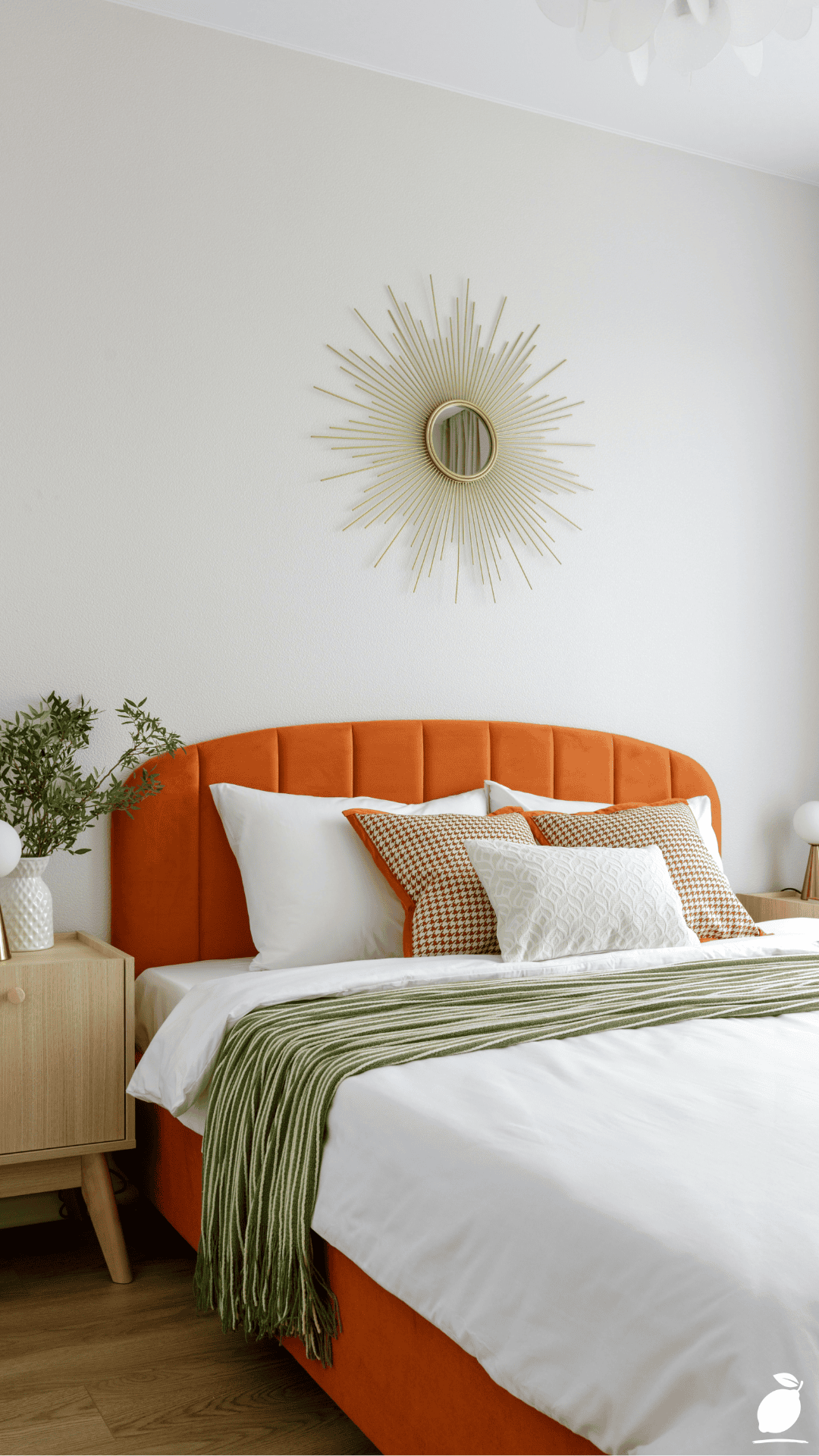
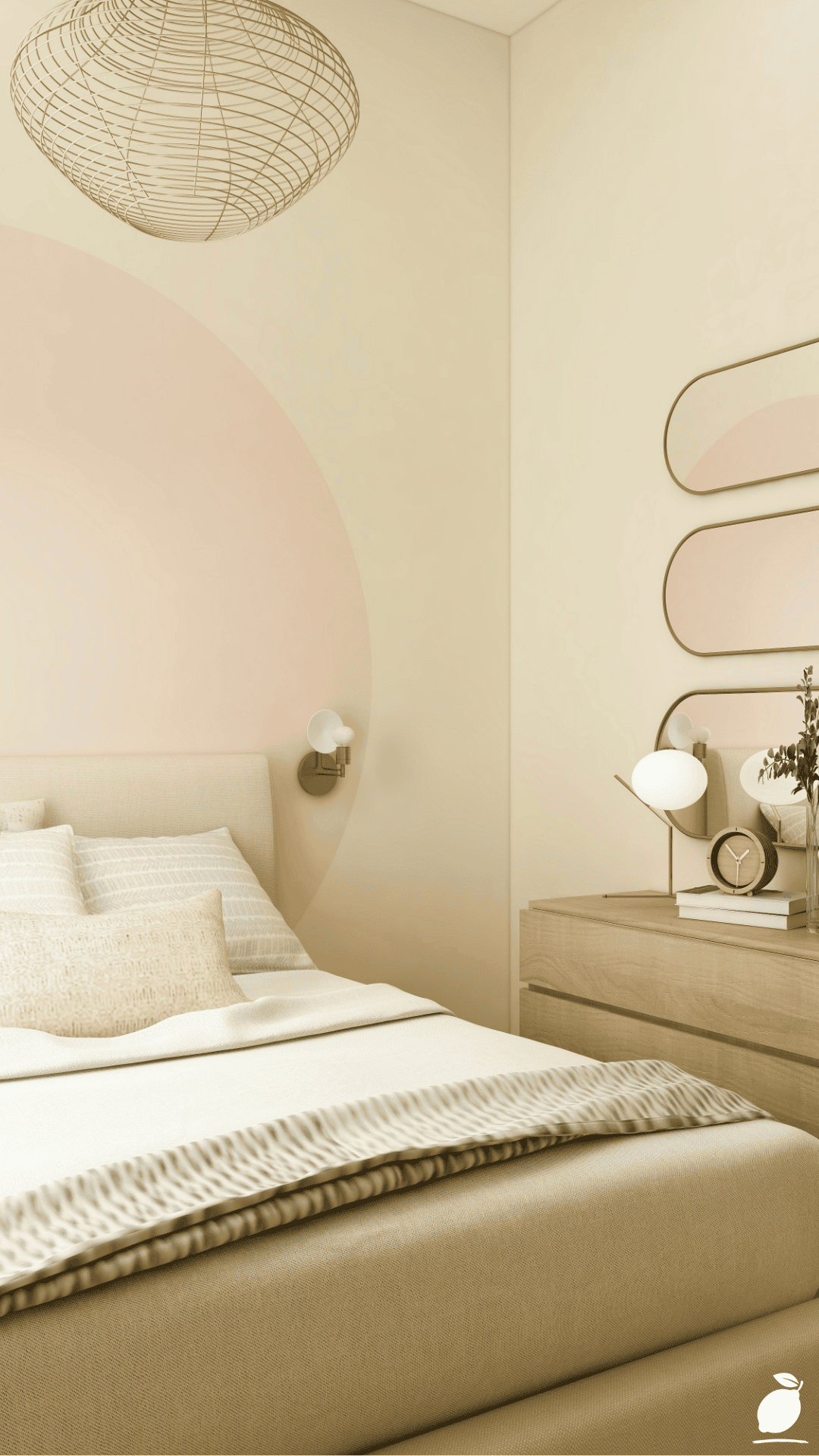
The bedroom in this guide does exactly that. Warm orange bedding energizes without overwhelming, white surfaces create spacious visual calm, sage green introduces the grounding quality of nature, and natural wood tones on the floor and nightstands anchor the space in organic warmth. A sunburst mirror above the bed radiates light and draws the eye upward, a gesture that opens rather than closes the visual field. Every element was chosen to signal one thing to the nervous system: you are safe here. You can rest now. This post will walk you through every design decision that makes a bedroom for somatic healing work so you can build your own, in your own space, at your own pace.
The Bedroom for Somatic Healing Blueprint
Designing a bedroom for somatic healing is a layered process. Work through these steps in sequence, and you’ll build a space that actively supports nervous system regulation, not just a room that looks calm, but one that genuinely feels that way from the moment you walk through the door.
Step 1: Audit Your Current Bedroom for Nervous System Triggers
Before introducing a single new element to your bedroom for somatic healing, spend ten minutes standing in the doorway of your current bedroom and noticing what you feel. Not what you think, but what you feel. Does anything create a sense of visual agitation? Piles of unprocessed paperwork, charging cables tangled across surfaces, clothing draped on chairs, mismatched bedding in competing patterns? Every object in a bedroom that represents an unfinished task or an unresolved decision is a low-level nervous system stressor. The body reads visual chaos as an environmental threat, a signal to stay alert rather than to release. Your first step in designing a bedroom for somatic healing is identifying and removing the elements that are actively working against rest, even before you add anything new.
Step 2: Choose a Color Palette That Regulates Rather Than Depletes
Color is one of the most direct and most underestimated tools in designing a bedroom for somatic healing. Research in environmental psychology consistently shows that certain color combinations support parasympathetic nervous system activation, the physiological state of rest and digest, while others maintain or amplify sympathetic arousal. For a bedroom for somatic healing, the most effective palette combines one warm, energetically grounding tone with expansive neutral surfaces and at least one natural green accent:
- Warm orange or terracotta on the dominant upholstered surface (headboard, bed frame, or accent wall) provides emotional warmth and gentle stimulation that communicates aliveness without urgency, the color equivalent of a banked fire rather than a blazing one.
- Crisp white on bedding and walls expands the visual field and creates psychological spaciousness, giving the nervous system room to exhale rather than contract.
- Sage green in textiles (a throw blanket, a pillow, a potted plant) introduces the biophilic calming effect of nature into the room’s color language. Even a single sage green element measurably shifts the room’s sensory tone toward groundedness.
- Natural wood tones on the floor and furniture anchor the palette in organic warmth, connecting the room to earthen, tactile material qualities that the body associates with safety and stability.
Step 3: Layer Textures for Tactile Safety
A bedroom for somatic healing engages the body through touch as deliberately as it engages the eye through color. Somatic healing theory recognizes that tactile safety, the experience of surfaces that feel pleasant, soft, and skin-friendly, activates the same parasympathetic response as physical safety. Layer your bedroom textiles intentionally: crisp cotton percale or linen for the primary bedding (breathable, clean, sensory-neutral), a chunky knit or fleece throw in sage green draped across the foot of the bed (available for reaching when the body wants weight and warmth), and decorative pillows in a gingham or softly patterned fabric that introduces visual interest without competing pattern aggression. The goal is a bed that invites the body toward it, that looks and feels like permission to fully arrive.
Step 4: Position Your Lighting for Nervous System Support
Lighting in a bedroom for somatic healing must do two very different jobs across the course of a single day: support wakefulness and morning energy in the hours after rising, and facilitate the physiological transition into rest in the evening hours before sleep. This requires layered, controllable lighting rather than a single overhead fixture. Install bedside table lamps with warm-toned bulbs (2700K maximum) on both sides of the bed; the symmetry creates a sense of balance and visual completeness that the nervous system finds inherently settling. Use a dimmer switch on any overhead lighting so the room can transition from bright and functional to dim and somatic-safe as the evening progresses. Keep screens and devices away from the immediate sleep environment; their blue-spectrum light directly suppresses melatonin and keeps the nervous system in a state of mild alert regardless of how tired the body feels.
Step 5: Choose Furniture That Creates Spatial Balance
The spatial arrangement of furniture in a bedroom for somatic healing communicates directly to the body’s sense of safety through what somatic practitioners call “orienting,” the instinctive assessment of a space for threat, escape routes, and shelter. A bed positioned with its headboard against a solid wall (rather than floating in the room or positioned under a window) satisfies the body’s orienting need for a protected back. Matching nightstands on both sides of the bed create visual symmetry that the nervous system registers as order and balance. Mid-century modern furniture legs, which keep pieces elevated off the floor, maintain visual lightness and prevent the room from feeling closed in or heavy. Keep the floor as clear as possible: an unobstructed floor is one of the most powerful spatial signals of spaciousness and ease in a bedroom for somatic healing.
Step 6: Add Intentional Natural Elements
Biophilic design, the practice of incorporating natural elements into interior spaces, is one of the most evidence-supported approaches to nervous system regulation through the environment. For a bedroom for somatic healing, incorporate nature through living plants (a small potted plant on each nightstand brings low-maintenance green life to eye level while you wake and wind down), natural materials (wood, linen, cotton, ceramic), and light that enters through unobstructed windows. A sunburst or starburst mirror above the bed is a particularly powerful addition; it reflects natural light deeper into the room, creates a radial focal point that draws the eye upward and outward rather than inward, and introduces a solar, expansive quality to the wall space that functions almost like a second window.
Expert Secrets for Success
Pro-Tips for a Better Result
- Use orange as an upholstered accent, not a wall color. In a bedroom for somatic healing, warm orange on a bed frame or headboard is grounding and energizing in exactly the right proportion. The same orange on all four walls can tip from stimulating to overwhelming. Let the headboard carry the color while white walls do the spacious, expansive work around it. This ratio delivers the emotional warmth of orange without its overstimulating potential.
- Place matching plants on both nightstands. Symmetry in a bedroom for somatic healing is not merely aesthetic; it satisfies the body’s orienting instinct for balance and order. Two small matching potted plants (pothos, snake plant, or peace lily, all of which thrive in bedroom conditions) flanking the bed create a sense of considered completeness that single-sided arrangements cannot achieve. They also improve air quality subtly over time, contributing to the overall sensory health of the sleep environment.
- Invest in pillow quality over pillow quantity. The bed is the centerpiece of any bedroom for somatic healing, and the bedding communicates the room’s entire sensory promise at a glance. Three to five pillows in complementary tones and high-quality fabrics create a bed that looks inviting and curated. Eight pillows in competing patterns create a bed that looks styled for a photograph but signals effort and performance rather than genuine rest.
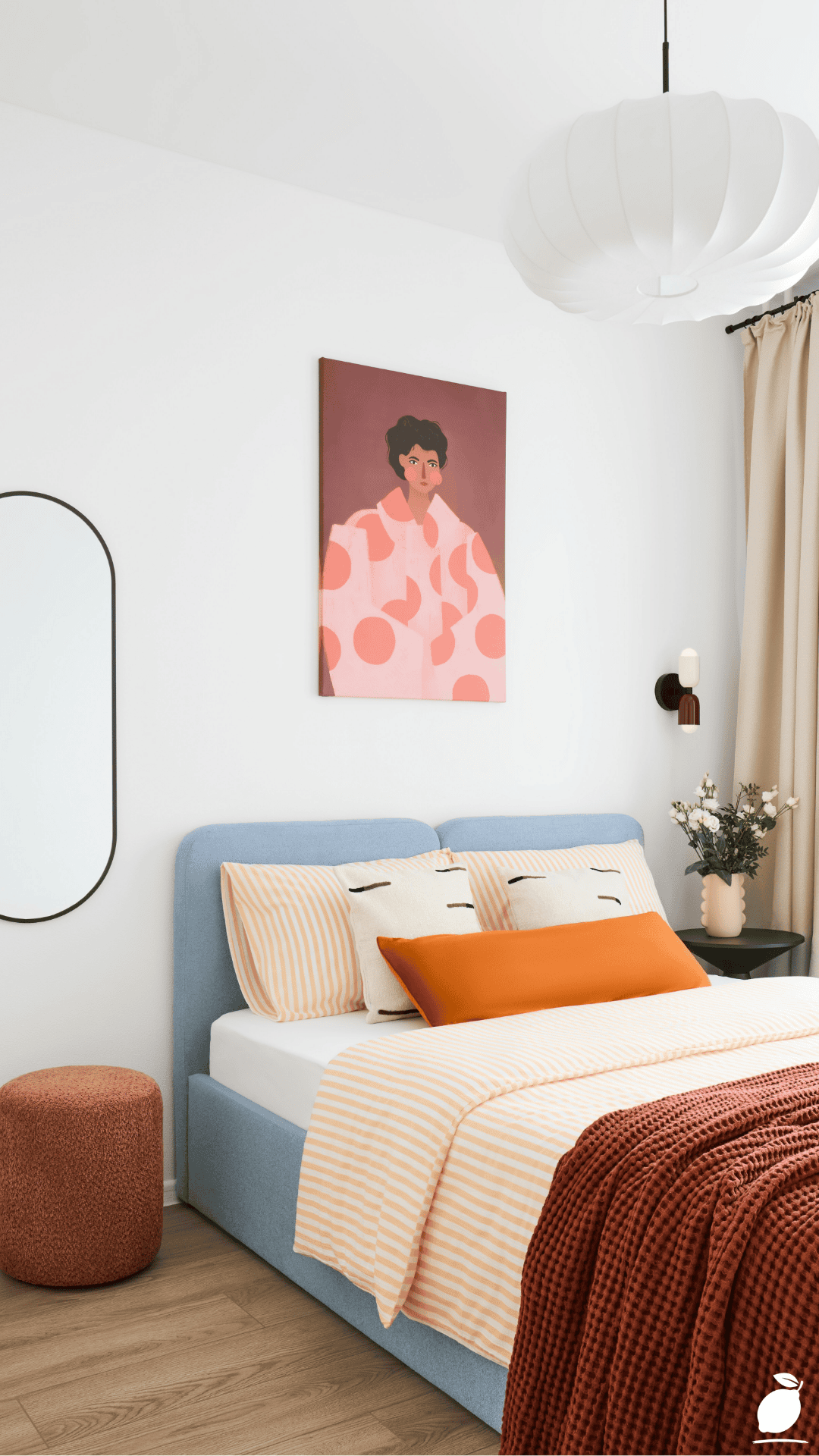
- Use beige or linen curtains to filter rather than block light. A bedroom for somatic healing benefits from natural light during daytime hours, light that connects the room to the rhythm of the day and provides the bright-morning cues that support healthy circadian function. Lightweight beige or linen curtains filter direct sunlight into a softer, diffused warmth while maintaining privacy. Layer blackout lining behind them for nighttime, so you have full control across both ends of the day-night cycle.
- Add a somatic grounding object at arm’s reach from the bed. A smooth stone, a small piece of driftwood, a weighted sachet filled with lavender, something with physical texture and sensory presence positioned on the nightstand, gives the hands a grounding anchor during moments of anxious wakefulness. The tactile engagement of a natural object activates the body’s proprioceptive awareness and can interrupt a runaway nervous system response more effectively than any mental technique.
Common Mistakes to Avoid
- Treating the bedroom as secondary storage. Boxes under the bed, a chair draped in tomorrow’s decisions, a dresser top buried in accumulated objects, all of these register as unfinished business in the body’s subconscious environmental assessment. A bedroom for somatic healing cannot function in a space that doubles as overflow storage. Create genuine homes for displaced objects elsewhere in the house before attempting to establish the bedroom as a healing environment.
- Choosing colors that are calming in theory but wrong for your nervous system specifically. Interior design culture promotes cool blue and gray as universally calming bedroom colors, and for many people, they are. But the nervous system is individual. If cool tones make you feel lonely, isolated, or emotionally flat, they are not calming for you, regardless of what the research average suggests. A bedroom for somatic healing should feel warm and held, not spa-clinical. Trust your body’s response to color over conventional decorating wisdom.
- Neglecting scent as a somatic healing tool. The olfactory system has the most direct pathway to the limbic brain, the emotional and memory center of any sensory system. A bedroom for somatic healing that addresses color, texture, and light but ignores scent is missing one of the most powerful regulation tools available. Diffuse lavender or cedarwood essential oil in the evening, use linen spray on bedding before sleep, or place a sachet of dried herbs inside the pillowcase. These small olfactory cues signal the nervous system that it is time, consistently night after night, to release.
- Installing overhead lighting without dimmer control. A single overhead light fixture at full brightness in the evening hours before bed is one of the fastest ways to disrupt the physiological transition into sleep. Bright overhead light suppresses melatonin and signals the circadian system that it is daytime. If you cannot install a dimmer immediately, use only your bedside lamps from two hours before your intended sleep time onward. The shift in the room’s light environment alone, from overhead bright to low bedside warm, is one of the most effective and most overlooked sleep interventions available without medication.
- Rushing the bedroom for somatic healing transformation all at once. The impulse to overhaul everything simultaneously is understandable, but it produces a room that feels assembled rather than cultivated, and it removes the opportunity to observe how each change affects how your body feels in the space. Make changes in stages: bedding and lighting first (the highest-impact, lowest-cost changes), then furniture arrangement, then color, then natural elements. Give each stage a week to settle into your nervous system before adding the next layer.
Why Bedroom for Somatic Healing Matters
The average person spends between 26 and 30 years of their life in their bedroom. That number is so large it ceases to feel meaningful until you consider what happens when those hours are spent in an environment that the nervous system cannot fully trust. Chronic sleep disruption, difficulty transitioning from alertness to rest, and morning fatigue that persists despite adequate hours in bed are not simply the results of stress or busy schedules. They are frequently the results of a physical environment that was never designed to support the specific biological process of nervous system downregulation. A bedroom for somatic healing addresses this at the root level, transforming the room from a passive backdrop into an active participant in your body’s nightly restoration.
The ripple effects of this restoration extend into every other dimension of a household’s life together. Adults who sleep in genuinely restorative environments have measurably better emotional regulation, which means more patient parenting, more generous partnership, more capacity to stay present through the inevitable difficulties of shared life. Children who observe parents taking the quality of their rest seriously learn early that their own well-being is worth tending. And the act of designing a bedroom for somatic healing, of making the quiet, intentional decision that this room will serve your nervous system’s genuine needs, is itself somatic. It is the body saying: I matter enough to do this. That belief, chosen and enacted in a room with an orange headboard and two small plants and the right light, has a way of spreading.
Frequently Asked Questions
What exactly is somatic healing, and how does bedroom design support it?
Somatic healing is a body-based approach to processing and releasing stored physical tension, emotional residue, and nervous system dysregulation, the accumulated effects of stress, trauma, and chronic overwhelm that live in the body’s tissues rather than in conscious thought. Bedroom design supports somatic healing by creating an environment that communicates safety, warmth, and order to the body’s subconscious orienting system through color, texture, light, spatial arrangement, and natural elements that activate the parasympathetic nervous system and facilitate genuine rest rather than merely the absence of activity.
Is orange really a good color for a bedroom for somatic healing?
Yes, when used intentionally and in the right proportion. Warm orange in a bedroom for somatic healing functions as an emotional anchor: it communicates warmth, belonging, and gentle vitality without the urgency of red or the coolness of blue. Used on an upholstered surface (headboard, bed frame, or a single accent wall) against white walls and natural wood tones, orange creates a sense of held warmth that many people find deeply soothing for the nervous system. It is not a universally prescribed color; observe your own body’s response, but for many people, it is far more genuinely soothing than the cool, detached tones that conventional bedroom design promotes.
How much does it cost to create a bedroom for somatic healing?
A meaningful bedroom for somatic healing transformation can be achieved at almost any budget level. The highest-impact, lowest-cost changes replacing bedding with high-quality white cotton, adding a warm-toned bedside lamp on each side of the bed, decluttering all non-bedroom objects from the space, and adding one small plant cost between $100 and $300 and produce a dramatically different sensory environment. Adding a statement headboard in a warm tone, natural wood nightstands, and a sunburst mirror represents a mid-range investment of $500 to $1,500. Full room renovation, including flooring, lighting fixtures, and custom window treatments, is a larger investment but rarely necessary to achieve the core somatic healing benefits.
Can I create a bedroom for somatic healing in a rental apartment?
Absolutely. The most powerful elements of a bedroom for somatic healing bedding quality, textile layering, lighting choices, plant life, decluttering, and scent are entirely portable and require no permanent changes to the space. A warm-toned headboard can be freestanding or hung with removable hardware. Bedside lamps replace overhead fixtures without electrical work. Curtain tension rods avoid wall damage. The nervous system responds to these portable, non-permanent changes with the same depth of regulation as it would in an owned, renovated space. The body doesn’t distinguish between a leased wall and a purchased one.
How long does it take to notice the effects of a bedroom for somatic healing?
Most people notice a perceptible shift in how their bodies feel when entering the bedroom within the first week of meaningful environmental changes, particularly after addressing lighting (switching to warm bedside lamps only in the evening) and decluttering (removing all non-sleep objects from the sleep environment). Bigger changes in sleep quality, morning restoration, and emotional regulation tend to emerge over four to eight weeks as the nervous system learns to associate the new environmental cues with genuine safety and release. The process is cumulative; each change builds on the last, and the full effect of a bedroom for somatic healing is experienced over seasons rather than days.