The summer watering routine starts with good intentions and ends in exhaustion. Every evening around six o’clock, the hose comes out, and for forty-five minutes you move from one thirsty plant to the next: the salvia that wilts dramatically by noon, the hydrangeas that make their distress visible from across the garden, the ornamental grasses that are technically drought-tolerant but somehow always look like they need one more pass of water before you can go inside. By August, the garden that was supposed to be a source of pleasure has become a daily obligation with consequences, and the water bill has become a monthly reminder that the garden was designed for a wetter world than the one it’s actually living in. The plants you chose in spring, when everything looked hopeful, were not chosen with the summer in mind.

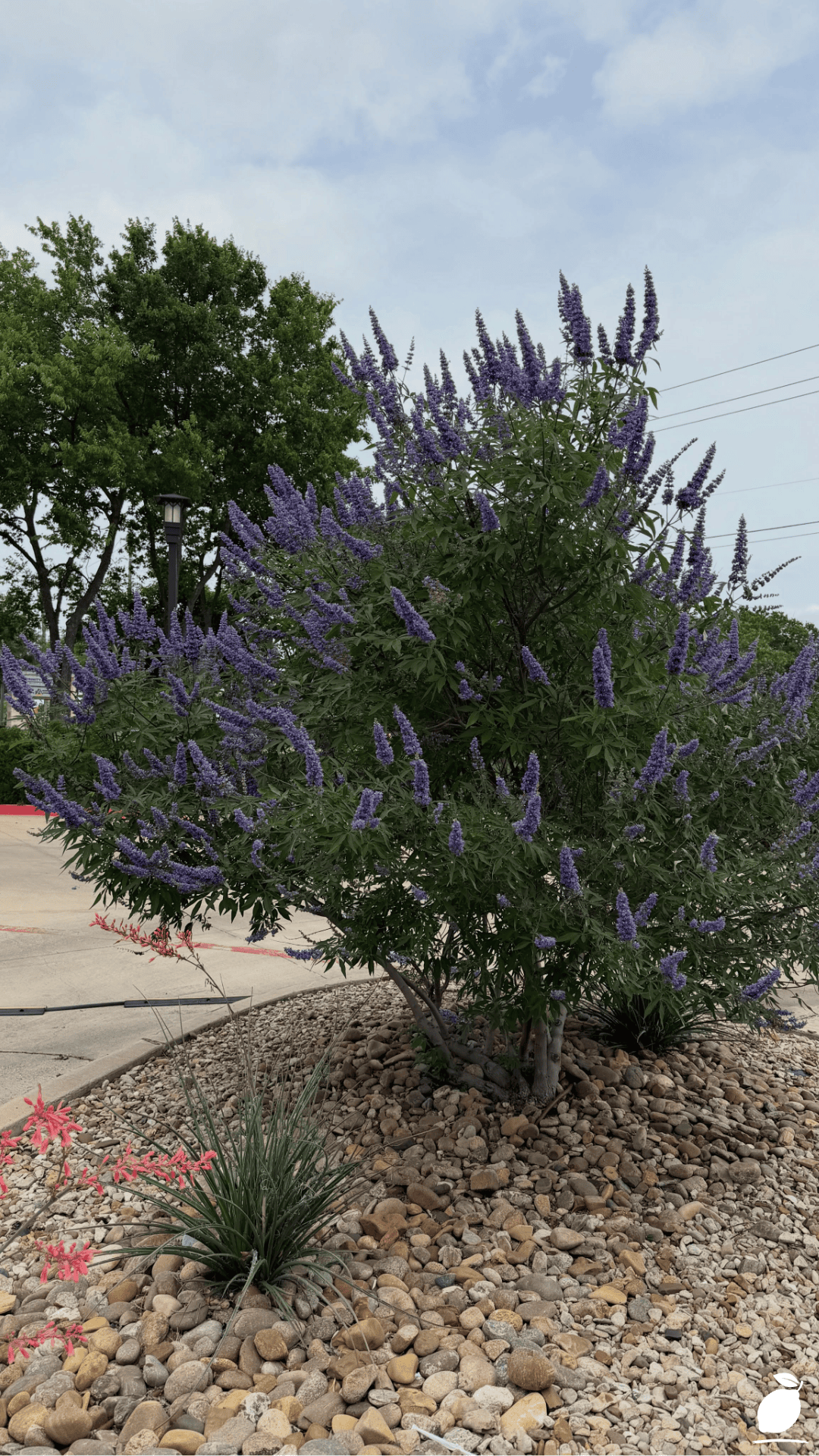
The image above is what a garden designed for the actual climate looks like. A lush green shrub covered in vibrant purple blooms grows from a bed of multicolored pebbles, unbothered by the warm, exposed conditions of a roadside planting where there is no irrigation, no irrigation timer, no person coming home at six o’clock with a hose. Smaller succulents at its base share the same pebble mulch. The road with its red curb behind the planting marks this as a fully exposed, no-supplemental-water environment. The shrub is flowering abundantly in these conditions not because of special treatment but because of good plant selection; a drought tolerant shrub in the right climate needs no management to deliver its best performance. It simply grows.
Drought tolerant shrubs are the most significant paradigm shift available to warm-climate gardeners in 2026, and the shift is overdue. Water restrictions are tightening across warm-climate regions from southern Europe to California to Australia’s urban corridors. The science of plant adaptation- selecting species that have evolved in water-scarce environments and bring that resilience to the garden has never been more accessible or more practically urgent. This guide covers the best drought tolerant shrubs for warm climates, chosen for their ability to perform beautifully in exactly the conditions the featured image shows: heat, limited water, exposed positions, and the specific demand of looking genuinely ornamental rather than merely surviving.
The Drought Tolerant Shrubs Guide
Lavender (Lavandula species)
Why it works: Lavender is the quintessential drought tolerant shrub; the purple-flowering candidate most consistent with the featured image’s abundant bloom and its combination of ornamental quality, aromatic foliage, and extraordinary heat and drought resilience makes it the most widely planted and most reliable warm-climate choice in this category. Lavandula angustifolia and its cultivars perform well in most temperate warm climates; Lavandula stoechas (French lavender, with its butterfly-wing bracts) extends the performance range into Mediterranean and sub-tropical conditions where other lavenders may struggle. A full-sun position in free-draining soil is the only requirement lavender insists on; it will rot in waterlogged conditions far more readily than it will suffer from drought. Plant in a pebble mulch exactly as in the featured image for maximum drainage and minimum maintenance.
Rosemary (Salvia rosmarinus, formerly Rosmarinus officinalis)
Why it works: Rosemary is simultaneously one of the best drought tolerant shrubs available and one of the most practically useful; its aromatic leaves are a culinary herb of the first order, its pale blue flowers attract bees from late winter through spring, and its evergreen silver-green foliage provides year-round structure in a warm-climate garden bed. Like lavender, it requires exceptional drainage and resents waterlogged soil far more than it resents drought. Upright varieties ‘Miss Jessopp’s Upright’ and ‘Tuscan Blue’ work as statement shrubs in a pebble or gravel garden. Prostrate varieties trail beautifully over walls, raised bed edges, and sloped sites. In a pebble mulch planting of the type shown in the featured image, rosemary and lavender planted in the same bed create a coherent aromatic planting with complementary silver-green foliage tones and sequential flowering periods.
Agave
Why it works: Agave is the architectural cornerstone of any serious warm-climate drought tolerant shrub planting, not a shrub in the conventional sense, but a structural succulent that performs the design function of a large-scale evergreen shrub in dry-garden contexts with an authority that no conventional shrub can match. Its rosette of thick, fleshy leaves, typically blue-green or grey-green, often with contrasting leaf margins in yellow or white, creates an unmistakable focal point that requires zero water input once established and zero maintenance beyond the occasional removal of dead lower leaves. Agave americana, the most widely planted species, creates a dramatic statement plant that can reach 2 metres in diameter at maturity. Smaller species Agave attenuata (soft agave, spineless leaves), Agave parryi (compact, steel-blue) are more manageable in smaller planting schemes.
Cistus (Rock Rose)
Why it works: Cistus is the drought tolerant shrub that most consistently surprises first-time growers with the abundance and beauty of its flowering display given how little it asks in return. Its paper-thin flowers in white, pink, magenta, and the spotted-blotched varieties with a dark basal mark on each petal are individually short-lived (lasting a single day) but produced in such continuous succession through late spring and early summer that the display appears constant for weeks. Cistus is native to the dry Mediterranean scrublands and is physiologically adapted to the precise conditions of the featured image: summer heat, perfect drainage, full sun, and the near-total absence of supplemental water. It is evergreen, provides aromatic foliage with a distinctive warm, resinous scent, and grows to a height of 60cm to 1.5 metres depending on the cultivar, making it one of the most versatile drought tolerant shrubs for mid-range planting positions in a warm-climate garden.
Bougainvillea
Why it works: Bougainvillea is the drought tolerant shrub for warm-climate gardeners who want maximum visual impact with minimum water input, and it delivers on this promise more dramatically than any other species in its category. The vibrant papery bracts, technically modified leaves rather than flowers, in cerise, orange, white, yellow, and bicolor combinations create a display of almost aggressive abundance that makes the shrub one of the most immediately recognizable plants in warm-climate horticulture. Bougainvillea performs best in full sun, in well-drained soil, and critically when subjected to genuine water stress between irrigations during the growing season. Overwatering bougainvillea produces lush green foliage at the expense of the bract display; drought stress triggers the flowering response that makes it extraordinary. Plant in a position with excellent drainage, water deeply but infrequently, and allow the soil to dry completely between watering events.
Callistemon (Bottlebrush)
Why it works: The bottlebrush is the drought tolerant shrub that most dramatically demonstrates how heat and aridity, rather than diminishing a plant’s performance, can amplify it. Its cylindrical flower spikes covered in dozens of fine, brightly colored stamens in red, crimson, pink, or cream are produced most abundantly in full sun and on the lean, dry soils that approximate its native Australian conditions. Beyond its ornamental value, callistemon is one of the most significant wildlife plants available in warm-climate gardens: its flowers are a primary nectar source for honeyeaters and lorikeets in Australia and for bees and hummingbirds in warm-climate garden contexts elsewhere. It establishes quickly, tolerates coastal wind and salt spray, and maintains its performance through the extended dry periods that warm-climate summers routinely produce.
Oleander (Nerium oleander)
Why it works: Oleander is the hardworking backbone of warm-climate drought tolerant shrub planting not the most sophisticated choice, but one of the most reliable and the most adaptable to challenging sites. It thrives in roadside plantings, in reflected heat from walls and paving, in coastal salt exposure, and in the kind of extended summer drought that defeats most conventional shrubs, producing its clusters of pink, white, red, or yellow flowers consistently through the warmest and driest months of the year. In the featured image’s roadside planting context, oleander would be the obvious companion to the purple-flowering shrub sharing the same low-water requirement, the same heat tolerance, and the same ability to look genuinely ornamental in an environment that provides no supplemental care. Note: Oleander is toxic if ingested; all parts of the plant should not be planted in gardens frequented by young children or pets.
Penstemon
Why it works: Penstemon is the drought tolerant shrub that brings hummingbird-attracting tubular flowers, exceptional color range, and genuine elegance to a warm-climate planting scheme that may otherwise trend toward the structural and foliage-focused. Its upright flower spikes in red, pink, purple, lavender, and white rise above neat mounds of narrow foliage from late spring through midsummer, providing a flowering display of extraordinary color intensity in positions with full sun and free-draining soil where drought tolerant shrubs perform best. Several penstemon species are native to the arid western regions of North America, giving them the physiological drought tolerance that garden-bred cultivars sometimes lack; Penstemon strictus, Penstemon pinifolius, and Penstemon barbatus are among the most reliably drought tolerant in cultivation.
Teucrium (Germander)
Why it works: Teucrium fruticans (shrubby germander) is the drought tolerant shrub most frequently encountered in Mediterranean-style gardens and least known outside that design context, which is a genuine oversight given its combination of attractive silver-grey foliage, small lavender-blue flowers produced over an extended season, complete drought tolerance in established plants, and the ability to be clipped into formal shapes or left to develop its natural soft-arching habit. It is evergreen, aromatic, completely unfazed by heat reflection from walls and paving, and productive of foliage that works as a silver foil against which the purple and pink flowering shrubs typical of drought-tolerant planting schemes read at their most vivid.
Expert Secrets for Success
Pro-Tips for Better Results
Use pebble or gravel mulch instead of organic mulch. Drought tolerant shrubs in warm climates perform best when mulched with pebbles, gravel, or crushed rock rather than bark or compost. Pebble mulch prevents moisture loss from soil evaporation exactly as organic mulch does, but it also provides the perfect drainage layer at the soil surface that prevents the collar rot that kills drought tolerant shrubs, particularly lavender, rosemary, and cistus in humid conditions after rain. The featured image demonstrates this approach precisely: the pebble mulch beneath the shrub is not decorative alone but functionally essential to the plant’s performance.
Establish drought tolerant shrubs with generous water, then withdraw it. The common misconception about drought tolerant shrubs is that they should be watered minimally from the point of planting. In reality, drought tolerance is a characteristic of established plants with deep, extensive root systems that have had time to explore the soil profile below the surface dry zone. Water all drought tolerant shrubs generously for their first two growing seasons to establish this root depth; then progressively reduce irrigation frequency to allow the plants to demonstrate their natural drought resilience. The transition to minimal irrigation should be gradual, not abrupt.
Plant in autumn in warm climates, not spring. In warm climates where summer heat is extreme, spring planting subjects newly established drought tolerant shrubs to the immediate heat stress of their first summer before their root systems are established, a combination that tests even the most resilient species. Autumn planting gives drought tolerant shrubs an entire cool season of root development before they face their first warm summer, producing plants that are measurably larger, healthier, and more genuinely drought-resilient by the following August than equivalent spring-planted specimens.
Common Mistakes to Avoid
Don’t plant drought tolerant shrubs in clay or poorly draining soil without amendment. Most drought tolerant shrubs are not simply drought tolerant they are adapted to the free-draining soils of their native environments and will rot at the root when planted in waterlogged clay, particularly through winter rainfall events that saturate heavy soils for extended periods. Amend clay soil with horticultural grit, coarse sand, or pumice before planting, or install drought tolerant shrubs in raised beds where drainage is controlled. Lavender and cistus are particularly susceptible to root rot in poorly draining soils; agave and bougainvillea are somewhat more tolerant.
Don’t fertilize drought tolerant shrubs with high-nitrogen products. Nitrogen encourages the lush, soft, water-demanding growth that drought tolerant shrubs have evolved to avoid. A high-nitrogen fertilizer applied to lavender, rosemary, or cistus produces rapid soft growth that is more susceptible to heat stress, drought, and fungal disease than the compact, hard growth that characterizes these species when grown in the lean conditions they prefer. If fertilizing at all, use a low-nitrogen, high-potassium formula in small quantities; most established drought tolerant shrubs in appropriate soils require no supplemental feeding once established.
Don’t prune drought tolerant shrubs into old wood. Lavender, rosemary, and most other drought tolerant shrubs of the Mediterranean-type will not regenerate from old wood that has no foliage. Hard pruning back into the woody base of these shrubs, the instinct when they become leggy, typically kills them. Prune annually immediately after flowering, removing up to one-third of the current year’s growth but never cutting below the lowest level of existing foliage. This timing and depth of pruning keep the shrub compact and productive; pruning below the foliage line does not.
Why Drought Tolerant Shrubs Matter
The choice to grow drought tolerant shrubs is not just a gardening decision; it is an alignment of the garden’s requirements with the reality of the climate it exists in, and that alignment has a quality of relief to it that goes beyond the practical. A garden full of plants that constantly need more water than the environment naturally provides is a garden in continuous low-grade crisis, and managing that crisis the watering, the monitoring, the wilting and recovery cycle generates a persistent background anxiety that drains the pleasure from what is supposed to be a restorative activity. Replacing water-hungry plantings with drought tolerant shrubs removes that anxiety at its source, producing a garden that gives rather than demands.
Research in environmental psychology consistently identifies access to low-maintenance natural environments as a more reliably restorative experience than access to high-maintenance ones. The effortful engagement of intensive garden maintenance, while physically beneficial, does not produce the same quality of psychological restoration as the passive, receptive engagement of sitting in a garden that simply looks after itself. A drought tolerant shrub planting that blooms abundantly in summer without irrigation is a garden that restores rather than depletes, and the family that spends time in it on a warm summer evening is spending that time in genuine rest rather than noticing what still needs to be done.
Easy Peasy Life Matters is built on the conviction that a home and garden should support the people living in them rather than adding to their management load. Drought tolerant shrubs are one of the most direct expressions of this principle available in the garden: plants that work with the climate, that provide beauty without demanding resources, and that make the warm-climate garden the easy, pleasurable, genuinely restorative space it should always have been. The shrub in the featured image is in full purple bloom without anyone standing beside it with a hose. That is the garden you deserve.
Frequently Asked Questions
How long do drought tolerant shrubs take to establish?
Most drought tolerant shrubs reach functional drought independence, the point at which they can survive on natural rainfall alone without supplemental irrigation in a warm climate, after two full growing seasons from planting. During this establishment period, regular deep watering is essential to develop the deep root system that gives established drought tolerant shrubs their resilience. After the second full season, irrigation can be progressively reduced to observe how the plants respond, increasing drought tolerance gradually rather than withdrawing water abruptly.
What is the most colorful drought tolerant shrub for a warm climate?
Bougainvillea produces the most dramatically colorful display of any drought tolerant shrub in warm climates; its cerise, orange, and magenta bracts create an almost theatrical abundance of color in full sun. For cooler climates where bougainvillea isn’t reliably hardy, lavender and cistus provide the most consistent flower color through the warm season. Callistemon in red-flowered forms provides a different but equally vivid color register in full sun positions. A combination of lavender for purple-blue tones, cistus for white and pink, and callistemon for red creates a drought tolerant shrub planting with a full warm-climate color spectrum.
Can drought tolerant shrubs grow in pots?
Yes, many drought-tolerant shrubs perform well in containers, provided the container has excellent drainage holes and is filled with a free-draining growing medium (standard peat-free compost mixed 1:1 with horticultural grit). Lavender, rosemary, agave, and penstemon are all reliable container choices. Container-grown drought-tolerant shrubs require more frequent watering than in-ground specimens during the establishment phase because container soil dries more rapidly than garden soil, but once established, they can be maintained on minimal irrigation schedules significantly more easily than water-hungry alternatives.
Do drought-tolerant shrubs survive frost?
Frost hardiness varies significantly across the drought-tolerant shrubs category. Lavender, rosemary, and cistus tolerate moderate frost (to approximately -10°C for established plants). Agave species vary widely; Agave americana tolerates light frost, while some compact species tolerate harder conditions. Bougainvillea and oleander are frost-tender and require protection below 0°C or indoor overwintering in climates with cold winters. Always check the specific frost hardiness rating of individual cultivars within each species; there are often cultivar-level differences in cold tolerance that can determine survival in marginal climates.