The small bedroom problem rarely announces itself all at once. It starts with a vague dissatisfaction with the room that functions perfectly well but never quite feels like the retreat it’s supposed to be. The ceiling feels lower than it is. The walls seem to close in on grey winter mornings. The furniture that looked proportional in the showroom now dominates the space in a way that feels permanent and slightly oppressive. You rearrange. You declutter. You buy new bedding. The room improves marginally and then settles back into that same flat, uninspired quality that makes you close the door rather than linger. And then, eventually, you start wondering whether the problem was there all along, painted onto the walls in a color that was always working against you.

Paint colors for small bedrooms are genuinely different from paint decisions in larger spaces, and understanding why is what separates a small bedroom that feels tight from one that feels considered and calm. Color affects the perception of space through two primary mechanisms: light reflectance how much illumination a wall bounces back into the room, and psychological temperature, which is the inherent sense of advance or recession that warm and cool tones create in the brain’s spatial processing. A small bedroom painted in the wrong color doesn’t just look smaller. It feels smaller, which is an entirely different problem and a significantly more uncomfortable one to live with every day.
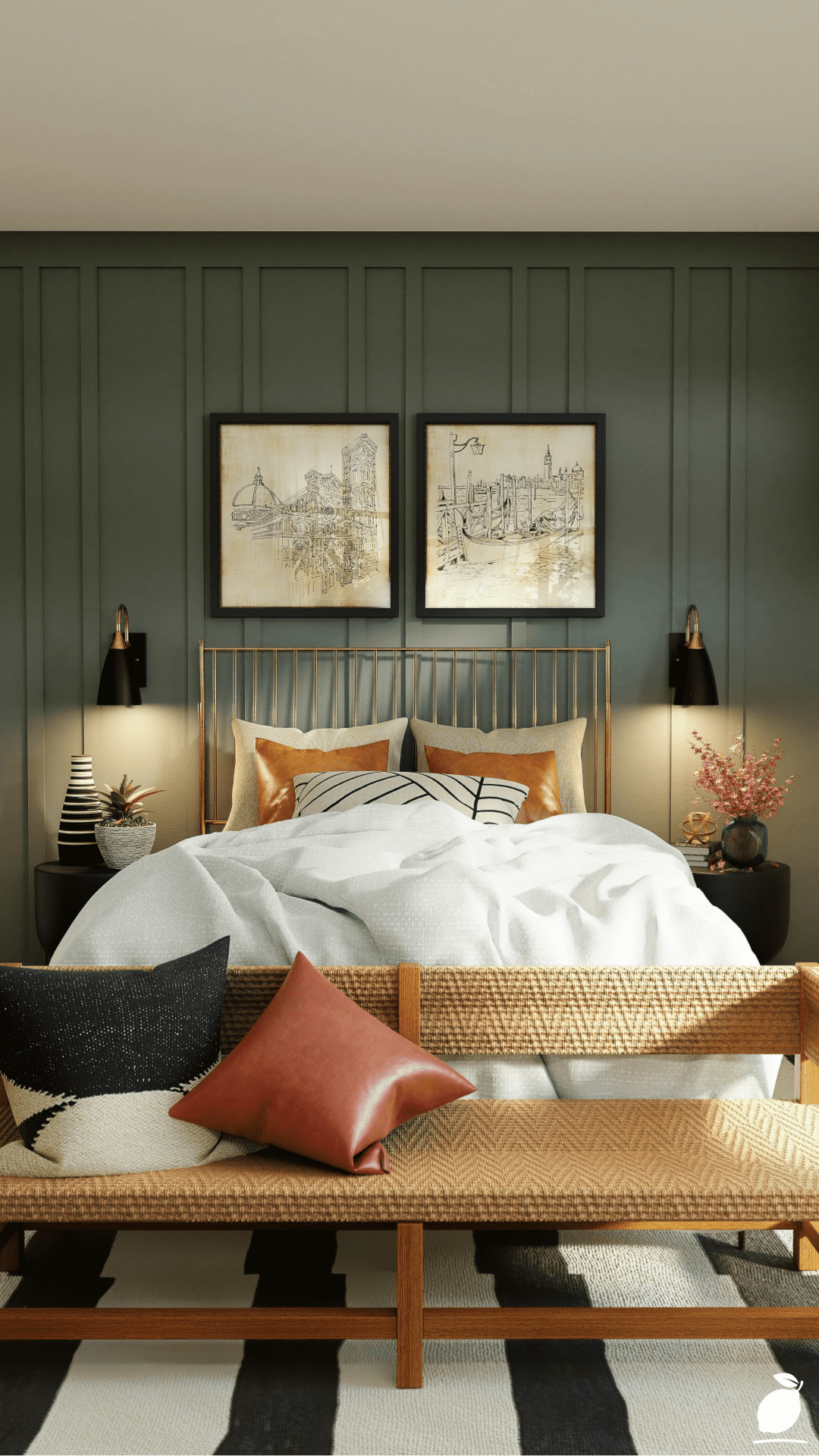
The bedroom in the image above is a masterclass in using paint colors for small bedrooms with intelligence and intention. The sage green accent wall with vertical paneling draws the eye upward and creates a feature that gives the space a sense of depth and deliberate design. The white walls on either side open the room outward. The black, white, and warm wood palette in the striped floor, the framed prints, the woven daybed, and the gold-accented lamps work in complete harmony with the sage backdrop to create a room that feels significantly more spacious, layered, and personal than its footprint suggests. This guide gives you the framework to achieve the same result in your own small bedroom, starting with the most powerful single decision in the room: the paint.
The Paint Colors Blueprint
Step 1: Understand How Paint Colors Affect Perceived Space
Before selecting a single shade, it’s worth establishing the visual mechanics that paint colors for small bedrooms exploit because once you understand them, every subsequent decision becomes logical rather than intuitive.
Light reflectance value, or LRV, is the percentage of light a paint color reflects into a room. Values range from 0 (pure black, absorbs all light) to 100 (pure white, reflects all light). In small bedrooms, paint colors with an LRV above 50 maintain a sense of openness; those below 50 begin to absorb light and compress the perceived volume of the space. This doesn’t mean small bedrooms must be painted white; the sage green accent wall in our featured image works because it’s a mid-to-high LRV color deployed on a single wall rather than throughout the full room, creating drama without sacrificing the overall brightness.
Warm colors, reds, oranges, yellows, and warm browns, visually advance toward the viewer, making walls feel closer and rooms feel smaller. Cool colors, blues, greens, true purples, and cool greys visually recede, making walls feel farther away, and rooms feel more expansive. This is why paint colors for small bedrooms so frequently favor the cool and soft end of the spectrum. It is not conventional; it is spatial physics.
Vertical elements in paint application, paneling, stripes, or color placed on a single tall wall draw the eye upward and create a sense of increased ceiling height. Horizontal elements, wide stripes, dado rails with contrasting below-dado color make rooms feel wider but lower. Understanding which dimension your small bedroom needs to gain guides whether you emphasize vertical or horizontal effects in your paint color application strategy.
Step 2: Identify Your Bedroom’s Light Conditions
The same paint color reads differently in a north-facing small bedroom than in a south-facing one, and this difference is large enough to turn a perfect shade into a problem shade without any other variable changing. Before shortlisting any paint colors for small bedrooms, spend time observing how your specific room receives light across a full day.
North-facing small bedrooms receive cool, indirect light all day. They need paint colors with warm undertones, soft sage greens with yellow-green bases, greige tones, warm whites, and dusty blush to prevent the room from feeling cold and grey. Avoid cool blues, cool greys, and stark whites in north-facing small bedrooms; their already cool undertones become significantly more pronounced without warm daylight to balance them.
South-facing small bedrooms flood with warm direct light for most of the day. They can handle a wider range of paint colors, cooler soft blues and aquas that would feel clinical in a north-facing room, become fresh and airy in a sun-drenched south-facing small bedroom. Warmer paint colors in south-facing rooms can shift significantly toward yellow or orange by midday; test all warm-toned shortlist shades in the room’s peak afternoon light before committing.
East-facing small bedrooms are warmest in the morning and cool by midday. West-facing rooms are neutral through the day and dramatically warm and golden in the evening. For east-facing rooms, choose paint colors that perform well in both warm and cool light. Mid-range neutral tones and soft greens are the most reliable performers. For west-facing rooms, assess your shortlisted paint colors under both noon daylight and evening lamplight, as the character of a west-facing small bedroom changes more dramatically across the day than any other orientation.
Step 3: Choose Your Paint Color Strategy
Paint colors for small bedrooms work through one of four primary strategies, each producing a distinct spatial effect. Identifying which strategy your bedroom needs before selecting specific shades prevents the common mistake of choosing a beautiful color that uses the wrong strategy for the room’s specific challenges.
The Whole-Room Light Strategy painting all four walls, ceiling, and trim in the same soft, high-LRV color creates an enveloping, immersive effect that visually dissolves the corners and angles of a small bedroom, making it feel like a continuous space rather than a box. Best for small bedrooms that feel choppy or angular. Effective with soft whites, pale sage greens, and warm, very-light-greige tones.
The Accent Wall Strategy painting one wall in a richer, more saturated color while keeping the remaining walls lighter creates depth, drama, and a visual focal point that draws the eye into the room rather than across it. This is the strategy used in the featured image, where the sage green paneled accent wall creates the sense that the room has a back, which paradoxically makes it feel deeper and more spacious. Best for small bedrooms that feel flat or lack character.
The Triadic Strategy using three related tones from the same color family in different values across walls, ceiling, and trim creates a sophisticated, layered effect that adds visual complexity without introducing contrasting colors that can make a small bedroom feel busy. Best for small bedrooms where the goal is a high-design, intentional aesthetic.
The White-Frame Strategy keeps all walls white while adding color through an architectural element (paneling, a built-in, a fireplace wall), maximizing the perception of openness while still giving the room personality and a designed quality. Best for very small bedrooms where any wall color might feel too much, but plain white feels too little.
Step 4: Shortlist Specific Paint Colors for Small Bedrooms
With your strategy selected, narrow to specific paint colors. The following shades consistently perform across the small bedroom use case, organized by the strategy they serve best.
For the Accent Wall Strategy, Farrow & Ball Mizzle (a warm, complex sage green with grey undertones that anchors a room without heaviness), Benjamin Moore Pale Eucalyptus (a fresh, slightly blue-green sage that reads airy in direct light), Sherwin-Williams Filmy Green (a dusty, sophisticated sage with enough grey to keep it from reading mint). For deeper accent walls in small bedrooms with good natural light: Farrow & Ball Calke Green (a rich, dark sage that creates dramatic depth), Benjamin Moore Rainy Afternoon (a complex grey-green with blue undertones for a moody, atmospheric small bedroom).
For the Whole-Room Light Strategy, Benjamin Moore White Dove (OC-17) is the gold standard soft white for small bedrooms: warm enough to prevent coldness, pure enough to maximize light reflectance. Farrow & Ball Strong White is the European equivalent of a complex white with warm grey undertones that adds sophistication while maintaining openness. For a very pale sage whole-room treatment, Sherwin-Williams Sea Salt at 50% dilution creates a barely-there green that reads almost white while adding a breath of color.
For the Triadic Strategy, build around a soft sage center tone: Sherwin-Williams Coastal Plain as the mid-tone wall, Rainwashed for the lighter walls and ceiling, and Artichoke for the deepest accent application. The three shades read as a family while each contributing different energy to different surfaces.
For the White-Frame Strategy, Benjamin Moore Chantilly Lace (OC-65) is the most light-forward white available in the major ranges: a true, clean white with minimal undertone that maximizes brightness in small bedrooms while providing a crisp backdrop for color elements introduced through furniture and textiles.
Step 5: Test Thoroughly Before Committing
No paint decision for a small bedroom should be made from a chip or a screen. The enclosed, lower-volume nature of small bedrooms means paint colors read more intensely on the walls than in any other room type. A mid-tone on a chip becomes a significantly stronger presence on four walls at close range. Buy sample pots of your top two or three paint colors for small bedrooms and paint generous 40 x 40cm swatches on each wall of the room, not just the primary wall, but every wall, including the one behind the door.
Observe the swatches under every light condition the room experiences across at least five days. Include at least one overcast day in the observation period. This is when the true character of paint colors for small bedrooms reveals itself most clearly, stripped of warm or cool direct daylight that can make almost any shade look good. Assess swatches under your bedroom’s specific artificial lighting in the evening, since small bedrooms are typically experienced primarily in low ambient light, and your paint colors need to perform under lamps as well as daylight.
Step 6: Prepare the Room and Apply Correctly
A paint decision executed incorrectly produces a result that doesn’t accurately represent the color, regardless of how well the shade was chosen. For small bedrooms, preparation and application technique matter more than in larger rooms because imperfections are closer and more visible at the distances you inhabit the space.
Fill any holes, cracks, or surface imperfections with fine surface filler and sand smooth before applying primer. Use a tinted primer matched to the direction of your final paint color: a warm-tinted primer under a sage green, a neutral primer under whites, and very pale tones. Apply two full coats of your chosen paint color, allowing complete drying time between coats as specified on the tin. Cut in edges carefully with a small brush before rolling the main wall area. Clean edge lines against the ceiling, floor, and trim are what give a small bedroom a professionally painted quality that transforms the overall finish of the room. For an accent wall with paneling, as in the featured image: install paneling before painting, prime the full paneled wall, including all panel faces and recesses, then paint the full wall in two coats so that the shadow lines within the paneling read as part of the same color rather than a separate element.
Expert Secrets for Success
Pro-Tips for a Better Result
Paint the ceiling the same color as the walls in very small bedrooms. The standard advice to paint ceilings white maximizes a sense of height, but in genuinely small bedrooms where the ceiling is already low, and the walls feel oppressive, painting the ceiling the same color as the walls or one shade lighter in the same tone creates a cocooning, enveloping effect that reads as intentionally designed rather than confined. This technique is used extensively in high-end boutique hotel room design precisely because it transforms a small room from feeling like a box to feeling like a sanctuary.
Use vertical paneling on your accent wall before painting. As demonstrated in the featured image, vertical wall paneling adds architectural interest, draws the eye upward, and makes paint colors for small bedrooms appear richer and more dimensional than flat paint on a plain wall. Standard MDF panel moldings applied in vertical strips and painted the same color as the wall create the panel shadow lines that give the sage green accent wall in the featured image its sophisticated, designed quality at a material cost of under fifty pounds or dollars for a single wall.
Extend the paint color onto the ceiling above the accent wall. Rather than stopping the accent wall color at the ceiling line, extend it approximately 30cm across the ceiling. This technique, borrowed from interior designers who use it to visually raise the perceived ceiling height, tricks the eye into reading the wall as taller than it is and creates a smooth visual transition that makes the accent wall feel like a permanent architectural feature rather than a painted surface.
Coordinate your paint colors with the floor, not just the furnishings. In small bedrooms, the floor occupies a significant portion of the visual field. The black and white striped floor in the featured image was chosen in active relationship to the sage green walls and white side walls. The graphic pattern grounds the room and gives the neutral walls something to contrast against. Whatever your floor material, hold paint chips against it before finalizing your selection, and ensure the relationship between wall color and floor tone reads as harmonious rather than competing.
Common Mistakes to Avoid
Don’t default to white because you’re afraid of color. White is a valid and often excellent choice for paint colors in small bedrooms, but choosing it out of fear rather than intention produces the flat, default result that made you dissatisfied with the room in the first place. If your small bedroom feels clinical, cold, or bland in white, the solution is not a different white. It is selecting a paint color with the intention of a soft sage, a warm greige, or a dusty blush applied through one of the four strategies described in Step 3.
Don’t choose paint colors for small bedrooms in the paint store. Paint chip colors are viewed under fluorescent retail lighting against a white background surrounded by thousands of competing shades, conditions that bear no resemblance to your bedroom. A shade that reads as a perfect soft sage green in the paint store becomes significantly more blue or more grey on your specific walls under your specific light conditions. The sample-pot-on-the-wall test is the only reliable assessment method, and there is no shortcut.
Don’t paint a small bedroom in multiple different wall colors. Using four different paint colors, one per wall in a small bedroom, is one of the fastest ways to make it feel smaller, busier, and more chaotic than any single color would. Paint colors for small bedrooms work through restraint and repetition. One primary wall color, possibly one accent wall in a related or contrasting shade, and a clear trim and ceiling strategy is the correct level of color complexity for a small bedroom. More than that compounds the visual busyness that makes small rooms feel cramped.
Don’t ignore the trim and ceiling in your paint color planning. Trim and ceiling are not neutral background elements; they are active participants in how paint colors for small bedrooms read. Brilliant white trim against a soft sage green makes the green appear richer and more deliberate. Off-white or greige trim against the same sage green softens the contrast and creates a more unified, hazy atmosphere. Decide on your trim and ceiling treatment at the same time as your wall color, not as an afterthought after the walls are painted.
Why Paint Colors Matter
The bedroom is the room where you begin and end every day, and the quality of that experience is the first thing your eyes register each morning. The last visual environment your nervous system processes before sleep has a genuine and measurable effect on psychological well-being. Research in environmental psychology identifies bedroom color environment as a significant predictor of sleep quality, morning mood, and the degree to which the bedroom functions as a restorative space rather than simply a utilitarian one. Paint colors matter in bedrooms in a way they don’t in rooms with more varied activity and social input. The bedroom’s quietness makes its visual environment the dominant stimulus, which means paint colors exert their influence continuously and without competition.
For couples sharing a small bedroom, the paint decision carries additional weight. A room that both people find visually comfortable, that neither triggers the low-grade dissatisfaction that sends someone scrolling through renovation inspiration at midnight, is a room that contributes positively to the quality of the relationship conducted within it. This is not a small thing. The home environment is the context for the most important relationships in a person’s life, and a bedroom that feels right is one small but persistent contribution to those relationships feeling right as well.
Easy Peasy Life Matters exists for the belief that good homes are built from intentional, small decisions, repeated and compounded over time. Choosing the right paint colors for small bedrooms is one of those decisions achievable in a weekend, informed by a clear framework, transformative in its daily impact. The room you want to close the door on becomes the room you want to wake up in. That is what the right paint color does, and it is well within reach.
Frequently Asked Questions
What are the best paint colors for a very small bedroom with no natural light?
For small bedrooms with minimal or no natural light, prioritize paint colors with the highest possible LRV (above 65) and warm undertones that prevent the room from reading cold. Benjamin Moore White Dove, Farrow & Ball Strong White, and Sherwin-Williams Alabaster are all warm-toned high-LRV paint colors that maximize the perception of light in genuinely dark small bedrooms. Supplement paint color strategy with layered artificial lighting, multiple light sources at varying heights rather than a single overhead fixture, and introduce warm reflective surfaces through mirrors, metallic accents, and glossy ceramic accessories that amplify whatever light the room does receive.
Can dark paint colors work in small bedrooms?
Yes, but with specific conditions. Deep paint colors in small bedrooms work when: the room has strong natural light, the dark color is applied to a single accent wall rather than all four, and the remaining walls are kept light to maintain overall brightness. The featured image demonstrates a version of this principle with its rich sage accent wall against white side walls. More dramatic dark applications, navy, deep forest green, charcoal, can create an extraordinary atmosphere in small bedrooms when handled correctly. The condition that makes them work is always the same: enough light in the room to prevent the dark color from absorbing so much illumination that the space feels underground rather than atmospheric.
Should the ceiling in a small bedroom be the same color as the walls?
For most small bedrooms, a ceiling painted in the same color as the walls or one shade lighter in the same tone produces a better result than the standard white ceiling approach. White ceilings create a hard visual boundary that emphasizes the ceiling as a lid over the room, drawing attention to how low it is. A tonal ceiling painted in the wall color or a lighter related shade dissolves this boundary and creates a more immersive, expansive sense of space. Reserve crisp white ceilings for small bedrooms with genuinely high ceilings (above 2.7m) where the contrast between wall color and ceiling reads as architectural rather than confining.
How do I use paint colors to make a small bedroom feel wider?
To increase the perceived width of a small bedroom, apply a slightly lighter or cooler paint color on the two end walls, the ones you see when standing in the doorway, and a slightly warmer or richer tone on the two side walls. This differential treatment makes the end walls appear to recede, and the room feels longer and wider. Horizontal elements at mid-wall height, a painted stripe, a chair rail with contrasting paint colors above and below, or a decorative dado treatment also increase the sense of horizontal dimension. The black and white striped floor in the featured image demonstrates this principle at floor level: its horizontal direction visually stretches the room’s width.
How often should I repaint a small bedroom?
Small bedrooms typically need repainting every four to six years under normal conditions, more frequently in rooms used by children, where walls are subject to regular contact and marking. Signs that paint colors for small bedrooms need refreshing include visible yellowing (particularly in rooms with high UV exposure), chalking or powdering of the paint surface, visible scuffs and marks that cleaning no longer resolves, and the psychological fatigue of a color that no longer feels right. Use a repaint as an opportunity to reassess whether the current paint color is still serving the room well, as light conditions change, as trees grow, adjacent rooms are repainted, and the furnishings that contextualize the wall color evolve over the years of accumulated change.