The farmhouse bathroom has been done so many times in so many homes that it has almost lost the quality that made it worth doing in the first place. Somewhere between the first wave of shiplap installations and the tenth version of the same open-shelf-with-mason-jars arrangement, the aesthetic that was supposed to communicate warmth, history, and the specific ease of a home that does not take itself too seriously became its own kind of formula, a checklist of farmhouse bathroom signals deployed in the same sequence by people who wanted the feeling without the process of actually developing one. You have probably done some version of this yourself. The burlap accents. The word “SOAK” on a wooden sign above the mirror. The black and white tile that looked perfect in the inspiration post and fine, just fine in your actual bathroom. The farmhouse bathroom colors were supposed to make the room feel special. They made it feel like a version of a room you had seen before.
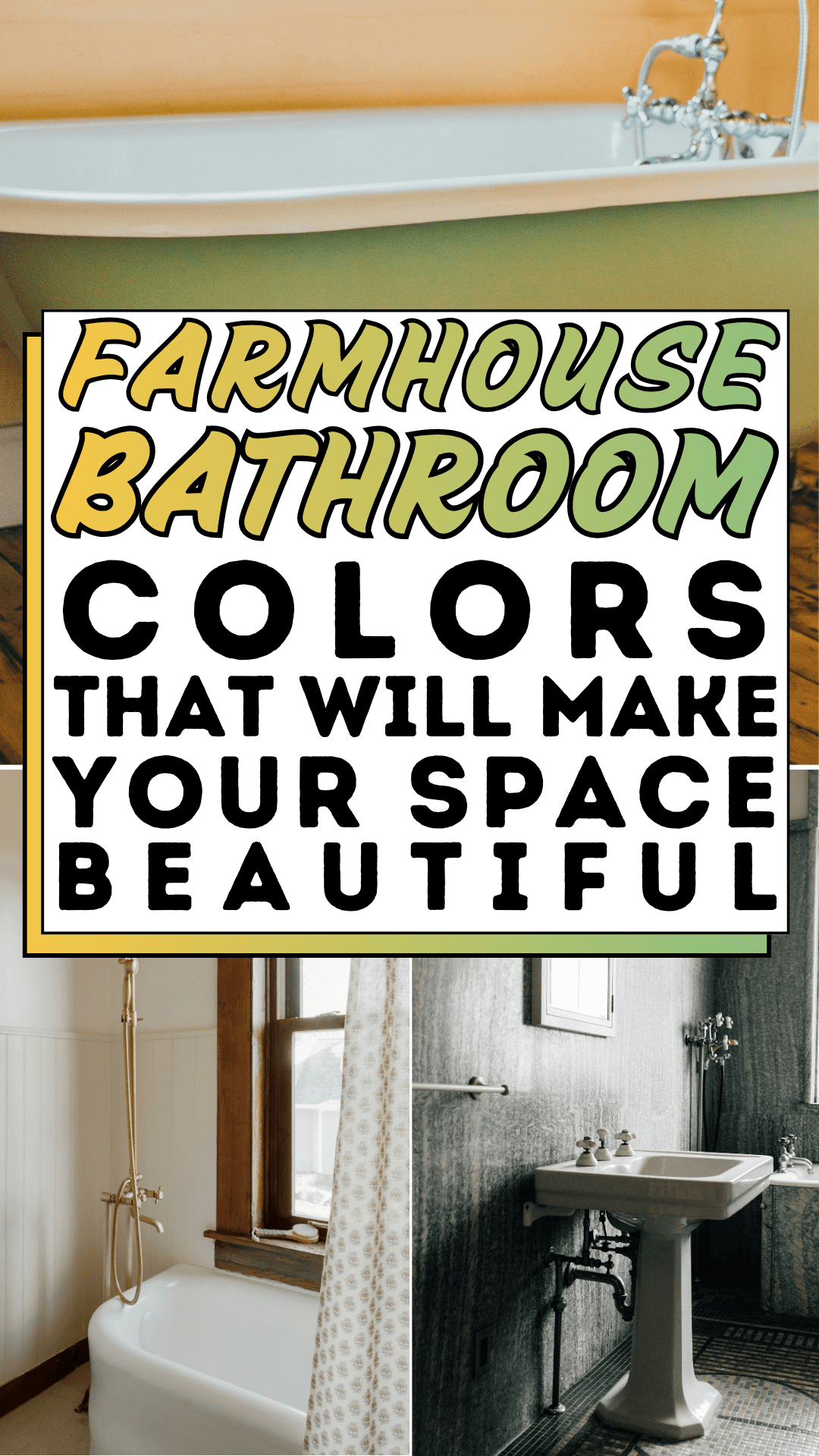
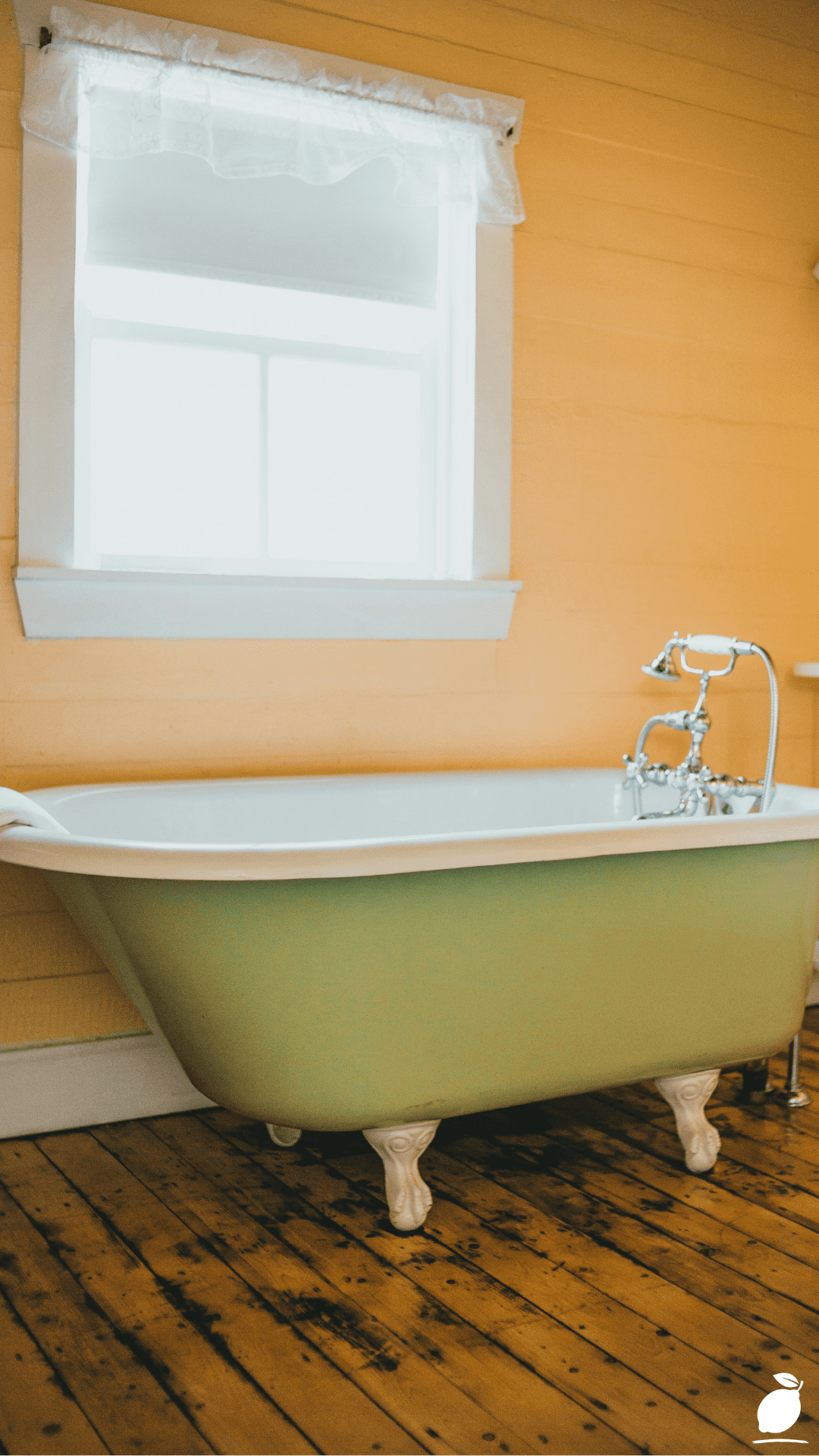
The bathroom in the image above is what a farmhouse bathroom looks like when the colors are allowed to be genuinely expressive rather than generically correct. The sage green clawfoot bathtub is the room’s declaration: not white, not black, not the cautious greige that hedges every risk, sage green, applied to the exterior of a clawfoot tub with the confidence of someone who knows exactly what farmhouse bathroom color they are building toward and why. Against the warm yellow horizontal wood paneling on the walls, the sage green reads as simultaneously earthy and surprising, grounded and alive. The dark, weathered wood floor with its visible grain and knots provides the room’s structural weight. The white interior of the tub, the chrome faucet, the white blinds and sheer curtain at the window, the rolled white towels on the small wall shelf, all of these white elements do what white always does in a farmhouse bathroom color scheme: they create the breathing room that allows the more saturated tones to register as intentional rather than overwhelming. The result is a bathroom that feels genuinely unique because every farmhouse bathroom color in it was chosen to express something rather than to avoid offending anyone.
Farmhouse bathroom colors that make a space beautiful and unique are not the farmhouse bathroom colors that are safest; they are the ones chosen with enough specificity and enough internal logic that the room they create could only have been built by someone who made real decisions. This guide gives you the complete process for choosing farmhouse bathroom colors at that level of specificity: from understanding the palette principles that make farmhouse colors work, to selecting the specific tones that will make your bathroom’s particular light conditions and material character come alive, to executing the color application in a way that holds its quality through daily family use. These farmhouse bathroom color ideas are for the bathroom that has been waiting, behind the formula, to become genuinely its own.
The Farmhouse Bathroom Colors Blueprint
Step 1: Understand the Farmhouse Bathroom Colors Palette Structure
Farmhouse bathroom colors that produce genuinely beautiful and unique results share a structural logic that is worth understanding before any specific color is chosen. The farmhouse bathroom color palette is not a collection of individual color preferences; it is a layered system in which each tone performs a specific role relative to the other tones in the room, and the quality of the finished farmhouse bathroom color scheme depends on each layer performing its role correctly, rather than each color being individually attractive in isolation.
The farmhouse bathroom color system has three layers. The base layer is the primary field color, the tone that covers the largest surface area in the bathroom and establishes the room’s dominant character. In the image, this is the warm yellow of the horizontal wood paneling: a color that provides the room’s overall warmth and vintage quality, against which every other farmhouse bathroom color reads. The accent layer is the personality color, the tone applied to a single significant element that expresses the room’s specific character and distinguishes it from generic farmhouse bathroom treatments. In the image, this is the sage green of the clawfoot tub exterior: a color that could only be present in this specific room because someone made a specific and confident farmhouse bathroom color choice. The neutral layer is the receding field of the whites and near-whites that provide visual rest, reflect light, and allow the base and accent layers to be perceived clearly. In the image, the white tub interior, white window treatment, white towels, and white shelf all perform this function.
Identify which layer each element in your farmhouse bathroom will occupy before choosing any farmhouse bathroom color. The layered assignment determines which colors to test for which surfaces, and prevents the common mistake of choosing farmhouse bathroom colors in isolation, individually beautiful but structurally unrelated, which produces a room without a coherent palette identity.
Step 2: Choose the Farmhouse Bathroom Wall Color as the Room’s Atmospheric Foundation
The wall color is the farmhouse bathroom colors decision with the greatest impact on the room’s overall atmospheric quality, the tone that determines whether the space reads as warm or cool, energized or restful, vintage or contemporary. Farmhouse bathroom colors in the wall category work most successfully when they come from the warm, slightly desaturated end of each color family: the tones that have enough color presence to communicate character but enough restraint to feel like a background that supports the room’s other elements rather than competing with them.
The warm yellow wood paneling in the image is a masterclass in farmhouse bathroom wall color selection: it is yellow enough to register as a deliberate and characterful farmhouse bathroom color choice, sufficiently warm and slightly aged in its saturation to prevent it from reading as a bright primary yellow, and applied to a horizontal board-and-batten surface that gives it dimensional texture the flat application of the same color on drywall could not produce. This combination of warm-spectrum farmhouse bathroom wall color applied to a textured surface is consistently the highest-performing approach for bathroom wall color in the farmhouse palette.
For your own farmhouse bathroom wall color selection, choose from the warm ochre-yellow range (Benjamin Moore’s Hawthorne Yellow HC-4, Farrow & Ball’s Hay No. 37, Sherwin-Williams’ Hopsack SW 6117), the warm sage register (Benjamin Moore’s Saybrook Sage HC-114, Sherwin-Williams’ Rosemary SW 6187), or the warm cream-to-greige range (Farrow & Ball’s String No. 8, Benjamin Moore’s Pale Straw 2154-50) depending on which farmhouse bathroom character direction your specific bathroom’s light and material conditions support best. Test all farmhouse bathroom wall color candidates on foam board and observe them across all lighting conditions, morning natural, midday, afternoon, and artificial evening light, before committing to a full gallon.
Step 3: Select the Farmhouse Bathroom Accent Color for the Room’s Statement Element
The accent farmhouse bathroom color, the personality layer applied to the single most significant design element in the room, is the decision that most distinguishes a beautiful and unique farmhouse bathroom from a formula farmhouse bathroom. Every farmhouse bathroom has a sink, a toilet, a tub or shower, and a vanity. The farmhouse bathrooms that are remembered and returned to in inspiration collections are the ones where one of those elements received an accent farmhouse bathroom color treatment that expressed genuine aesthetic confidence: a sage green clawfoot tub, a navy blue vanity, a terracotta-painted wainscoting accent wall, and a forest green painted ceiling above white walls.
The sage green of the clawfoot tub in the image earns its authority as a farmhouse bathroom accent color through the specific quality of the sage tone chosen: it carries enough yellow-green warmth to relate to the warm yellow paneling on the walls without matching it, enough gray in its composition to prevent it from reading as bright, and enough color presence against the room’s white elements to register as the deliberate, confident farmhouse bathroom color choice it is. The farmhouse bathroom accent color principle: choose a tone that speaks the same warm temperature language as the wall color but occupies a different hue position, and apply it to one single element at the room’s most significant scale.
Candidates for the accent farmhouse bathroom color element include: the exterior of a freestanding clawfoot or soaking tub (as in the image, the highest-impact accent application in a farmhouse bathroom colors project), the vanity or cabinet base, a single accent wall behind the toilet or vanity, the ceiling applied in a contrasting farmhouse bathroom color above white walls, or exterior-painted wainscoting on one wall. Apply the accent farmhouse bathroom color to one element only; its authority depends on its singularity.
Step 4: Apply Farmhouse Bathroom Colors to Surfaces With Appropriate Finish Selection
Farmhouse bathroom colors applied in the wrong finish, a beautiful sage green in a high-gloss formulation on a clawfoot tub exterior, a warm yellow paneling in a flat wall paint that cannot withstand the bathroom’s humidity, will fail within eighteen months, regardless of the farmhouse bathroom color itself being well-chosen. Finish selection for farmhouse bathroom colors is not a secondary consideration; it is the decision that determines whether the color holds its quality over years of daily use.
For wall surfaces in farmhouse bathroom colors projects, use an eggshell or satin finish bathroom-specific paint formulation. Eggshell provides the low-sheen, matte-adjacent quality that most farmhouse bathroom colors require to read as vintage and organic high-gloss wall paint in a farmhouse bathroom color looks industrial rather than handcrafted, and flat wall paint without moisture resistance will show mildew and peeling within a year in a bathroom environment. For wood-paneled wall surfaces like the image’s horizontal boards, apply the farmhouse bathroom wall color in a satin finish to provide adequate moisture resistance at the board joints where humidity infiltration is most likely.
For accent elements like the clawfoot tub exterior, use a durable oil-based enamel or a high-quality water-based enamel specifically formulated for furniture and cabinetry, not standard wall paint, which lacks the hardness and adhesion required for surfaces that receive frequent contact and cleaning. Apply two coats of the farmhouse bathroom accent color enamel over a bonding primer, and allow full cure time, typically 7 to 14 days for oil-based enamel, before the tub re-enters service. The cured farmhouse bathroom color on a properly primed and painted clawfoot tub exterior is durable enough to maintain its quality for five to ten years with normal care.
Step 5: Integrate Farmhouse Bathroom Hardware and Fixture Finishes Into the Color Scheme
Hardware and fixture finishes are the farmhouse bathroom colors’ detail layer, the metallic tones applied to faucets, towel bars, shower fixtures, and cabinet hardware that either complete the palette or introduce a conflicting material note. The chrome vintage-style faucet and shower assembly in the image demonstrates the most important principle of farmhouse bathroom colors and hardware selection: the fixture finish should respond to the room’s warmth without exactly matching any of the primary farmhouse bathroom colors. Chrome reads as appropriately cool and reflective against the warm sage and yellow palette, creating the visual tension that makes the room feel layered rather than monochromatic.
For farmhouse bathroom color palettes in the warm yellow, sage, and terracotta range, the most common authentic farmhouse bathroom color directions are the most compatible hardware finishes, which are brushed brass, unlacquered brass (which develops natural patina), aged bronze, and chrome. Matte black works in farmhouse bathroom color schemes that include at least one dark grounding element, such as a dark wood floor, a deep-toned accent wall, but it reads as too graphic and contemporary against purely warm farmhouse bathroom colors without those grounding elements.
Apply the chosen hardware finish consistently across every metal element visible in the farmhouse bathroom: faucet, shower assembly, towel bar, toilet paper holder, door hardware, and any wall-mounted accessories. Consistent finish in the farmhouse bathroom colors context is the detail most responsible for whether the room reads as designed or assembled, and it is among the most cost-effective improvements available in a farmhouse bathroom colors refresh that does not involve tile or fixture replacement.
Step 6: Complete the Farmhouse Bathroom Colors Scheme With Textiles and Natural Materials
The final farmhouse bathroom colors layer the textiles and natural materials that complete the palette and make the room feel lived-in rather than photographed is where the white neutral layer from Step 1 is deployed in practice. The white towel draped over the tub rim, the rolled white towels on the wall shelf, and the sheer white curtain with ruffled valance in the image all perform the neutral receding function that keeps the farmhouse bathroom color palette from becoming visually dense while simultaneously adding the organic, soft, slightly imperfect quality that distinguishes farmhouse bathroom aesthetics from more formal or contemporary bathroom design.
For the textile layer of a farmhouse bathroom colors project, choose waffle-weave, stonewashed linen, or natural cotton towels in white or off-white for the primary towel layer; their texture provides visual interest within the neutral register without introducing a competing color. Layer a secondary textile in a tone that bridges the wall color and the accent color: a soft sage linen hand towel in the image’s palette, or a warm ochre waffle-weave throw across the tub rim, would add a connected textile color note that reinforces the farmhouse bathroom colors scheme at a small scale. Natural materials, such as a rattan side table, a wooden shelf with visible grain, and a jute bath mat, provide the organic material texture that farmhouse bathroom colors require as their physical counterpart.
Expert Secrets for Success
Pro-Tips for a Better Result
Paint the clawfoot tub exterior in a farmhouse bathroom accent color using a foam roller rather than a brush. Brush application on the curved exterior surface of a clawfoot tub produces visible stroke marks that are especially apparent in low-sheen or matte farmhouse bathroom colors. A foam roller with a 6-inch nap produces a smooth, consistent application across curved surfaces and eliminates the stroke marks that make DIY tub painting look amateur at close range. Apply in thin, even coats. Three thin coats of farmhouse bathroom color enamel produce a better result than two heavy ones and allow full dry time between coats.
Test farmhouse bathroom wall colors against the natural light from the window at three times of day. The warm yellow paneling in the image reads as warm and honeyed in the soft natural light from the large window, a quality that depends on the specific relationship between the paint tone and the light source’s color temperature. Farmhouse bathroom colors that read as warm and vintage in southern or western light read as cool and flat in northern or eastern light. Test every farmhouse bathroom wall color candidate at morning, midday, and late afternoon natural light before committing, and note any significant shifts in the color’s apparent warmth or hue across those lighting conditions.
Use horizontal board orientation for wall paneling in farmhouse bathrooms with standard ceiling heights. The horizontal boards in the image contribute to the bathroom’s vintage, cabin-like farmhouse quality and simultaneously make the room feel wider than its actual dimensions. Vertical board paneling draws the eye upward, appropriate for very tall ceilings, but in standard 240cm to 260cm ceiling-height bathrooms, horizontal boards create a more authentic farmhouse bathroom character and a more spatially generous feeling. The board width matters: wider boards (15cm to 20cm) read as more rustic and more farmhouse-appropriate than narrow boards (5cm to 8cm), which read as more contemporary shiplap than vintage farmhouse paneling.
Apply a second color to the interior of built-in cabinetry or shelving for farmhouse bathroom color depth. The visible interior of open wall shelves in a farmhouse bathroom colors project the back panel behind rolled towels or displayed objects, which is an opportunity to introduce a second farmhouse bathroom color accent at a small scale without any significant additional commitment. Painting the shelf back panel in the room’s accent farmhouse bathroom color, or in a slightly deeper tone of the wall color, creates a layered depth effect that makes open shelves read as a designed element rather than a storage solution. The farmhouse bathroom colors depth this creates is visible at the scale of the rolled towels on the shelf in the image.
Common Mistakes to Avoid
Don’t apply farmhouse bathroom colors over bare or unprimed wood paneling. Wood paneling in a bathroom environment requires bonding primer before any farmhouse bathroom color topcoat is applied, both to ensure the paint adhesion that prevents peeling in high-humidity conditions and to seal the wood’s natural tannins, which bleed through water-based paint and produce a brown discoloration that shows through the farmhouse bathroom color topcoat within weeks of application. Apply one coat of shellac-based primer or high-adhesion oil-based primer to all wood surfaces before any farmhouse bathroom color topcoat, including the backs of panels, all edges, and any end-grain surfaces. This step is invisible in the finished result and is the most important preparation step in the entire farmhouse bathroom colors project.
Don’t choose farmhouse bathroom colors from a digital screen without ordering physical samples. The warm yellow of the image’s wall paneling and the sage green of the tub exterior look the way they do because they are real pigments in real light, a quality that digital color representation cannot accurately replicate. Farmhouse bathroom colors chosen from a phone screen or laptop display and applied directly to the bathroom wall without physical sample testing almost always produce a color that differs from the digital preview in warmth, saturation, or undertone in ways that are only apparent once the color is on the wall in full application. Order physical sample pots of every farmhouse bathroom color candidate and apply them to the actual surfaces before committing.
Don’t skip the clawfoot tub’s primer step to save time. Primer adhesion on the exterior of a cast iron or acrylic clawfoot tub is the single step most often omitted in DIY farmhouse bathroom color tub-painting projects, and its omission is the single most common cause of farmhouse bathroom accent color failure on tub exteriors, typically presenting as peeling or chipping within six to twelve months of application. Use a bonding primer specifically formulated for metal (cast iron tubs) or plastic (acrylic tubs), apply one full coat, allow to cure completely, and sand lightly with 220-grit before applying the farmhouse bathroom accent color topcoat. The primer step adds two hours to the project and adds years to the farmhouse bathroom color result.
Don’t repeat the accent farmhouse bathroom color in multiple elements at multiple scales. The sage green of the clawfoot tub in the image is powerful precisely because it appears nowhere else in the bathroom, not in the towels, not in the wall color, not in a decorative object on the shelf. A sage green tub paired with a sage green hand towel, sage green paint on the shelf interior, and a sage green soap dispenser produces a color-story repetition that reads as thematic decoration rather than an expressive farmhouse bathroom accent color choice. The accent farmhouse bathroom color earns its authority from singularity. Apply it to one element, at one significant scale, and let the neutrals and the base wall color do the rest of the palette’s work.
Why Farmhouse Bathroom Colors Matter
The bathroom is a daily ritual space, the room where the body is attended to, where the day’s first and last private moments happen, and where the quality of the environment has a direct and measurable effect on the quality of those moments. Farmhouse bathroom colors that are beautiful and unique do something that generic or default bathroom colors cannot: they create an environment that rewards daily presence in it. A bathroom where the sage green tub and the warm yellow paneling and the white light from the window create a specific, considered atmosphere is a bathroom that a person enters and pauses in not long, but long enough to register that this room was made with care for the person who uses it. That registration, repeated daily across years, compounds into something significant: a home that feels genuinely personal, and a daily routine that feels supported by its environment rather than indifferent to it.
Farmhouse bathroom colors matter in the broader context of family well-being because bathrooms are among the most shared and most frequently occupied rooms in a family home. The quality of a shared bathroom’s color environment affects every family member who uses it, multiple times each day, in the moments of transition between sleep and waking, between home and work, between the private self and the social one. Research in environmental color psychology has consistently documented the relationship between warm, naturally derived color environments, the ochres, sages, and cream tones of the farmhouse bathroom palette, and reduced physiological stress responses. The farmhouse bathroom colors that make a space beautiful and unique are not merely aesthetic choices. They are environmental investments in the daily quality of every person who moves through the space they create.
Easy Peasy Life Matters is built on the conviction that the most meaningful home improvements are the ones made with the intention of creating a daily experience rather than a monthly photograph. The farmhouse bathroom colors in the image above, the sage green tub against the warm yellow wall, the dark weathered floor, and the white light from the curtained window create a daily experience of such specific quality that you would not mistake this bathroom for any other bathroom anywhere. That specificity is what makes farmhouse bathroom colors beautiful. That dailiness is what makes them matter. This guide gives you the path from a bathroom that is fine to one that is genuinely, unmistakably yours.
Frequently Asked Questions
What are the best farmhouse bathroom colors for a small bathroom?
The most effective farmhouse bathroom colors for small bathrooms combine a warm, light-value base color, such as warm cream, pale yellow, or soft sage, with white on all trim, fixtures, and ceiling surfaces to maximize light reflectance and perceived space. The layered farmhouse bathroom colors approach described in this guide works in any bathroom size, but small bathrooms benefit specifically from keeping the base layer in a lighter value (avoiding deep darks on all four walls) while concentrating the accent farmhouse bathroom color on a single element, the tub exterior, the vanity, or an accent wall, rather than distributing it across multiple surfaces. Warm-toned floor materials in lighter values, aged blonde wood, and cream-toned tile amplify the perceived floor area.
How do I paint a clawfoot tub in a farmhouse bathroom accent color?
The clawfoot tub exterior painting process for farmhouse bathroom colors requires four steps: thorough cleaning with a degreasing cleaner and isopropyl alcohol wipe-down to remove all residue; sanding with 220-grit sandpaper to create mechanical adhesion for the primer; application of one coat of bonding primer appropriate to the tub material (oil-based bonding primer for cast iron, plastic-adhesion primer for acrylic); and two to three thin coats of durable oil-based or water-based enamel in the chosen farmhouse bathroom accent color, applied with a foam roller for smooth coverage. Allow full cure time before filling with water, typically 7 to 14 days for oil-based enamel.
Can farmhouse bathroom colors work in a modern or contemporary home?
Yes, farmhouse bathroom colors translate successfully into modern and contemporary homes when the warm, organic tones of the farmhouse palette are applied with clean lines and minimal surface ornamentation. A sage green vanity against white walls and large-format gray tile, or warm yellow walls behind a freestanding tub with minimalist chrome fixtures, each brings farmhouse bathroom color warmth into a contemporary spatial language without requiring any decorative farmhouse elements. The key is separating the farmhouse palette from the farmhouse theme: the colors are transferable, the decorative iconography is not.
What floor material works best with warm farmhouse bathroom colors?
The dark weathered wood floor in the image is the single most effective grounding material for warm farmhouse bathroom colors because its deep brown tone anchors the room’s lighter wall and fixture colors, and its visible grain and knots communicate the material honesty and age that farmhouse bathroom colors require as their physical context. For bathrooms where real wood flooring is not practical due to moisture exposure, wood-look porcelain tile in warm brown and gray tones provides equivalent visual grounding at greater moisture resistance. For farmhouse bathroom colors in the lighter, more cottage-adjacent range, pale yellow, soft sage, cream, a warm terracotta tile, or a cream-and-blue encaustic pattern floor provides the visual contrast and pattern complexity that the farmhouse bathroom palette needs at the floor level.
How often should I repaint farmhouse bathroom colors to keep them looking fresh?
Farmhouse bathroom colors applied in a properly primed and finish-appropriate paint formulation typically maintain their quality for five to seven years in a regularly used family bathroom before repainting is needed. The most common early-failure conditions are peeling at the bottom edges of paneling (moisture infiltration at unprimed end grain or unsealed joints), yellowing of warm-toned farmhouse bathroom colors under certain artificial light sources (addressable by switching to warm-temperature LED bulbs), and fading at the most light-exposed surfaces (addressable by using a light-fast pigment formulation in the farmhouse bathroom color selection). Annual inspection of all painted surfaces for early moisture damage, bubbling, peeling at seams, and darkening at joints allows minor repairs before they become full repainting requirements.