My living room had everything it needed and nothing it wanted. A sofa I had chosen carefully and a rug I had agonized over, and a coffee table that had required three returns before I committed to it, all of them technically correct choices, sitting in a room that felt, despite the effort, like a showroom floor rather than a place anyone actually lived. Guests sat on the sofa and were comfortable. They did not linger. They did not settle in with the ease of people who feel held by a room rather than placed in it. I kept rearranging things, adding a throw here, removing an accessory there, trying to locate the specific adjustment that would tip the farmhouse living room from arranged to welcoming. The problem I could not name for a long time was that I was adjusting pieces when I should have been adjusting the concept that a welcoming farmhouse living room is not a collection of good individual choices but a room where those choices share a governing warmth, a coherent palette, and a layered approach to comfort that operates at every scale from architecture to accessory.
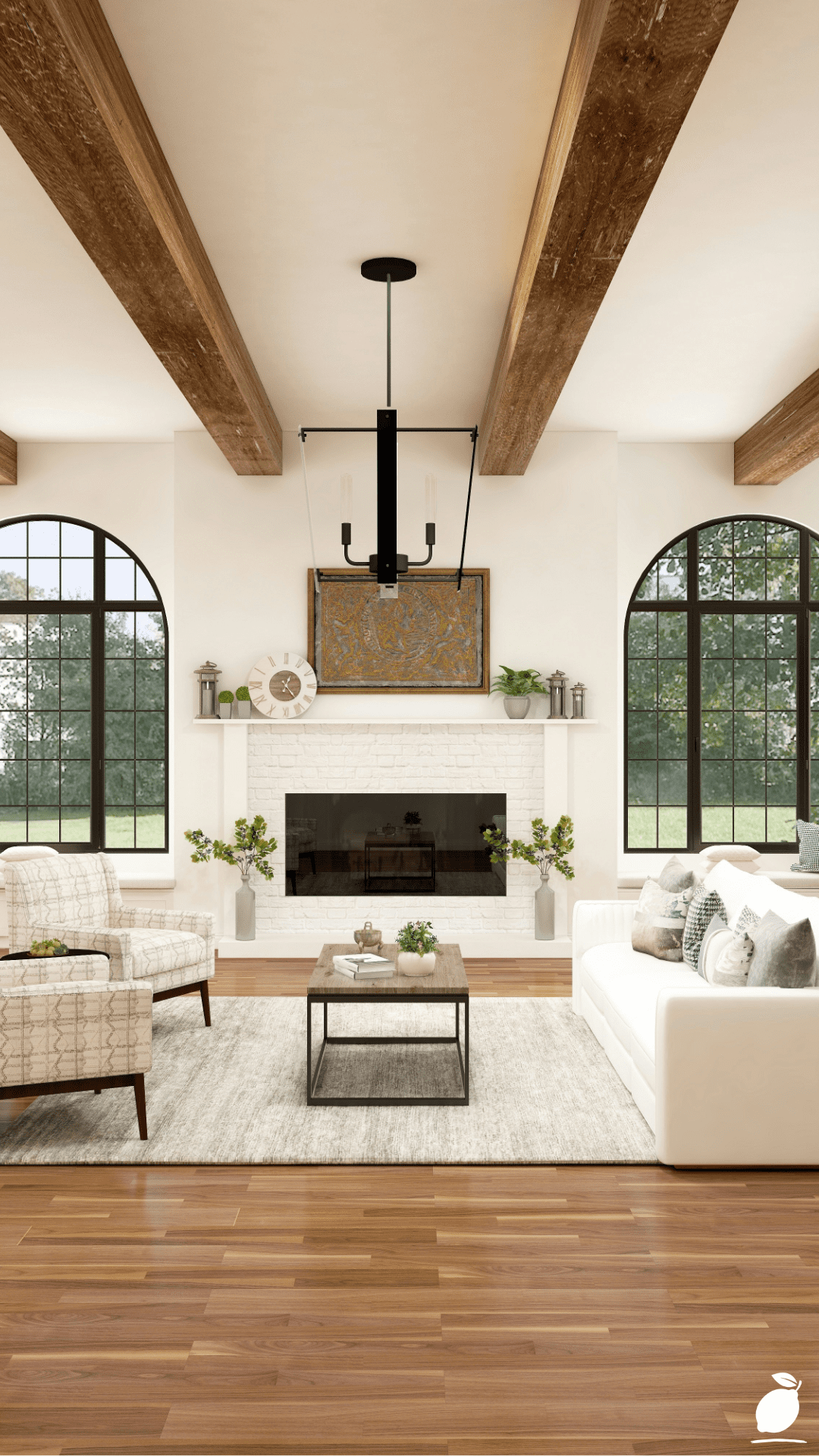
The farmhouse living room in the image above is what that governing warmth looks like when it has been built deliberately from the ceiling down. Exposed wooden beams on a white ceiling immediately establish the farmhouse living room’s defining architectural quality, the honest structural material left visible rather than boxed in, the contrast of warm wood against clean white that is the visual signature of the farmhouse interior. Two large arched windows with black frames flank a white brick fireplace with a black interior, creating a symmetrical composition that anchors the room’s primary wall with the confidence of a space that knows its focal point and builds everything around it.
A black modern chandelier with multiple arms hangs from the ceiling’s center, a farmhouse living room detail that bridges the traditional exposed beam with the contemporary furniture below. And below: a white modern sofa with clean lines on a light gray area rug, a beige armchair with a geometric pattern, green plants flanking the fireplace and filling the corner, a black metal coffee table with a glass top that brings the ceiling’s black accents to the floor level. The farmhouse living room in the image is welcoming not because it is soft or casual or imprecise but because every element in it belongs to the same warm, natural, quietly intentional world.
Styling my farmhouse living room to feel genuinely welcoming rather than merely good-looking took a season of deliberate choices and one clear shift in perspective: from asking “does this piece look right?” to asking “does this room feel right?” The farmhouse living room ideas in this guide are organized around that shift. They address the architectural layer first, the furniture layer second, and the styling and accessory layer last, the correct sequence for building a farmhouse living room that holds its welcoming quality through daily family life rather than only in the hour after it is tidied. These are the specific farmhouse living room decisions that made the difference in my room. They will make the same difference in yours.
The Farmhouse Living Room Blueprint
Step 1: Anchor the Farmhouse Living Room Around a Single Architectural Focal Point
Every farmhouse living room that feels genuinely welcoming rather than decoratively assembled is organized around a single dominant architectural focal point, the element that the room’s furniture arrangement, sight lines, and visual hierarchy all reference and support. In the image, the white brick fireplace flanked by arched windows is the focal point: it commands the primary wall, is visible from every seating position, and provides the farmhouse living room’s structural warmth even when no fire is lit. The exposed ceiling beams, the chandelier, and the symmetrical window arches all relate to that focal point without competing with it.
For a farmhouse living room without an existing fireplace, the focal point can be created: a floor-to-ceiling shiplap or white brick accent wall in the fireplace’s position, a large-format farmhouse artwork centered on the primary wall, or a custom built-in shelving unit flanked by tall floor plants. The principle is not that a fireplace is required; it is that the farmhouse living room’s furniture arrangement, sight lines, and styling hierarchy need an architectural anchor to organize around. A farmhouse living room without a clear focal point produces the untethered quality that makes rooms feel like they have not fully decided what they are.
Position all seating in the farmhouse living room to face or orient toward the focal point. The sofa faces the fireplace in the image; the armchair angles toward it from the side. Every piece of furniture in the seating arrangement maintains a clear visual relationship to the anchor wall, and the result is a farmhouse living room that has a center of gravity, a quality that makes every seat in the room feel intentionally placed rather than incidentally arranged.
Step 2: Establish the Farmhouse Living Room’s White and Warm Wood Palette
The farmhouse living room palette in the image is built on three tones deployed at specific scales: white at the architectural level (ceiling, walls, fireplace surround, sofa), warm honey wood at the floor level (hardwood in the signature farmhouse tone that grounds the white above it), and black as the accent finish at the details level (window frames, chandelier, fireplace interior, coffee table). This three-tone farmhouse living room palette is the most versatile and most consistently successful of all farmhouse living room color approaches. It works in any room size, with any natural light condition, and with a wide range of accessory and textile additions without requiring any major element to be replaced.
Paint the farmhouse living room walls in a warm white Benjamin Moore White Dove (OC-17), Sherwin-Williams Alabaster (SW 7008), or Farrow & Ball Strong White (No. 2001) that carries enough warmth to prevent the white from reading as clinical under the room’s artificial lighting. Apply the same warm white to the ceiling, or within one shade of it in the same hue family, to create the enveloping quality the image demonstrates without the ceiling contrast that would emphasize the beams as an interruption rather than a feature.
For farmhouse living rooms where warm honey hardwood flooring is not a current option, a large-format warm-toned rug, jute, sisal, or a flat-weave wool runner in warm cream or natural fiber provides the warm wood register at floor level without permanent installation. The light gray area rug in the image serves a secondary function: it defines the seating zone within the larger floor area, creating a room-within-a-room quality that makes the farmhouse living room feel intentionally bounded rather than adrift in an open-plan space.
Step 3: Select Farmhouse Living Room Seating That Combines Clean Lines With Natural Materials
The farmhouse living room’s seating layer in the image demonstrates the specific combination that makes modern farmhouse interiors feel both contemporary and genuinely warm: a white modern sofa with clean, minimal lines paired with a beige upholstered armchair in a geometric pattern fabric. Neither piece is overtly rustic; there are no distressed finishes, no rolled arms, no visible ticking stripe. Both pieces are unmistakably farmhouse living room in character because of their materials (natural fabric, warm-toned upholstery) and their relationship to the architectural elements around them (white sofa echoing white walls and fireplace, beige chair relating to the wood floor and ceiling beams).
For a farmhouse living room sofa, choose upholstery in white, warm cream, natural linen, or light gray tones that reflect the farmhouse living room’s architectural white and hold up visually across the room’s full color range. Avoid heavily patterned sofa fabric in a farmhouse living room; the architecture and accessories carry the room’s pattern interest; the sofa should serve as the farmhouse living room’s largest neutral surface. Performance fabric versions of linen and white upholstery are now available from multiple retailers and provide the farmhouse living room aesthetic with the cleanability that daily family use requires.
Introduce the farmhouse living room’s secondary seating element, the armchair or pair of accent chairs, in a tone or texture that provides a material contrast to the sofa without breaking the palette. The beige geometric-pattern armchair in the image adds texture and pattern to the seating grouping without introducing a color that competes with the white-wood-black farmhouse living room palette. A beige, warm gray, or muted earth-tone armchair performs this function in any farmhouse living room; an armchair in a saturated or cool color displaces the farmhouse living room’s palette warmth.
Step 4: Install the Farmhouse Living Room’s Black Accent Layer Consistently
Black is the farmhouse living room detail finish that gives the modern farmhouse interior its contemporary character, the element that prevents the white-and-wood farmhouse living room palette from reading as cottage-generic or purely traditional. The image deploys black at four distinct levels of the farmhouse living room: the window frames (architectural level), the chandelier (ceiling level), the fireplace interior (focal point level), and the coffee table (furniture level). These four black elements create a vertical through-line that connects every layer of the farmhouse living room from ceiling to floor, giving the room its composed, designed quality.
For a farmhouse living room without black architectural elements, introduce the black accent layer through fixtures and furniture: a black-finish chandelier or pendant light above the seating zone, a black metal coffee table or side tables, and black-framed artwork or mirrors on the walls. The black accent layer requires only two to three applications to function effectively, too few and the farmhouse living room feels unanchored; too many and the black overpowers the warm white and wood palette that gives the farmhouse living room its welcoming quality.
Replace any builder-grade or mismatched light fixtures in the farmhouse living room as part of the same project that establishes the room’s palette. The chandelier in the image, a black modern chandelier with multiple arms, is the farmhouse living room lighting element that most bridges traditional farmhouse architecture (the exposed beams above it) with contemporary furniture below. A black multi-arm chandelier or pendant cluster in a farmhouse living room is available from multiple online retailers at $150 to $400 and produces a visual quality shift that is immediately apparent as a design decision rather than a fixture replacement.
Step 5: Introduce the Farmhouse Living Room’s Green Plant Layer at Two Scales
The green plants in the farmhouse living room image are not accessories; they are structural palette elements, and their contribution to the room’s welcoming quality is specific and irreplaceable. Two white ceramic vases with green plants flank the fireplace symmetrically, connecting the floor level to the mantle level and adding living color to the primary wall. A large green potted plant in the corner fills the room’s dead zone, the space that no furniture occupies, but that empty floor leaves feeling unresolved with the organic, vertical presence that makes a farmhouse living room corner feel inhabited rather than unconsidered.
For the farmhouse living room’s paired fireplace plants, choose plants with upright growth and architectural leaf form: Sansevieria (snake plant) for lower-light fireplaces, Ficus lyrata (fiddle-leaf fig) for farmhouse living rooms with good indirect light, or Dracaena for reliable, low-maintenance vertical presence. Container choice is as important as plant choice in a farmhouse living room: white ceramic vases, as in the image, maintain the room’s white palette while providing the material warmth of handmade ceramic against the brick fireplace surround.
The farmhouse living room corner plant should be scaled to the room rather than to the pot. A plant that reaches shoulder height or above in a generous planter fills the corner as an architectural element rather than a decorative accessory. A large fiddle-leaf fig, a tall monstera, or an oversized bird of paradise provides the corner presence the farmhouse living room requires; a medium-sized plant on a plant stand provides the same vertical quality in a farmhouse living room with lower ceilings or more limited corner space.
Step 6: Style the Farmhouse Living Room Surfaces With Intentional Restraint
The final farmhouse living room styling layer, the throw pillows, the coffee table objects, the mantle arrangement, the surface accessories, is the layer most responsible for whether the farmhouse living room reads as welcoming or as decorated, and the most important principle governing it is restraint applied with intention rather than restraint applied from habit. The image’s farmhouse living room surface styling is spare: white throw pillows with gray patterns on the sofa and armchair, the glass-top coffee table with negative space rather than accumulated objects, the fireplace flanked by the two plant-filled vases rather than a layered mantle display.
For farmhouse living room throw pillows, use the formula demonstrated in the image: two to three pillows per seating piece, all within the white-gray-beige palette range, in a combination of solid and subtle pattern that provides texture interest without color competition. The farmhouse living room pillow palette should be the most restrained surface in the room. The architecture, the plants, and the black accent layer carry all the visual interest the farmhouse living room needs; the pillows provide comfort and subtle texture without adding a fourth color conversation.
Style the farmhouse living room coffee table with the same intentional restraint: a single tray containing two to three grouped objects (a candle, a small book, a natural object like a stone or dried botanical), and an open glass surface beyond the tray. The coffee table’s negative space is as designed as its styled area; it communicates that the farmhouse living room is a room used by people who value space and calm, and it prevents the surface from becoming the default landing zone for remote controls and coasters that quietly communicate the opposite.
Expert Secrets for Success
Pro-Tips for a Better Result
Install exposed ceiling beams before any other farmhouse living room upgrade if your budget allows for one significant structural investment. Among all farmhouse living room elements, exposed wooden beams on a white ceiling have the single highest impact on the room’s fundamental character. They establish the farmhouse living room’s architectural identity at the room’s uppermost level, which means every other element installed below them reads as a farmhouse living room choice rather than a generic interior decision. Faux beam installations, lightweight polyurethane beams in realistic wood finishes, are available for $200 to $600 for a standard living room and are installed with construction adhesive without structural work, producing a result that is indistinguishable from real timber at ceiling distance.
Use the fireplace’s black interior as the palette’s darkest reference point and repeat it nowhere darker. The farmhouse living room’s black accent layer functions as a contained, high-contrast detail because it does not go darker than the fireplace interior; every black element in the room is the same value level or slightly lighter. Black coffee tables in matte finish, black window frames in the same matte quality, and black chandelier arms all read as the same tone family, creating palette coherence. Introducing a dramatically darker element, a near-black sofa, a deep charcoal wall, breaks this consistency and shifts the farmhouse living room palette toward drama rather than warmth.
Position the farmhouse living room area rug so that all front sofa legs rest on it. The light gray area rug in the image defines the farmhouse living room’s seating zone by creating a physical boundary that contains the furniture grouping. The most common area rug sizing mistake in a farmhouse living room is choosing a rug that is too small, one that the front sofa legs sit off, creating a disconnected relationship between the rug and the seating above it. For a standard farmhouse living room sofa-and-two-chairs arrangement, a rug of 240cm × 300cm (8 × 10 feet) is the minimum size that places all front furniture legs on the rug surface and creates the seating zone definition the farmhouse living room needs.
Choose the farmhouse living room chandelier before any other light fixture. The chandelier in the image is the farmhouse living room’s visual connector, the element that bridges the exposed beam architecture above and the contemporary furniture below by occupying the space between them with a designed object that belongs to both registers. Choosing the chandelier first and selecting every other fixture in the farmhouse living room to relate to it in finish and character, produces the fixture coherence that reads as a designed lighting scheme rather than a collection of individually chosen light fittings.
Common Mistakes to Avoid
Don’t use a farmhouse living room fireplace surround in a color that conflicts with the room’s white palette. A fireplace surround in natural stone beige, warm gray, or any color other than the wall’s warm white creates a focal point with its own independent color voice that competes with the farmhouse living room’s palette rather than anchoring it. Paint the fireplace surround the same warm white as the walls, or install white brick as in the image, so that the fireplace reads as an architectural extension of the white wall rather than as a decorative element placed against it. The fireplace’s visual authority in the farmhouse living room comes from its scale and its black interior, not from a contrasting surround color.
Don’t allow the farmhouse living room’s white sofa to dominate the room’s textile layer. A white sofa in a white-walled farmhouse living room can produce a visually monochromatic result where the sofa disappears into the wall behind it rather than anchoring the seating zone. Prevent this by ensuring that the sofa reads as distinct from the wall through three means: position it away from the wall with enough clearance to cast a shadow, place a large piece of art or a textured wall treatment at wall height directly behind it, and use a rug beneath it in a tone deep enough (light gray, warm beige) to provide a base-level contrast that makes the sofa read as a composed element rather than a wall continuation.
Don’t install farmhouse living room arched windows without addressing the view they frame. The arched windows in the image look out onto green foliage, a view that contributes to the farmhouse living room’s welcoming quality by bringing the outdoors into the room’s visual field. Arched windows that frame a view of a fence, a blank wall, or an unattractive outdoor element undermine the farmhouse living room’s connection to the natural world that the design approach specifically cultivates. If window views cannot be improved externally, use sheer white curtains hung at ceiling height that diffuse the view while maintaining the arched window’s light-admitting quality.
Don’t style the farmhouse living room mantle with a symmetrical arrangement of identical objects. The farmhouse living room in the image places living plants, not identical decorative objects, on either side of the fireplace, a choice that produces organic symmetry rather than manufactured symmetry. A perfectly symmetrical mantle arrangement in a farmhouse living room reads as formal rather than welcoming, which directly contradicts the farmhouse living room’s core atmospheric goal. Use asymmetric balance in the mantle arrangement, one taller element on one side, a grouped cluster of smaller objects on the other, and the mantle will read as personally curated rather than store-styled.
Why Farmhouse Living Room Matters
The living room is the room where the household gathers, the space designed specifically for the kind of collective, unstructured time that is not quite work and not quite rest but is, in the long view, the time that most directly determines the quality of a family’s daily life together. A farmhouse living room that is genuinely welcoming, that draws people into it rather than past it, that makes sitting down feel like a destination rather than a default, that provides the specific warmth of a space that was made with the people in it in mind, supports that collective time in ways that accumulate into the texture of a family’s shared experience. The living room you loved spending time in is the one that held the conversations that mattered and the comfortable silences that mattered equally, and the quality of the room was not incidental to those moments; it was their container.
Research in environmental psychology has documented what most people feel without being able to articulate: that the warmth, the material naturalness, and the organic abundance of the farmhouse living room aesthetic are not stylistic preferences but environmental conditions that specifically support the kind of relaxed, open, socially receptive state that the best family time requires. Warm wood surfaces, natural light, living plants, and the visual calm of a white and neutral palette all reduce physiological stress markers in ways that are small per exposure and significant in accumulation across thousands of hours of daily living room occupation. The farmhouse living room that is welcoming is doing something more than looking good; it is creating the conditions under which the people in it are more fully themselves, more present with each other, and more able to experience the specific quality of being genuinely at home.
Easy Peasy Life Matters is built on the conviction that the living room is the home’s most important room to get right and that getting it right means more than selecting the correct pieces in the correct arrangement. It means building a farmhouse living room that actively supports the quality of daily life inside it, that communicates welcome before a word is spoken, and that holds its welcoming quality through the years of use and wear and daily rearrangement that constitute the life of a family home. The farmhouse living room in the image is that kind of room. These farmhouse living room ideas are how you build yours.
Frequently Asked Questions
What are the key elements of a farmhouse living room?
The essential farmhouse living room elements that distinguish the aesthetic from other neutral-palette interior approaches are: exposed wooden beams or a visible structural wood element at ceiling or wall level; a white brick or shiplap fireplace or accent wall as the room’s primary focal point; warm honey-toned hardwood flooring or a natural fiber rug; a sofa and seating in white, cream, or warm neutral linen upholstery; a black accent layer in fixtures, frames, and furniture details; and at least two living plants at different scales. These farmhouse living room elements create the warm-white-wood-black palette relationship that is the modern farmhouse living room’s defining visual character.
How do I make a farmhouse living room feel cozy rather than sterile?
The farmhouse living room tips for cozy quality over sterile white are: textiles at multiple scales (throw pillows, a chunky knit blanket draped over the sofa back, a large area rug under all seating furniture), warm-temperature lighting at multiple heights (ceiling chandelier plus floor lamp plus table lamp at seated eye level), living plants rather than artificial ones, and wood elements with visible grain rather than smooth painted surfaces. The farmhouse living room that feels sterile is almost always a room where the white palette was applied without the warm wood, warm light, and organic living elements that make the white read as clean and airy rather than cold and clinical.
What size rug works best in a farmhouse living room?
For a standard farmhouse living room with a three-piece seating arrangement (sofa plus two chairs), the correct rug size places the front two legs of every seating piece on the rug surface, typically requiring a minimum of 240cm × 300cm (8 × 10 feet). A rug smaller than this creates a floating furniture effect where the seating appears to sit above rather than within the defined seating zone, and undermines the farmhouse living room’s grounded, cohesive quality. For open-plan farmhouse living rooms where the living area is part of a larger combined space, the rug should be large enough to clearly define the seating zone as visually distinct from the adjacent dining or kitchen zone.
Can a farmhouse living room work without a fireplace?
Yes, the fireplace is the most architecturally complete farmhouse living room focal point, but it is not the only one that works. A built-in shiplap or white brick accent wall in the fireplace’s position, centered on the primary wall and flanked by windows or tall plants, provides the same visual anchoring function without requiring any fireplace installation. A large-scale farmhouse living room artwork or gallery wall arrangement at the same position can also serve as the focal point, particularly when it is flanked by floor lamps or wall sconces that create the light-source quality that a fire provides. The farmhouse living room needs a focal anchor, not specifically a fireplace.
What plants work best in a farmhouse living room?
The farmhouse living room plants that most effectively contribute to the room’s welcoming quality are those with architectural leaf form and sufficient scale to read as designed elements rather than accessories: fiddle-leaf fig for the tall, large-leaf quality the image demonstrates, monstera deliciosa for the organic, dramatic leaf shape that provides corner presence, snake plant for low-light farmhouse living rooms that need vertical green without demanding care, and ZZ plant for the most maintenance-tolerant option in a farmhouse living room with minimal natural light. In white ceramic or terracotta containers, any of these farmhouse living room plants connects to the room’s warm, natural material palette while adding the living, organic quality that manufactured décor cannot replicate.