The terrace was approximately two and a half meters wide and felt like it. A narrow strip of outdoor space between the back wall and the garden boundary, it had accumulated the particular kind of neglect that happens to outdoor areas that are technically accessible but not genuinely usable. Two folding chairs that needed cleaning before sitting in. A plastic storage box that held gardening equipment you could never find when needed. A pair of terracotta pots that had been there so long they had merged with the corner. Every spring, the intention was there this year, the terrace gets sorted, and every autumn, the terrace looked more or less the same as the previous autumn, because the path from “outdoor space I tolerate” to “outdoor space I actually want to be in” had no clear first step.
The problem with most small terrace ideas encountered online was that they solved a different problem from the one being faced. The beautiful examples assumed either more square footage or more budget, or a blank slate without the accumulated objects and structural constraints of a real terrace that had been neglected rather than planned. The small terrace ideas that actually helped were the ones that started from the function: what does this space need to make someone want to spend time in it? rather than from the aesthetic. And the answer, in almost every case, was not more furniture or more plants but a specific quality of enclosure, a single destination element, and the removal of everything that competed with both.
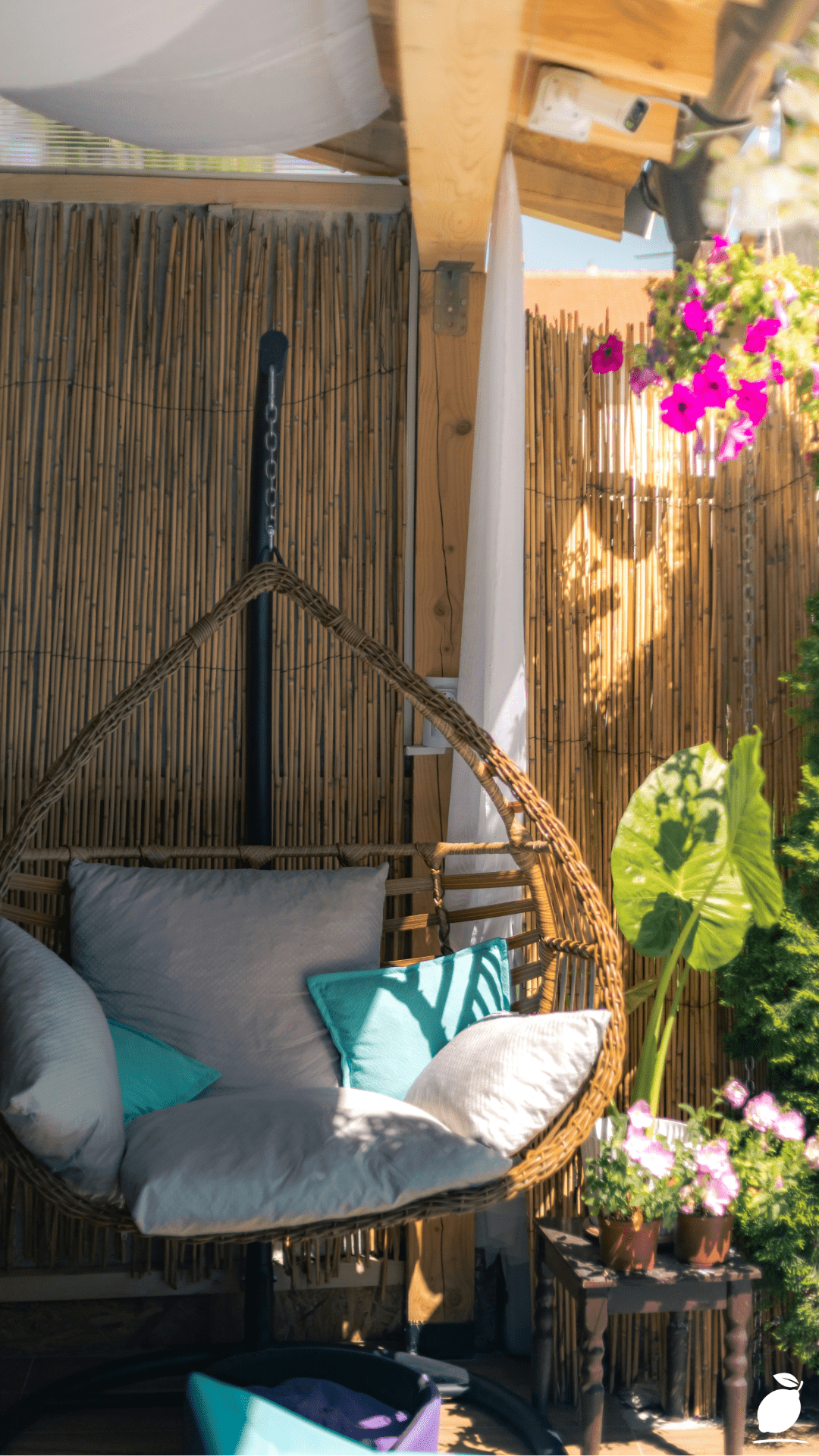
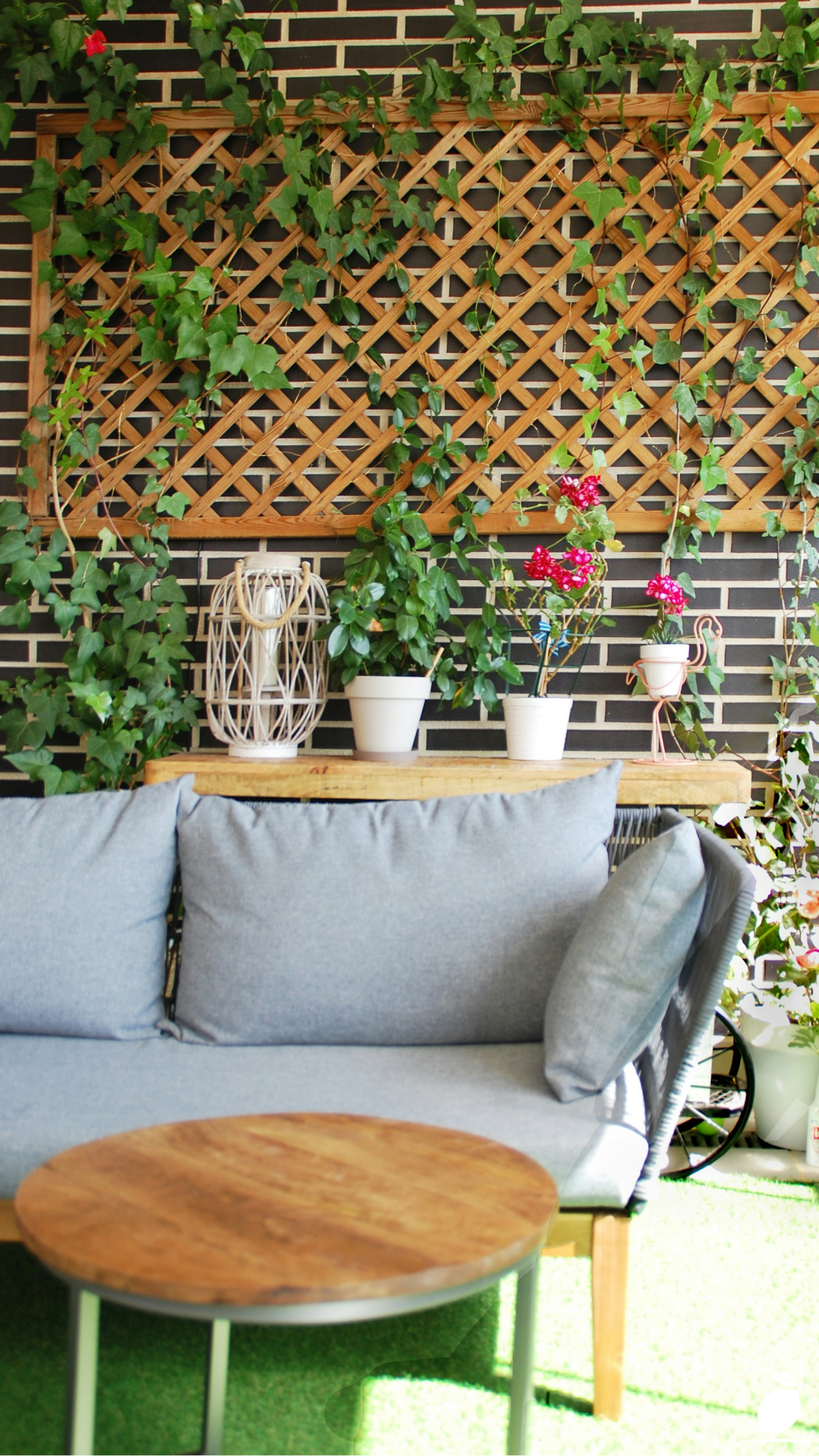
The image above is the result of applying exactly those small terrace ideas. A teardrop rattan hanging chair suspended from an exposed beam, soft grey cushions with turquoise accents, a bamboo privacy screen creating the feeling of enclosure behind it, flowering plants on a small side table to the right, fabric canopy overhead filtering the light. The space behind the photograph is not large, but it is complete. Every element earns its presence, every material relates to its neighbor, and the overall effect is of a place that invites occupancy rather than tolerance. Here is exactly how those small terrace ideas were applied, step by step.
The Small Terrace Ideas Blueprint
Transforming a small terrace into a usable outdoor escape is a project with a clear sequence. The steps below address the decisions in the order in which they determine each other from the structural framework through the destination piece and into the finishing details that complete the effect.
Step 1: Edit the Existing Terrace to Its Bare Frame
Every successful application of small terrace ideas begins with removal rather than addition. Before any planning, purchasing, or rearranging, everything on the terrace needs to be physically removed and assessed: every piece of furniture, every pot, every storage item, every object that has accumulated without a deliberate decision behind its placement. Set it all aside and stand in the empty terrace space.
The bare terrace reveals its actual dimensions, its structural elements, the beams, walls, and boundaries that define it, and the relationship between its floor surface and the spaces it looks toward. Small terrace ideas that work with the existing structural elements rather than against them produce a result that feels inevitable rather than imposed. Note where the natural light falls at the times of day the terrace is most likely to be used. Note the sightline from the primary indoor viewing point, the kitchen window, and the back door. Note whether any existing structural element, a beam, a wall section, or a boundary fence, offers an anchor point for a hanging element or provides an existing privacy boundary to build from.
Return only the objects that survive the one-question test: does this earn its place through function, beauty, or both? Everything else leaves the terrace.
Step 2: Install Privacy Screening as the Structural Backdrop
Among all small terrace ideas, the single intervention that produces the most immediate and most transformative effect is privacy screening. A terrace without enclosure feels like a corridor or an observation point rather than a destination because human beings do not genuinely relax in spaces where they are visually exposed on multiple sides. The bamboo privacy screen in the image is doing the most important structural work in the composition: it creates the sense of a wall, of enclosure, of a room defined by something other than open air.
Natural bamboo screening panels available in rolls or rigid panels from garden centers and online suppliers are the most versatile and most cost-effective privacy screening option for small terraces because they install against existing fence or wall structures without requiring planning permission, they provide an instant natural backdrop that improves rather than comprometes plant and furniture placement, and they establish a tonal foundation (warm brown-gold natural material) that every subsequent small terrace ideas decision can build from.
Attach bamboo panels to the existing fence or wall using timber battens and exterior screws, or use freestanding panel frames if attachment is not possible. Install panels to the maximum height permitted. The taller the privacy screen, the greater the sense of enclosure and the more effective the small terrace ideas principle of creating a room outside. A 1.8 to 2 meter bamboo screen transforms a terrace’s spatial character from exposed outdoor space to enclosed outdoor room.
Step 3: Install the Destination Piece — The Hanging Chair
Every successful small terrace ideas application has a destination element, the single piece that gives the space its reason for being, the object that makes the terrace feel like somewhere you specifically want to go, rather than simply outside. In the image, that destination piece is the teardrop rattan hanging chair, suspended from the existing wooden beam overhead. It is the piece the eye goes to immediately, the piece that makes the space look resolved and intentional, and the piece that justifies the enclosure and the canopy around it.
For small terrace ideas in a covered or semi-covered outdoor space with an overhead structural beam, a hanging chair rattan, macramé, or woven wicker is among the highest-impact investments available because it uses vertical space rather than floor space, provides the particular quality of suspended comfort that no standard chair replicates, and creates an unmistakable visual identity for the terrace that makes the space feel designed rather than furnished. Fix a stainless steel eye bolt rated for a minimum of 150kg into the beam through-bolt rather than a lag bolt for maximum security. Hang a galvanized steel S-hook, and suspend the hanging chair at a height that allows comfortable seated access from a standing position (typically 45 to 50cm clearance from the floor to the lowest point of the seat).
For terraces without an existing beam, a freestanding hanging chair frame in powder-coated steel or hardwood timber provides the same destination quality without requiring structural fixing. Position the freestanding frame against the bamboo privacy screen to create the same backed, enclosed composition visible in the image.
Step 4: Establish the Canopy or Overhead Element
The ceiling of a small terrace is as important to its enclosure quality as the walls. A terrace fully open to the sky feels less room-like than one with an overhead element, even a partial one, that signals shelter and creates the dappled, filtered light quality visible in the image. Small terrace ideas for the overhead plane include shade sails in natural or neutral canvas, fabric canopies suspended from corner points, bamboo or timber slatted overhead panels, or climbing plants trained over a wire framework.
The white fabric canopy in the image, suspended loosely between the beam structure and the wall behind, creates the soft, diffused light that makes the hanging chair space feel genuinely tropical and resort-like at a fraction of the cost of a constructed pergola. Outdoor-rated canvas or polyester canvas in white, natural linen, or sage attached at corner grommets to eye bolts screwed into the beams or walls provides weatherproof shade and the specific quality of filtered overhead light that makes a small terrace feel like a room rather than a corner. Ensure the canopy has at least a 10-degree pitch to allow rainfall to drain rather than pool in the center.
Step 5: Add Plants as Living Architectural Elements
Plants in small terrace ideas serve a specific and important role; they provide the organic, living quality that no inanimate object in the space can replicate, and they soften the hard edges of the structural elements (beam, screening, floor surface) that provide the terrace’s framework. The pink flowering plants and trailing green foliage on the small wooden side table in the image are precisely positioned to do this: they provide color, scent, and a quality of organic irregularity at exactly the point where the hard edge of the side table meets the bamboo screening behind it.
For small terrace ideas, plant selection follows two principles: choose plants that thrive in the terrace’s specific light conditions (full sun, partial shade, or deep shade under the canopy), and choose plants that provide long-season interest either through continuous flowering (impatiens, pelargoniums, petunias) or through year-round foliage structure (bamboo in a large planter, small ornamental grasses, ferns). Place the largest plant specimen at the highest priority position, the corner behind the hanging chair, visible from inside the house, and cluster smaller flowering plants on the side table or on tiered shelving against the bamboo screen to create height variation without consuming floor space.
Step 6: Complete With Cushions, Lighting, and Seasonal Accessories
The finishing elements of small terrace ideas, the cushions, the outdoor lighting, and the small side table are the details that convert a functionally complete outdoor space into a genuinely welcoming one. The grey cushions with turquoise accent pillows in the hanging chair deliver two functions simultaneously: comfort and the color accent that gives the terrace its personality. Choose outdoor-rated cushions in UV-stabilized fabric; they will spend extended periods in sunlight and need to resist fading and moisture without requiring constant cover storage.
Outdoor lighting is the detail that most small terrace ideas guides undervalue. A terrace that is beautiful in daylight but unusable in the evening has halved its available hours of enjoyment. Solar-powered string lights suspended between the beam and the bamboo screen provide warm, atmospheric ambient light that continues the resort-like quality of the hanging chair and canopy after dark. Add a single outdoor lantern on the side table for task lighting at reading or dining height. These two light sources, overhead, ambient, and surface level, create the layered lighting that makes the small terrace feel as designed at 9 pm as it does at 9 am.
Expert Secrets for Success
Pro-Tips for a Better Result
- Treat the bamboo screen as a living design surface, not just a background. The privacy screen in small terrace ideas is not simply something to put behind the furniture, it is the terrace’s primary backdrop and should be treated as a designed element. Attach wall-mounted planters to the bamboo at different heights to create a vertical garden layer. Hang a single piece of outdoor artwork, a ceramic, a woven textile panel, or a sculptural piece against it as a focal accent. String outdoor lights horizontally across its surface. A bamboo screen treated as a surface rather than a neutral background transforms small terrace ideas from furniture-in-front-of-a-wall to a fully composed outdoor room.
- Choose one dominant color and one accent throughout. The most visually cohesive small terrace ideas applications are color-disciplined: one dominant neutral (the natural brown-grey of rattan, bamboo, and grey cushions in the image) and one deliberate accent (the turquoise of the accent pillows). Introducing additional colors, a third cushion tone, a contrasting pot color, and a different-colored table distributes the accent across too many elements and reduces the impact of each. Commit to the palette before purchasing any finishing element.
- Select furniture in proportion to the terrace’s smallest dimension. In small terrace ideas, the limiting measurement is almost always the narrowest dimension, and furniture sized to the generous reading of a small space creates a cramped, obstructed result. Measure the narrowest dimension of the terrace and ensure that any furniture, once placed, leaves at least 60 to 70cm of clear circulation space. A hanging chair is particularly well-suited to small terrace ideas because its suspended form takes no floor footprint, freeing all surface space for planting, a side table, and circulation.
- Install lighting before the furniture and plants are in their final position. String lights, cable runs for outdoor power, and any solar panel positioning are significantly harder to install around furniture than before it is in place. String the overhead lights from beam to screen before positioning the hanging chair, install the lantern power supply or solar positioning before the side table is in place, and route any cable behind the bamboo screen before it is fully loaded with plants. Lighting is infrastructure, not decoration, and should be treated as a structural decision made before the finishing touches.
- Use a single outdoor rug to define the sitting area and ground the composition. A natural-fiber outdoor rug, jute, sisal, or polypropylene, in a flat weave, placed beneath the hanging chair and side table anchors both pieces as a composed vignette rather than two freestanding objects on a bare floor surface. The rug creates a defined “room” within the broader terrace, which is the spatial device that makes small terrace ideas feel intentional at the room scale rather than simply at the individual object scale. Choose a rug large enough that all four feet of the side table sit comfortably on it.
Common Mistakes to Avoid
- Installing the hanging chair without adequate structural assessment. The most dangerous of all small terrace ideas mistakes is hanging a chair from a beam, pergola, or overhead structure without confirming the structural capacity of the fixing point. A hanging chair with a 70kg occupant generates significant dynamic load, especially with the swinging motion that is part of its function. The fixing point must be structural timber (not fascia board or decorative cladding), the eye bolt must be through-bolted rather than lag-screwed for maximum integrity, and the hardware must be rated for at least twice the intended load. If the beam’s structural capacity is uncertain, engage a carpenter or structural engineer before installation.
- Using standard indoor cushions on an outdoor terrace. Cushions not rated for outdoor use absorb moisture, develop mildew within a single wet season, and degrade to an unusable state far faster than the small terrace ideas investment justifies. Every cushion placed outdoors, whether on a hanging chair, a bench, or a seat pad, must be filled with a quick-dry foam or hollow fiber insert and covered in UV-stabilized, water-resistant fabric. The upfront cost differential between indoor and outdoor cushions is small relative to the replacement cost of indoor cushions destroyed by their first autumn.
- Choosing bamboo screening without checking the required height for a genuine enclosure. A bamboo privacy screen at 1.2 meters provides partial enclosure but not the room-like quality that makes the sitting area in the image feel genuinely private and sheltered. For the enclosure effect that drives the most valuable of all small terrace ideas, the privacy screen needs to be at or above standing eye height, 1.8 to 2 meters minimum. A screen that only reaches seated shoulder height still reveals the surroundings when standing and creates an incomplete sense of enclosure that undermines the resort-like quality the design is working toward.
- Planting without considering the terrace’s light conditions. The most common planting failure in small terrace ideas applications is selecting plants based on appearance rather than light compatibility. A terrace under a heavy canopy or against a north-facing wall that receives three or fewer hours of direct sunlight needs shade-tolerant plants, such as ferns, impatiens, and hostas, not the sun-loving flowering pelargoniums and petunias that look appropriate in a well-lit display. Assess the actual light conditions of the terrace at the planting stage and select specifically for them.
- Over-furnishing the small terrace in pursuit of multiple functions. A small terrace that attempts to be simultaneously a dining area, a relaxation zone, a kitchen garden, and a storage space produces a cluttered, confused result that serves none of those functions well. The most successful small terrace ideas applications commit to a single primary function, in this case, the relaxation and retreat function embodied by the hanging chair, and subordinate everything else to it. If the terrace is primarily a relaxation space, the dining table is not there. If it is primarily a dining space, the hanging chair is not there. Clarity of function is the precondition for clarity of design.
Why Small Terrace Ideas Matter
A small terrace transformed into a genuine outdoor escape changes the daily experience of the home in a way that is felt rather than noticed, the way the morning coffee takes on a different quality when it is drunk in a space that feels designed and peaceful rather than tolerated and neglected. The addition of a functional, beautiful outdoor room to a home does not require a large garden or a significant renovation budget. It requires the right small terrace ideas applied in the right sequence to an existing space, however small, that has been underperforming for years. The result is not just a more attractive terrace, but an additional room of the house that earns its use every day of the warmer months.
For families, a well-designed small terrace creates the outdoor breathing space that even the most carefully designed interior cannot provide. Children need outdoor air, irregular surfaces, natural light, and the particular quality of freedom that exists beyond walls. Adults need the outdoor-indoor transition that a genuinely inviting terrace provides, the ability to take work calls in the fresh air, to eat breakfast outside on a sunny weekday morning, to sit in the hanging chair in the evening with a book and feel briefly elsewhere. Small terrace ideas that create this quality of outdoor room return the function to the household that an underused outdoor space has been withholding for years.
And for the person who conceives and executes the transformation who removes the accumulated neglect, installs the privacy screen, hangs the chair with the right hardware, and plants the first flowering plants on the side table the completed small terrace is a reminder of something that daily life rarely provides so directly: that a meaningful change in the quality of a space, and therefore in the quality of the experience of living in it, can be achieved in a weekend with the right plan and the right principles. That is what the best small terrace ideas deliver. Not aspiration, but outcome. Not someday, but this Saturday.
Frequently Asked Questions
What is the minimum terrace size for applying these small terrace ideas effectively?
The hanging chair and privacy screen combination shown in the image can be applied in a terrace as small as 2 meters by 2 meters. The hanging chair requires approximately 1 meter of diameter clearance on all sides when suspended, and the privacy screen and side table fit into the remaining wall and corner space. For terraces narrower than 1.5 meters, a wall-mounted folding seat or a narrow bench with cushions replaces the hanging chair as the destination element, with the same principles of privacy screening, overhead canopy, and plant layering applied around it. Small terrace ideas scale down to almost any functional outdoor space.
How do I attach a bamboo privacy screen to an existing fence without permanent fixing?
The most non-damaging bamboo screen attachment method for existing fences uses cable ties or garden wire threaded through the bamboo at multiple horizontal points, secured to the existing fence slats or rails. This method is reversible, leaves no permanent marks on the fence, and provides sufficient attachment for bamboo panels up to 1.8 meters high in most wind exposure conditions. For exposed positions where wind loading is higher, attach a timber batten horizontally along the top of the existing fence and screw the bamboo panel to the batten, a semi-permanent attachment that can be removed without significant fence damage.
How do I maintain a bamboo privacy screen over multiple seasons?
Natural bamboo screening silvered naturally over its first season outdoors, lightening from warm gold to pale grey. This weathering is a natural aesthetic progression that most small terrace framework ideas accommodate and welcome. To slow significant degradation, apply a coat of natural teak or linseed oil to the bamboo surface annually before winter, working the oil into the bamboo with a brush. Replace individual panels showing significant split or breakage rather than the entire screen. A well-maintained bamboo screen performs effectively for three to five years before the degradation of individual strands becomes visible enough to warrant full replacement.
What are the best hanging chair options for small terraces without overhead beams?
For small terrace ideas applied in spaces without existing overhead beams, a ground-level patio without a covered structure, a balcony with a flat ceiling soffit, or a freestanding hanging chair frame is the most practical solution. Look for frames in powder-coated steel with a wide, stable base (minimum 1.2 meters in diameter), rated for outdoor use, and finished in a tone that complements the terrace’s material palette: black powder coat for a contemporary small terrace aesthetic, and natural hardwood for a warmer, more organic look. The freestanding frame should be positioned against the bamboo privacy screen to create the same backed-and-enclosed composition that the suspended version achieves against the beam.