My living room was the first thing guests saw and the last thing I wanted them to notice. A loveseat that was technically the right size but somehow filled every sight line. A floor lamp that had to live behind the sofa because there was nowhere else for it. Plants were balanced on the windowsill because every inch of floor space was committed. The room wasn’t messy, I’d made peace with that much, but it had the specific quality of a space that was trying too hard to be multiple things simultaneously and succeeding at none of them. Functional storage room. Comfortable reading spot. Presentable gathering space. Every living room idea I attempted made it better at one of these things and worse at the others. The room refused to settle, and so did I.
What changed my approach completely was moving away from living room ideas that tried to maximize capacity and toward ones that prioritized perception. A tiny living room that feels spacious is not larger; it is the same room with different design decisions. The ceiling height hasn’t changed. The floor plan hasn’t expanded. But the choices about color, furniture scale, vertical space, and the specific deliberate details that give a room its visual signature can shift the experience of a space so dramatically that visitors ask whether you’ve knocked through a wall. I hadn’t. I’d just started applying tiny living room ideas that worked with the room’s dimensions rather than despite them.
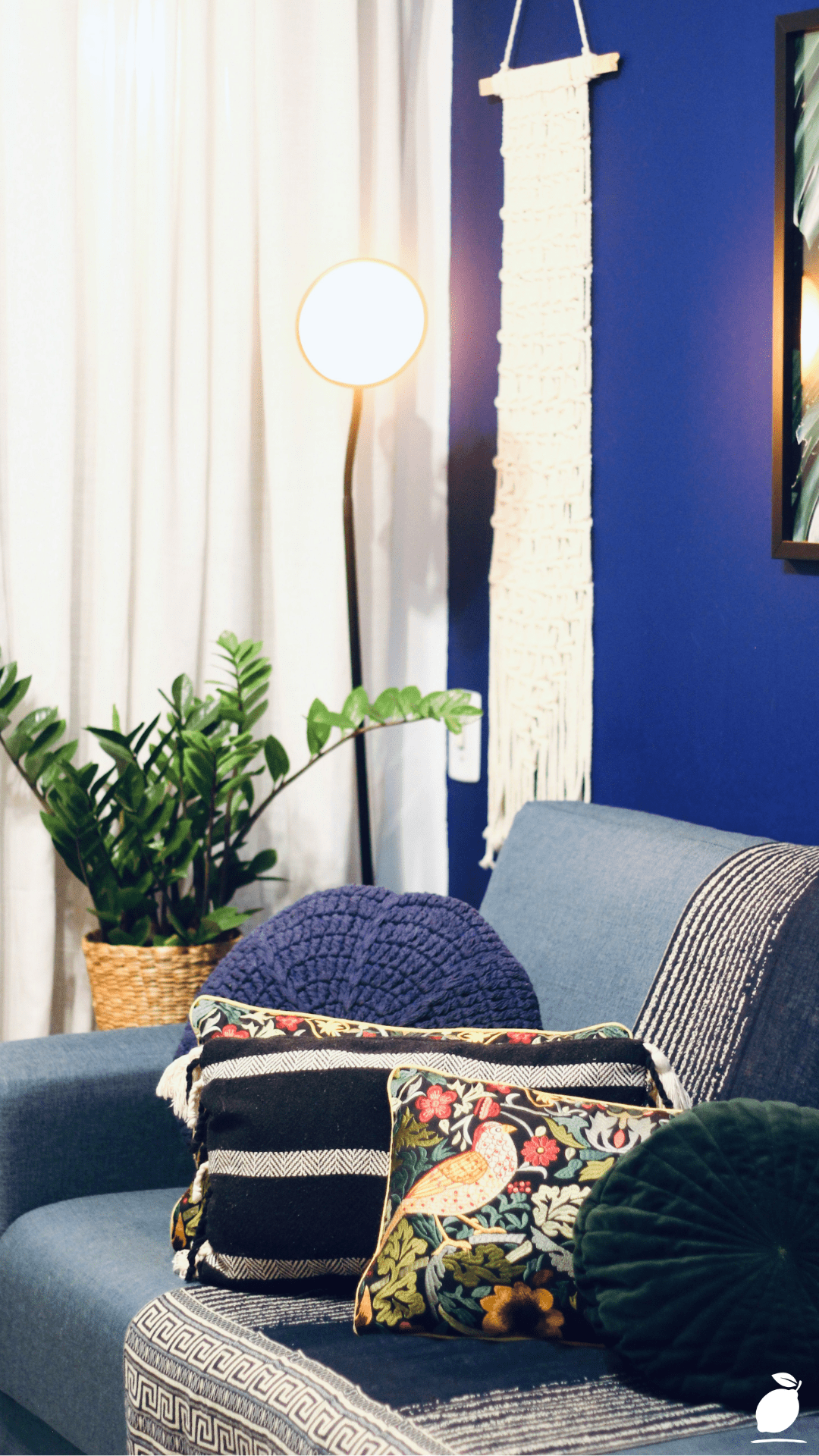
The living room in the image above is the result I was working toward: a navy blue accent wall creating depth where there was flatness, a grey loveseat scaled precisely for the space, white curtains extending from high on the wall to the floor, a macramé wall hanging drawing the eye upward, a floor lamp providing layered light, a Zamioculcas plant in a woven basket adding life and organic height, and throw pillows that layer texture and pattern without cluttering. The room is small. It doesn’t feel small. Every tiny living room idea deployed in it is deliberate, and the cumulative effect is exactly what a compact space needs most: the sense that someone made considered choices here, and that those choices paid off. This guide shares every one of them.
The Living Room Ideas Blueprint
Step 1: Commit to One Accent Wall and Keep Everything Else Light
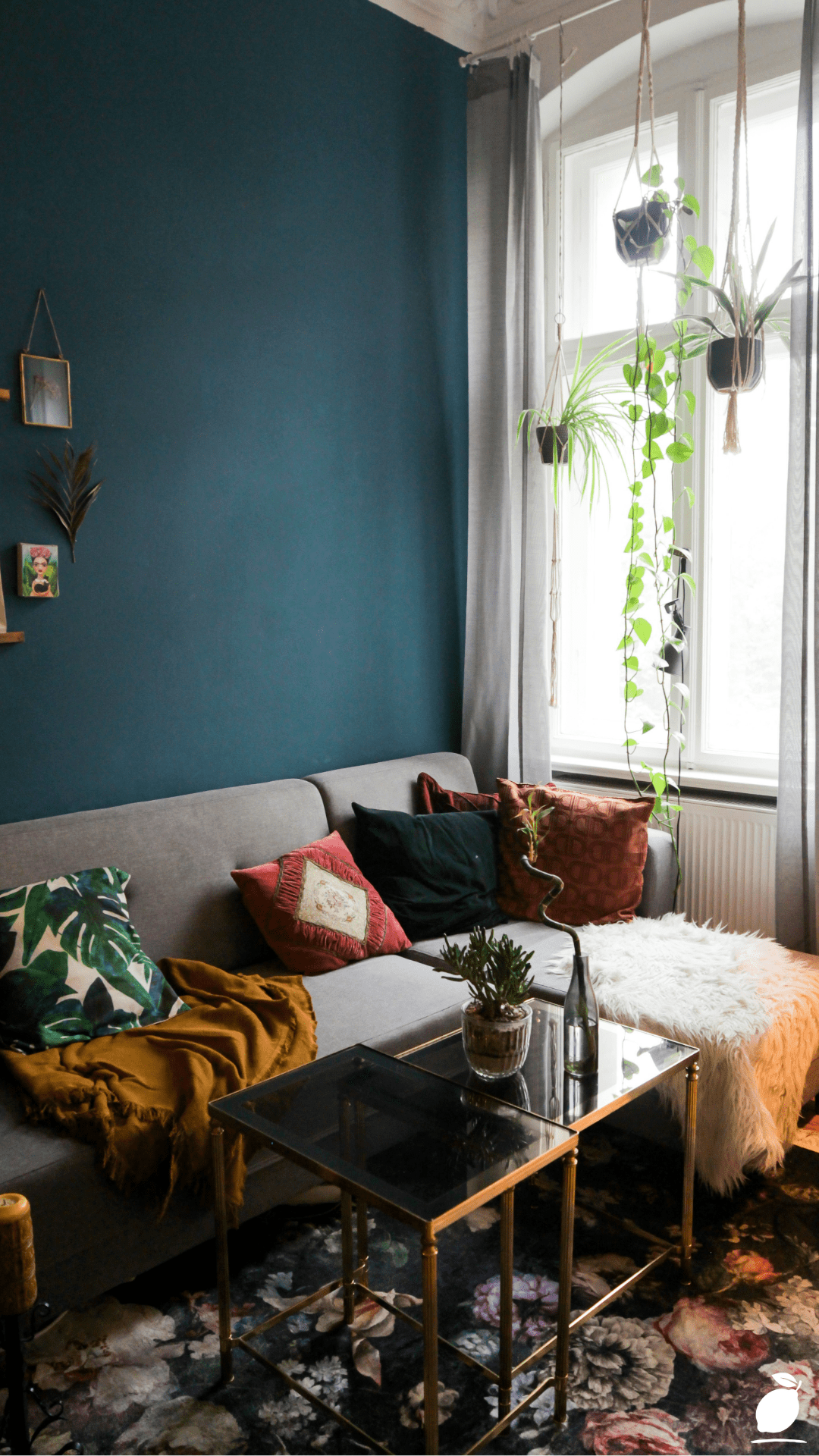
The first tiny living room idea that changed my space most dramatically was the accent wall decision, specifically, choosing one bold wall and allowing every other surface to recede. In the featured room, the navy blue accent wall is the axis around which the entire living room ecosystem rotates. Every other surface, the ceiling, the three remaining walls, and the curtains, is white or near-white, which keeps the overall light level high and prevents the navy from compressing the room. The accent wall creates depth. The surrounding light surfaces maintain openness. Together they produce a room that reads as more three-dimensional than a uniformly light room, without sacrificing the brightness that small rooms depend on.
For your own tiny living room ideas application, choose the wall that the main seating faces, the wall you look at most when using the room, as the accent. This positioning creates the illusion of spatial depth directly in the viewer’s primary line of sight, which is where depth perception is most active and most powerful. The remaining walls in your lightest neutral. The ceiling is the lightest version of the wall color or a crisp white. This single living room idea costs one tin of paint and returns a spatial transformation that furniture rearrangement rarely achieves.
Step 2: Choose Furniture Scaled Precisely for the Room
The loveseat in the featured living room is not a compromise; it is a considered living room idea in its own right. A standard three-seat sofa in a small living room fills the space both physically and visually, leaving no room for the floor, the accessories, and the breathing space that makes a small room feel livable rather than packed. A loveseat of the right scale leaves the floor visible on either side, allows the room’s other living room ideas to operate the plant, the lamp, the wall hanging without competition, and creates a sense of purposefulness that the room-filling sofa never achieves.
The living room idea here is not “buy smaller furniture,” it is “buy appropriately scaled furniture.” There is a meaningful difference. Furniture that is too small for a room’s floor plan reads as proportionally unresolved and makes the room feel more uncertain rather than more spacious. The loveseat in the image fills the primary seating zone completely and confidently, with a footprint that allows clear floor area on both sides, visible floor being one of the most consistent contributors to perceived spaciousness in any living room idea framework.
When selecting seating as part of your tiny living room ideas, measure the proposed furniture footprint within a taped outline on your actual floor before purchasing. The visual reality of floor space around the furniture is more accurately assessed on the floor with tape than on a floor plan on paper.
Step 3: Layer Textiles and Throw Pillows to Add Depth Without Physical Volume
The throw pillow arrangement in the featured room delivers one of the highest-return living room ideas available for small spaces: genuine visual richness that adds no physical volume to the room. The navy textured pillow, the black and white striped pillow, and the botanical patterned pillow with bird motifs in green and white create three layers of visual interest: texture, graphic pattern, and organic print against the grey loveseat. The result is a sofa that looks stylish, comfortable, and genuinely designed without any additional furniture in the room.
The living room idea principle at work here is layering within a contained zone rather than distributing additional elements across the floor plan. Every pillow delivers visual complexity in a space that costs nothing in terms of room area. For tiny living room ideas focused on creating fullness without crowding, this layering strategy, concentrating visual richness in the vertical and surface zone above floor level, consistently outperforms adding more furniture or accessories at ground level.
Choose pillows in a palette that connects to the accent wall color and the plant’s green tones simultaneously: the navy pillow echoes the wall, the botanical print bridges the wall and plant, and the graphic stripe provides contrast. This three-way connection is what makes the pillow arrangement read as designed rather than collected.
Step 4: Use Vertical Space with a Statement Wall Hanging
The white macramé wall hanging in the featured room is among the most important tiny living room ideas in the entire composition and the most frequently overlooked category of small room intervention. Vertical wall art that hangs high on the wall and descends in long tassels or drapes draws the eye upward along its full length, activating the upper wall zone and making the ceiling feel farther away than it is. In a tiny living room, the eye that is drawn upward registers more vertical space than it does in a room where everything is arranged at eye level and below.
The living room idea here is specifically to choose wall hangings with vertical orientation and a significant drop of a macramé with long tassels, a tall framed print, a hanging woven textile, and a vertical gallery arrangement. Horizontal or square wall art at standard eye height doesn’t deliver the ceiling-raising effect of vertically oriented pieces positioned high on the wall. Mount art and hangings higher than convention suggests, the top of frames at 210 to 220cm from floor level, and allow the vertical drop to earn its spatial value.
Step 5: Add a Single Large Plant for Scale and Life
The Zamioculcas in a woven basket planter is one of the most effective tiny living room ideas in the featured room because it solves multiple spatial problems simultaneously with a single element. Its height creates a vertical presence on the left side of the sofa that balances the floor lamp on the right, preventing the room from feeling weighted to one side. Its dark, glossy foliage introduces a natural element that softens the room’s harder architectural surfaces without introducing pattern or complexity. The woven basket grounds it organically with the macramé and the room’s natural material palette.
The living room idea principle is choosing one large plant rather than several small ones. Multiple small plants in a tiny living room create visual clutter and fragment the floor area. A single large plant, a fiddle leaf fig, a bird of paradise, a Zamioculcas, and a rubber plant deliver the same biophilic warmth and visual presence while concentrating its floor impact in a single contained footprint. Place it at sofa height or taller, in a planter with enough visual weight to anchor it, a woven basket, a ceramic vessel, a wicker pot holder rather than a plain plastic nursery container.
Step 6: Install a Floor Lamp Rather Than Overhead-Only Lighting
The tall floor lamp in the featured room is a tiny living room idea that addresses one of the most consistent failings of compact room lighting: single-source overhead illumination that flattens the room’s depth and makes every surface read at the same level. A floor lamp placed behind or beside the sofa creates a secondary light source at a different height, introducing a shadow and highlight dynamic that makes the room feel three-dimensional rather than uniformly lit.
In a tiny living room context where a side table lamp may not be practical, a floor lamp behind the sofa provides the same layered lighting effect without requiring floor space beyond the sofa’s existing footprint. Choose a lamp with a circular or drum shade like the one in the featured image that diffuses light broadly upward and sideways rather than directionally downward. The warm ambient glow this creates in the upper half of the room activates the ceiling and upper wall zone and makes the whole space feel taller and more atmospheric.
Step 7: Hang Curtains High and Wide for Visual Height
The white curtains in the featured room are mounted at or near ceiling height, and their panels extend to the floor in a full, clean drop. This tiny living room idea is among the most impactful for perceived ceiling height and among the most inexpensive. Curtains hung at window-top height terminate the vertical line at the room’s midpoint, drawing attention to how much wall exists above them. Curtains hung at ceiling height create an unbroken vertical line from ceiling to floor that the eye reads as the room’s full height, making the space feel proportionally taller and more generous than its actual measurements.
Width matters as much as height. Extend the curtain rod beyond the window frame on both sides so that when the curtains are open, the fabric hangs entirely outside the window opening, revealing the full glass area and maximizing natural light entry. This living room idea makes any window appear significantly wider than it is and contributes to the sense of spatial openness that the featured room demonstrates throughout.
Expert Secrets for Success
Pro-Tips for a Better Result
Create a connected color story across every element. The featured room’s navy accent wall, navy throw pillow, botanical print with green notes that echo the Zamioculcas, and white surfaces that connect to the macramé; every element shares a color reference with at least one other element. This web of color connections is what makes a curated tiny living room ideas scheme read as designed rather than assembled. Before purchasing any new element for a tiny living room redesign, identify which existing color in the room it will reference, and don’t introduce anything that doesn’t connect.
Limit the number of distinct materials to three or four. The featured room’s material palette is deliberately constrained: grey upholstery, woven natural fibers (basket, macramé), metal (lamp), and the organic gloss of the Zamioculcas leaves. Four materials, all relating to each other through the common thread of warmth and natural texture. Adding more distinct materials, such as lacquered furniture, velvet cushions, glass accessories, and chrome hardware, increases visual complexity in a small room that benefits most from material restraint. Choose your materials as deliberately as your colors, and stay within the palette.
Use a single large piece of art rather than a gallery wall. The framed palm leaf print on the featured room’s right wall is one piece, clearly framed, given sufficient space around it to read as a focal point. Gallery walls are a beloved approach in larger spaces where they fill a significant wall area productively. As a tiny living room idea, however, multiple framed pieces create visual busyness that adds no spatial benefit. A single generous piece of art gives the room a clear focal point and leaves the surrounding wall as breathing room.
Common Mistakes to Avoid
Don’t choose a rug that’s too small for the seating area. The single most common living room idea execution error in small spaces is a rug that floats in the center of the seating arrangement without connecting to the furniture. The correct living room idea is a rug large enough that all front legs of the sofa and side chairs sit on it, connecting the seating zone into a cohesive visual unit that grounds the arrangement and defines the living area clearly. A too-small rug divides the room visually and makes the furniture appear unanchored.
Don’t fill every wall with something. The macramé on the accent wall and the single framed print on the side wall work precisely because the remaining wall areas are left deliberately empty. A tiny living room with something on every wall feels enclosed and overworked. Empty wall space in a small room is not wasted space; it is the breathing room that allows every displayed element to read clearly and the room to feel considered rather than crowded.
Don’t introduce furniture that serves only one function. In a tiny living room, every piece of furniture should earn its floor space by serving at minimum two purposes: a coffee table with storage beneath, a loveseat with removable cushion storage, and a side table that also functions as a plant stand. Single-function furniture that takes up floor area without maximizing utility is the living room idea that the small room can least afford. Audit every piece currently in your tiny living room for its functional contribution per square foot, and remove or replace pieces that don’t justify their footprint.
Why Living Room Ideas Matter
The living room is the room that does the most work in a home. It is where the family lands at the end of the day, where guests are received, where children spread out, where the household decompresses from everything the day has asked of it. In a tiny home or apartment, this room often also serves as the dining area, home office, reading corner, and playroom, a space carrying the full weight of domestic life in a floor area that wasn’t designed for that much. The quality of the tiny living room ideas applied to that space determines, more than any other single factor, whether the home feels livable or merely habitable.
Research in environmental psychology identifies perceived spaciousness as a primary contributor to residential well-being, specifically, the subjective sense that the home is not constraining the life conducted within it. Tiny living room ideas that create perceived spaciousness in genuinely small rooms deliver a real, measurable reduction in ambient domestic stress. The family that comes home to a living room that feels intentional and comfortable behaves differently in it than one that comes home to a room that feels cramped and disorganized. The difference is not in the square footage. It is in the design decisions, and those decisions are entirely within reach.
Easy Peasy Life Matters is built on the conviction that a well-designed home is not an expensive luxury; it is an achievable outcome of informed, intentional choices applied consistently. The living room ideas in this guide transformed my own tiny living space from a room I tolerated to one I genuinely look forward to being in. These tiny living room ideas are not renovations. They are decisions. A tin of navy paint. A well-chosen loveseat. A floor lamp behind the sofa. Curtains hung at the ceiling. A single large plant in a woven basket. These are the tiny living room ideas that change everything without spending everything, and they are exactly what this room and yours deserve.
Frequently Asked Questions
What color makes a small living room look bigger?
Soft whites and warm off-whites with high light reflectance values (LRV above 65) are the most reliable choices for maximizing perceived spaciousness in a small living room. However, as the featured room demonstrates, a bold accent wall can work powerfully in a tiny living room without making it feel smaller, provided the three remaining walls, ceiling, and curtains maintain high brightness. The living room idea is not to avoid color but to concentrate it on one wall while keeping the surrounding field light. Navy, deep sage green, charcoal, and terracotta all work as accent wall colors in small living rooms when the surrounding surfaces remain pale and reflective.
How do I make a tiny living room feel cozy without making it feel cluttered?
Among the most practical tiny living room ideas for warmth without visual noise: concentrate layering in the vertical zone rather than spreading across the floor. Throw pillows, a textured throw blanket, a wall hanging with organic texture, and a plant with lush foliage all deliver warmth and visual richness at sofa level and above without occupying floor space. Warm lighting from a floor lamp or table lamp at seated eye level activates the coziness of any space more effectively than overhead lighting. A palette sharing warm undertones across wall, textile, and wood surfaces creates unified warmth that reads as intentional rather than cluttered.
What furniture works best in a tiny living room?
When it comes to tiny living room ideas for furniture, a loveseat or compact two-seat sofa with clear floor visibility around it outperforms a full-size sofa in almost every small space configuration. Add a coffee table with storage (ideally on casters for flexibility), one or two accent chairs rather than a full secondary sofa, and a single floor lamp. Every tiny living room idea for furniture comes back to one principle: maximize visible floor area and concentrate visual richness vertically.
How do I add storage to a small living room without making it feel like a storage room?
One of the most underrated tiny living room ideas for storage is built-in shelving running floor to ceiling on a single wall. It concentrates the storage function on one plane and keeps the rest of the room clear. For renters, modular open shelving in a single material and color reads as architectural rather than utilitarian when styled deliberately. Coffee tables with closed storage beneath, media consoles with closed-door lower sections, and ottomans with interior storage all provide concealed storage without visual bulk.
How do I choose throw pillows for a small living room without overdoing it?
The living room idea for throw pillow selection in a small space is the rule of three: three pillows on a loveseat, or five on a full sofa, in a deliberate mix of one solid or textured pillow in the room’s dominant accent color, one graphic or geometric pattern, and one organic or botanical print. This combination delivers the full sensory richness of layered textiles without visual overload. Choose pillows in sizes that relate to each other: one larger anchor pillow (50 x 50cm) and two smaller ones (40 x 40cm), rather than uniform sizing, which creates a stiff, showroom quality. The colors in the pillow selection should each reference at least one other element in the room, the wall color, the plant, the rug, creating the connected color story that makes the living room idea scheme feel designed rather than assembled.